Form 5472 for a Foreign-Owned U.S. Corporation: Section 6038A, Part IV, and the $25,000 Penalty
A German parent owns 40 percent of a Delaware corporation. The Delaware company buys parts from the parent, pays it interest on a loan, and sells it finished goods — each transaction goes on Form 5472, one form per related party, attached to the corporation's return. It is an information return, not a tax computation, and skipping it costs $25,000 per year before the continuation penalty starts.
Who is a reporting corporation — section 6038A(a) and (c)
Section 6038A(a) makes a corporation a reporting corporation if, at any time during a taxable year, it is a domestic corporation that is 25-percent foreign-owned. One day of foreign ownership in the year is enough.
Under section 6038A(c)(1), a corporation is 25-percent foreign-owned if one foreign person owns at least 25 percent of the total voting power of all classes of stock entitled to vote, or of the total value of all classes of stock. Either measure trips the test — 30 percent of the votes with 20 percent of the value is enough.
Ownership is measured under section 318 as modified by section 6038A(c)(5): attribution reaches down at a 10 percent interest, and a U.S. person is never treated as owning stock owned by a foreign person. Indirect ownership counts — a parent owning 100 percent of a holding company that owns 30 percent of the U.S. corporation is a 25-percent foreign shareholder through the chain — and Part II asks for the direct and ultimate indirect shareholders (lines 4 through 7).
Line 2 asks whether any foreign person owned at least 50 percent of the voting power or total value at any time during the year; line 3 asks whether the corporation is a foreign-owned domestic disregarded entity — that side is covered in our single-member LLC Form 5472 guide.
Related party — section 6038A(c)(2)
Section 6038A(c)(2) defines a related party in three prongs: (A) any 25-percent foreign shareholder; (B) any person related under section 267(b) or 707(b)(1) to the corporation or to a 25-percent foreign shareholder; and (C) any other person related under section 482 to the corporation. A foreign person is any person who is not a United States person under section 7701(a)(30).
That definition reaches past the parent: a sister company under the same parent, a foreign individual holding 25 percent, and a foreign partnership the shareholder controls are all related parties. The corporation files a separate Form 5472 for each related party with a reportable transaction — line 1g the total number filed, line 1h the total gross payments on all of them.
What the form asks — Parts I through IX
Every reporting corporation completes Part I; the rest follows its transactions. Part IV is the core for a corporation — monetary transactions with a foreign related party, lines 9 through 35 — and Part V is not for corporations: it covers a foreign-owned U.S. disregarded entity.
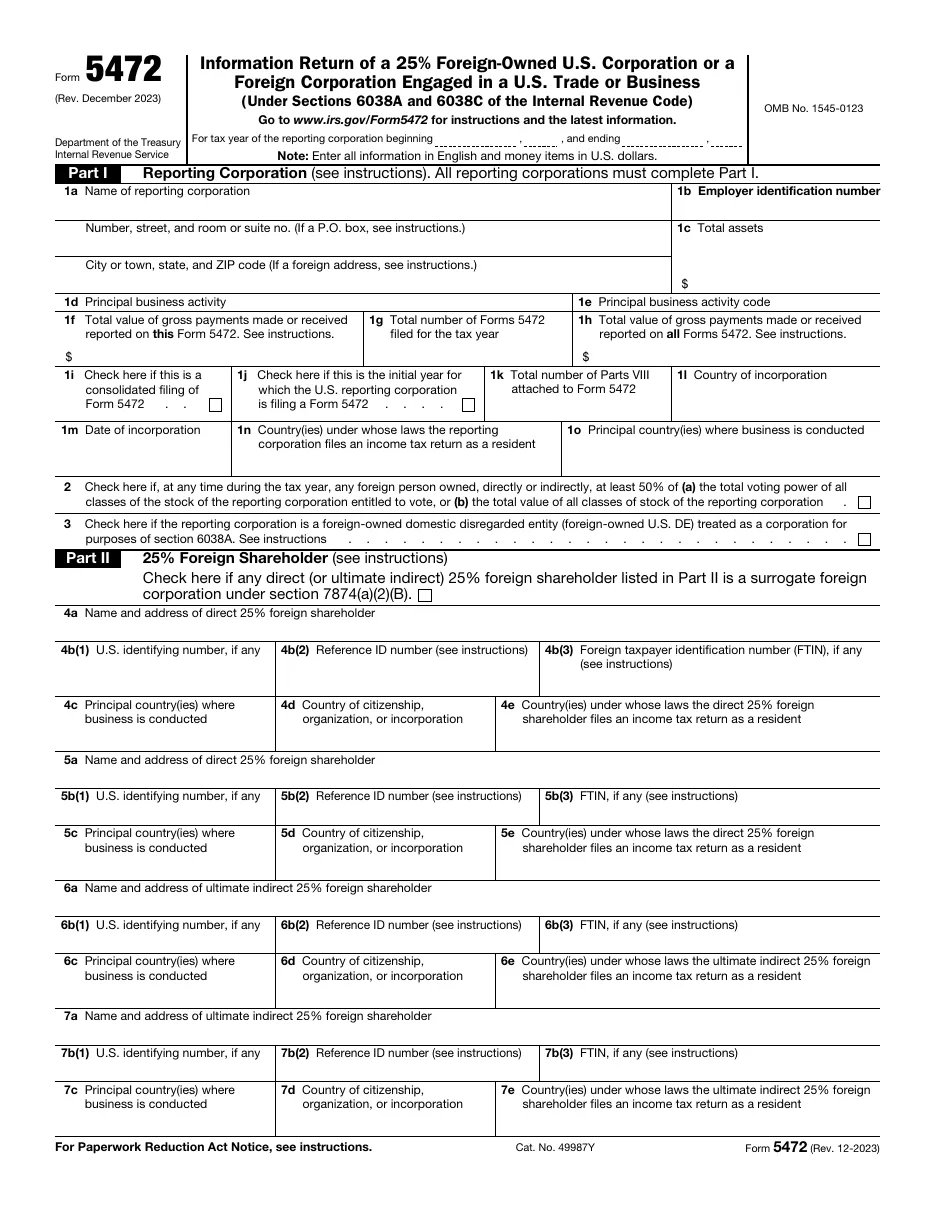
| Part | What it reports | Authority |
|---|---|---|
| I | Reporting corporation: name, EIN, assets, business, payments, form count | Form 5472, Part I |
| II | 25% foreign shareholder, direct and ultimate indirect | § 6038A(c)(1) |
| III | Related party: identity and relationship | § 6038A(c)(2) |
| IV | Monetary transactions, lines 9–35 | § 6038A(b)(1)(C) |
| V | Reportable transactions of a foreign-owned U.S. disregarded entity | § 6038A; Reg. § 1.6038A-2 |
| VI | Nonmonetary and less-than-full-consideration transactions | Reg. § 1.482-1(i)(7) |
| VII | Additional information: imports, § 267A, FDII, loans | §§ 267A, 250 |
| VIII | Cost sharing arrangement | Form 5472, Part VIII |
| IX | Base erosion payments and benefits, lines 50–52 | § 59A |
Part VII reaches past disclosure: line 37, whether the corporation imports goods from a foreign related party; line 38, whether their basis or inventory cost exceeds customs value; lines 40a and 40b, interest or royalty whose deduction section 267A disallows for hybrid arrangements, and the total disallowed; lines 41a through 41d, a foreign-derived intangible income deduction under section 250. Part IX reports base erosion payments under section 59A — corporations with three-year average gross receipts of at least $500,000,000 and a base erosion percentage of 3 percent or higher (2 percent for banks and securities dealers).
Worked example — Harbor Components Inc., Part IV
Harbor Components Inc. is a Delaware corporation; a German parent owns 40 percent of its voting stock, so Harbor is a reporting corporation. In 2026 Harbor sold the parent $480,000 of finished inventory, paid it $24,000 for management services, and borrowed $1,200,000 from it on January 1 at 6.00 percent, outstanding all year.
Interest for the year:
On the form, the inventory sale is line 9 ($480,000 received); the management fee is line 29 ($24,000 paid); the loan is line 17 (beginning $0, ending $1,200,000) and the interest is line 32 ($72,000 paid). Line 22 totals the amounts received at $480,000; amounts paid total $96,000. Line 1f, the total value of gross payments on this Form 5472, is:
Part IV amounts are stated in U.S. dollars, with a schedule of the exchange rates used. Where actual amounts are not determinable, the Instructions allow reasonable estimates — 75 percent to 125 percent of the actual amount, so $360,000 to $600,000 on the $480,000 sale. An amount of $50,000 or less may be reported as "$50,000 or less." U.S. related-party transactions need not be specifically identified in Parts IV, V, and VI.
The penalty — section 6038A(d)
Under section 6038A(d)(1), a reporting corporation that fails to furnish the subsection (b) information in time, or fails to maintain records as subsection (a) requires, "shall pay a penalty of $25,000 for each taxable year with respect to which such failure occurs." The Instructions add that a penalty of $25,000 will be assessed on any reporting corporation that fails to file when due and in the manner prescribed — and a substantially incomplete Form 5472 constitutes a failure to file.
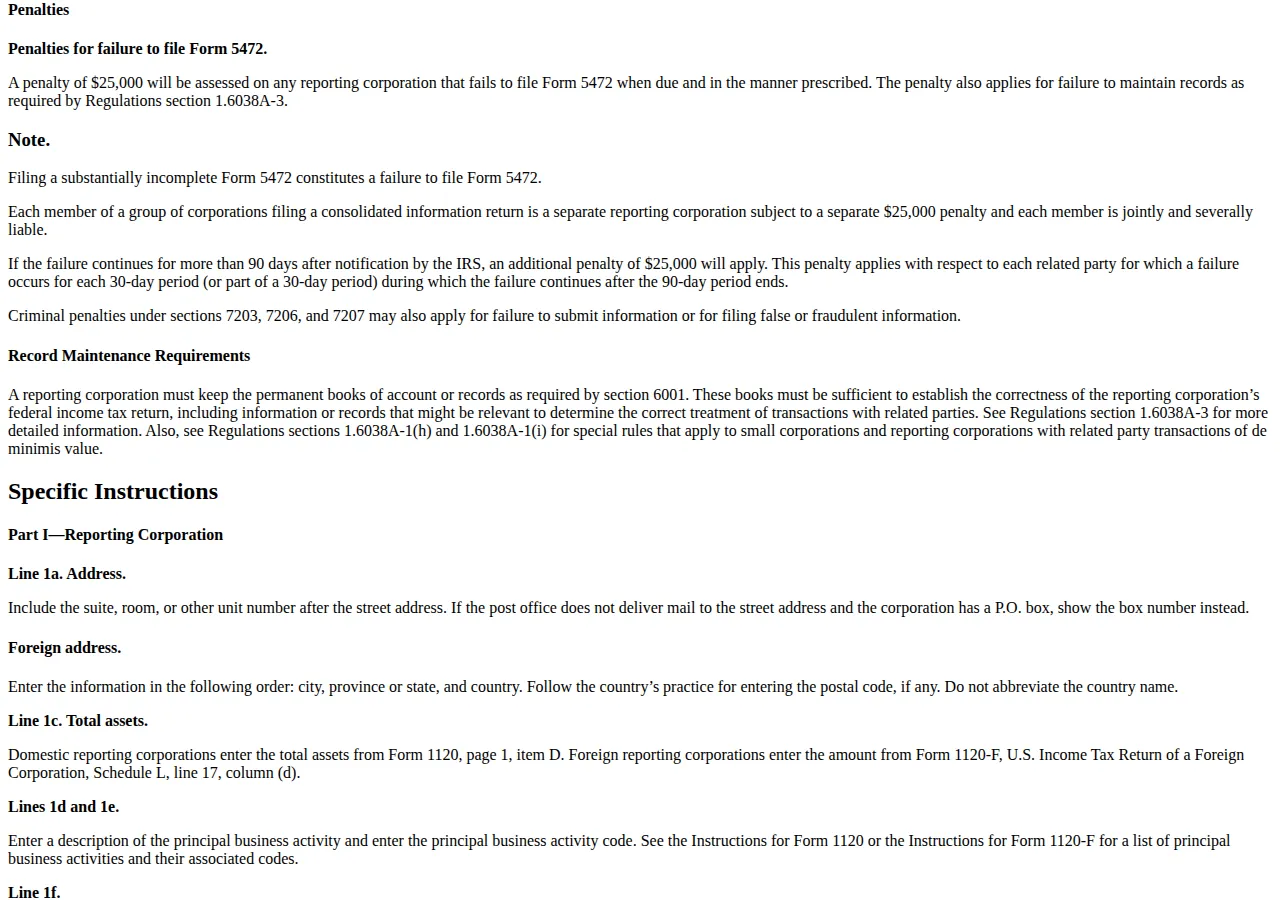
The continuation penalty is where a missed year turns expensive: under section 6038A(d)(2), if the failure continues more than 90 days after the Secretary mails notice, the corporation pays another $25,000 "for each 30-day period (or fraction thereof)" after the 90-day period expires — per related party, per the Instructions.
Worked example — Harbor files no Form 5472 for 2023, 2024, or 2025. The base penalty is three years at $25,000:
Notice of the 2023 failure is mailed March 1, 2026; the 90-day period ends May 30, 2026. Harbor files September 15, 2026 — 108 days later, and a fraction counts as a full period, so 108 days is four periods:
The 2023 failure alone costs $125,000; the three missed years total $175,000 before interest. Reasonable cause is the only exit: under section 6038A(d)(3), the clock runs from the last day reasonable cause existed, as shown to the Secretary's satisfaction. Each member of a consolidated group is a separate reporting corporation with its own $25,000 penalty, jointly and severally liable; criminal penalties under sections 7203, 7206, and 7207 may also apply.
Records — section 6038A(a) and (e)
Section 6038A(a) requires the reporting corporation to maintain — in the location, manner, and extent the regulations prescribe — records appropriate to determine the correct treatment of transactions with related parties, or to cause another person to maintain them. The Instructions point to Regulations section 1.6038A-3: permanent books of account or records under section 6001, sufficient to establish the correctness of the return. Special rules apply to small corporations and to de minimis transactions, under Regulations sections 1.6038A-1(h) and 1.6038A-1(i).
Section 6038A(e) is the enforcement arm. Unless the foreign related party agrees to authorize the reporting corporation to act as its limited agent for summons and examination under sections 7602, 7603, and 7604, the Secretary may apply section 6038A(e)(3): the deduction for any amount paid to the related party, and the cost of any property acquired from it, is "the amount determined by the Secretary in the Secretary's sole discretion." Refusing to produce records does not protect the deduction.
The section 482 linkage
Form 5472 reports the transaction; section 482 prices it. Section 482 lets the Secretary allocate gross income, deductions, credits, or allowances between organizations owned or controlled by the same interests, where necessary to prevent evasion of taxes or clearly to reflect income. The arm's-length standard is the test: related-party prices must match what unrelated parties would charge.
Worked example — Harbor buys 10,000 units from its German parent at $85 per unit; the arm's-length price, from the example's stated comparable, is $110 per unit. The section 482 adjustment is the shortfall times the volume:
Harbor's income rises by $250,000 — or its deduction falls by the same amount — and at the 21 percent corporate rate under section 11(b), the additional tax is:
The adjustment is not a penalty; it is a re-pricing — and it is exactly what the Form 5472 data feeds: Part IV shows the IRS the $85 price, the volume, and the related party. A corporation that reports accurately and prices at arm's length has nothing to fear from the linkage. The tax estimator runs the 21 percent rate on your numbers.
Form 5472 versus Form 5471
The two forms point in opposite directions: Form 5472 reports a U.S. corporation that has a foreign owner, under sections 6038A and 6038C; Form 5471 reports a U.S. person with respect to certain foreign corporations, under section 6038. Our Form 5471 playbook covers the foreign-corporation side; a foreign corporation in a U.S. trade or business is also a reporting corporation under section 6038C.
One exception links the two forms: a reporting corporation need not file Form 5472 if a U.S. person controlling the foreign related corporation files Form 5471 with a Schedule M showing all reportable transactions between the two. That exception does not apply to foreign-owned U.S. disregarded entities. Other exceptions: no reportable transactions in Parts IV and VI; a foreign sales corporation filing Form 1120-FSC; a foreign corporation with no permanent establishment under a treaty that timely files Form 8833; a foreign corporation entirely exempt under section 883; or two non-U.S. persons with no U.S.-source income or allocable deductions. Entity classification is made on Form 8832, covered in our entity classification playbook.
When and where to file
File Form 5472 as an attachment to the reporting corporation's income tax return, by the due date — including extensions — of that return. For a calendar-year corporation, Form 1120 is due April 15 under section 6072(a); an extension moves the filing date, not the obligation. A foreign-owned U.S. disregarded entity has no return of its own, so it files a pro forma Form 1120 with Form 5472 attached, by that return's due date, at the dedicated address the Instructions specify; it may extend on Form 7004.
Founder & CEO Insight — Enow A. Jovial
Execution checklist
- Test the 25 percent rule: one foreign person at 25 percent or more of voting power or total value, at any time in the year, direct or indirect under section 318 as modified.
- List every related party under section 6038A(c)(2) — the 25-percent shareholder, sections 267(b) and 707(b)(1), and section 482.
- For each related party with a reportable transaction, prepare a separate Form 5472 — Parts I, II, and III on every form — and carry the totals to lines 1g and 1h.
- Report monetary transactions in Part IV, lines 9 through 35, in U.S. dollars with an exchange-rate schedule; use the 75-to-125 percent estimate band only where actual amounts are not determinable.
- Report nonmonetary and less-than-full-consideration transactions in Part VI on an attached sheet; leave Part V blank unless the corporation is a disregarded entity.
- Answer Part VII completely — imports, section 267A, FDII under section 250 — and Part IX if section 59A applies.
- Attach each Form 5472 to the corporation's return by the due date, including extensions; run the break-even calculator on the penalty if any year is already late.
- Keep the section 6001 books and section 6038A-3 records — loan agreements, service contracts, price lists — producible in the United States.
- Price every related-party transaction at arm's length under section 482, and keep the comparable that supports it.