IRC §382: The NOL Ownership-Change Limitation — 50-Point Test, Annual Cap & Worked $12M Example
A company that lost $12 million owns a tax asset worth real money: those losses can shelter future income until they are used up. A buyer will pay more for it than for an identical company with a clean slate — the buyer is buying the losses too.
IRC §382 exists to stop that trade from becoming a tax shelter. Once ownership changes hands past a threshold, the new owners may use the old losses only at a slow annual drip — the value of the company times a low IRS-published rate.
1. Who this hits: loss corporations and their NOLs
A "loss corporation" under §382(k)(1) is a corporation entitled to use an NOL carryover, or one with an NOL for the year of the ownership change. The losses that matter are "pre-change losses" under §382(d)(1): the NOL carryforward on the books when the change happens, plus the part of the change-year NOL allocable to the period on or before the change date, allocated ratably day by day.
The entity is usually a C-Corp — an S-Corp passes losses to shareholders instead, and an LLC taxed as a partnership does the same, so §382 rarely bites them directly. The losses are measured under GAAP on the books and under the IRC on the return; a CPA reconciles the two and tracks the deferred tax asset that represents the NOL. The company's EIN identifies the taxpayer on every filing, and FASB rules under ASC 740 govern whether the deferred tax asset needs a valuation allowance — a separate question from whether §382 lets the losses be used at all. FICA and SECA taxes never enter this analysis: they are payroll taxes, and §382 is an income-tax limitation. The value at the heart of the cap is fair market value (FMV): the FMV of the corporation's stock, and the FMV of its assets where built-in gains are involved.
Two facts make §382 easy to trip by accident: the test aggregates all 5-percent shareholders, so a funding round with several new investors can cross the line even when no single investor buys control — and it looks back three years.
2. The ownership-change test: more than 50 points in three years
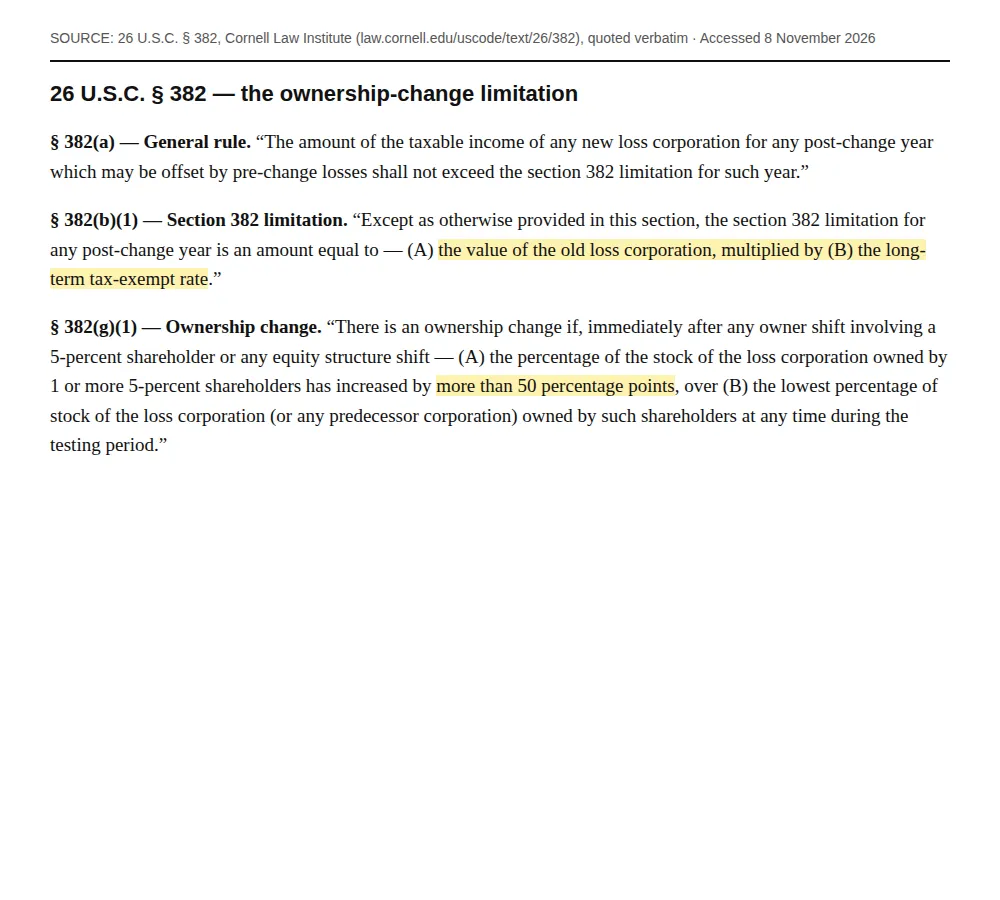
Section 382(g)(1) states the test in one sentence: there is an ownership change if, immediately after any owner shift involving a 5-percent shareholder or any equity structure shift, the percentage of stock owned by one or more 5-percent shareholders has increased by more than 50 percentage points over the lowest percentage those shareholders owned at any time during the testing period.
| Element of the test | What it means | Authority |
|---|---|---|
| 5-percent shareholder | Owns 5%+ of the stock, before or after the shift | IRC §382(g)(1)–(2) |
| Testing period | The 3-year period ending on the day of the shift | IRC §382(i)(1)–(2) |
| Owner shift | Any change affecting a 5-percent shareholder — purchase, issuance, redemption, gift | IRC §382(g)(2) |
| Equity structure shift | A §368 reorganization, with narrow exclusions | IRC §382(g)(3) |
| The 50-point trigger | Aggregate increases only; decreases ignored | IRC §382(g)(1) |
Only increases count: a shareholder who sells from 15% to 10% does not cancel out another shareholder's increase, and the lowest point is measured over the whole three years. Options and convertibles can also count as stock under the regulations.
Example: Meridian Robotics Inc. has investors A at 20% and B at 15%. In a Series C round, A rises to 55% (up 35 points) and a new investor D buys 20% (up 20 from zero); B sells down to 10%, which counts for nothing. Total increase: 55 percentage points — more than 50, so an ownership change occurs on the closing date. If D had bought only 15%, the total would be exactly 50 — not more than 50 — and no ownership change would occur.
3. The limitation: value times the long-term tax-exempt rate
Once an ownership change occurs, §382(a) caps the taxable income of the new loss corporation that pre-change losses may offset at "the section 382 limitation for such year." Section 382(b)(1) defines that limitation as the value of the old loss corporation multiplied by the long-term tax-exempt rate.
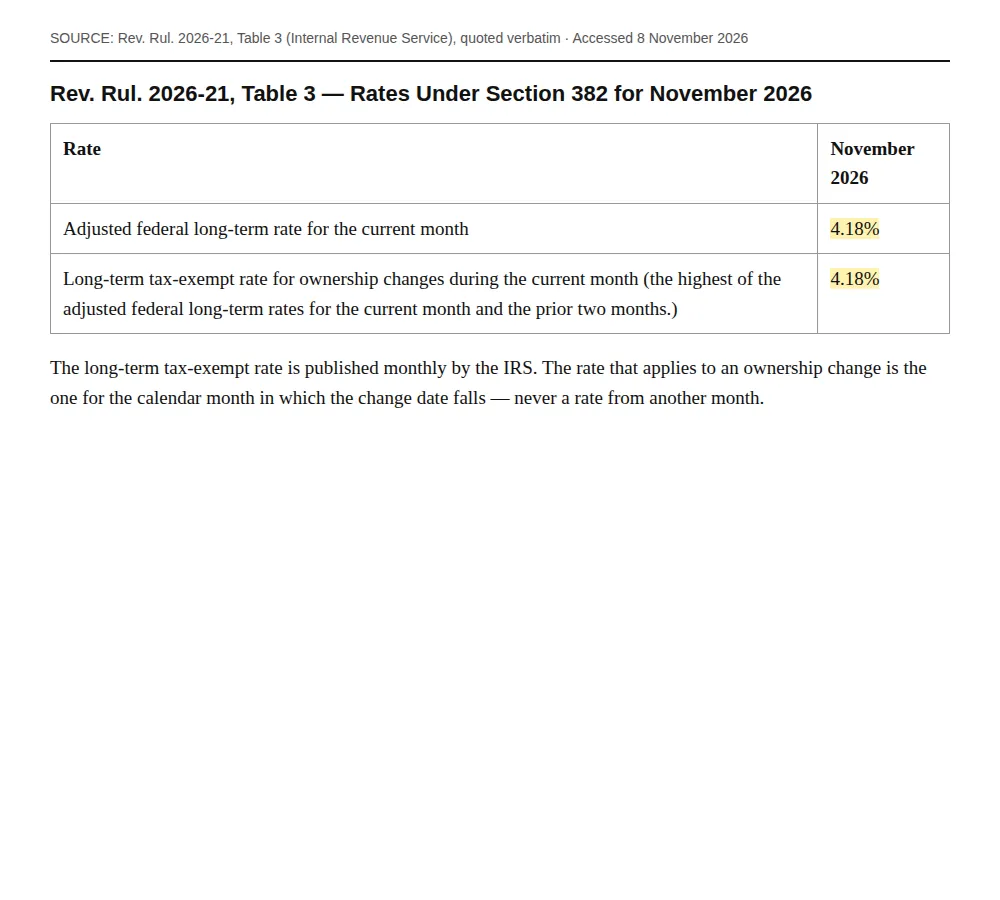
The value is the fair market value of the old loss corporation's stock immediately before the ownership change under §382(e)(1), after any redemption or corporate contraction in connection with the change. The rate is the long-term tax-exempt rate under §382(f)(1): the highest of the adjusted federal long-term rates in effect for any month in the three-month period ending with the change month, published monthly by the IRS.
| Month of change | Long-term tax-exempt rate | Authority |
|---|---|---|
| November 2026 | 4.18% | Rev. Rul. 2026-21, Table 3 |
| October 2026 | 3.95% | Rev. Rul. 2026-19, Table 3 |
The month that matters is the month of the change date — never the month the return is filed. Two features soften the cap: under §382(b)(2) unused limitation carries forward and increases the next year's limitation, and under §382(b)(3) a post-change year that includes the change date is prorated by the days after that date (26 CFR § 1.382-5 confirms both).
4. Worked example: a $12 million NOL meets a $50 million valuation
Worked example: Meridian Robotics Inc. carries a $12,000,000 pre-change NOL. On 15 November 2026 an ownership change occurs; the fair market value of Meridian's stock immediately before the change is $50,000,000, and the long-term tax-exempt rate for November 2026 is 4.18% under Rev. Rul. 2026-21.
At the full annual rate, five post-change years absorb $10,450,000 of the NOL, and the sixth year absorbs the remaining $1,550,000 — assuming Meridian earns enough taxable income each year. The cap is a ceiling, not a guarantee: in a $1,000,000-income year only $1,000,000 of NOL can be used, and the unused $1,090,000 of limitation carries forward.
| Post-change year | Annual §382 limitation | NOL used | NOL remaining |
|---|---|---|---|
| Year 1 | $2,090,000 | $2,090,000 | $9,910,000 |
| Year 2 | $2,090,000 | $2,090,000 | $7,820,000 |
| Year 3 | $2,090,000 | $2,090,000 | $5,730,000 |
| Year 4 | $2,090,000 | $2,090,000 | $3,640,000 |
| Year 5 | $2,090,000 | $2,090,000 | $1,550,000 |
| Year 6 | $2,090,000 | $1,550,000 | $0 |
Now the second cap enters: §172 limits the NOL deduction to 80% of taxable income for post-2017 losses. Suppose Meridian's year-1 post-change taxable income, before any NOL deduction, is $2,500,000. The §172 cap is 80% of that, $2,000,000 — below the $2,090,000 §382 limitation. Both caps apply, and the lower one binds:
Meridian deducts $2,000,000 and pays tax on the remaining $500,000. The $90,000 of unused §382 limitation carries forward under §382(b)(2), so the year-2 limitation becomes $2,180,000. Run the income side through the profit calculator before a deal — the taxable-income forecast is the input both caps depend on.
5. Section 172: the other cap, and three different eras of NOL law
Section 172 is the other rationing rule: it governs how much NOL can be deducted in a year and how far losses travel.
| NOL vintage | Carryback | Carryforward | 80% cap | Authority |
|---|---|---|---|---|
| Arising before 1 Jan 2018 | 2 years | 20 years | No | IRC §172(b)(1)(A) |
| Arising after 31 Dec 2017 | None | Indefinite | Yes | IRC §172(a)(2)(B) |
| Arising in 2018–2020 | 5 years (CARES Act) | Indefinite | Suspended before 1 Jan 2021 | IRC §172(b)(1)(D) |
The Tax Cuts and Jobs Act of 2017 rewrote §172 for losses arising after 31 December 2017: no carryback, indefinite carryforward, and the deduction capped at 80% of taxable income computed without regard to the NOL deduction and without the §199A and §250 deductions. Pre-2018 losses keep the old treatment and the two vintages are tracked separately. (Farming losses keep a 2-year carryback.) The CARES Act of 2020 reopened a 5-year carryback window for 2018–2020 losses and suspended the 80% cap for taxable years beginning before 1 January 2021.
One sourcing note: the IRS flagged Publication 536 as 'will no longer be revised' in October 2024. Publication 536 covers individuals, estates and trusts — it never covered corporations; corporate NOLs are in Publication 542. Cite the statute, not the retired publication. Section 172(d)(8) disallows the §199A deduction in computing an NOL; the §199A rules are in the §199A QBI deduction playbook, and the interest limits that often bind alongside §382 are in the §163(j) business interest limitation playbook.
6. Built-in gains and losses: the hidden second NOL
Section 382(h) adds a second layer. If the old loss corporation's assets exceed their tax basis on the change date, the difference is a net unrealized built-in gain (NUBIG); if worth less, a net unrealized built-in loss (NUBIL). Gains recognized during the 5-year recognition period increase the annual §382 limitation, up to the NUBIG; losses recognized in that period are treated as pre-change losses, up to the NUBIL.
The threshold test in §382(h)(3)(B) switches the regime off for small amounts: if the net unrealized built-in gain or loss is not greater than the lesser of 15% of the assets' fair market value or $10,000,000, it is treated as zero. Take Meridian again: assets worth $60,000,000, aggregate basis $52,000,000, so the NUBIG is $8,000,000. The threshold is the lesser of 15% of $60,000,000 ($9,000,000) or $10,000,000 — and $8,000,000 does not clear it, so Meridian's NUBIG is zero. Cash, cash items and marketable securities are excluded, and §382(h)(6) treats items accruing before the change but taken into account after it as built-in gains or losses.
7. Continuity of business: the zero-limitation trap
Section 382(c)(1) carries the sharpest edge: if the new loss corporation does not continue the old loss corporation's business enterprise at all times during the 2-year period beginning on the change date, the section 382 limitation for any post-change year is zero. The only floor is §382(c)(2) — the built-in-gain increase for the year.
Continuity is judged on the business enterprise, not the legal entity or the brand name. Bankruptcy rules under §382(l)(5) can preserve losses in a title 11 case, but they carry their own conditions and a second ownership change test.
8. Execution sequence
- Identify the loss corporation and its pre-change losses. Pull the NOL schedule and split pre-2018 and post-2017 vintages.
- Map every 5-percent shareholder over the last three years. Record each shareholder's lowest percentage and every owner shift and equity structure shift.
- Run the 50-point test on the proposed transaction. Add the increases only; above 50 points, an ownership change occurs on closing.
- Value the old loss corporation. Fair market value of the stock immediately before the change, after any redemption.
- Pull the long-term tax-exempt rate for the change month. Use the IRS revenue ruling for that month — 4.18% for November 2026 — never another month's rate.
- Compute the annual limitation and the absorption schedule. Value times rate; divide the pre-change NOL by the limitation; apply the §172 80% cap yearly and carry unused limitation forward.
- Test for built-in gains and losses. Value the assets against their basis, apply the 15%-or-$10-million threshold, calendar the 5-year recognition period.
- Confirm the business will continue for two years. Document the continuity plan before closing; if the business will be wound down, value the NOLs at zero.
Founder & CEO Insight — Enow A. Jovial
9. Who should not use this playbook
This guide is written for C-Corp buyers, sellers and investors dealing with corporate NOLs under US federal law. Pass-through owners should not apply it as written: partners and S-Corp shareholders claim losses on their own returns. Non-US groups face different rules, and anyone relying on the bankruptcy exception in §382(l)(5) needs its own analysis. The honest limitation is valuation: the "value of the old loss corporation" is a fair-market-value determination, and two competent appraisers can differ by millions. The arithmetic here is exact; the input is judgment. For loss planning on the personal side, the tax-loss harvesting playbook covers capital losses and the wash-sale rule.