Tax-loss harvesting means selling at a loss on purpose, claiming that loss against gains or income, and staying invested. Done inside the rules, it lowers the tax bill for the year. Done outside them, the loss is disallowed. The difference is one statute, 26 U.S.C. section 1091, and a 61-day window that catches far more investors than expect it.
Every figure below comes from a primary source opened for this article: the statute, IRS Topic 409, IRS Publication 550, Revenue Procedure 2025-32, and IRS Notice 2014-21.
Why it matters
An investor with 10,000 dollars of long-term gain and 10,000 dollars of short-term loss in the same year. The loss wipes out the gain: without it, the tax at 15 percent is 1,500 dollars; with it, the tax is zero. In a year with no gains, only 3,000 dollars offsets ordinary income and 7,000 dollars waits.
Timing decides the value: the loss must be realized in the tax year, so a paper loss on December 31 is worth nothing while a realized loss on December 30 is worth the full netting value.
How capital gains and losses actually work
Almost everything owned for personal or investment purposes is a capital asset (IRS Topic 409). On a sale, the difference between the amount realized and the adjusted basis is the capital gain or loss.
Under section 1222, an asset held for more than one year produces a long-term gain or loss; one year or less produces a short-term gain or loss, counted from the day after acquisition through the day of disposition.
Long-term gains get preferential rates; short-term gains are taxed as ordinary income. For 2026, Revenue Procedure 2025-32 sets the zero percent ceiling at 49,450 dollars for single filers and married taxpayers filing separately, 98,900 dollars for joint filers, and 66,200 dollars for heads of household. The 15 percent ceiling is 545,500 dollars for single filers, 613,700 dollars for joint filers, 579,600 dollars for heads of household, and 306,850 dollars for married taxpayers filing separately. Above those ceilings the rate is 20 percent.
Netting follows a fixed order: short-term losses offset short-term gains first, long-term losses offset long-term gains first, then any remaining net loss in one bucket offsets net gain in the other. Only after that netting does the 3,000 dollar limit apply to what is left. That order makes a short-term loss against a short-term gain the most valuable harvest.
> [!KEY TAKEAWAY]
> Harvest short-term losses first: they cancel short-term gains taxed as ordinary income. Harvest long-term losses against long-term gains inside the 15 or 20 percent bands. A loss harvested in a year with no gains is worth only 3,000 dollars of ordinary income offset that year, with the balance carried forward.
The wash-sale rule: section 1091 in plain language
Section 1091(a) states the rule plainly. If a loss is claimed from the sale of stock or securities, and within a period beginning 30 days before the date of that sale and ending 30 days after it, the taxpayer has acquired substantially identical stock or securities, or has entered into a contract or option to acquire them, then no deduction is allowed under section 165 unless the taxpayer is a dealer in stock or securities acting in the ordinary course of that business. The window is 61 days in total: the 30 days before, the day of sale, and the 30 days after.
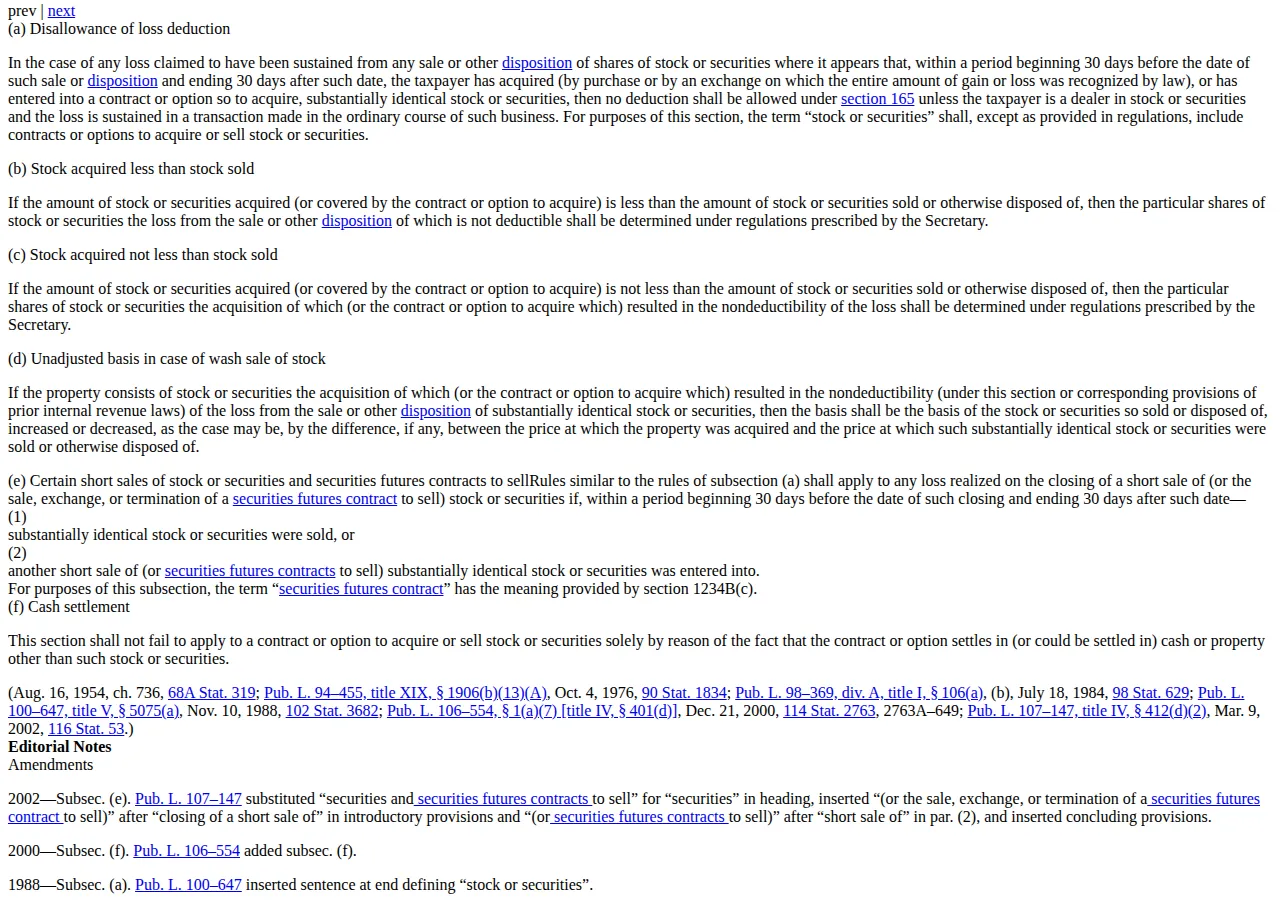
The statute reaches further than a rebuy in the same account. Publication 550 lists four triggers inside the window: buying substantially identical stock or securities, acquiring them in a fully taxable trade, acquiring a contract or option to buy them, or buying them inside an IRA or Roth IRA. A spouse or a controlled corporation buying the same stock also triggers it.
Substantially identical is a facts-and-circumstances test, not a ticker-symbol test. Publication 550 states that stock of one corporation is ordinarily not substantially identical to stock of another, and bonds or preferred stock are ordinarily not substantially identical to the common stock of the same corporation. The exception: convertible preferred stock with the same voting rights and dividend restrictions can be substantially identical. Two share classes of the same company, or a stock and a call option on it, are the danger zone.
The IRA trap is the most expensive corner of the rule. Publication 550 states the disallowed loss is added to the cost of the new shares except in the IRA case: the basis add-back that normally preserves the loss does not apply when the replacement sits in a retirement account. The loss is not deferred. It is gone.
> [!WARNING]
> The wash-sale window counts purchases made before the sale, not only after it. Buying the replacement shares 20 days before the loss sale triggers the rule exactly as buying them 20 days after it does. Dividend reinvestment inside the window counts as an acquisition.
The basis adjustment: the loss is deferred, not destroyed
When a wash sale disallows a loss, section 1091(d) preserves the economics in the replacement shares: the new basis equals the old basis adjusted by the difference between the replacement purchase price and the sale price. Where the same number of shares is involved, new basis equals the replacement purchase price plus the disallowed loss.
$
\text{New basis} = \text{replacement purchase price} + \text{disallowed loss}
$
$
\text{Tax saved} = \text{deductible loss} \times \text{marginal tax rate}
$
Publication 550 prints this example: an investor buys 100 shares of X stock for 1,000 dollars, sells them for 750 dollars, and within 30 days buys 100 shares of the same stock for 800 dollars. The 250 dollar loss cannot be deducted; it is added to the 800 dollar cost, giving a basis of 1,050 dollars in the new position. The loss sits in the new basis until those shares are sold outside a wash-sale window.
A second example shows the tax saving at stake. An investor buys 200 shares at 50 dollars each for 10,000 dollars and sells at 40 dollars each for 8,000 dollars, a loss of 2,000 dollars. Rebuying 200 shares at 42 dollars each within 30 days, for 8,400 dollars, disallows the entire 2,000 dollar loss, and the new basis is 10,400 dollars. Waiting until day 31 and rebuying at the same price makes the loss deductible. At an assumed 22 percent marginal rate, used here only as an illustration, the deductible loss saves 440 dollars: 2,000 dollars times 0.22 equals 440 dollars. A 10,000 dollar gain costs 1,500 dollars at 15 percent and 2,200 dollars at an assumed 22 percent rate.
The 3,000 dollar limit and the carryforward
Section 1211(b) sets the annual limit: a taxpayer other than a corporation may deduct capital losses only to the extent of capital gains, plus the lower of 3,000 dollars, or 1,500 dollars for a married individual filing a separate return, or the excess of losses over gains. Topic 409 adds the mechanics: the limit is the lesser of 3,000 dollars or the total net loss on line 16 of Schedule D, claimed on line 7a of Form 1040, and the excess carries forward on the Capital Loss Carryover Worksheet.
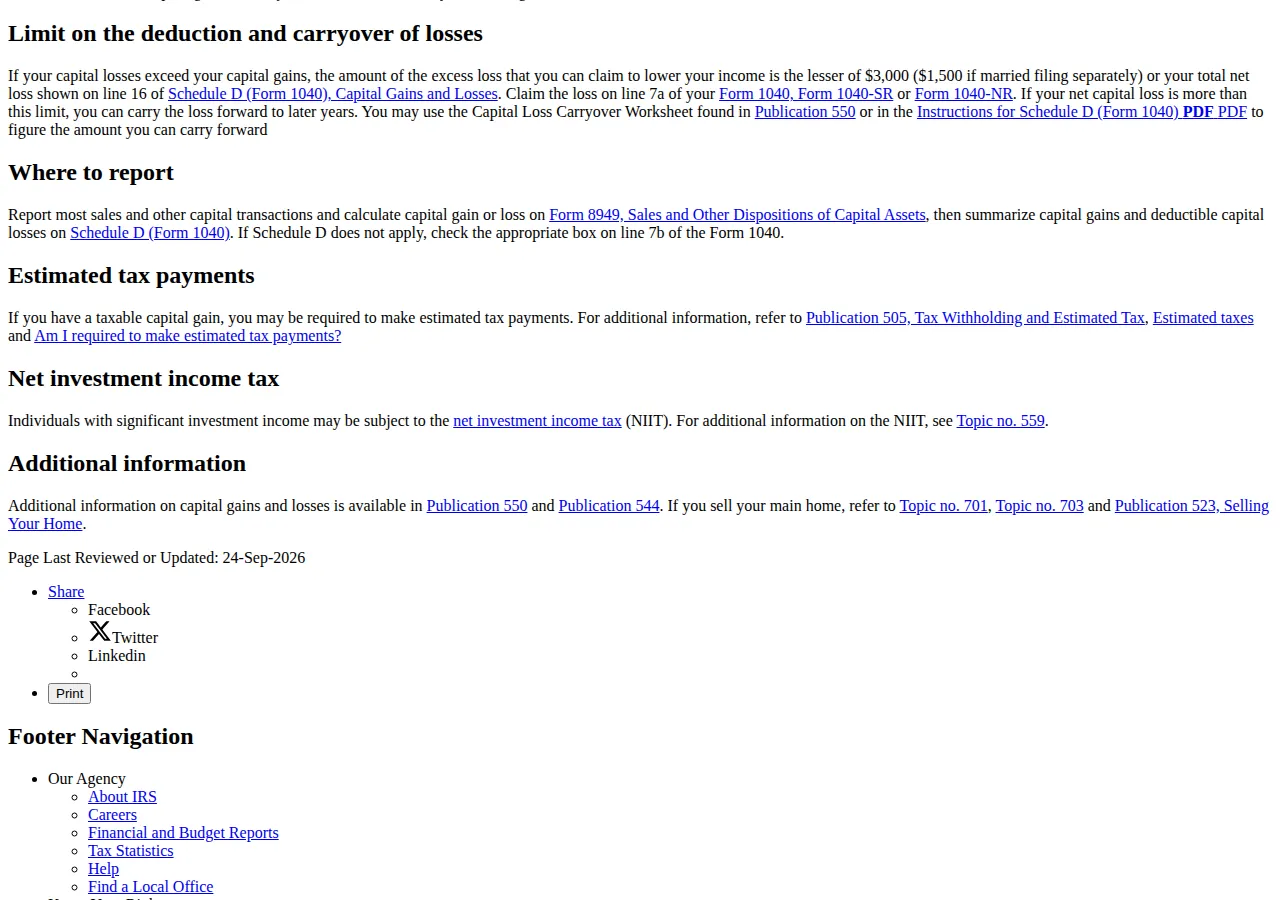
Suppose an investor ends the year with an 11,000 dollar net capital loss and no gains. Year one deducts 3,000 dollars and carries 8,000 dollars forward. Year two deducts 3,000 dollars and carries 5,000 dollars. Year three deducts 3,000 dollars and carries 2,000 dollars. Year four deducts the final 2,000 dollars. The full 11,000 dollars is used, but it takes four tax years.
$
\text{Carryforward to next year} = \text{net capital loss} - \$3{,}000 = \$11{,}000 - \$3{,}000 = \$8{,}000
$
| Move | Result | Authority |
|---|---|---|
| Sell at a loss, wait 31 days, then rebuy the same security | Loss deductible in the year of sale | Section 1091(a), 30-day window |
| Sell at a loss and rebuy the same security within 30 days | Loss disallowed; added to replacement basis | Section 1091(a) and (d); Publication 550 |
| Sell at a loss and rebuy inside an IRA or Roth IRA | Loss disallowed and basis add-back does not apply | IRS Publication 550, Wash Sales |
| Sell at a loss; spouse or controlled corporation rebuys | Loss disallowed as a wash sale | IRS Publication 550, Wash Sales |
| Sell a stock loss and buy a call option on the same stock | Loss disallowed; option is a contract to acquire | Section 1091(a); Publication 550 |
| Sell crypto at a loss and rebuy the same crypto | Section 1091 does not apply as written; loss generally deductible | Section 1091 covers stock or securities; Notice 2014-21 treats virtual currency as property |
| Sell at a loss and buy a different company in the same sector | Loss generally deductible; different issuer is ordinarily not substantially identical | Publication 550, Substantially identical |
The entity and payroll boundaries
The 3,000 dollar limit belongs to individuals. A C-Corp gets no such allowance: under section 1211(a), a corporation deducts capital losses only to the extent of capital gains, and under section 1212(a) a corporate net capital loss carries back 3 years and forward 5 years. An S-Corp passes its capital losses through to shareholders, who report them on their own returns. A single-member LLC is a disregarded entity, so the loss reports on the owner return under the owner SSN; an entity account reports under its EIN. Capital gains and losses are investment income, not wages, so FICA and SECA do not apply. Book accounting under GAAP records the loss when the sale closes, while the tax treatment follows section 1091, so book and tax can disagree in the wash-sale year. Before filing, export the broker 1099-B as a CSV and have a CPA review the wash-sale adjustments.
The crypto gap: property, not a security
IRS Notice 2014-21 answers its first question directly: for federal tax purposes, virtual currency is treated as property. Section 1091, by its own text, applies to losses from wash sales of stock or securities. A digital asset treated as property is neither stock nor a security under that text, so a sale of crypto at a loss followed by a repurchase inside 30 days does not trigger section 1091.
That gap describes the statute as written, not a recommendation. The same property treatment means every crypto-to-crypto trade is a taxable disposition, and crypto losses still go on Form 8949, still net under the same rules, and still face the 3,000 dollar limit.
Who should NOT harvest losses this way
Not every loss deserves to be harvested. With no capital gains and a low marginal rate, a 3,000 dollar deduction at a 12 percent assumed rate is worth 360 dollars, and trading costs plus 31 days out of the market can exceed it. Losses inside an IRA or a 401(k) are not deductible at all. An investor who cannot track replacement purchases across every account, including a spouse account and dividend reinvestment, should not harvest: one unnoticed purchase converts a planned deduction into a disallowed loss.
A large carryforward already on the books argues against adding more. The rule rewards the investor who sells a loser, waits out the window, and rebuys a position they actually want to own.
The five-step harvest
1. List the losses — separate long-term from short-term, with size and basis for each position.
2. List the gains — total every realized gain this year, so the netting order shows which losses count.
3. Search the window — check every account, including a spouse account, for purchases in the 30 days before the sale.
4. Pause reinvestment — set dividend reinvestment to cash at least 35 days before the harvest.
5. Sell, record, calendar — sell, record the trade date, proceeds, and basis, and calendar day 31.
The year-end execution checklist
Run this checklist before the last trading week of the year: a mistake found on December 31 cannot be fixed by a trade that settles in January.
> [!TIP]
> Set dividend reinvestment to cash at least 35 days before a planned harvest: a reinvested dividend of a few dollars inside the window can disallow a loss worth thousands.
Reporting the harvest and keeping the records
Report most sales on Form 8949 and summarize them on Schedule D. Publication 550 gives the wash-sale mechanics: enter W in column (f) and the disallowed loss as a positive number in column (g). Broker reporting generally covers one account, while the rule covers the taxpayer, the spouse, and controlled corporations, across every account. Reconcile the broker figures against personal records before filing.
The tax estimator on this site runs the same netting logic against the current rate bands, so a harvest can be priced before the trade is placed. A large harvested loss also changes estimated payments, and the quarterly estimated tax payments guide works through the schedule. Self-employed readers should also read the Schedule C playbook, because business income and investment losses sit on different lines of the return. The section 199A deduction guide covers the qualified business income deduction, which interacts with taxable income and therefore with the capital gain rate bands.
> [!FOUNDER]
> Most investors lose money twice on the same trade: once in the market, and once on the tax return, because they sell at a loss and buy the same shares back before the window closes. The statute gives you 30 days of patience in exchange for the deduction. Take the 30 days.
> — Enow A. Jovial, Founder & Chief Executive Officer
Our editorial analysis found the wash-sale rule the single most misunderstood provision in individual tax planning, because the 30-day window runs backward as well as forward and the IRA version of the trap destroys the loss instead of deferring it. Read section 1091 once, calendar the window before every loss sale, and the harvest does what it is supposed to do.