IRC §367(d): Moving Intellectual Property to a Foreign Corporation — the Super-Royalty Playbook
A U.S. company contributes a patent, a brand, or a software platform to a new foreign subsidiary for stock. Between two domestic corporations that exchange is tax-free under section 351. Cross the border and section 367(d) rewrites the deal: the transferor is treated as having sold the intangible for a stream of royalty payments, included in gross income every year for the property's useful life. The tax world calls it the super-royalty. This playbook works the statute as written and prices the choice with reproducible math — including one widely repeated error about where the election sits. The inversion angle is a different section 367 problem; see the cross-border inversion playbook.
What counts as intangible property
Section 367(d)(4) defines the term broadly. It covers a patent, invention, formula, process, design, pattern, or know-how; a copyright, literary, musical, or artistic composition; a trademark, trade name, or brand name; a franchise, license, or contract; a method, program, system, procedure, campaign, survey, study, forecast, estimate, customer list, or technical data; goodwill, going concern value, or workforce in place; and any other item whose value is not attributable to tangible property or the services of any individual. That last clause is the catch-all. Goodwill and workforce in place were added by later amendments, so moving a whole business offshore carries its goodwill in.
The trigger: a section 351 or 361 exchange
Section 367(d)(1) switches on only when a U.S. person transfers intangible property to a foreign corporation in a section 351 or 361 exchange — a contribution to a controlled corporation or a tax-free reorganisation. When it switches on, section 367(a) does not apply to that property. The two regimes never run together on the same asset. Tangible property in the same contribution is tested under section 367(a); the patent goes under section 367(d). Before 2018, the active trade or business exception in old section 367(a)(3) offered a way out for operating assets; the Tax Cuts and Jobs Act repealed it for transfers after December 31, 2017.
The deemed sale and the annual inclusion
Section 367(d)(2)(A) treats the U.S. person as having sold the property for payments contingent on its productivity, use, or disposition — amounts reasonably reflecting the annual receipts over the useful life, or on disposition, at that time. The amounts must be commensurate with the income attributable to the intangible — the section 482 standard. Reg. § 1.367(d)-1T(c)(1) makes it an annual routine: each year, the transferor includes an arm's-length charge under section 482, less any royalty the transferee pays to an unrelated person, deemed received on the last day of the year. Section 367(d)(2)(C) taxes every inclusion as ordinary income, treated as a royalty for the section 904(d) credit limitation; section 367(d)(2)(B) cuts the transferee's earnings and profits by the inclusion. The GILTI inclusion playbook covers the other side.
Worked math 1: the $1,000,000 inclusion
A U.S. corporation contributes a patent to a wholly owned Irish subsidiary in a section 351 exchange: FMV $10,000,000, basis $1,500,000, life 10 years, attributable sales $12,500,000 a year, royalty 8 percent. The annual inclusion:
Over 10 years at constant sales, the inclusions total $10,000,000 — the full fair market value, taxed as ordinary income: $210,000 a year at the 21 percent rate, $2,100,000 over the patent's life. No gain is recognised on the $8,500,000 of built-in appreciation at transfer; it is recovered gradually through the royalty. Run your own rate and sales through the profit calculator before fixing the transfer price.
The decision table
| Situation | Result | Authority |
|---|---|---|
| Patent contributed for stock (§351) | Annual inclusion over useful life | §367(d)(1), (d)(2)(A) |
| Trademark moved in a §361 reorganisation | Same annual inclusion | §367(d)(1); Reg. § 1.367(d)-1T(c)(1) |
| Goodwill or workforce moved with the business | Included as intangible property | §367(d)(4)(F) |
| Actual licence to the foreign subsidiary | No §367(d); §482 governs | Reg. § 1.367(d)-1T(g)(4)(i) |
| Sham licence priced far below arm's length | Disregarded; §367(d) transfer | Reg. § 1.367(d)-1T(g)(4)(ii) |
| Transferor sells subsidiary stock to an unrelated buyer | Deemed sale; gain at once | Reg. § 1.367(d)-1T(d)(1) |
| Subsidiary sells the patent to an unrelated buyer | Deemed sale; inclusions stop | Reg. § 1.367(d)-1T(f)(1) |
| IP repatriated to a qualified domestic person | §367(d) terminates, with reporting | T.D. 9994 (Oct. 10, 2024) |
The election — and a correction about where it lives
Most advisers point to section 367(d)(3) for the election. It contains no election — only authority to extend the rules to partnerships by regulation. The election is in Treas. Reg. § 1.367(d)-1T(g)(2), "Election to treat transfer as sale". It lets the transferor recognise ordinary income in the year of transfer — fair market value less adjusted basis — and escape paragraphs (c) through (f). But it is available only on one of two gates: foreign-government compulsion — legally required as a condition of doing business, or a genuine threat of immediate expropriation; or a transfer within three months of the foreign corporation's organisation, as part of its original capitalisation, with the transferor at 40 to 60 percent of voting power and value, at least 40 percent held by unrelated foreign persons, and intangibles at least 50 percent of the value transferred.
Worked math 2: election vs. ten years of inclusions
If the election were available:
At 21 percent, the year-one tax is $1,785,000. The annual route pays $210,000 a year for 10 years; at a 5 percent discount rate, the present value of ten $1,000,000 inclusions is:
The tax on the annual route is 21 percent of that present value, or $1,621,564 — about $163,436 less than the $1,785,000 election tax. The election fixes the tax on the transfer-date value; the annual route defers it but re-measures the inclusion yearly.
How section 367(d) meets section 482
Section 367(d) and section 482 share a standard but cover different transactions: section 482 governs actual dealings between related parties, while section 367(d) governs a deemed transaction, a contribution of intangibles for stock where nothing was sold or licensed. Under Reg. § 1.367(d)-1T(g)(4)(i), section 367(d) does not apply to an actual sale or licence, and a section 482 adjustment to one does not trigger it. But paragraph (g)(4)(ii) disregards a purported sale or licence as a sham when its terms differ so greatly from economic substance or arm's-length terms that it is not a real licence. A $1-a-year licence of a patent that earns $12,500,000 is not a licence; it is a contribution wearing a licence agreement. The TCJA added section 367(d)(2)(D) in 2017: valuation on the realistic alternatives to the transfer, if the most reliable means — in practice, what the transferor would have earned by keeping the patent and licensing it directly. The arm's-length methods do this work; see the section 482 transfer pricing playbook. Under Reg. § 1.367(d)-1T(g)(5), fair market value is the single-payment price an unrelated purchaser would pay; the parties' own allocation to intangibles is not controlling. Under Reg. § 1.367(d)-1T(g)(6), routing the patent through a domestic corporation first does not help: a transfer to a domestic corporation to avoid section 367(d), followed by a transfer of its stock to a related foreign corporation, is treated as a direct transfer, presumed avoidant if the domestic transfer happened less than two years earlier.
What ends the inclusions
The annual inclusion ends only on events the regulation names. If the transferor sells the transferee's stock to an unrelated person within the useful life, Reg. § 1.367(d)-1T(d)(1) treats the transferor as having sold the intangible itself, recognising gain — not loss — of fair market value less former basis. A transfer to a related U.S. person passes the inclusions along proportionately under paragraph (e)(1); to a related foreign person they stay put under paragraph (e)(3). If the transferee itself disposes of the property to an unrelated person, paragraph (f)(1) requires gain on the same measure plus a partial-year payment, and the inclusions stop.
The newest ending arrived in 2024: Treasury's May 3, 2023 proposed regulations (REG-124064-19), finalised in T.D. 9994 effective October 10, 2024, terminate section 367(d) on repatriation to a qualified domestic person. When the transferee transfers the property back to the initial U.S. transferor, a qualified successor, or a related U.S. person, and the reporting is satisfied, section 367(d) stops applying. The transferor still includes a partial inclusion for the part of the year the foreign corporation held the property. One cash-flow rule also surprises: the deemed payments are income whether or not the subsidiary pays them. Reg. § 1.367(d)-1T(g)(1) lets the transferor record a receivable for each unpaid year — but if any part is still unpaid on the last day of the third taxable year after the year it relates to, it is deemed paid and the transferor is deemed to have contributed that amount to capital. Unpaid super-royalties do not vanish; after three years they become a capital contribution never chosen.
Form 926 and the section 6038B penalty
Every section 367(d) transfer must be reported on Form 926, filed with the transferor's return for the year of the transfer.
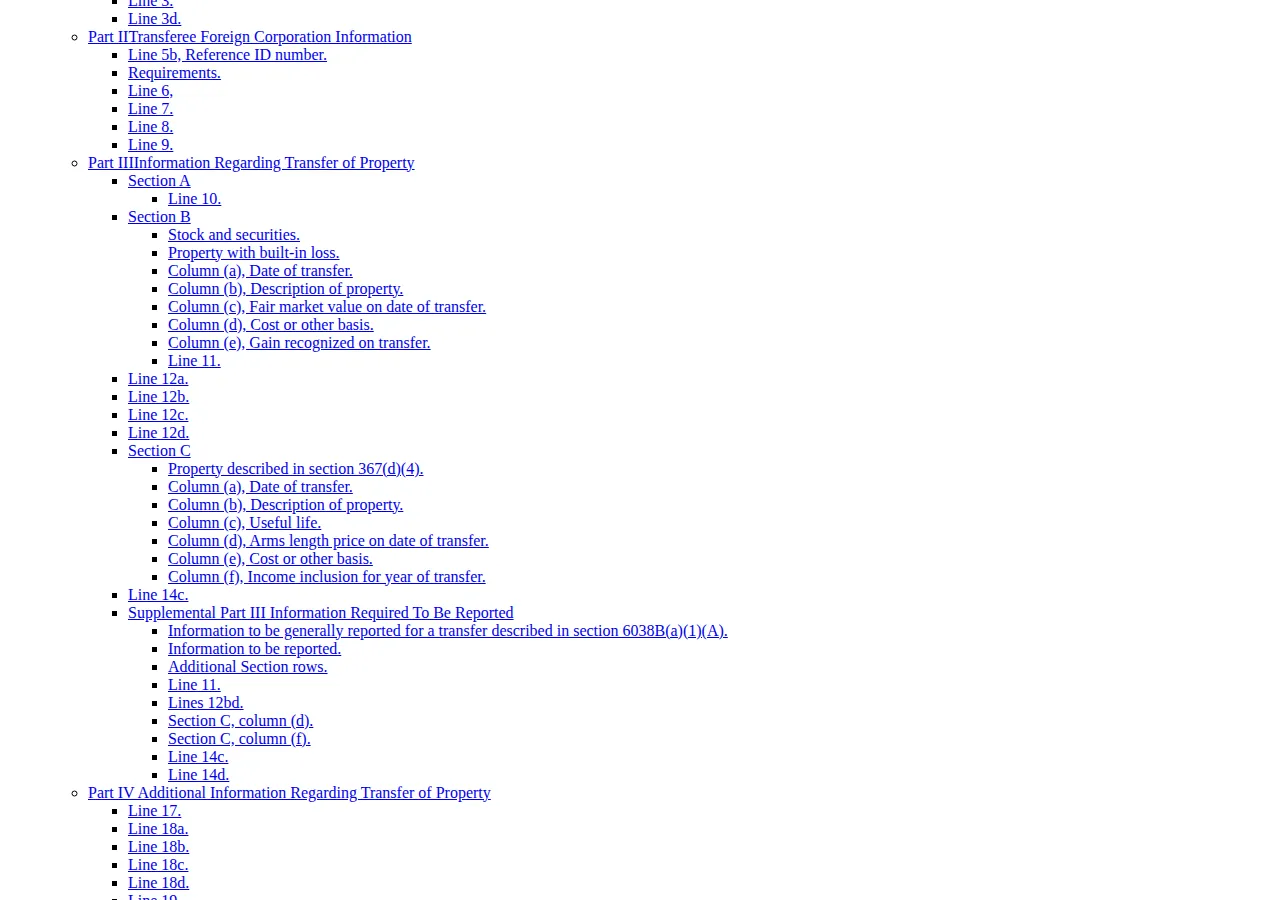 Its Part III, Section C covers intangible property subject to section 367(d): description, fair market value, basis, and gain recognised. The form is an information return, not a tax computation — but section 6038B(c) imposes 10 percent of fair market value at the exchange, capped at $100,000 per transfer, the cap removed for intentional disregard, with reasonable-cause relief. The transferor also reports the continuing inclusions each year; the Form 5471 foreign corporation playbook covers the annual return that tracks the subsidiary.
Worked math 3: the $100,000 penalty
On the patent in Worked math 1:
Ten percent of $10,000,000 is $1,000,000, but the cap holds the penalty at $100,000 — unless the IRS finds intentional disregard, when the full $1,000,000 applies. The sharper edge is the statute: under section 6501(c)(8), the three-year period does not begin until the information is furnished, so an unfiled Form 926 leaves the transfer open indefinitely.
Who this playbook is for — and who must stay away
This playbook is for a U.S. founder or finance chief capitalising a real foreign subsidiary with real IP, who needs to budget the annual inclusion as a recurring cash tax and keep Form 926 clean. It is not for a business that wants IP offshore to escape U.S. tax: section 367(d) was written in 1984 to stop exactly that. It is not for a transfer priced by an internal memo, or for anyone who treats the annual inclusion as a one-time filing: it runs for the property's useful life.
Run the transfer: execution checklist
- Inventory the intangibles. List every patent, trademark, copyright, customer list, and goodwill item moving offshore, and value each.
- Confirm the exchange. Verify a section 351 contribution or section 361 reorganisation; a straight licence is a section 482 matter.
- Commission the section 482 valuation. Price the arm's-length royalty before the transfer and keep the report.
- Model the inclusion. Compute the annual inclusion and its present value; compare with the election only if a gate in Reg. § 1.367(d)-1T(g)(2) is met.
- Check the election gates honestly. Foreign-government compulsion, or the three-month, 40-to-60-percent, 40-percent-unrelated, 50-percent-intangibles test.
- Budget the tax as a recurring line. Ordinary income each year, deemed received on the last day; set estimated payments accordingly.
- File Form 926 with the transfer-year return. Complete Part III, Section C for the intangibles, and calendar the annual reporting that follows.
- Track the accounts receivable. If the subsidiary does not pay the deemed royalty, record the receivable yearly and watch the three-year conversion to capital.
- Docket the disposition triggers. Any sale of the subsidiary's stock or the IP itself changes the inclusion; get advice before signing.
- Revisit on repatriation. If the IP ever comes home, use the T.D. 9994 termination rule and satisfy its reporting.
Founder & CEO Insight — Enow A. Jovial
The decision in advance
Section 367(d) is a toll, not a trap: move the patent, pay the royalty every year until the useful life ends or a named event closes the account. Value the property, model the stream, file Form 926 on time.