IRC Section 280E: The Cannabis Business Tax Playbook
A licensed dispensary earns $180,000 of real profit on $1,200,000 of sales and owes $126,000 of federal income tax. A bakery with the same revenue, costs, and profit owes $37,800. The $88,200 gap is one sentence of the Internal Revenue Code, enacted in 1982: section 280E. It denies every deduction and credit to a business trafficking in a Schedule I or II substance — and in April 2026 the schedule changed for part of the industry.
The statute, in one sentence
Section 280E is the shortest tax trap in the Code: "No deduction or credit shall be allowed for any amount paid or incurred during the taxable year in carrying on any trade or business if such trade or business (or the activities which comprise such trade or business) consists of trafficking in controlled substances (within the meaning of schedule I and II of the Controlled Substances Act) which is prohibited by Federal law or the law of any State in which such trade or business is conducted." Congress added it in 1982 (Pub. L. 97-248, § 351(a)) after a drug dealer deducted his business expenses.
The IRS reads "trafficking" to cover every business that sells marijuana, including a state-compliant dispensary. Its cannabis industry FAQs state that § 280E applies to businesses that sell marijuana "even if they operate in states that have legalized the sale of marijuana," and the Tax Court agreed in N. California Small Business Assistants Inc. v. Commissioner, 153 T.C. 65 (2019).
What § 280E does not touch is the income itself: income from any source is taxable, and a state-compliant dispensary pays employment tax like any other business — see the IRS Form 941 quarterly payroll tax filing playbook. Cash over $10,000 must be reported on Form 8300 within 15 days and kept five years.
The math: tax on gross profit
Take a dispensary with $1,200,000 of revenue, $600,000 of cost of goods sold, and $420,000 of operating expenses. True economic profit is $180,000.
An ordinary business pays tax on $180,000 — $37,800 as a C corporation at 21%. Under § 280E, the $420,000 of operating expenses vanishes from the return. Taxable income becomes gross profit, $600,000, and the tax is $126,000.
The business keeps $54,000 of its $180,000 profit. That 70% effective rate is computed on figures the operator already knows — which is why the first planning move is always to verify the COGS number, not to hunt for a deduction that does not exist.
Now run the identical dispensary as a pass-through — an LLC taxed as a partnership, or an S corporation — where the $600,000 flows to owners taxed at 37%. Ordinary tax on $180,000 would be $66,600. Under § 280E the bill is $222,000, more than the $180,000 the business actually earned: a 123% effective rate, paid from capital or reserves. The C corporation's 21% flat rate is the cheaper container — the gap is worth $96,000 a year here, before state tax.
The boundary case is worse. A dispensary with $1,000,000 of revenue, $700,000 of COGS, and $300,000 of operating expenses has zero true profit — yet under § 280E it still owes $63,000 as a C corporation, $111,000 as a pass-through at 37%. A business can break even on every sale and still owe income tax. Model your own figures in the Self-Employed Tax & Quarterly Estimator before signing a lease.
The COGS carve-out: section 471
If § 280E is the wall, cost of goods sold is the one door through it. COGS is not a deduction. It is the subtraction that converts gross receipts into gross income, and it happens before any deduction is taken, so § 280E never reaches it. The IRS FAQs state that a marijuana business may reduce its gross receipts by its properly calculated cost of goods sold under § 471 and the associated regulations (Chief Counsel Advice 201504011).
What counts as COGS depends on what the business does. A retailer subtracts the purchase price of the inventory it sells, plus freight-in. A cultivator capitalizes production costs — seed or clone, nutrients, grow labor, grow-room electricity, equipment depreciation — into inventory under the § 263A uniform capitalization rules, releasing it as the product sells. A manufacturer capitalizes the input flower plus the production costs § 263A requires.
What is never COGS is the trap. The IRS FAQs name advertising and selling expenses as non-deductible, and the same logic reaches administrative costs, budtender wages, and storefront rent. The line between production cost and selling cost is where audits are won and lost; the Tax Court has upheld § 6662 penalties for inadequate books and records (Olive v. Commissioner, 139 T.C. 19 (2012)).
Section 471(c): the small-business rules
Most cannabis operators are small by the Code's measure. A taxpayer meeting the § 448(c) gross receipts test — average annual gross receipts of $32,000,000 or less for 2026 ($31,000,000 for 2025) over the prior three years — is exempt from § 471(a) under § 471(c) and may treat inventory as non-incidental materials and supplies, or follow its books.
That is a real simplification, not a free pass: it changes how inventory is accounted for, not what may be capitalized into COGS, and it creates no deduction for operating expenses.
Entity choice still matters
A single-member LLC is a disregarded entity and reports on the owner's Schedule C; a multi-member LLC files Form 1065 as a partnership unless it elects corporate treatment; a C-Corp files Form 1120 and pays the 21% flat rate; an S-Corp files Form 1120-S and passes income to shareholders on Schedule K-1. Each needs an EIN from the IRS, a CPA who has filed a § 280E return before, and books kept on a GAAP basis so COGS can be defended line by line. The bookkeeping is usually a SaaS product — a seed-to-sale platform feeding an accounting API — and the quality of that feed is what stands between the operator and a § 6662 penalty.
The § 199A deduction partly survives, in narrowed form. In Savage v. Commissioner, 165 T.C. No. 5 (2025), the Tax Court held that a cannabis business may claim the § 199A deduction, but wages disallowed under § 280E do not count as W-2 wages for the § 199A wage limitation. The section 199A QBI deduction SSTB phaseout playbook covers the limits in full.
An ownership interest is an estate asset at fair market value — see the estate tax exemption $15 million OBBA portability playbook.
State returns: where 280E does not follow
Federal law is uniform; state law is not. A state that starts from federal taxable income with no adjustment follows § 280E automatically. A state that decouples lets the business deduct on the state return what § 280E disallows federally. Two states are verified here.
| State | State treatment of § 280E | Authority |
|---|---|---|
| California | Licensed businesses deduct COGS and ordinary expenses; decoupling runs through Dec. 31, 2029 | FTB page; AB 37; SB 167 |
| Oregon | Subtraction for § 280E-disallowed deductions, for licensed businesses | ORS 316.680(1)(i); Measure 91 |
California is the clearest case. The Franchise Tax Board states that most licensed cannabis businesses "may deduct cost of goods sold, and ordinary and necessary business expenses on their California returns," while unlicensed taxpayers may deduct only COGS. The decoupling began with AB 37 for 2020 through 2024 and was extended by SB 167 through December 31, 2029. The same dispensary pays federal tax on $600,000 of gross profit but computes California taxable income on $180,000 of true profit — the federal-state gap is the entire § 280E penalty.
Rescheduling: what April 28, 2026 changed
For forty years the § 280E analysis started with one fact: marijuana was Schedule I. On April 28, 2026, that fact changed for part of the industry. The Acting Attorney General issued a final order (AG Order No. 6754-2026, 91 Fed. Reg. 22714) placing two categories in Schedule III under 21 U.S.C. § 811(d)(1): marijuana in an FDA-approved drug product, and marijuana under a qualifying state medical marijuana license. The order took effect on publication and created an expedited DEA registration process for state medical licensees.
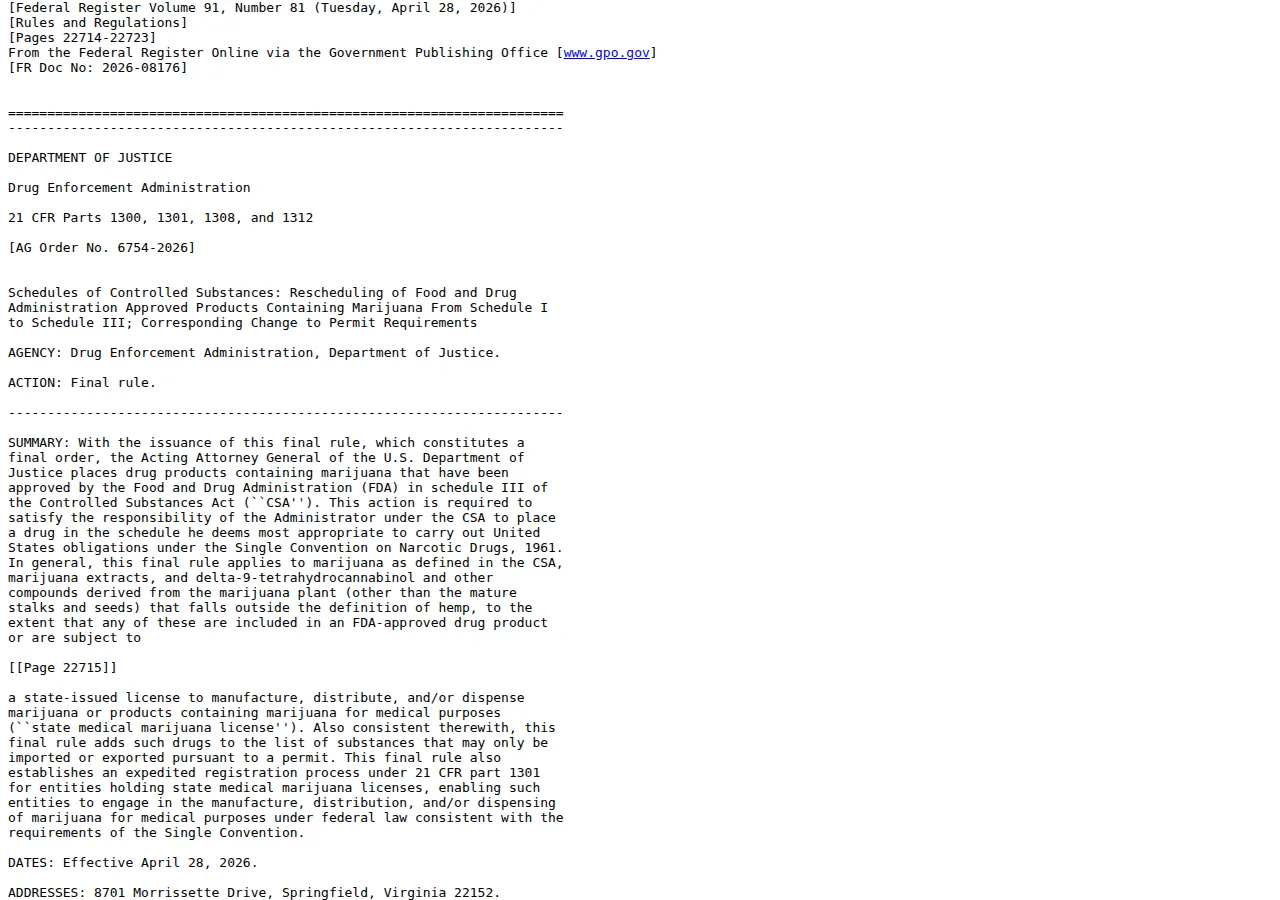
Because § 280E reaches only Schedule I and II substances, the order lifts it for the covered activities. A dispensary under a qualifying state medical license can, from the effective date, deduct the rent, payroll, and marketing § 280E had disallowed — subject to Treasury and IRS guidance on the transition, announced April 23, 2026 and still pending.
What the order did not do is just as important. Adult-use cannabis remains Schedule I. A dual-license operator selling both medical and adult-use product must allocate — the medical side is now Schedule III and deductible, the adult-use side is still Schedule I and fully under § 280E — and the allocation method belongs on Form 8275 until the IRS issues guidance. The broader proceeding on moving all cannabis to Schedule III was stayed on September 29, 2026 with no decision. Until a further final order issues, no operator should budget as though adult-use relief has arrived.
The hemp boundary
The 2018 Farm Bill drew a line through the cannabis plant. Hemp — Cannabis sativa L. with a delta-9 THC concentration of not more than 0.3 percent on a dry weight basis — was removed from the Controlled Substances Act, and the IRS states directly that a business selling only hemp is not subject to § 280E. A CBD business built on compliant hemp deducts its expenses like any other business.
Two cautions. First, the definition tightened: effective November 12, 2026, the statute measures total THC, including THCA, at not more than 0.3 percent — a crop compliant under the old measure can fail under the new one, and a failed crop is marijuana, not hemp. A mixed business does not get to choose: the hemp side deducts, the marijuana side does not.
Filing mechanics
The return is where the playbook becomes a calendar. File the right form, put COGS where it belongs, disclose the aggressive positions, and pay on time.
- Choose the entity return: Form 1120 for a C corporation, Form 1065 for a partnership LLC, Form 1120-S for an S corporation, Schedule C for a sole proprietor.
- Compute COGS under § 471 and § 263A first, and keep the invoices, production logs, and § 263A worksheet that prove the number.
- Report gross receipts, subtract COGS to reach gross income, and claim no operating deductions.
- Disclose the positions that need it on Form 8275, filed with the original return, to avoid the disregard and substantial-understatement portions of the 20% accuracy-related penalty where the position has a reasonable basis.
- Pay quarterly estimated tax on the inflated base — Form 1040-ES for individuals, EFTPS for entities — computed on gross profit, not on the cash the business keeps.
- Report every cash receipt over $10,000 on Form 8300 within 15 days and retain the forms five years, as § 6050I requires.
Operator boundaries
This playbook is written for the operator of a state-licensed cannabis business. It is not written for an unlicensed operator, for whom the state return offers no relief; it is not written for a hemp-only business, outside § 280E entirely; and it is not a substitute for a CPA's review before filing. The numbers here are worked examples, not a tax opinion.
| Decision | Under § 280E | After Schedule III (medical only) | Authority |
|---|---|---|---|
| Rent, payroll, marketing | No federal deduction | Deductible for covered activity | IRC § 280E; 91 Fed. Reg. 22714 |
| Adult-use sales | Under § 280E | Still under § 280E | 91 Fed. Reg. 22714 |
Execution checklist
- [x] License type confirmed, allocation written down
- [x] COGS under § 471 and § 263A, with records to prove it
- [x] § 471(c) status checked against the $32,000,000 threshold for 2026
- [x] Entity selected; C-corp vs pass-through modeled at 21% vs 37%
- [x] State return checked for decoupling before filing
- [x] Form 8275 filed for aggressive positions
- [x] Form 8300 filed for every cash receipt over $10,000
- [x] Estimated payments set on gross profit
Founder & CEO Insight — Enow A. Jovial
The decision in advance
Section 280E will not be repealed by a clever return position. It is one sentence, it has survived every Tax Court challenge, and it taxes gross profit until the schedule changes. The operator's levers are the ones this playbook names: a COGS number that survives an audit, an entity that pays 21% instead of 37%, a state return that decouples, and — since April 28, 2026 — a medical license that moves the activity to Schedule III. Price the tax before the sale and keep the records that prove the COGS.