What § 172 actually does
Section 172(a) allows a deduction for the taxable year equal to the aggregate net operating loss carryovers and carrybacks to that year. A net operating loss arises when allowable business deductions exceed gross income for the year — the business spent more than it earned, and the Code lets the excess offset income in other years instead of vanishing. The loss is computed on Form 172 for individuals, estates, and trusts; a C-Corp claims the same deduction on Form 1120. An LLC taxed as a sole proprietorship or partnership passes the loss through to the owner, so the NOL is figured at the owner level, while an S-Corp shareholder's loss is limited first by stock and debt basis under § 1366(d) before § 172 ever sees it.
Three rules decide how much of a loss you can use, and all three changed in the last decade. The table is the whole statute in one view.
| Loss arose in | Carryback | Carryforward | Annual use limit | Authority |
|---|---|---|---|---|
| Tax years beginning before 2018 | 2 years | 20 years | 100% of taxable income | § 172(b)(1)(A)(i), (b)(1)(A)(ii)(I) |
| 2018–2020 (CARES Act relief) | 5 years | Indefinite | 80% cap suspended for tax years beginning before 2021 | § 172(b)(1)(D); CARES Act § 2303 |
| 2021 and later | None, except farming losses (2 years) | Indefinite | 80% of taxable income | § 172(a)(2), (b)(1)(A)(ii)(II), (b)(1)(B) |
The § 382 ownership-change limitation playbook prices the second cap on the same losses: after a 50-percentage-point ownership change, the annual NOL use is capped at the company's value times the long-term tax-exempt rate. The § 461(l) excess business loss limitation playbook covers the limit that creates NOLs for noncorporate taxpayers in the first place.
The 80% cap: worked example
Take a C-Corp that lost $900,000 in 2024 and earns $1,000,000 of taxable income in 2025, computed before any NOL deduction. The cap in § 172(a)(2)(B) is the lesser of the NOL carried to the year or 80% of taxable income computed without regard to the deductions under §§ 172, 199A, and 250:
Taxable income after the deduction is $200,000, and at the 21% corporate rate the tax is:
The remaining $100,000 of NOL carries to 2026, still subject to the same 80% cap — but in 2026 the cap is $800,000 against $1,000,000 of income, so the whole $100,000 is deductible and taxable income is $900,000. The loss is fully absorbed in two years. The cap therefore costs $21,000 of extra tax in 2025 — 21% of the $100,000 the cap held back — and the total tax over the two years is the same as without the cap: the cap is a timing rule, not a permanent haircut, unless tax rates rise or the loss expires. The permanent cost appears when income is small relative to the loss: a company earning $100,000 a year against a $900,000 loss can use only $80,000 a year, pays tax on $20,000 every year, and takes twelve years to absorb the loss — eleven years at $80,000, then $20,000 in year twelve.
Pre-2018 losses behave differently and the difference is worth real money. A $300,000 NOL from 2017 carried to 2026 is not subject to the 80% cap at all — § 172(a)(2)(A) lets it shelter 100% of taxable income — but it expires after 20 years, so it must be used by 2037. Section 172(b)(2) orders the carryovers: the entire loss is carried to the earliest year it may be carried to, so the oldest NOL is used first. When a return carries both pre-2018 and post-2017 losses, the pre-2018 loss is absorbed first against the uncapped slice, and the post-2017 loss is then capped at 80% of what remains.
The ordering gauntlet: § 461(l) makes the NOL
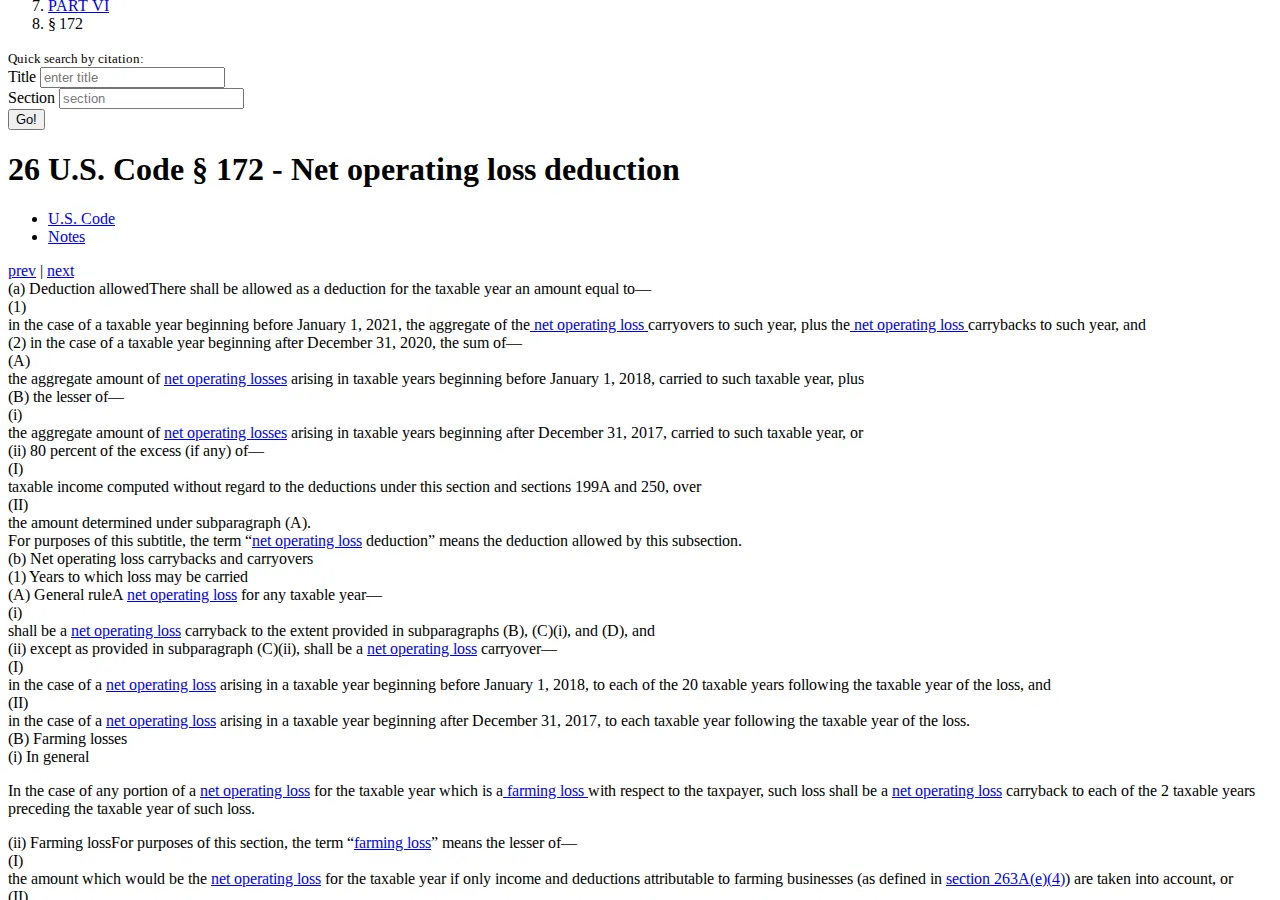
For a noncorporate taxpayer, the NOL does not start with § 172. The loss passes four gates in order, and each gate can shrink it: the at-risk rules of § 465, the passive-activity rules of § 469, the excess business loss limit of § 461(l), and only then § 172. Section 461(l)(1) disallows a noncorporate taxpayer's business loss above a threshold — $256,000 for a single filer and $512,000 for a joint return for tax years beginning in 2026, under Rev. Proc. 2025-32, § 3.31, rising to $264,000 and $528,000 for 2027 under Rev. Proc. 2026-35, § 3.33. The One Big Beautiful Bill Act, Pub. L. 119-21, § 70601, made the limit permanent by striking its 2029 sunset and reset the inflation base year from 2017 to 2024, which is why the 2026 threshold is lower than the 2025 figure. Section 461(l)(2) then treats the disallowed amount as a net operating loss for the taxable year for purposes of § 172(b) carryovers.
Worked example: a single filer with $400,000 of business deductions and $50,000 of business income in 2026 has a $350,000 net business loss. The § 461(l) threshold is $256,000, so the excess is:
The $94,000 is disallowed for 2026 and becomes an NOL carryforward. In 2027 it can shelter at most 80% of taxable income — on $200,000 of 2027 income, the deduction is capped at $160,000, so the $94,000 is fully usable and $106,000 of income is still taxed. The same loss that § 461(l) pushed forward is then throttled again by § 172. Run the sequence through the tax estimator before year-end: a $50,000 invoice collected in December instead of January can move the loss across the threshold and change the carryforward by the full amount.
Carryback: the door that mostly closed
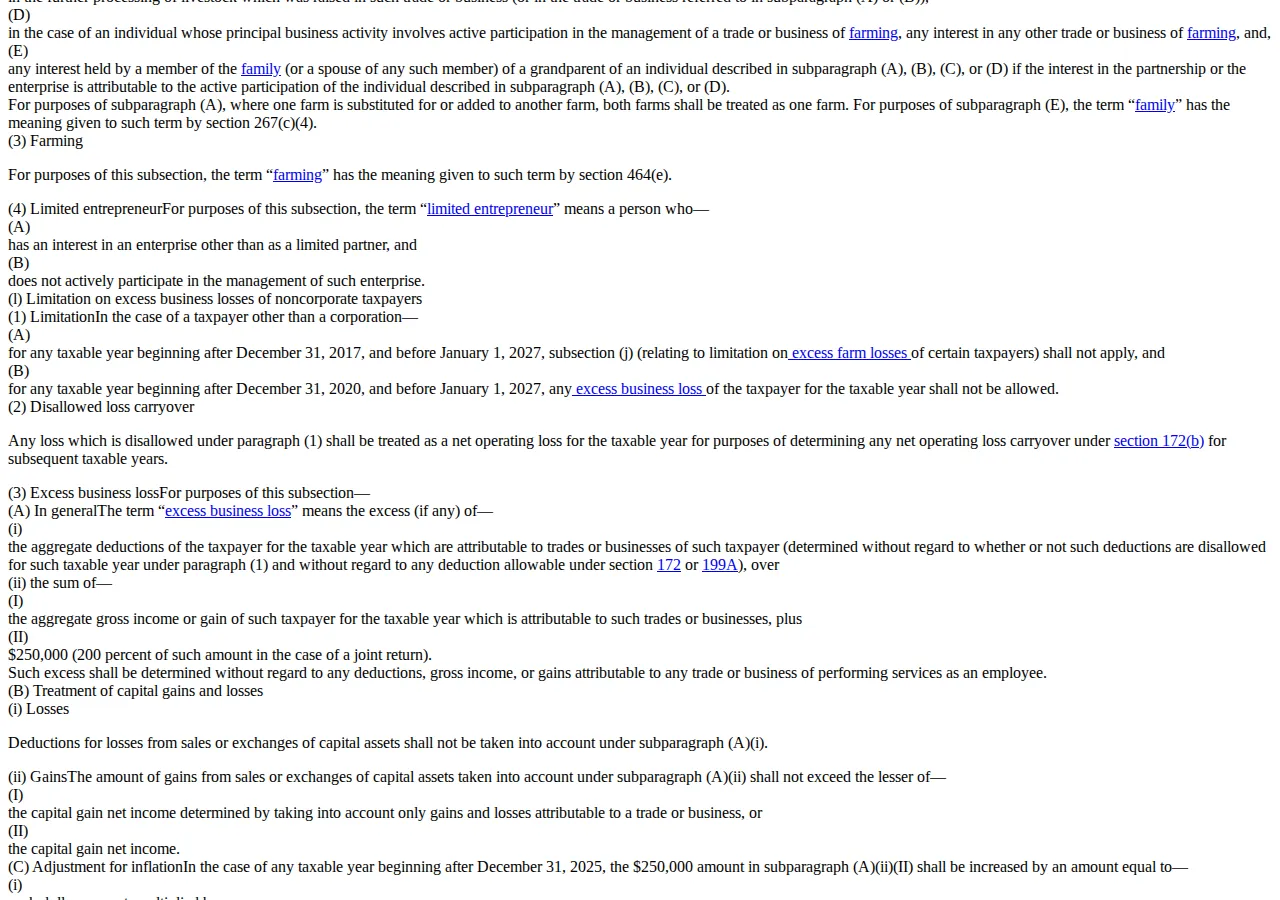
For losses arising after 2020, there is generally no carryback. The exceptions are narrow and they are the only ones: farming losses carry back 2 years under § 172(b)(1)(B), and certain insurance-company losses carry back 2 years under § 172(b)(1)(C). Everything else goes forward only. The CARES Act opened a temporary window — losses arising in 2018, 2019, and 2020 could be carried back 5 years, and the 80% cap was suspended for tax years beginning before 2021 — but that window is closed, and a 2021-or-later loss cannot use it. A taxpayer who still holds an unused 2018–2020 loss should check whether the 5-year carryback was ever claimed; the refund claim for a carryback runs on Form 1045, Application for Tentative Refund, or on an amended return, and § 6411 requires the IRS to act on a Form 1045 application within 90 days.
Section 172(b)(3) lets a taxpayer elect to waive the carryback period entirely and carry the loss forward only. The election must be made by the due date, including extensions, of the return for the loss year, and once made it is irrevocable for that year. Waiving is the right call when the carryback years were taxed at low rates — a loss carried back to a 12% year recovers 12 cents on the dollar, while the same loss carried forward against a 21% corporate rate or a 37% individual bracket recovers far more. The election is also the only way to keep a farming loss out of a low-rate year.
| Choice | Best when | Cost | Authority |
|---|---|---|---|
| Carry back | Carryback years were high-rate; cash is needed now | Refund capped at tax actually paid in those years | § 172(b)(1), § 6411 |
| Carry forward | Future rates are higher; carryback years were low-rate | 80% cap leaves 20% of income exposed every year | § 172(a)(2), (b)(1)(A)(ii)(II) |
| Waive the carryback | Farming loss that would land in a low-rate year | Irrevocable once made | § 172(b)(3) |
What OBBBA changed around the NOL
The One Big Beautiful Bill Act did not change § 172's 80% cap or its indefinite carryforward, but it changed three things that feed NOLs. First, § 461(l) is now permanent, as above, so the excess-business-loss-to-NOL pipeline is a standing feature rather than a provision expiring in 2029. Second, 100% bonus depreciation is permanent for qualifying property acquired after January 19, 2025, which means a capital purchase can create an NOL in the year of acquisition — the deduction is real, and so is the loss it generates. Third, OBBBA amended § 170(b)(2) to impose a 1% floor on corporate charitable contribution deductions for tax years beginning after December 31, 2025: a corporation may deduct contributions only to the extent they exceed 1% of taxable income, and the floor interacts with the 80% NOL limit in a way that can reduce the NOL carryover by more than the NOL deduction actually used. A C-Corp that gives generously in a loss year should model the § 170 floor and the § 172 cap together, not separately.
The § 199A QBI deduction playbook matters here for a mechanical reason: § 172(a)(2)(B)(ii) computes the 80% cap on taxable income without regard to the § 199A deduction, so a QBI deduction does not shrink the cap — but the NOL deduction itself reduces the qualified business income that § 199A is computed on, which can shrink the QBI deduction in the year the NOL is used. The two deductions interact in both directions, and the return should be modelled with both.
Founder & CEO Insight — Enow A. Jovial
Execution checklist
- [x] Step 1: Figure the loss in the loss year. Complete Form 172 for an individual, estate, or trust; a C-Corp figures the NOL on Form 1120. Keep the computation, the return, and the supporting schedules.
- [x] Step 2: Run the gates in order. Apply § 465 at-risk, § 469 passive-activity, and § 461(l) excess business loss limits before § 172. Record how much each gate disallowed.
- [x] Step 3: Decide carryback vs carryforward before the return's due date. If a carryback applies — farming, insurance, or a leftover 2018–2020 loss — decide whether to claim it or waive it under § 172(b)(3). The waiver is irrevocable.
- [x] Step 4: Apply the 80% cap every year the loss is used. Compute taxable income without §§ 172, 199A, and 250, take 80%, and use the lesser of the NOL or the cap. Track the remaining carryforward on a running schedule.
- [x] Step 5: Check § 382 after any ownership change. A 50-percentage-point shift in ownership caps annual NOL use at the company's value times the long-term tax-exempt rate — a second cap on top of the 80% cap.
- [x] Step 6: Retain the record until the carryforward is exhausted plus three years. The IRS can examine the loss year when the carryforward is claimed, even if the loss year's own limitation period has closed.