IRS Form 1040 Schedule D Capital Gains Playbook: Netting, 28% Collectibles, 25% Section 1250, and the $3,000 Loss Limit
Schedule D turns brokerage statements into one number on your return. Every stock sale, crypto disposal, rental property exit, and K-1 capital gain passes through it. The form is twenty-one lines and does three jobs: sort by holding period, net in a fixed order, and route the survivor to the correct maximum rate. Get the order wrong and you pay the wrong rate on the wrong dollars.
What Schedule D does, and who must file it
You file Schedule D when you sold a capital asset, carry a capital loss forward, or receive capital gain or loss on a Schedule K-1. Gain or loss is sale price minus basis, minus selling costs. Basis is what you paid plus improvements; the IRS receives the sale price on Form 1099-B, so a missing basis invites a notice. A broker reports under your SSN or ITIN, a business entity under its EIN. Schedule D feeds Form 1040, line 7.
> [!KEY TAKEAWAY]
> Schedule D sorts first, nets second, and taxes third. Holding period decides the bucket, netting decides what survives, and the rate stack decides what you owe. Never compute tax on a gain before netting is finished.
The map of the form: Parts I, II, and III
Part I covers short-term transactions, Part II long-term ones, and Part III combines the halves and applies the special rates and the loss limit. Transactions go on Schedule D lines 1a and 8a when basis was reported to the IRS, or through Form 8949 for everything else. Form 8949 is the detail sheet; Schedule D carries only subtotals. Line 7 ends Part I, line 15 ends Part II, and line 16 combines them. Line 18 holds 28 percent rate gain, line 19 unrecaptured section 1250 gain, and line 21 caps the deductible loss. Part III ends with the tax computation, usually on the Schedule D Tax Worksheet or the Qualified Dividends and Capital Gain Tax Worksheet.
The holding period rule: one year is the wall
Section 1222 draws the line. A short-term gain or loss comes from a capital asset held for not more than one year. A long-term gain or loss comes from one held for more than one year. Buy on March 4, 2025, sell on March 4, 2026, and you held the asset exactly one year, which is not more than one year, so the gain is short-term. Sell on March 5, 2026, and it is long-term. Wash-sale timing belongs to our companion guide on tax-loss harvesting and the wash-sale rule.
The netting order: the step everyone skips
Netting is mandatory. First, net short-term gains against short-term losses inside Part I. Second, net long-term gains against long-term losses inside Part II. Third, combine the two nets on line 16. If the two nets have opposite signs, they offset, and the survivor keeps the larger side character. A net short-term loss of 9,000 dollars against a net long-term gain of 14,000 dollars leaves a net long-term gain of 5,000 dollars. You cannot choose which gain a loss offsets.
> [!WARNING]
> Never net across the wall by hand. A long-term loss does not cancel a short-term gain inside Part I, and a short-term loss does not cancel a long-term gain inside Part II.
The rate stack: 0, 15, 20, 25, and 28 percent
Section 1(h) sets the maximum rates on net capital gain; 2026 breakpoints come from Revenue Procedure 2025-32. A single filer pays 0 percent to 49,450 dollars of taxable income, 15 percent to 545,500 dollars, and 20 percent above that. Joint filers: 0 percent to 98,900 dollars, 15 percent to 613,700 dollars. Heads of household: 66,200 and 579,600 dollars. Separate filers: 49,450 and 306,850 dollars. Estates and trusts: 3,300 and 16,250 dollars. Thresholds apply to taxable income, and ordinary income fills the bottom of the brackets first. Preferential rates apply only to net capital gain: net long-term gain minus net short-term loss. Collectibles gain is capped at 28 percent and unrecaptured section 1250 gain at 25 percent. Both are maximums, not flat rates.
Worked example: a mixed year, netted and taxed
Maya, a single filer, trades a brokerage account in 2026 under her SSN. She buys 200 shares of a C-Corp on March 4, 2025 for 18,000 dollars and sells them on January 15, 2026 for 30,000 dollars, a short-term gain of 12,000 dollars. A second short-term position loses 4,000 dollars. She buys land on June 10, 2024 for 50,000 dollars and sells it on February 20, 2026 for 80,000 dollars, a long-term gain of 30,000 dollars. A long-term bond fund loses 6,000 dollars. Her other taxable income is 28,000 dollars, so total taxable income is 60,000 dollars; her AGI adds the net capital gain below. She uses FIFO lot selection. The netting:
$
\text{Net short-term gain} = 12{,}000 - 4{,}000 = 8{,}000
$
$
\text{Net long-term gain} = 30{,}000 - 6{,}000 = 24{,}000
$
$
\text{Line 16 net capital gain} = 8{,}000 + 24{,}000 = 32{,}000
$
$
\text{Room in the 0\% bracket} = 49{,}450 - 28{,}000 = 21{,}450
$
$
\text{Gain taxed at 15\%} = 24{,}000 - 21{,}450 = 2{,}550
$
$
\text{Tax on long-term gain} = 2{,}550 \times 0.15 = 382.50
$
Maya owes 382.50 dollars of tax on 24,000 dollars of long-term gain, most of it inside the 0 percent bracket. The 8,000 dollars of net short-term gain is taxed at ordinary rates. Had she held the first position one day longer, that 12,000 dollar gain would have been long-term.
The 28 percent collectibles rate
Section 1(h)(4) defines 28 percent rate gain as collectibles gain plus section 1202 gain, minus collectibles loss, net short-term loss, and long-term loss carried forward. Section 408(m) collectibles include art, antiques, metals, gems, stamps, coins, and alcohol held more than one year. A collector who sells gold coins held three years for a 10,000 dollar gain, with no offsetting losses, owes at most 10,000 dollars times 28 percent, or 2,800 dollars. The same gain as plain long-term stock gain would cost 1,500 dollars at 15 percent, a 1,300 dollar difference. Keep the purchase invoice: a dealer statement often reports proceeds without basis.
The 25 percent unrecaptured section 1250 gain
Unrecaptured section 1250 gain is the part of the gain on the sale of depreciable real property that represents depreciation already deducted, up to the total gain. Section 1(h)(1)(E) caps the tax on it at 25 percent, computed on the line 19 worksheet. A landlord who sells a rental property for a 100,000 dollar gain, of which 40,000 dollars is unrecaptured section 1250 gain, owes at most 40,000 dollars times 25 percent, or 10,000 dollars, on that slice, while the remaining 60,000 dollars is taxed at the ordinary long-term rates.
> [!TIP]
> Before you sell a rental property, ask your CPA for accumulated depreciation and run the line 19 worksheet on a draft basis. The slice is fixed by history, not by negotiation.
The 3,000 dollar loss limit and the carryforward
Section 1211(b) sets the annual limit: capital losses are deductible only up to capital gains plus 3,000 dollars, or 1,500 dollars married filing separately. Publication 550 states it as the lesser of 3,000 dollars or total net loss on line 16. Section 1212(b) carries it forward, keeping its short-term or long-term character, year after year until used. There is no expiry date on an individual capital loss carryforward. It dies with the taxpayer: an unused capital loss generally does not transfer to the estate or heirs. Daniel, a single filer, has an 18,000 dollar net short-term loss and a 5,000 dollar net long-term gain in 2026:
$
\text{Net capital loss} = 18{,}000 - 5{,}000 = 13{,}000
$
$
\text{Deducted in 2026} = \min(13{,}000,\ 3{,}000) = 3{,}000
$
$
\text{Carryforward to 2027} = 13{,}000 - 3{,}000 = 10{,}000\ \text{(short-term)}
$
Daniel deducts 3,000 dollars in 2026 and carries 10,000 dollars of short-term loss into 2027, where it offsets 2027 gains first. The Capital Loss Carryover Worksheet preserves the character split. If Daniel files separately from his spouse, the 2026 deduction is 1,500 dollars and the carryforward is 11,500 dollars.
Where the paper lands: 1099-B, 1099-K, and K-1
Form 1099-B is the starting point for most taxpayers. Your broker reports each sale with proceeds, and usually basis and holding period when the security is covered. Noncovered, inherited, and gifted shares often arrive with basis missing, and the taxpayer must supply it. When basis was reported to the IRS, summarize directly on Schedule D lines 1a or 8a; otherwise use Form 8949. Wash-sale adjustments, marked code W on Form 8949, belong to the harvesting guide linked above and must be entered before netting begins. Form 1099-K reports payment card and third-party network transactions. It creates Schedule D work when the underlying sale was a capital asset. A loss on personal-use property reported on a 1099-K is generally not deductible, though the transaction must still be reported, with the loss coded out on Form 8949.
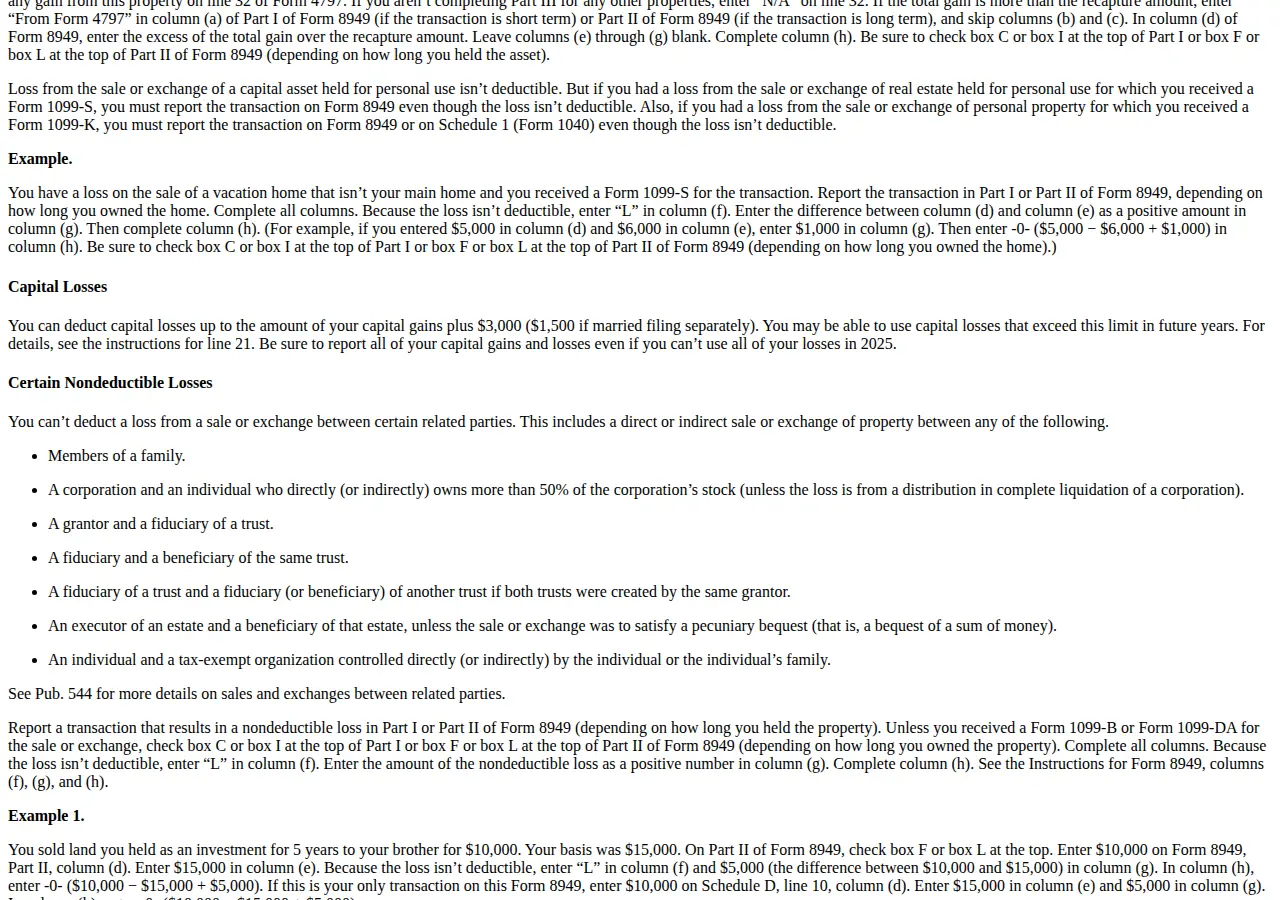
!IRS Instructions for Schedule D: a loss on personal-use property reported on Form 1099-K must still be reported on Form 8949 even though the loss is not deductible, and capital losses are capped at 3,000 dollars A Schedule K-1 from a partnership, S corporation, estate, or trust carries capital gain or loss into your return. Short-term and long-term amounts arrive separately and enter through lines 5 and 12. A K-1 also carries the 28 percent rate gain and unrecaptured section 1250 gain figures to lines 18 and 19. Do not re-derive the entity figures yourself; the K-1 is the authority. An LLC taxed as a partnership issues a K-1; one taxed as a C-Corp does not, and its distributions arrive as dividends. An S-Corp also issues a K-1.
Decision table: which rate, which line, which authority
| Situation | Schedule D treatment | Maximum rate | Authority |
|---|---|---|---|
| Held one year or less | Part I, line 7, ordinary income | Ordinary marginal rate | 26 U.S.C. section 1222, section 1(h) |
| Held more than one year | Part II, line 15, then line 16 | 0, 15, or 20 percent | 26 U.S.C. section 1(h), Rev. Proc. 2025-32 |
| Collectibles, held over one year | Line 18 worksheet | 28 percent | 26 U.S.C. section 1(h)(4), section 408(m) |
| Depreciated real property | Line 19 worksheet | 25 percent | 26 U.S.C. section 1(h)(1)(E), section 1250 |
| Net capital loss, individual | Line 21 caps deduction at 3,000 dollars | Deduction limit, not a rate | 26 U.S.C. section 1211(b), section 1212(b) |
| Net loss, married filing separately | Line 21 caps deduction at 1,500 dollars | Deduction limit, not a rate | 26 U.S.C. section 1211(b), IRS Publication 550 |
| K-1 gain or loss | Lines 5 and 12, then 18 and 19 | Follows the character on the K-1 | Schedule D instructions; IRS Publication 550 |
| Personal-use loss on 1099-K | Form 8949, nondeductible, coded out | No deduction allowed | Schedule D instructions |
Execution checklist: complete Schedule D in order
1. Gather every Form 1099-B, every Form 1099-K that reflects a capital sale, and every Schedule K-1, and match each to a sale in your records.
2. List every sale on Form 8949, Part I short-term and Part II long-term, with dates, proceeds, basis, and adjustment codes, and verify the holding period on each row.
3. Carry Form 8949 subtotals and directly reported lines 1a and 8a transactions into Schedule D, and add K-1 amounts on lines 5 and 12.
4. Net Part I to line 7 and Part II to line 15, combine them on line 16, and confirm the sign of each figure.
5. Complete the line 18 worksheet if you sold collectibles or qualified small business stock, and the line 19 worksheet if you sold depreciated real property.
6. If line 16 is a loss, apply the line 21 limit of 3,000 dollars, or 1,500 dollars if married filing separately, and record the carryforward for next year.
7. Use the tax worksheet the instructions direct, the Schedule D Tax Worksheet when lines 18 or 19 carry amounts, otherwise the Qualified Dividends and Capital Gain Tax Worksheet.
8. Carry the result to Form 1040, line 7, reconcile against your 1099-B proceeds, and keep the forms, basis records, and worksheets with the return for at least three years.
Who should NOT use this playbook
This playbook covers the individual return, Form 1040 with Schedule D. It does not cover a section 475 mark-to-market trader, a C-Corp return, where the 3,000 dollar limit does not exist, or section 1256 contracts, where a 60/40 split applies regardless of holding period. It does not cover a main-home sale, where the section 121 exclusion can remove up to 250,000 dollars of gain, or 500,000 dollars joint, before Schedule D sees it. It does not cover installment sales, like-kind exchanges, or qualified opportunity zone deferrals, and it does not replace a CPA for a return with AMT exposure. A sole proprietor should read the Schedule C companion guide on IRS Form 1040 Schedule C for the self-employed first. FIFO is the broker default; LIFO applies when you identify specific lots. GAAP books help keep basis straight, but GAAP does not set tax basis.
Common errors that cost real money
Report the sale without the basis, and a small gain becomes a large one. Net across Parts I and II by hand, and the character is misstated. Forget a prior-year carryforward, and a paid-for deduction is thrown away. Tax a collectibles gain at 15 percent, and you underpay. Treat a 1099-K as taxable income on a personal-use loss, and you overpay. Use the joint 98,900 dollar threshold on a single return, and the rate computation shifts.
> [!FOUNDER]
> Schedule D rewards the taxpayer who keeps records and punishes the one who reconstructs them. The money is in the basis file, the acquisition dates, and the carryforward worksheet from last year. Keep those three, and the form fills itself.
> — Enow A. Jovial, Founder & Chief Executive Officer
The bottom line
Holding period decides the bucket, netting decides what survives, the rate stack decides the tax, and the 3,000 dollar limit decides how much loss you may use this year. Model the numbers before you sell, keep the carryforward alive across years, and test the result in the tax estimator before you file.