IRS Form 1040 Schedule 2: Additional Taxes — The Operator's Playbook
Schedule 2 is where the return reckons what else you owe: the AMT, the self-employment tax, household employment taxes, premium credit repayment, the additional Medicare tax, the net investment income tax. One schedule, two totals, two lines on Form 1040. Get either total wrong and the return is wrong by that amount, plus interest.
One caution: as of November 7, 2026, the IRS has not posted the 2026 Schedule 2 form; the file served is still the 2025 edition. This guide follows the 2025 line structure with 2026 dollar amounts.
Who this is for, and who should stop
This playbook is for a noncorporate filer whose 2026 return carries at least one of these: self-employment income, a household employee paid $3,000 or more, advance premium tax credits, investment income with modified AGI above $200,000 single or $250,000 joint, or income large enough to need a real AMT computation.
Hand the return to a CPA if you are a C-Corp or an estate or trust, hold a deferred compensation plan that failed § 409A, are recapturing a low-income housing credit, or hold foreign tax credits interacting with the AMT. A sole proprietor with a disregarded-entity LLC, an S-Corp owner taking salary plus distributions, and a household employer are inside it.
> [!WARNING]
> Schedule 2 has no de minimis rule: a $367 additional Medicare tax and a $3,772 self-employment tax both reach Form 1040 line 23 in full. A blank small line understates the return, accruing interest from the original due date.
The authority frame: two totals, two lines
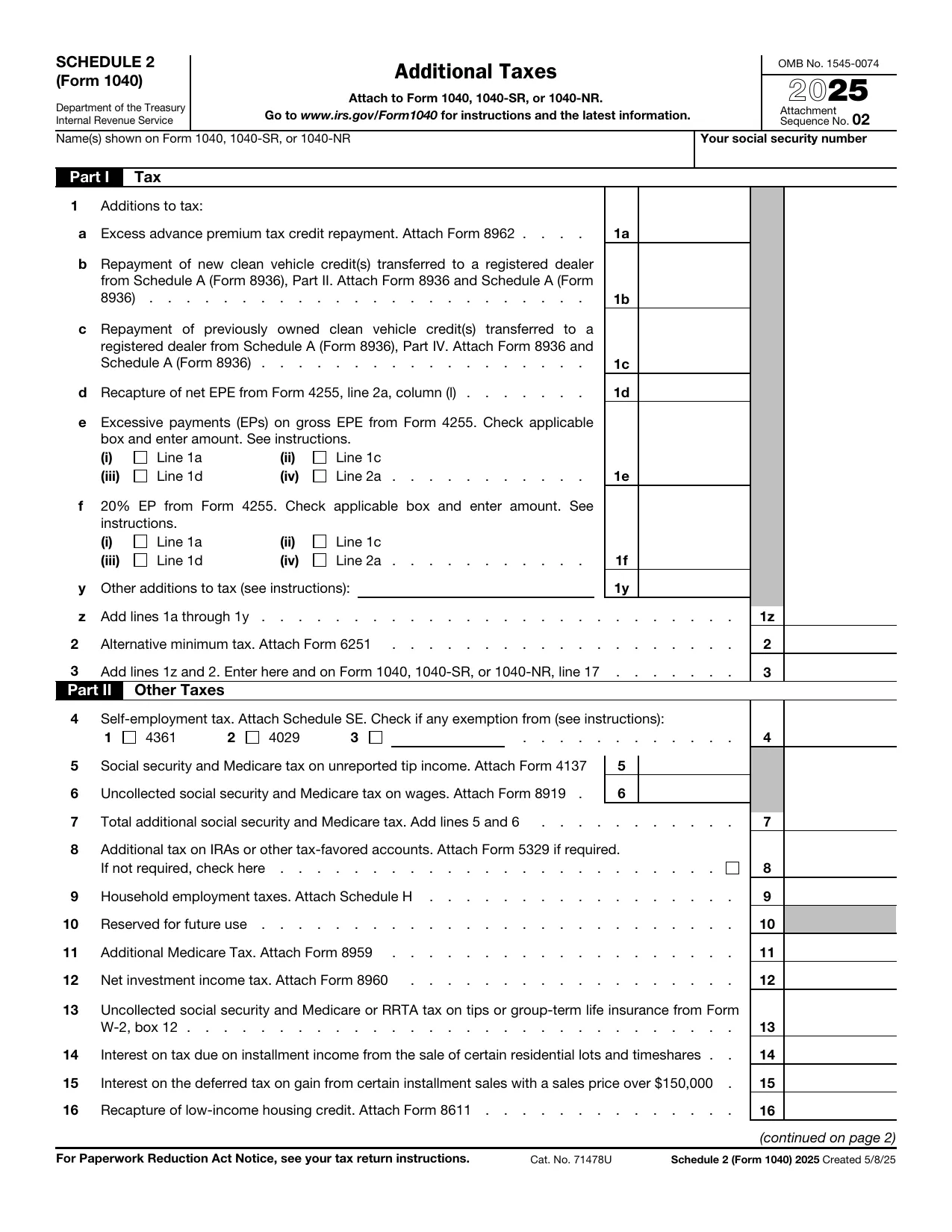
Part I collects additions to tax and the AMT; Part II collects the other taxes — one total each. The arithmetic is trivial; the routing is where returns break.
$
\text{Schedule 2, line 3} = \text{line 1z} + \text{line 2} \rightarrow \text{Form 1040, line 17}
$
$
\text{Schedule 2, line 21} = \text{line 4} + \text{line 7} + \text{lines 8-16} + \text{line 18} + \text{line 19} \rightarrow \text{Form 1040, line 23}
$
Line 1z sums lines 1a–1y; line 2 is the AMT from Form 6251. Line 21 adds line 4, the line 7 total, lines 8–16, line 18, and line 19 — but not line 3. Form 1040 line 17 takes Part I; line 23 takes Part II.
!Schedule 2 form, 2025 edition
> [!KEY TAKEAWAY]
> Only self-employment tax? You still file Schedule 2 — the only route that tax takes onto Form 1040.
Part I: additions to tax and the alternative minimum tax
Line 1a — excess advance premium tax credit repayment. If advance premium tax credit payments under § 36B exceed the credit you can claim, the excess increases your tax: "If the advance payments to a taxpayer ... exceed the credit allowed by this section ..., the tax imposed by this chapter for the taxable year shall be increased by the amount of such excess." Form 8962, line 29, gives the amount. For 2026 the repayment limitation was repealed by § 71305 of Pub. L. 119-21 (tax years beginning after December 31, 2025): the full excess is repaid, with no cap.
Lines 1b through 1f — clean vehicle credits and elective-pay recapture. Lines 1b and 1c repay new and previously owned clean vehicle credits transferred to a registered dealer when the buyer no longer qualifies, from Schedule A of Form 8936. Lines 1d through 1f recapture net elective payment amounts from Form 4255.
Line 1y — other additions to tax. The catch-all: recapture of the alternative fuel vehicle refueling property credit, excessive credit transfers under § 6418(g)(2), and any other addition the instructions list. Identify each item exactly as directed — "ARPCR", "6418(g)(2)".
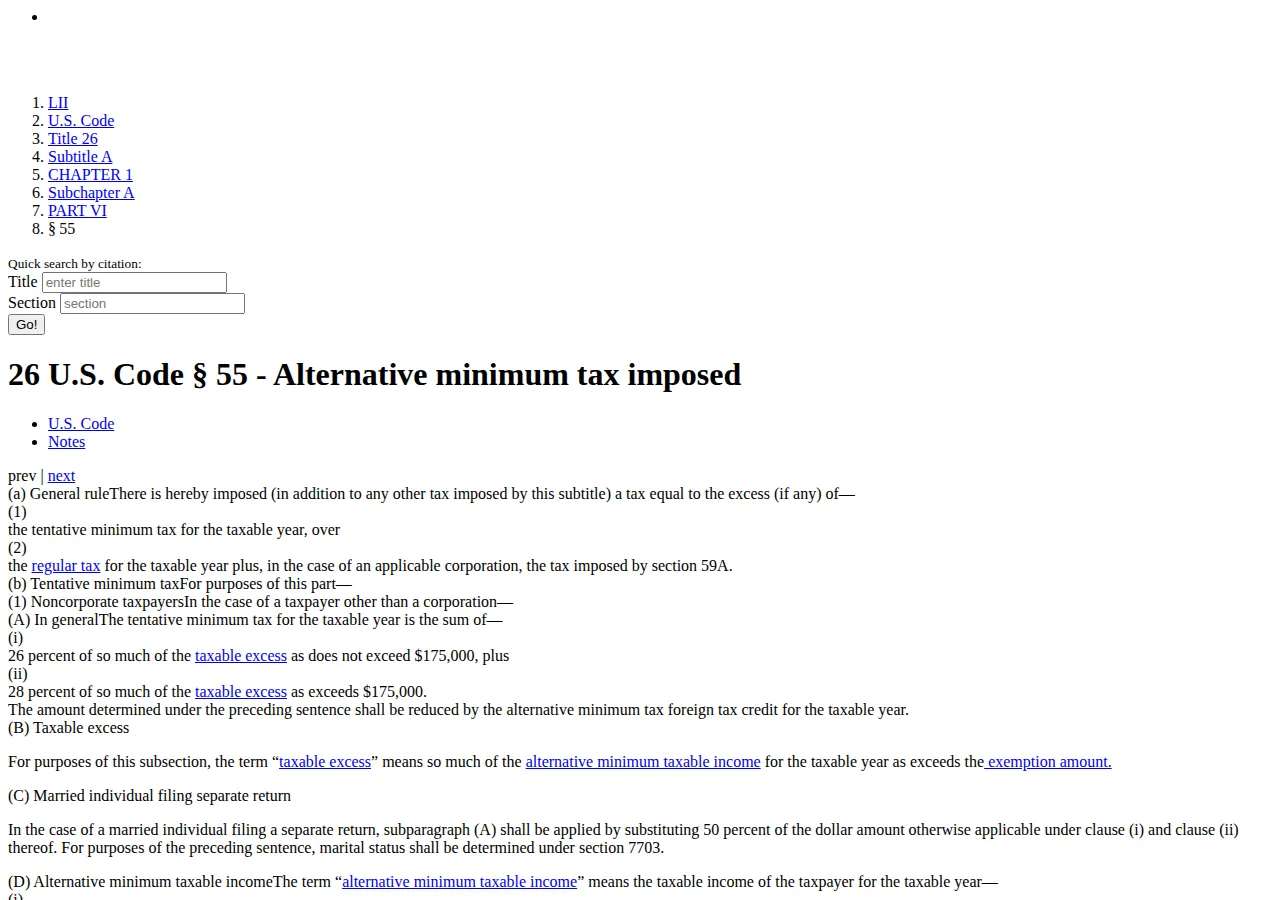
Line 2 — alternative minimum tax. Section 55(a) imposes "a tax equal to the excess (if any) of — (1) the tentative minimum tax for the taxable year, over (2) the regular tax for the taxable year." Tentative minimum tax is 26 percent of taxable excess up to the threshold and 28 percent above it, where taxable excess is AMTI less the exemption. For 2026, Rev. Proc. 2025-32 sets the exemption at $140,200 joint, $90,100 unmarried, and $70,100 married filing separately; the 28 percent rate starts at $244,500 of taxable excess ($122,250 married filing separately). The exemption phases out above $1,000,000 joint or $500,000 single and separate, and is fully gone at $1,280,400 joint, $680,200 single, and $640,200 separate — exactly twice the exemption above each threshold, so it shrinks by 50 cents per dollar in 2026.
Part II: the other taxes, line by line
Line 4 — self-employment tax. Section 1401 imposes 12.4 percent for Social Security and 2.9 percent for Medicare — the SECA tax, the self-employed counterpart to FICA. The base is not net profit: Schedule SE multiplies net profit by 92.35 percent first, matching the treatment of the employer share of FICA. The 12.4 percent portion stops at the $184,500 wage base for 2026, and W-2 wages use that base first; Medicare has no cap. One-half is deductible on Schedule 1, line 15.
Lines 5 through 7 — unreported and uncollected tax. Line 5 takes Form 4137 for unreported tips; line 6 takes Form 8919 for wages never withheld; line 7 is their sum. If an employer paid you on a 1099 for work that was really employment, Form 8919 puts the tax here.
Line 8 — additional tax on IRAs and other tax-favored accounts. Form 5329 computes the 10 percent additional tax on early distributions and excess contributions; otherwise check the box on line 8 and enter zero.
Line 9 — household employment taxes. The nanny tax, flowing from Schedule H. For 2026 the threshold is $3,000 of cash wages to any one household employee (Publication 926; 2025: $2,800). Pay $3,000 or more and you owe both shares of Social Security and Medicare, plus federal unemployment tax on the first $7,000. Schedule H line 26 is the total, and it goes on Schedule 2, line 9. Each share is 6.2 percent Social Security plus 1.45 percent Medicare; the unemployment tax is 6.0 percent less the 5.4 percent state credit, a net 0.6 percent. A household employee is not a contractor; the Schedule H household employment taxes playbook runs the household lane in full.
Line 11 — additional Medicare tax. The 0.9 percent additional tax under § 1401(b)(2) applies above $250,000 joint, $200,000 single, and $125,000 married filing separately, computed on Form 8959, not Schedule SE. Employers withhold it on wages above $200,000 regardless of filing status, so a joint return can be under-withheld even when the employer did everything right.
Line 12 — net investment income tax. Section 1411 imposes 3.8 percent on the lesser of net investment income or the excess of modified AGI over the threshold — $250,000 joint, $200,000 single, $125,000 married filing separately — computed on Form 8960, not indexed for inflation.
Lines 13 through 21 — the rest. Line 13 takes uncollected tax on tips or group-term life insurance from Form W-2, box 12; lines 14 and 15 are interest on installment-sale tax; line 16 recaptures the low-income housing credit. Line 17 collects the other additional taxes — credit and mortgage-subsidy recapture, the HSA additional tax, § 409A failures, golden parachute payments — line 18 totals them. Line 19 recaptures elective payment amounts, line 20 takes the § 965 installment, and line 21 is the Part II total for Form 1040, line 23.
!Section 55 tentative minimum tax rates
What is not on Schedule 2
Two items look like Schedule 2 taxes and are not.
The § 461(l) excess business loss. Section 461(l) limits a noncorporate taxpayer's deductible business losses to aggregate business income plus a threshold — $256,000 single and $512,000 joint for 2026, up from $313,000 and $626,000 for 2025. The disallowed amount is not a tax and does not appear on Schedule 2; it reduces the loss through Schedule 1 and carries forward as a net operating loss under § 172. § 70601 of Pub. L. 119-21 made the limit permanent for tax years beginning after December 31, 2026. With $800,000 of aggregate deductions and $150,000 of aggregate income, the $650,000 net loss exceeds the $512,000 joint threshold by $138,000, disallowed and carried forward — $800,000 − ($150,000 + $512,000) = $138,000.
Backup withholding under § 3406. Fail to furnish a correct taxpayer identification number and the payor must withhold at the fourth lowest rate under § 1(c) — 24 percent. It is claimed as a withholding credit on Form 1040, never computed on Schedule 2; the fix is a correct SSN or ITIN on Form W-9.
Worked example: one joint return, 2026
A married couple files jointly for 2026: one spouse earns $180,000 of W-2 wages; the other runs a consulting business as a single-member LLC with $120,000 of net profit on Schedule C. They earn $5,000 of interest, paid a household employee $12,000, and received $6,000 of advance premium tax credits against a $4,800 credit. They claim the standard deduction.
Self-employment tax. Net earnings: $120,000 × 92.35% = $110,820. The 2026 wage base is $184,500, and W-2 wages of $180,000 have used all but $4,500 of it, so the 12.4 percent portion applies to $4,500 only: $4,500 × 12.4% = $558.00. Medicare: $110,820 × 2.9% = $3,213.78. Total $3,771.78, rounded to $3,772, on line 4; one-half ($1,886) is the Schedule 1, line 15 adjustment.
Additional Medicare tax. Medicare wages ($180,000) plus self-employment income ($110,820) total $290,820; above the $250,000 joint threshold, $40,820 is exposed at 0.9 percent: $40,820 × 0.9% = $367.38, rounded to $367, on line 11.
Household employment taxes. Social Security on $12,000 at 12.4 percent is $1,488 ($744 each side); Medicare at 2.9 percent is $348 ($174 each side). Federal unemployment tax is 0.6 percent on the first $7,000, or $42. Schedule H line 26 totals $1,836 + $42 = $1,878, on line 9.
AGI and regular tax. Gross income: $180,000 + $120,000 + $5,000 = $305,000; less one-half of the self-employment tax ($1,886), AGI is $303,114; less the $32,200 standard deduction, taxable income is $270,914. Regular tax: $35,932 on the first $211,400, plus 24 percent of the $59,514 above it ($14,283.36) — $50,215.36, rounded to $50,215.
Alternative minimum tax. AMTI is $303,114 — the standard deduction is not allowed for AMT. Less the $140,200 exemption, taxable excess is $162,914; 26 percent is $42,357.64, rounded to $42,358, less than the $50,215 regular tax, so AMT is $0 and line 2 is $0.
Excess premium tax credit. Advance payments of $6,000 against a $4,800 credit leave a $1,200 excess; for 2026 the repayment cap is repealed, so the full $1,200 is repaid on line 1a.
The two totals. Part I: line 1z $1,200, line 2 $0, line 3 $1,200 → Form 1040, line 17. Part II: lines 4, 11, and 9 are $3,772, $367, and $1,878; line 21 is $6,017 → Form 1040, line 23. Total: $1,200 + $6,017 = $7,217.
The lesson: only $4,500 of net earnings paid the 12.4 percent portion. Applying 15.3 percent to the full $110,820 overstates the tax by $13,184 — confirm the $3,772 in the tax estimator before you file.
> [!FOUNDER]
> "Schedule 2 punishes the filer who adds up the lines and trusts the total. The lines are easy; the routing is the return. Check which Form 1040 line each total feeds, check the wage base before multiplying by 12.4 percent, and check the AMT even when you are sure it is zero."
> — Enow A. Jovial, Founder & Chief Executive Officer
The decision table: which lines apply to you
| Situation | Schedule 2 lines | Authority |
| --- | --- | --- |
| Self-employed, no W-2 wages | Line 4 | § 1401; Schedule SE |
| Salary plus side business | Lines 4 and 11 | § 1401(b)(2); Form 8959 |
| Household employee, $3,000 or more | Line 9 | Schedule H; Pub. 926 |
| Marketplace plan, credits too high | Line 1a | § 36B(f)(2); Form 8962 |
| Investment income, MAGI over threshold | Line 12 | § 1411; Form 8960 |
The 5-step filing workflow
1. Assemble the feeder forms first. Complete Schedule C, Schedule SE, Schedule H, Form 8962, Form 8959, Form 8960, and Form 6251 before you touch Schedule 2 — it adds totals, nothing more. The Schedule 1 playbook runs the lines and adjustments that set AGI, and the Schedule C profit-and-loss playbook runs the net profit Schedule SE starts from.
2. Compute the AMT even if you expect zero. Complete Form 6251; enter any excess on line 2.
3. Coordinate the wage base. Enter W-2 wages on Schedule SE line 8a before multiplying anything by 12.4 percent.
4. Reconcile the Marketplace plan. Complete Form 8962 from Form 1095-A; enter the line 29 excess on line 1a. For 2026 there is no repayment cap.
5. Route the two totals separately. Line 3 goes to Form 1040, line 17; line 21 to line 23. Read both back before filing.
Execution checklist
The identifiers paragraph
A Schedule 2 return is an identifiers return: the SSN or ITIN must match the Social Security Administration record, or the refund freezes. The EIN identifies the business on Schedule C and the household employer account on Schedule H; the two are not interchangeable. An S-Corp owner reports salary on a W-2 and distributions on Schedule K-1; only the salary uses up the wage base. A C-Corp owner is an employee for FICA purposes. A CPA preparer signs and enters a Preparer Tax Identification Number; the engagement letter should state whether the fee covers the AMT computation and the Form 8962 reconciliation. Under GAAP the books record the self-employment tax as a draw against owner equity, not a business expense — which is why the one-half deduction is an adjustment on Schedule 1, never a Schedule C expense.
> [!TIP]
> File Schedule H with the return even if you owe no income tax; filing it by itself by April 15, 2027 covers the 2026 year for a household employer not otherwise required to file.