A foreign fund can pay you the same dividend three years running, and the fourth payment can cost more tax than the first three combined. That is IRC § 1291, the default regime for a U.S. shareholder of a passive foreign investment company (PFIC) who has made no election: it reaches back across your entire holding period, spreads the excess over every day you held the stock, taxes each year's slice at the highest rate for that year, and charges interest on the tax it says you deferred.
This playbook works the operation end to end: the 125% test, the ratable allocation, the highest-rate tax, the interest charge, and the QEF, mark-to-market and deemed-sale escape hatches, with the Form 8621 lines where each number lands.
1. Who § 1291 applies to: the PFIC and the section 1291 fund
A PFIC is a foreign corporation that meets either test in IRC § 1297(a): 75 percent or more of its gross income for the taxable year is passive income — largely FDAP-type income: dividends, interest, rents and royalties — or at least 50 percent of the average percentage of its assets produce passive income or are held to produce it. A U.S. person owning such stock is a PFIC shareholder, reported on Form 8621.
A "section 1291 fund" is a PFIC for which the shareholder has made neither a QEF election under § 1295 nor a mark-to-market election under § 1296 — the default bucket, where most shareholders land by inaction: no PFIC Annual Information Statement ever arrives, no election is ever made, and § 1291 first surfaces in the year a distribution trips the test. Our editorial analysis found the most common PFIC failure is assuming a foreign fund's dividend is taxed like a domestic qualified dividend. Under § 1291 it is not: the excess portion is ordinary income, allocated backwards, taxed at the highest rate for each prior year. The regime switches off where the company is a QEF for every PFIC year in the holding period, or where a § 1296(k) mark-to-market election is in effect (§ 1291(d)(1)) — the escape hatches in section 7.
2. The 125% test: when a distribution becomes "excess"
Section 1291(b)(2)(A) defines the total excess distribution as the excess, if any, of (i) the distributions received during the taxable year over (ii) 125 percent of the average received during the 3 preceding taxable years — or, if shorter, the portion of the holding period before the taxable year. The comparison is against your own distribution history for that stock: steady payers build a high baseline, light payers a low one. An excess distribution received during the 3-year period counts toward the average only to the extent it was included in gross income under § 1291(a)(1)(B), so one large year cannot inflate the average and shield the next.
Section 1291(b)(2)(B) adds a hard floor: the total excess distribution is zero for the year in which the holding period begins. A first-year distribution, however large, is never excess; it is taxed under § 301 — the Form 8621 instructions carry the same rule into Part V, line 15a.
Worked example 1 — the boundary. A shareholder received $8,000 in 2022, $10,000 in 2023 and $12,000 in 2024: a $10,000 average, a $12,500 threshold. A 2025 distribution of $12,000 produces no excess — it is below the threshold, so the whole amount is taxed under § 301. A 2025 distribution of $40,000 produces a total excess of $27,500.
The test is computed share by share under § 1291(b)(3)(A), with adjustments for splits, annualization, prior-holder distributions, foreign-currency translation and § 959(a)/§ 1293(c) amounts.
3. Ratable allocation: the excess is spread over every day you held the stock
Once a total excess distribution exists, § 1291(a)(1)(A) allocates it ratably to each day in the holding period, which is treated as ending on the distribution date (§ 1291(a)(3)). Form 8621 lines 16a and 16b state the mechanics: divide the amount on line 15e(2) or 15f by the holding-period days, then add the daily amounts allocable to each tax year.
Only two slices enter gross income for the current year as ordinary income under § 1291(a)(1)(B): the amount allocated to the current year, and the amount allocated to any period before the first PFIC year beginning after December 31, 1986. Every other slice drives the deferred tax under § 1291(c).
Worked example 2 — the full computation. Same shareholder: 2025 distribution $40,000, total excess $27,500, stock acquired January 1, 2022, distribution December 31, 2025. Holding period 1,461 days (2024 is a leap year), so the daily allocation is $27,500 ÷ 1,461 ≈ $18.82 per day (the yearly figures below use the unrounded rate):
The $6,870.29 allocated to 2025 is ordinary income on the 2025 return. The $12,500 that is not excess — the 125% threshold amount — is taxed under § 301 as a dividend: on Form 8621, line 15e(1) takes the lesser of line 15a or line 15d, and for an individual that amount goes on Form 1040 line 3b.
4. The deferred tax amount: the highest rate, every year, plus interest
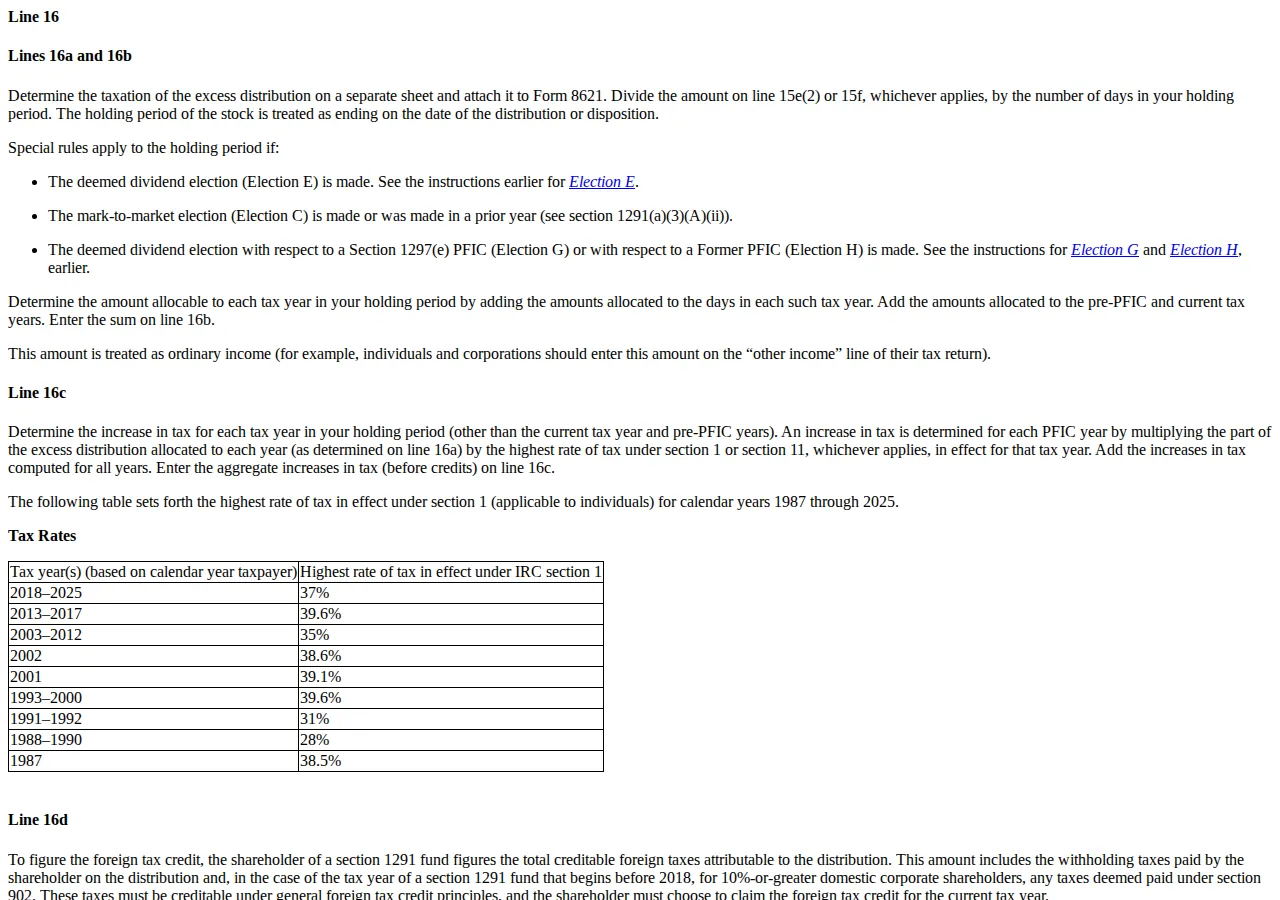
Section 1291(c)(2) sets the aggregate increase in tax: each amount allocated to a prior PFIC year is multiplied by the highest rate in effect for that year under § 1 (individuals) or § 11 (corporations), whichever applies — not the taxpayer's marginal rate, the highest rate. The instructions print the table of highest § 1 rates for 1987 through 2025 at line 16c: 37% for 2018–2025, 39.6% for 2013–2017 and 1993–2000.
All three prior years fall in the 37% band:
That $7,632.99 — the aggregate increase before credits and interest — goes on line 16c. The line 16e total is included on the return as additional taxes — for an individual, as part of the Form 1040 line 16 total, with box 3 checked and "1291TAX" entered.
Then comes the interest charge. Section 1291(c)(3)(A) charges interest on each year's increase from that year's due date to the distribution year's due date, at the § 6621 underpayment rates; the due date is determined without regard to extensions (§ 1291(c)(3)(B)). The instructions at line 16f repeat the rule and point to Revenue Ruling 2024-18 for historical § 6621 rates, and § 1291(c)(1) treats the interest portion as interest paid under § 6601.
No single rate can be printed here, because § 6621 underpayment rates are set quarterly; the correct figure for each year comes from the Revenue Ruling in force for that period.
5. Dispositions: gain is an excess distribution, loss is ignored
Section 1291(a)(2) applies the whole regime to dispositions: gain recognized on the sale of PFIC stock is treated as an excess distribution. The Form 8621 instructions at line 15f state the asymmetry bluntly — a loss on the disposition is not taken into account under § 1291 and does not reduce the gain subject to the regime. The loss may be recognized under another provision of the Code, but it never offsets the § 1291 gain. Stock is disposed of if it is sold, transferred, or pledged.
6. Form 8621 Part V: where every number lands
Part V of Form 8621 (revised December 2025) follows the statute in order. Line 15a takes total distributions for the year; 15b totals the prior three years; 15c divides 15b by 3, or by the number of preceding holding-period years if fewer than 3; 15d is 125% of 15c; 15e(1) is the nonexcess distribution — the lesser of 15a or 15d — taxed under § 301; and 15e(2) reports that amount in U.S. dollars, new in the December 2025 revision, which also requires a three-letter currency code above line 15a for foreign-currency distributions. Lines 16a and 16b perform the ratable allocation. Line 16c computes the aggregate increase. Line 16d figures the foreign tax credit: creditable foreign taxes are apportioned between the excess and nonexcess portions and allocated the same way as the distribution, reducing that year's increase but not below zero, with no carryover of unused excess-distribution taxes. Line 16e is the total increase in tax. Line 16f is the interest charge.
Who files. The U.S. shareholder files Form 8621 — an individual, an LLC, an S-Corp or a C-Corp alike — carrying the PFIC's EIN where it has one; a CPA should review the allocation before filing. Keep the worksheet, the instructions PDF and the FX rate with the workpapers.
Two filing facts matter beyond the arithmetic. First, a separate Form 8621 is filed for each PFIC held directly or indirectly — in a chain of ownership, one for each PFIC in the chain. Second, Part I is the annual information report required by § 1298(f), with an exception where the shareholder's aggregate PFIC stock is $25,000 or less — but that exception covers Part I reporting, not the § 1291 computation in Part V.
7. The three escape hatches — and what each one costs
| Route | How it works | What it costs | Authority |
|---|---|---|---|
| Default § 1291 fund | Excess distribution allocated ratably; highest rates plus § 6621 interest | Highest rates, interest, no capital-gain treatment | § 1291(a)–(c); Form 8621 Part V |
| QEF election (§ 1295) | Includes pro rata share of the PFIC's ordinary earnings and net capital gain each year | Needs the fund's PFIC Annual Information Statement; binds later years unless revoked with the Secretary's consent; late switch needs a purge election | § 1295; § 1291(d); Form 8621 Part II, D–E |
| Mark-to-market (§ 1296) | Include FMV minus basis each year as ordinary income; deduct declines up to unreversed inclusions | Marketable stock only; first-year coordination restarts the holding period | § 1296; § 1291(d)(1); Form 8621 Part II, Election C |
| Deemed-sale election (§ 1291(d)(2)) | On becoming a QEF, elect to recognize gain as if sold on the first day of the QEF year | The purging gain is itself taxed as an excess distribution | § 1291(d)(2)(A); Form 8621 Part II, Election D |
The QEF election is the cleanest exit, but only when the fund cooperates: § 1295(a) requires the company to meet the Secretary's requirements for determining ordinary earnings and net capital gain — in practice, the PFIC Annual Information Statement. The mark-to-market election is available only for marketable stock, and its first-year coordination restarts the holding period, so the pre-election years stay inside § 1291 until the stock is sold. The deemed-sale election purges the taint, but the purge itself is taxed as an excess distribution.
Run the computation in this order.
- Test the threshold. Three years of distributions per holding; 125 percent of the average.
- Allocate the excess. Total excess divided by holding-period days, spread ratably.
- Price each slice. Highest § 1 or § 11 rate for that year — 37 percent for 2018–2025.
- Charge the interest. § 6621 interest from each prior year's due date to the distribution year's.
- File Part V. Lines 15a–16f; line 16e total as additional tax with "1291TAX".
8. Execution checklist
- [x] Identify every foreign fund holding and test it against § 1297(a).
- [x] Confirm whether a QEF or mark-to-market election is in effect; if neither, it is a section 1291 fund.
- [x] Pull the last three years of distributions per holding and lot, and compute the 125% threshold before the current distribution arrives.
- [x] If the current distribution exceeds the threshold, compute the total excess and the daily allocation.
- [x] Apply the highest § 1 or § 11 rate for each prior PFIC year (37% for 2018–2025).
- [x] Compute the § 6621 interest for each prior year (Revenue Ruling 2024-18).
- [x] Complete Form 8621 Part V lines 15a–16f, report the line 16e total as additional tax with "1291TAX", and attach the allocation.
The reporting side — who must file Form 8621, the Part I annual information report, and the Part II election mechanics — is in the IRS Form 8621 PFIC reporting playbook. Foreign tax credits against the increase are claimed under the Form 1116 foreign tax credit playbook, and the parallel disclosure duty for the account holding the PFIC is in the Form 8938 FATCA reporting playbook. Before an exit trade, run the numbers through the tax estimator.
Founder & CEO Insight — Enow A. Jovial