Form 8938 is the return's foreign-asset schedule
Form 8938, Statement of Specified Foreign Financial Assets, is an attachment to your annual income tax return, required by 26 U.S.C. section 6038D. It exists because the Foreign Account Tax Compliance Act (FATCA), part of the HIRE Act, requires the IRS to see U.S. taxpayers' foreign assets directly. Section 1471 backs that reporting with a 30 percent withholding tax on withholdable payments to foreign financial institutions that do not report. The statute, added March 18, 2010, is short: an individual holding an interest in a specified foreign financial asset must attach the required information to the return "if the aggregate value of all such assets exceeds $50,000 (or such higher dollar amount as the Secretary may prescribe)."
> [!KEY TAKEAWAY]
> Form 8938 is a disclosure form, not a tax. It does not change what you owe on the income — it changes what the IRS can see, what it can penalize, and how long it can come back.
Who must file: specified persons only
The instructions open: "Unless an exception applies, you must file Form 8938 if you are a specified person that has an interest in specified foreign financial assets and the value of those assets is more than the applicable reporting threshold." A specified person is a specified individual or a specified domestic entity.
A specified individual is a U.S. citizen, a resident alien for any part of the tax year, a nonresident alien electing resident treatment to file jointly, or a nonresident alien bona fide resident of American Samoa or Puerto Rico — each files under an SSN, or an ITIN for a nonresident alien.
Specified domestic entities are the filer class founders miss: certain domestic corporations — a C-Corp or an S-Corp — partnerships, and trusts "formed or availed of for the purpose of holding specified foreign financial assets" must file under their EIN when the total exceeds $50,000 on the last day or $75,000 at any time. A closely held domestic corporation qualifies when at least 50 percent of its income or assets is passive.
The thresholds: two tests, four filer classes
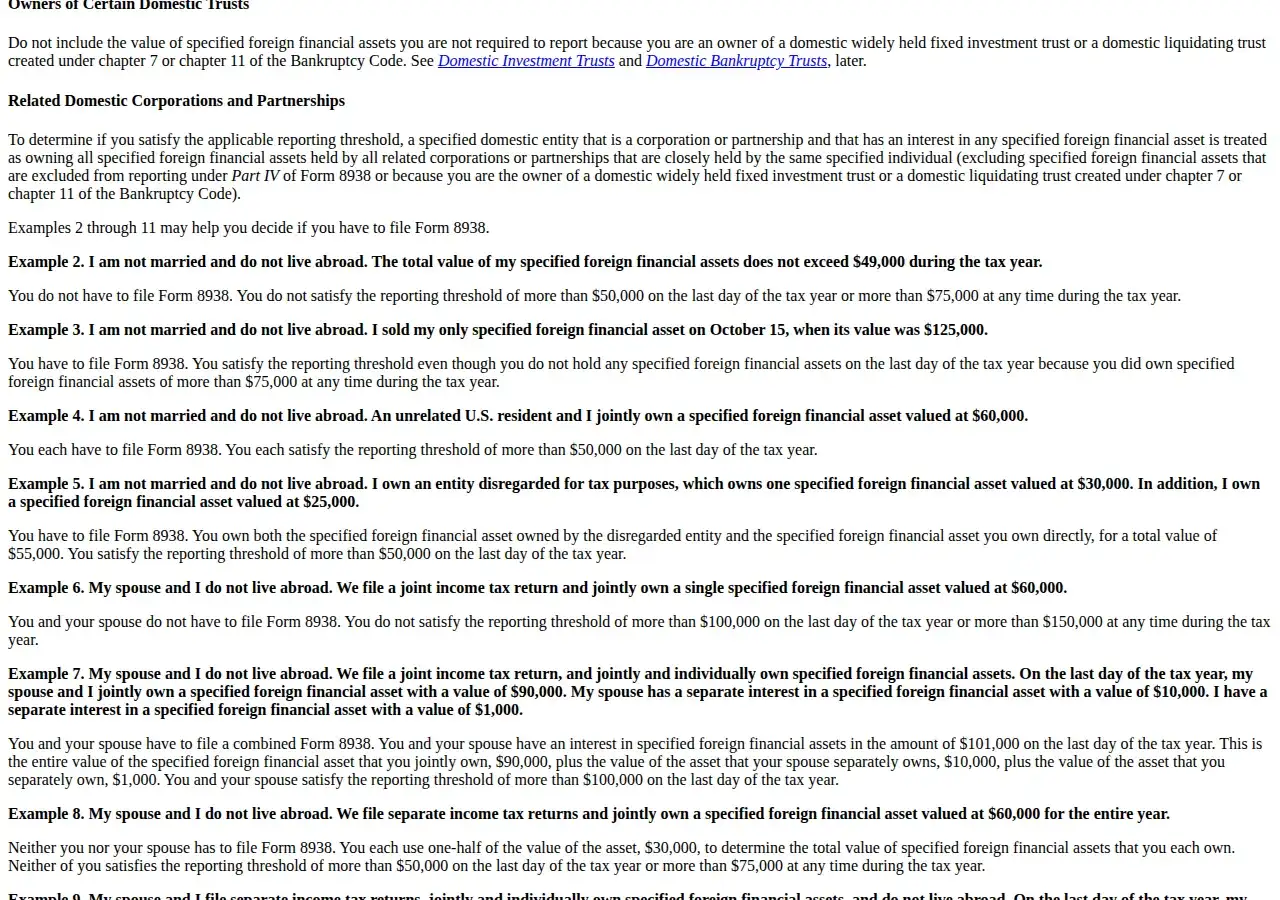
Every filer class faces two tests, and meeting either one triggers the form. A single U.S. filer with $62,000 on December 31 exceeds the $50,000 last-day threshold and must file; so must a filer whose balance touched $80,000 in June and fell to $40,000 by year-end.
| Filer class | Last day of tax year | At any time during tax year | Authority |
| :--- | :--- | :--- | :--- |
| Single, U.S. | More than $50,000 | More than $75,000 | IRS |
| Married jointly, U.S. | More than $100,000 | More than $150,000 | IRS |
| Married separately, U.S. | More than $50,000 | More than $75,000 | IRS |
| Single, abroad | More than $200,000 | More than $300,000 | IRS |
| Married jointly, abroad | More than $400,000 | More than $600,000 | IRS |
| Married separately, abroad | More than $200,000 | More than $300,000 | IRS |
| Specified domestic entity | More than $50,000 | More than $75,000 | IRS |
Married filing separately does not double the threshold, and "living abroad" means your tax home is in a foreign country.
!Form 8938 reporting thresholds
> [!TIP]
> Test the any-time threshold on monthly statements, not the December one — a mid-year spike is the filing trigger most filers miss.
What counts: the two statutory buckets
Section 6038D(b) defines a specified foreign financial asset in two buckets. Bucket one is any financial account maintained by a foreign financial institution. Bucket two is the assets held for investment outside any account: stock or securities issued by a non-U.S. person; any investment instrument or contract whose issuer or counterparty is not a U.S. person; and any interest in a foreign entity.
The instructions add swaps and similar agreements with a foreign counterparty.
| Asset | Specified foreign financial asset? | Where it is reported |
| :--- | :--- | :--- |
| Foreign bank deposit or custodial account | Yes | Part V |
| Foreign stock held directly, not in an account | Yes | Part VI |
| Foreign stock held inside a foreign account | Report the account only | Part V only |
| Capital or profits interest in a foreign partnership | Yes | Part VI |
| Foreign pension or deferred compensation interest | Yes, in Part VI | Do not separately report the plan's assets |
| U.S. mutual fund, IRA, 401(k), U.S. brokerage account | No — maintained by a U.S. payer | Not reported |
| Foreign social security equivalent | No | Not reported |
You have an interest in an asset if any income, gains, losses, deductions, credits, gross proceeds, or distributions from holding or disposing of it are or would be required to be reported on your return.
Valuing what you hold: maximum value, last-day rate
Every asset on Form 8938 is reported at its maximum value during the tax year, — in most cases, its fair market value. You may rely on periodic account statements unless you know they do not reflect a reasonable estimate of the maximum.
The maximum value is determined in the foreign currency first, then converted to U.S. dollars at the U.S. Treasury Bureau of the Fiscal Service rate for the last day of the tax year, even if you sold or disposed of the asset before then.
Joint ownership has two rules, and they point in different directions. For the threshold test, spouses filing separately count one-half of a jointly owned asset each — a 60,000 dollar joint asset is 30,000 dollars per spouse, which is why neither spouse files in the IRS's own Example 8; spouses filing jointly count the entire value once. Once the form is due, the reporting rule flips: each spouse filing separately reports the jointly owned asset on their own Form 8938 at the entire maximum value.
Form 8938 vs the FBAR: the decision table
Treating Form 8938 and the FBAR as the same filing is the costliest confusion. The IRS comparison page states it in one sentence: "The Form 8938 filing requirement does not replace or otherwise affect a taxpayer's obligation to file FinCEN Form 114 (Report of Foreign Bank and Financial Accounts)." Form 8938 is a Title 26 disclosure attached to your tax return and filed with the IRS; the FBAR is a Title 31 AML report filed with FinCEN through the BSA E-Filing System. Your foreign bank already identifies you under KYC rules and reports the account.
| Question | Form 8938 | FinCEN Form 114 (FBAR) | Authority |
| :--- | :--- | :--- | :--- |
| Who files | Specified individuals and specified domestic entities | U.S. persons | 26 U.S.C. § 6038D; 31 U.S.C. § 5314 |
| Threshold | $50,000–$600,000 by residence and filing status | Over $10,000 aggregate, at any time | IRS i8938; IRS comparison |
| Filed with | IRS, attached to the annual return | FinCEN, via BSA E-Filing System | IRS i8938; IRS comparison |
| Due date | Return due date, with extensions | April 15, automatic extension to October 15 | IRS i8938; IRS comparison |
| Signature authority only | No, unless you otherwise have an interest | Yes, subject to exceptions | IRS comparison |
| Account at a foreign branch of a U.S. institution | No | Yes | IRS comparison |
| Account at a U.S. branch of a foreign institution | No | No | IRS comparison |
| Foreign stock not held in an account | Yes | No | IRS comparison |
| Foreign partnership interest | Yes | No | IRS comparison |
The Schedule B playbook covers the third document in this chain: Part III of Schedule B asks the foreign-account questions that point toward both filings. The Form 5471 playbook covers the companion filing for U.S. persons with interests in certain foreign corporations and a foreign-owned single-member LLC.
The penalty math: 10,000 dollars, then the clock
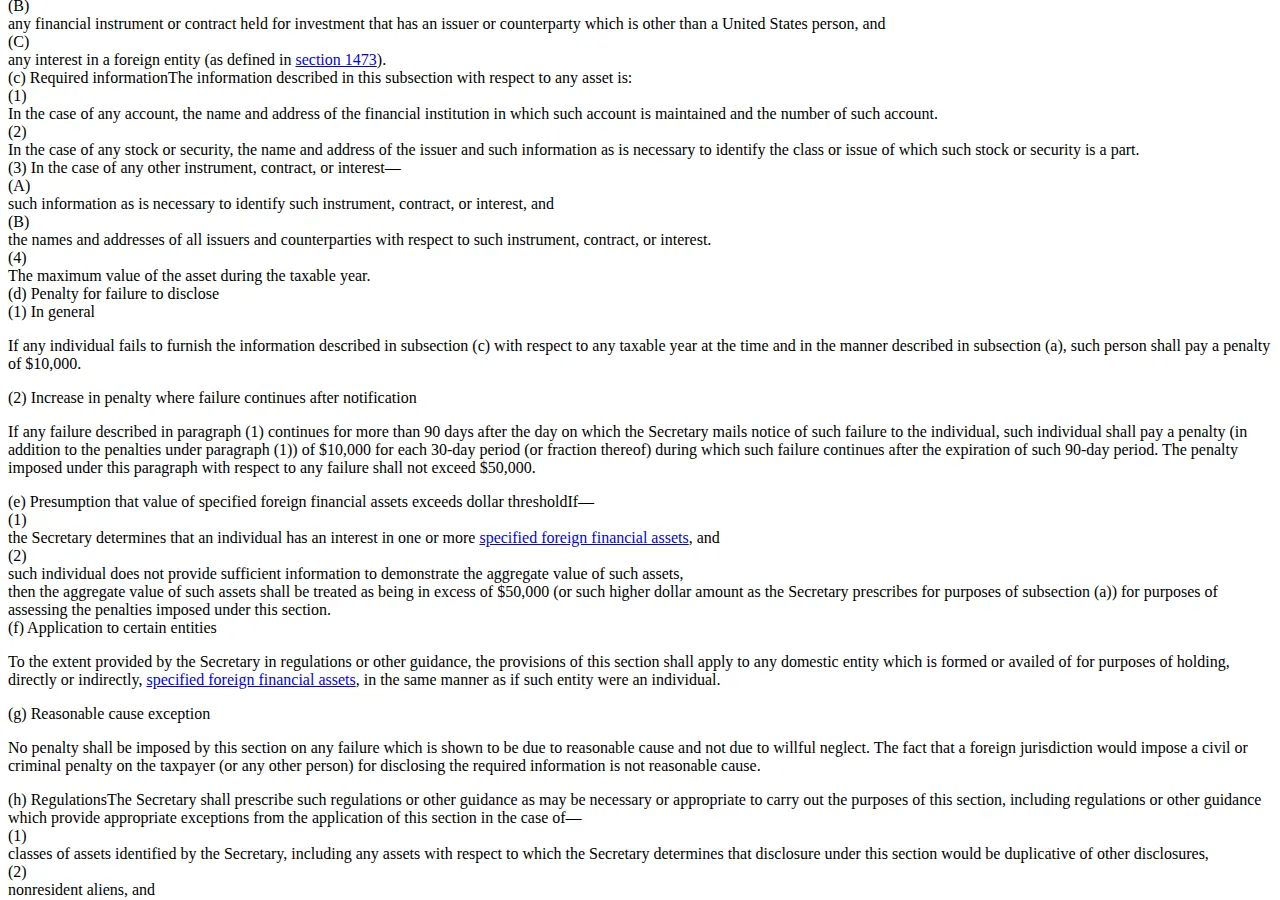
Section 6038D(d) sets the penalty in two parts. The first part is flat: fail to furnish the required information on time and in the required manner, and the penalty is $10,000. The second part is a clock that starts only after the IRS mails a notice of the failure. If the failure continues for more than 90 days after the notice is mailed, an additional $10,000 applies for each 30-day period, or fraction of one, during which the failure continues after the 90-day period expires — capped at $50,000 of additional penalty.
$
\text{Maximum Section 6038D Penalty} = \$10,000 + \min(\$10,000 \times \text{30-Day Periods}, \$50,000) = \$60,000
$
Counting from the notice date, the cap is reached 240 days after mailing — 90 days of grace, then 150 days of accrual.
$
\text{Days to Maximum Penalty} = 90 + (5 \times 30) = 240 \text{ days after IRS notice}
$
!Section 6038D(d) penalty text: 10,000 dollars, 10,000 dollars per 30 days, 50,000 dollar cap
> [!WARNING]
> The 90-day clock starts when the IRS mails the notice, not when you open it. Treat day 89 as the deadline.
Reasonable cause is the only exit: no penalty applies on a failure shown to be due to reasonable cause and not due to willful neglect. But foreign bank-secrecy law is not reasonable cause — the statute says so expressly.
Worked example: Amara in London
Amara is a U.S. citizen living in London, filing as single, with her tax home in the United Kingdom. She holds a deposit account with a London bank and shares in a German company held directly, outside any account. On December 31 her London account holds $40,000 and the German shares are worth $15,000.
Her living-abroad single threshold is more than $200,000 on the last day, or more than $300,000 at any time. Her $55,000 total sits $145,000 below the last-day threshold. She does not file Form 8938 for this year. Move the same facts to a single filer living in the United States and the answer flips: her $55,000 clears the $50,000 last-day threshold by $5,000, and the form is due.
Give the U.S.-based Amara a harder year: her London account peaked at $82,000 in March before falling to $40,000 by December 31, while the shares stayed at $15,000. Her last-day total is still $55,000; her any-time total is $97,000 — $82,000 plus $15,000 — which clears the $75,000 test as well. She reports the account at $82,000, its maximum, not the $40,000 year-end balance.
> [!FOUNDER]
> "The mistake I see founders make is treating Form 8938 as a tax form. It is a visibility form. The IRS does not care whether your London account earned twelve dollars of interest — it cares whether it can see the account at all. Build the inventory once, in a spreadsheet you update every December, and the form becomes ten minutes of copying. Skip the inventory and you are reconstructing years of maximum values under a penalty clock."
> — Enow A. Jovial, Founder & Chief Executive Officer
Who must not file: the boundaries
You do not file if you are not a specified person: a nonresident alien with no election to be treated as a resident, no U.S. return, and no bona fide residence in American Samoa or Puerto Rico is outside the form. You do not file if you have no income tax return due for the year, even with assets above the threshold. U.S.-payer accounts alone — the IRA, the 401(k), the U.S. brokerage account, the U.S. mutual fund — are not specified foreign financial assets.
You do not re-report an asset in Part V or Part VI if you reported it on a timely filed Form 3520, 3520-A, 5471, 8621, or 8865 for the same tax year; list the count in Part IV instead — but the asset's value still counts toward your threshold.
A foreign branch of a U.S. institution is not a foreign financial institution for Form 8938 purposes, so an account there is not an 8938 asset.
The filing sequence: ten steps, in order
1. Inventory every foreign account and asset, including signature-authority accounts.
2. Classify each item as a Part V account, a Part VI other asset, or not reportable.
3. Pull the maximum value of each item from periodic statements, using the 52-week high where it exceeds the year-end value.
4. Convert to dollars at the last-day rate — the Treasury Bureau of the Fiscal Service rate, or the rate on an annual account statement.
5. Add the totals and test both thresholds, counting one-half of a jointly owned asset for each spouse filing separately (the entire value if filing jointly).
6. Apply the duplicative-reporting exception: assets already reported on Forms 3520, 3520-A, 5471, 8621, or 8865 keep their value in the threshold total but move to Part IV counts.
7. Complete Part III first — the tax items attributable to the assets.
8. Complete Parts I and II summaries, then Parts V and VI detail for each account and asset.
9. Run the FBAR test separately against the $10,000 threshold and file FinCEN Form 114 through the BSA E-Filing System if it is met.
10. Attach and file with the return by the return's due date including extensions, keeping the inventory and statements with the workpapers.
The two risks that outlive the penalty
The first is the accuracy-related penalty under section 6662(j). If you underpay tax on a transaction involving an undisclosed specified foreign financial asset, the penalty is 40 percent of that underpayment — double the ordinary 20 percent rate, because section 6662(j) substitutes "40 percent" for "20 percent." The tax estimator can model the underlying tax on a distribution or gain, but it cannot model the penalty — the penalty depends on disclosure, not arithmetic.
The second risk is time. If you fail to file Form 8938 or fail to report a required asset, the statute of limitations for the tax year may remain open until 3 years after the date you file Form 8938. Section 6501(c)(8) states the rule: where information required under section 6038D is not furnished, the time for assessment "shall not expire before the date which is 3 years after the date on which the Secretary is furnished the information." Separately, omitting more than $5,000 of income relating to a specified foreign financial asset extends assessment to 6 years after you filed the return.
What to do before the return is due
Form 8938 rewards one habit: a standing inventory, updated each December. Test both thresholds, value at the maximum, convert at the last-day rate, run the FBAR separately.