IRS Form 8621 PFIC Reporting Playbook
IRS Form 8621 PFIC Reporting Playbook
A US person holding shares in a foreign mutual fund, foreign ETF, or foreign startup fund usually owns a PFIC. It is not taxed like a domestic fund. Three regimes apply: the default excess-distribution regime under 26 U.S.C. §1291, the qualified electing fund election under §1293 and §1295, and the mark-to-market election under §1296 — and Form 8621 is where you report the holding and make the election. All figures come from the statute and the IRS Instructions for Form 8621 (12/2025), read 12 November 2026.
Step 1: Is the foreign company a PFIC?
Under §1297(a), a foreign corporation is a PFIC if it meets either of two tests for the year. The income test: 75\% or more of gross income is passive income. The asset test: at least 50\% of average assets produce passive income or are held to produce it. Passive income means investment-type income under §954(c), not income from an active trade or business. Most of a fund's income is FDAP-type investment income, not ECI from a US trade or business, so a foreign fund holding a portfolio of stocks and bonds usually passes the income test with ease, and an operating company with a large cash pile can trip the asset test by accident.
A US person owning PFIC stock directly or indirectly must file Form 8621; ownership can be attributed through partnerships, trusts, and estates under §1298. Your broker's KYC and AML checks will not flag PFIC status. Ask the fund for its income and asset mix, or treat a foreign pooled vehicle as a PFIC until its statements prove otherwise. Holding the same fund inside an LLC or a C-Corp does not change the analysis at the shareholder level.
Step 2: The $25,000 exception — who can skip Part I
The Instructions for Form 8621 (12/2025) excuse Part I if the aggregate value of the shareholder's PFIC stock is $25,000 or less on the last day of the tax year — $50,000 or less for a joint return — and the shareholder received no excess distribution and recognized no gain on a sale that year. A separate exception covers indirect PFIC stock worth $5,000 or less. Both excuse Part I only, and both turn on last-day-of-year value, so a December crossing loses the exception for the whole year.
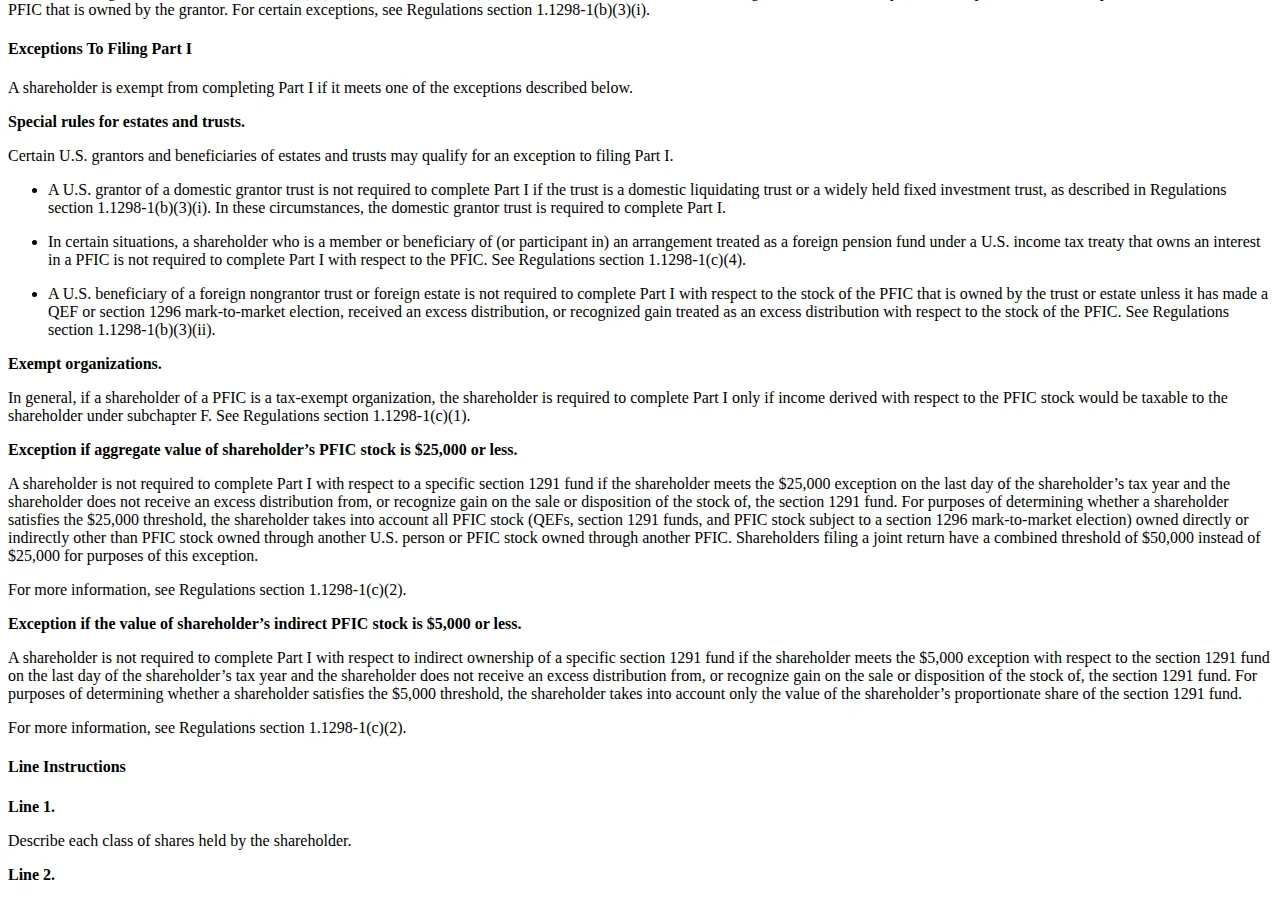
The $25,000 figure counts all PFIC stock you own, including QEF stock and stock under a §1296 election: a $20,000 foreign ETF plus a $10,000 foreign bond fund is $30,000, and the exception is gone. It also dies the moment you take an excess distribution or sell at a gain.
Step 3: The §1291 default regime — excess distributions, worked to the dollar
If you make no election, §1291 governs. An excess distribution is the part of a distribution above 125\% of the average distributions on that stock during the three preceding tax years. No part of a distribution is an excess distribution in the first year of your holding period, and a gain on selling the stock is treated the same way under §1291(a)(2).
The statute does three things with the excess: it allocates it ratably to each day in your holding period; only the slice allocated to the current year enters gross income as ordinary income now; and the prior-year slices are taxed at the highest rate in effect for each of those years under §1 or §11, with interest running from each prior year's due date to the current year's due date at the §6621 underpayment rates. That interest is treated as interest paid under §6601.
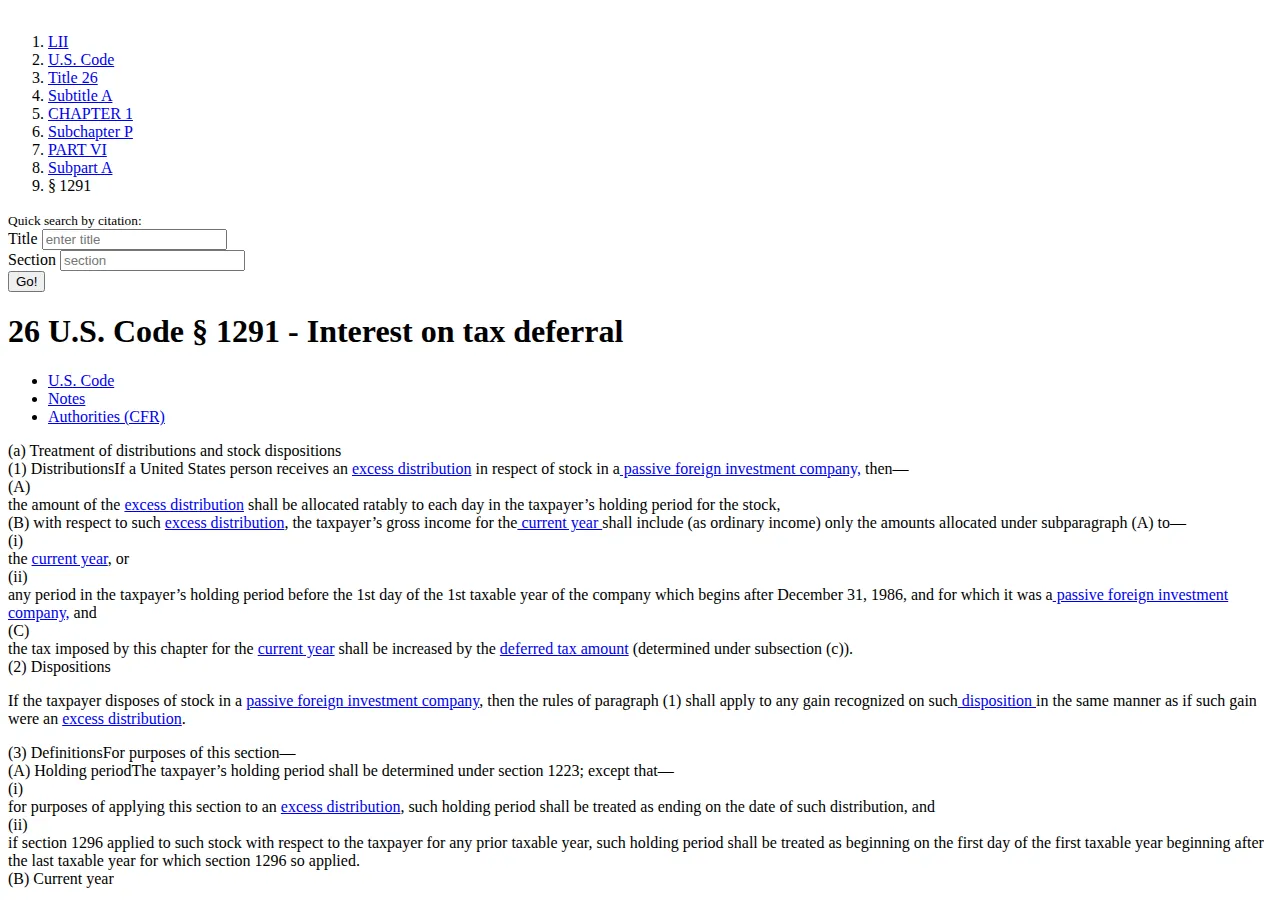
Worked example. Assume you bought the stock on 1 January 2022 and receive a $50,000 distribution on 31 December 2026. Your distributions in the three preceding years were $8,000 in 2023, $9,000 in 2024, and $10,000 in 2025. The average is $9,000, so 125\% of the average is $11,250, and the excess is $50,000 minus $11,250, or $38,750. Your holding period is 1,826 days: 365, 365, 366, 365, and 365 across 2022–2026.
The daily rate puts $7,745.76 in each of 2022, 2023, 2025, and 2026, and $7,766.98 in leap year 2024 — $38,750.02 in all, the $0.02 being rounding. The 2026 slice of $7,745.76 is ordinary income in 2026; the four prior-year slices total $31,004.26. Assume, for illustration only, a 37\% highest rate under §1 in each prior year: deferred tax is $31,004.26 times 37\%, or $11,471.57. Interest is the second bite. Assume, again for illustration only, a flat 8\% simple rate — the real §6621 rates change quarterly — over whole years from each prior due date: $917.10 for 2022, $687.82 for 2023, $459.80 for 2024, $229.27 for 2025. Total interest is $2,293.99, so deferred tax plus interest is $13,765.56. Add the $2,865.93 of tax on the current-year slice at 37\%, and the $38,750 excess costs $16,631.49 — 42.92\% effective, against 37\% without the interest charge.
Founder & CEO Insight — Enow A. Jovial
Step 4: The QEF election — pay tax now, keep the character
A QEF election under §1295 changes the deal. Under §1293(a), a QEF shareholder includes each year a pro rata share of the fund's ordinary earnings as ordinary income and its net capital gain as long-term capital gain, for the shareholder year in which the fund's year ends. Make the election by your return due date, with extensions, under §1295(b)(2); once made it applies to all later years unless revoked with the Secretary's consent.
Worked example. A fund reports $100,000 of ordinary earnings and $40,000 of net capital gain, and you own 10\%. Your inclusion is $10,000 of ordinary income and $4,000 of long-term capital gain. Basis rises by the $14,000 included, so a later $12,000 distribution comes out of taxed basis and is not taxed again; remaining basis is $2,000. Only QEF preserves capital-gain character; the other two regimes convert the return to ordinary income.
The catch is paperwork. The fund must give you a PFIC Annual Information Statement, or an intermediary an Annual Intermediary Statement. The QEF figures are stated under US tax rules, not the fund's home-country GAAP. A fund that will not provide the statement cannot be a QEF for you in practice. A late election needs a purging election — a deemed sale or deemed dividend — plus a protective statement or consent filing to clear the §1291 years first.
Step 5: The mark-to-market election — for listed stock only
Section 1296 offers a simpler bargain, but only for marketable stock: stock regularly traded on a national securities exchange registered with the SEC or the national market system, or on an exchange the Secretary finds adequate. At each year end, FMV above basis is ordinary income; basis above FMV gives a deduction capped at the lesser of the decline or your unreversed inclusions. Basis moves with each inclusion and deduction under §1296(b).
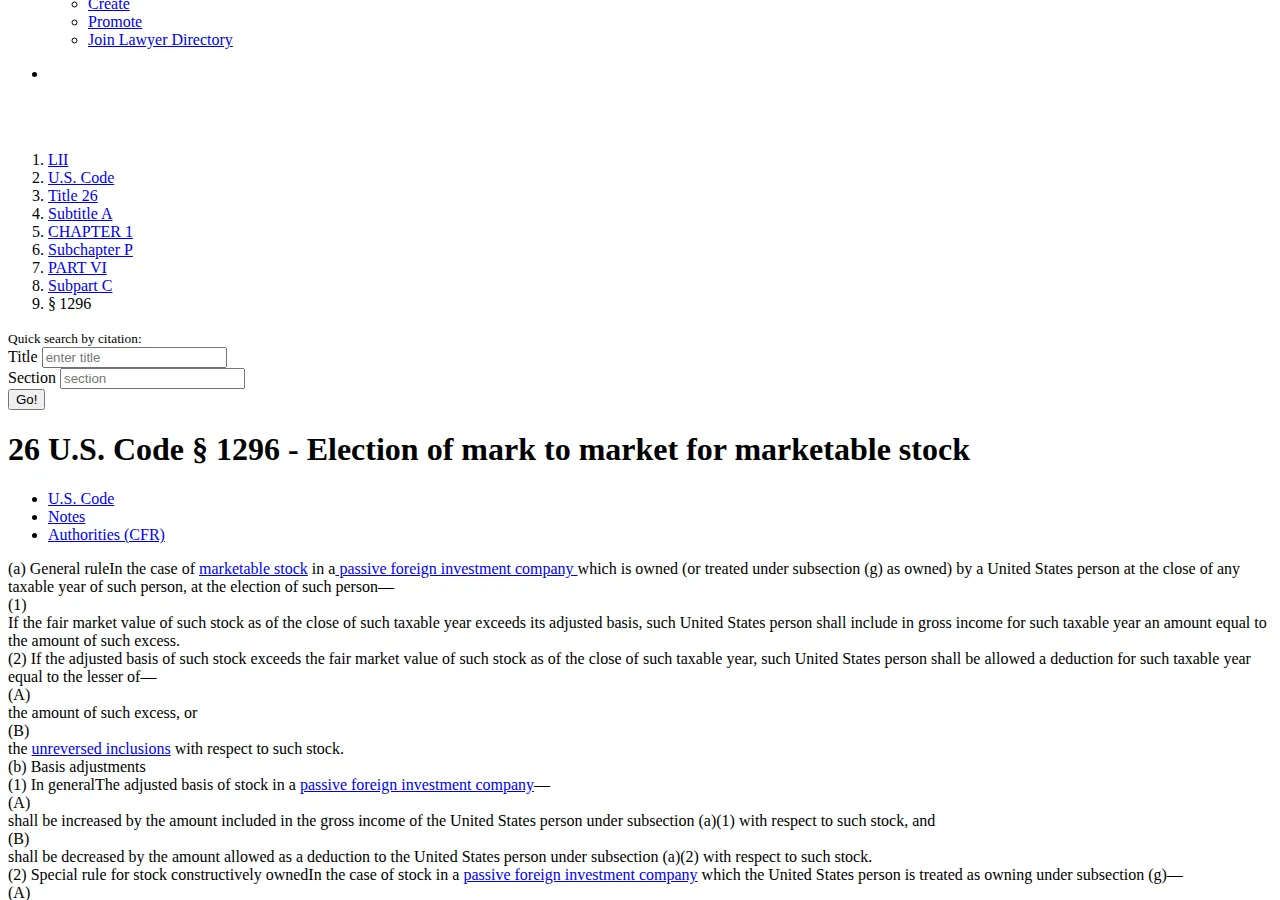
Worked example. You buy 1,000 shares for $20,000. Year one: FMV $26,000, so you include $6,000 and basis becomes $26,000. Year two: FMV $23,000, so the $3,000 decline is deductible in full — it is below the $6,000 of unreversed inclusions — and basis falls to $23,000. In the first mark-to-market year, §1291 can still apply under Reg. §1.1291-1(c)(4) and §1.1296-1(i).
| Regime | How gains are taxed | When tax is due | Authority |
|---|---|---|---|
| §1291 default, no election | Highest §1/§11 rate per prior year, plus §6621 interest | On distribution or sale, spread over the holding period | 26 U.S.C. §1291(a)–(c) |
| QEF election | Ordinary earnings as ordinary income; capital gain as long-term gain | Each year, as the fund earns it | 26 U.S.C. §1293(a); §1295(b) |
| Mark-to-market election | Year-end gain as ordinary income; loss capped at unreversed inclusions | Each year end, on marketable stock only | 26 U.S.C. §1296(a), (e) |
| No filing, small holding | Part I excused if the value test and no-distribution, no-gain conditions hold | Measure value on the last day of the year | Instructions for Form 8621 (12/2025) |
QEF usually wins on character when the fund cooperates; mark-to-market wins on simplicity when the stock is listed. If neither is available, §1291 is the penalty box — sell, take the hit once, and redeploy into a domestic fund. Run the after-tax return through the ROI calculator first.
Step 6: Filing the form — parts, numbers, and the checklist
Form 8621 rides with your income tax return for the year. Part I summarizes each class of shares, the share count, and the value. Part II holds the elections: QEF, extension of time to pay, mark-to-market, and the deemed sale and deemed dividend elections. New Part V lines require a three-letter currency code and the line 15e(1) amount in US dollars on line 15e(2). Put your identifying number on the form — SSN, ITIN, or EIN — and keep the IRS PDF of the instructions with the workpapers.
Form 8938 reports the asset and Form 8621 taxes it — see the Form 8938 playbook. The §250 rules in the FDII and GILTI playbook are a deduction for US companies earning abroad, not a regime for individuals holding foreign funds.
- [x] List every foreign fund, ETF, and pooled vehicle you own, with purchase dates.
- [x] Run the §1297 income and asset tests for each one, and keep the fund's statements.
- [x] Measure aggregate PFIC value on 31 December and test the $25,000 exception before skipping Part I.
- [x] Rebuild the distribution history for the three preceding years.
- [x] Choose QEF, mark-to-market, or §1291 in writing, with the QEF statement on file.
- [x] Attach Form 8621, complete Parts I and II, and enter the currency code and USD amounts Part V requires.
- [x] Reconcile Form 8621 values with Form 8938 and the broker's year-end statement.
- [x] Keep the workpapers — statements, distribution CSV, and the allocation math.
Elect in the first year you hold the stock; every year you wait adds another year of §1291 interest.