The Foreign Tax Credit Playbook: Form 1116, Section 904, and the 2026 Numbers
An American earning income abroad pays tax twice on the same dollar — once to the foreign country, once to the United States, which taxes worldwide income. Section 901 is the relief valve: a dollar-for-dollar credit for foreign income tax, claimed on Form 1116. The credit is capped by section 904, computed separately per category, reduced by anything allocable to excluded income.
What the credit is — section 901
Section 901(a) states the rule in one sentence: "If the taxpayer chooses to have the benefits of this subpart, the tax imposed by this chapter shall, subject to the limitation of section 904, be credited with the amounts provided in the applicable paragraph of subsection (b)." The credit is an election — you choose it year by year.
What counts is narrow: section 901(b)(1) allows "the amount of any income, war profits, and excess profits taxes paid or accrued during the taxable year to any foreign country or to any possession of the United States." Taxes paid "in lieu of" such a tax also qualify, and U.S. territories count as foreign countries. A U.S. citizen claims it on foreign taxes anywhere in the world; a resident alien on taxes paid to a foreign country; a nonresident alien only on taxes tied to effectively connected income — see our Form 1040-NR playbook. The identifier on the return matters. A citizen files with an SSN; a resident alien who cannot get one files with an ITIN; a single-member LLC is disregarded, so the credit rides on the owner's return under the owner's SSN or EIN. An S-Corp passes the credit through to its shareholders; a C-Corp claims it on Form 1118, not Form 1116.
The limitation — section 904(a)
Section 904(a) is the whole game, in one sentence: "The total amount of the credit taken under section 901(a) shall not exceed the same proportion of the tax against which such credit is taken which the taxpayer's taxable income from sources without the United States (but not in excess of the taxpayer's entire taxable income) bears to his entire taxable income for the same taxable year." In arithmetic:
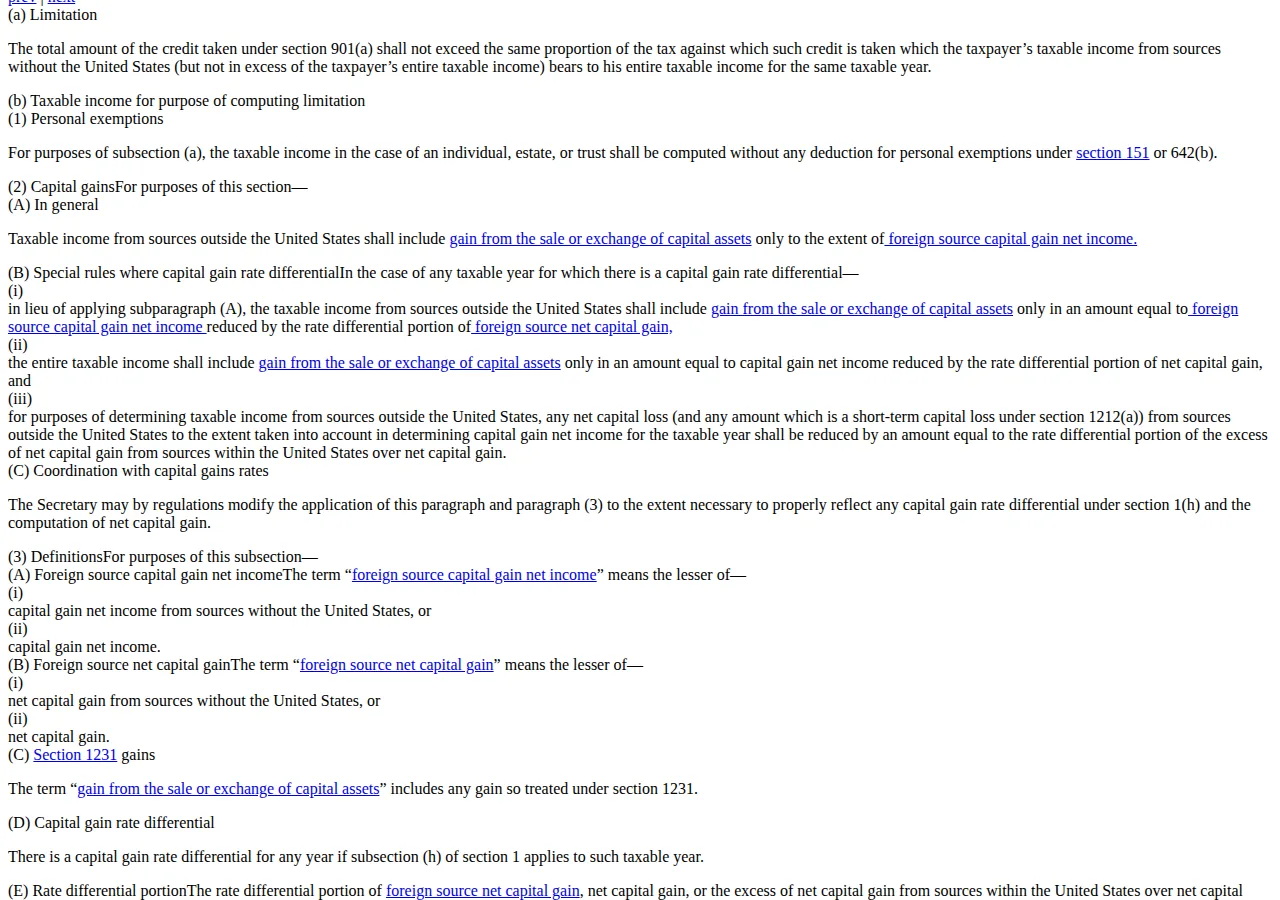
The ratio is the point: if half your taxable income is foreign, the credit cannot exceed half your U.S. tax. When the foreign rate is lower, the credit covers the whole foreign tax and the unused limitation is wasted. When it is higher, the excess is stranded, and only the section 904(c) carryback and carryforward can rescue it.
Worked example — Maya, general category income
Maya, single filer, 2026: a $200,000 London salary and $50,000 of U.S. wages. The United Kingdom taxes her salary at 25 percent — $50,000 of foreign tax paid. Gross income is $250,000; less the $16,100 single standard deduction, entire taxable income is $233,900.
Form 1116 allocates deductions between U.S. and foreign income. The only deduction is the standard deduction, apportioned by gross income: the foreign share is 80 percent, so $12,880 sits against the foreign income. Foreign source taxable income is $187,120, and the ratio is 0.80 exactly.
Her U.S. tax on $233,900 (2026 single table, Rev. Proc. 2025-32, § 4.01):
The limitation is 80 percent of that tax:
Line 24 takes the smaller of the foreign taxes available ($50,000) and the limitation ($41,043.20). Maya's credit is $41,043.20; the $8,956.80 excess carries back to 2025 first, then forward to 2027 through 2036. Her U.S. tax after the credit is $10,260.80.
One form per category — section 904(d)
The limitation is computed separately per category: section 904(d)(1) requires subsections (a), (b), and (c) to "be applied separately with respect to" four categories; Form 1116 adds three boxes.
| Category | What sits in it | Authority |
|---|---|---|
| § 951A | GILTI inclusions | § 904(d)(1)(A) |
| Foreign branch | Foreign branch income | § 904(d)(1)(B) |
| Passive | Dividends, interest, rents, royalties | § 904(d)(1)(C) |
| General | Salaries, business profits, all other | § 904(d)(1)(D) |
| (e)–(g) | Sanctioned-country tax; treaty income; lump sums | Form 1116 |
Each category gets its own Form 1116, limitation, and carryover account — a loss in one cannot offset income in another. Part IV of the form with the largest line 24 summarizes all categories; line 35 lands on Schedule 3 (Form 1040), line 1.
Worked example — Leo, passive category. Leo, single, earns $60,000 of U.S. wages and $20,000 of foreign dividends (nonqualified); withholding is 15 percent, $3,000. His entire taxable income is $63,900 after the $16,100 standard deduction; the foreign share is 25 percent, so $4,025 of the deduction sits against the foreign income and foreign source taxable income is $15,975, so the passive limitation is 0.25 × $8,770 = $2,192.50. Leo's credit is $2,192.50; the $807.50 excess carries forward.
One reclassification matters: section 904(d)(2)(B)(iii)(II) excludes "high-taxed income" from passive income, and line 13 moves it — passive income taxed abroad above the highest U.S. rate, 37 percent for 2026, is reclassified as general category income.
The de minimis election — section 904(j)
Before touching Form 1116, check the exit. Section 904(j)(1) provides that where the subsection applies, "the limitation of subsection (a) shall not apply" — no limitation computation, no Form 1116. The gate has three prongs: (A) all foreign-source gross income "consists of qualified passive income", (B) creditable taxes "does not exceed $300 ($600 in the case of a joint return)", and (C) the individual elects it.
Qualified passive income means passive income shown on a payee statement — in practice, a Form 1099-DIV.
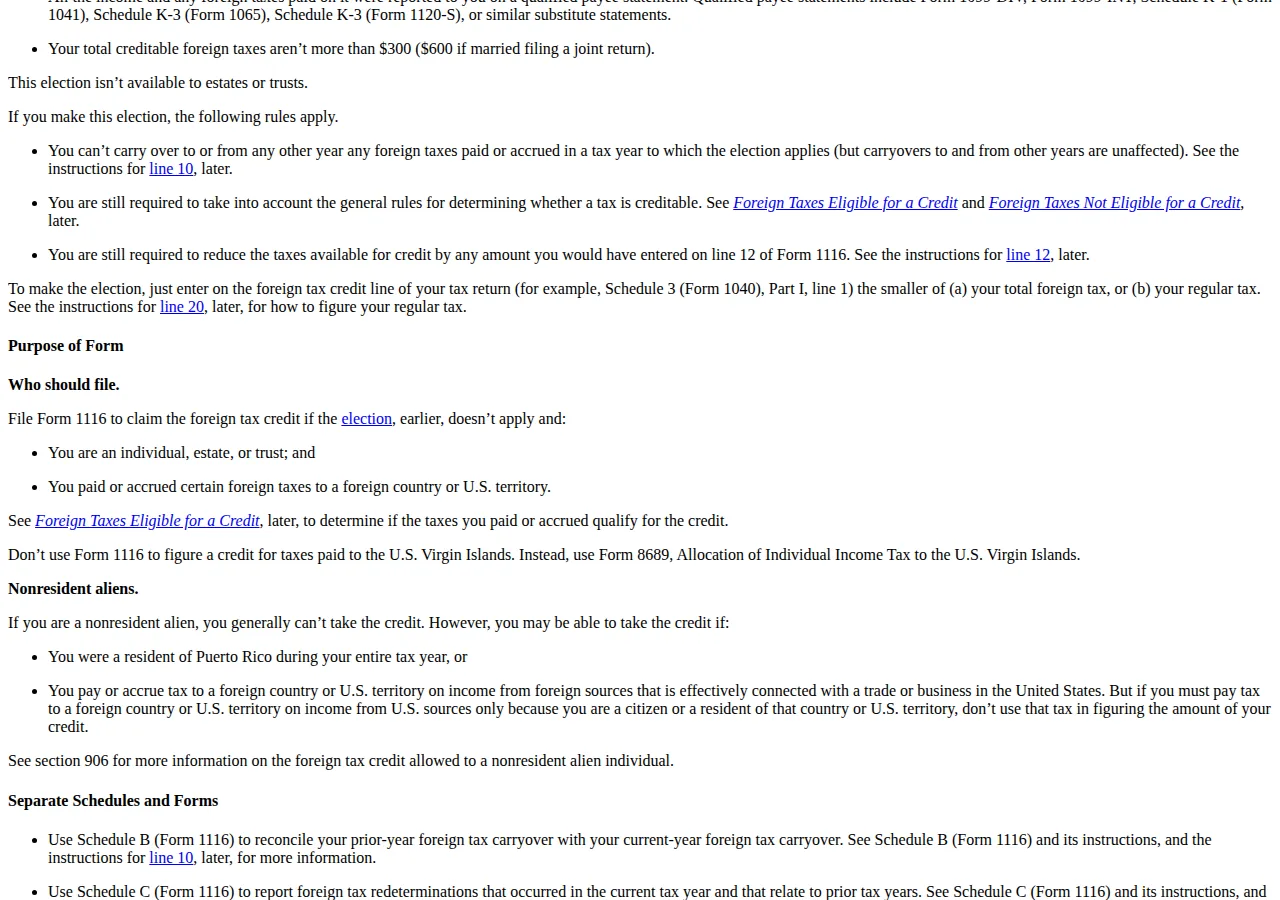 A salary earner cannot use the election at any amount: a dollar of foreign wages anywhere in the return closes the gate. Estates and trusts cannot elect it, and no carryover runs to or from an election year. A single filer with $250 of withholding on foreign dividends, all on a 1099-DIV, is below $300: no Form 1116 — claim the $250 on Schedule 3, line 1.
Credit or deduction — the choice
Instead of the credit, you may deduct foreign income taxes on Schedule A: "Instead of claiming a credit for eligible foreign taxes, you can choose to deduct foreign income taxes." But the two are not close: a credit reduces tax dollar for dollar, while a deduction reduces taxable income and is worth only your marginal rate — and it means itemizing.
Worked example — Maya's numbers, deduction route: she itemizes the $50,000 of U.K. tax and taxable income is $200,000. The tax on it is:
| Route | Tax after relief |
|---|---|
| Credit (Form 1116) | $10,260.80 |
| Deduction (Schedule A) | $40,598 |
| Credit wins by | $30,337.20 |
The deduction wins only when the limitation is near zero because your U.S. tax is near zero — a loss year — and you itemize anyway. The windows are asymmetric: deduction to credit any time before the end of the special 10-year period in section 6511(d)(3), but credit to deduction only before the end of the standard 3-year period. Choose the credit first. The tax estimator runs both routes on your own numbers.
The FEIE interaction — line 12
Section 911(d)(6) forbids claiming the exclusion and the credit on the same dollar: "No deduction or exclusion from gross income under this subtitle or credit against the tax imposed by this chapter (including any credit or deduction for the amount of taxes paid or accrued to a foreign country or possession of the United States) shall be allowed to the extent such deduction, exclusion, or credit is properly allocable to or chargeable against amounts excluded from gross income under subsection (a)."
Line 12 applies it: reduce taxes paid or accrued by the taxes allocable to excluded foreign earned income, on a fraction of excluded over total foreign earned income (each net of allocable expenses).
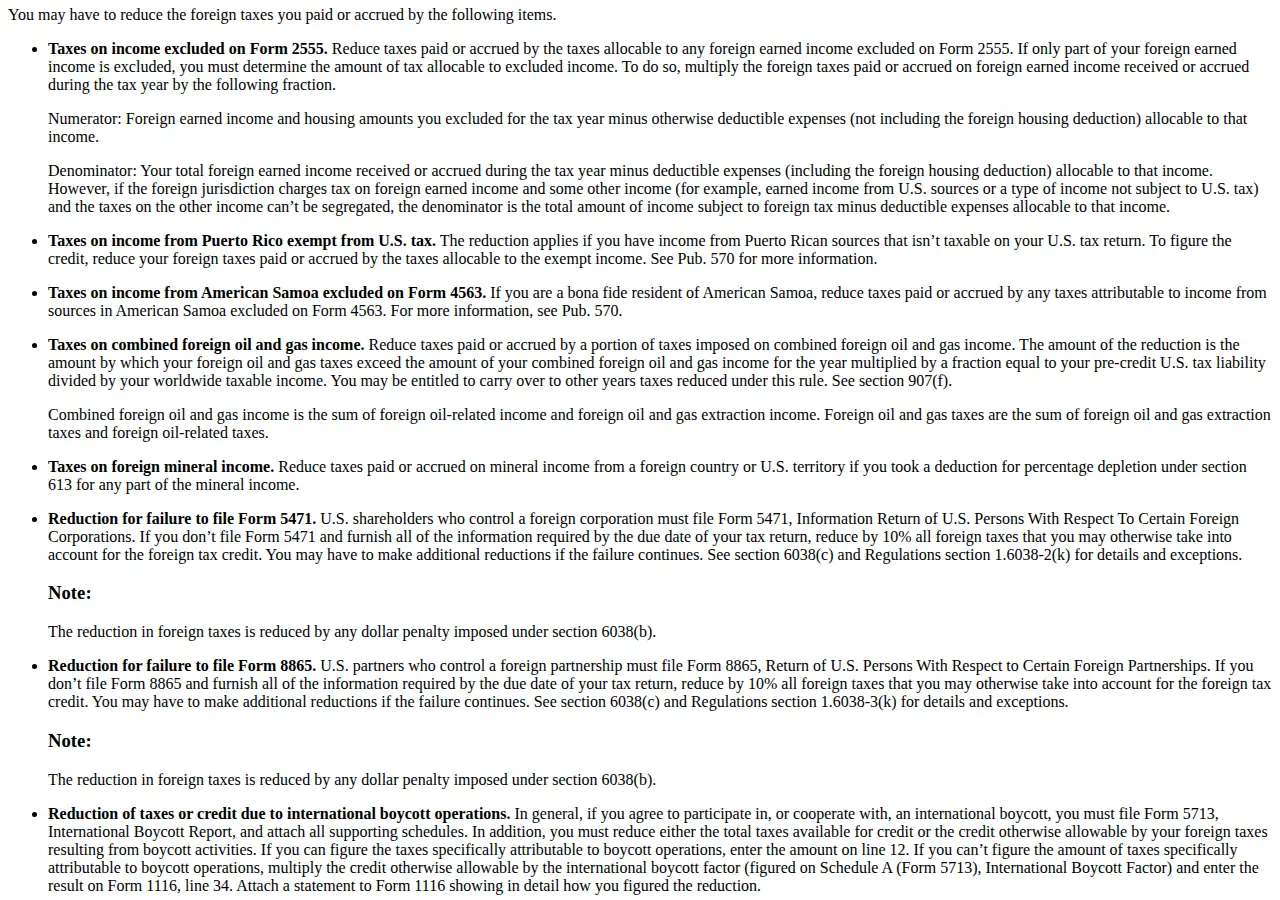
Worked example — from our FEIE playbook: $30,000 of foreign tax on $200,000 of income, with the $132,900 exclusion for 2026:
Carryback and carryforward — section 904(c)
Excess foreign tax is parked, not lost. Section 904(c) provides that any amount by which foreign taxes "exceed the limitation under subsection (a) shall be deemed taxes paid or accrued to foreign countries or possessions of the United States in the first preceding taxable year and in any of the first 10 succeeding taxable years, in that order". The Instructions add: apply the excess to the earliest year first, then the next — and the period "can't be extended even if you are unable to take a credit in 1 of the intervening years."
Maya's $8,956.80 of 2026 excess goes to 2025 first. If her 2027 foreign tax is $40,000 against a $45,000 limitation, $5,000 applies there and $3,956.80 remains, usable through 2036 and dead after it. A carryback requires an amended return — Form 1040-X with a revised Form 1116. Carryovers are tracked on Schedule B; line 10 pulls from Schedule B, line 3, column (xiv). No carryovers for section 951A category income — leave line 10 blank there.
Form 1116, line by line
- Part I: foreign source income or loss, lines 1a–7 — check the category box above Part I.
- Part II: foreign taxes — line 9 the total, line 10 adds carryovers and carrybacks, line 12 subtracts reductions (including Form 2555), line 13 moves high-tax-kickout amounts, line 14 the total available.
- Part III: the limitation — line 15 foreign source taxable income, line 17 the net figure, line 18 entire taxable income, line 19 the ratio (capped at 1), line 20 total U.S. tax, line 21 the maximum credit, line 24 the smaller of the two.
- Part IV: summarize on the form with the largest line 24 — lines 25–31 by category, line 32 the total, line 33 the smaller of line 20 or line 32, line 35 the credit, entered on Schedule 3 (Form 1040), line 1.
- Attach Schedule B for carryovers and Schedule C for any foreign tax redetermination.
Failure modes
The credit is often denied by mechanics, not by the limitation. Section 901(k)(1)(A)(i) denies any credit for withholding tax on a dividend if the stock "is held by the recipient of the dividend for 15 days or less during the 31-day period beginning on the date which is 15 days before the date on which such share becomes ex-dividend" — hold the stock at least 16 days, or the withholding tax is unrecoverable.
Taxes you do not legally owe are not creditable. The Instructions' example: Country X withholds $25, the treaty leaves $15 owed and $10 refundable, and only $15 is creditable "whether or not you apply for a refund." Taxes offset by a foreign tax credit are likewise not creditable, unless the offsetting credit is fully refundable. Sanctioned-country tax under section 901(j) sits in category (e) and gets no credit.
Who should not claim it
Do not file Form 1116 when the de minimis election covers you: $300 or less of creditable tax on qualified passive income goes straight to Schedule 3. Do not claim the credit with no U.S. tax to offset — a loss year leaves it with nothing to reduce. And the credit does not travel to your state return: section 901 is federal. See our tie-breaker playbook for the residency question, and the break-even calculator for the comparison.
Founder & CEO Insight — Enow A. Jovial
Execution checklist
- List every foreign tax, by country and category.
- Check the de minimis gate: all foreign income qualified passive, taxes $300 or less ($600 joint) — if yes, claim on Schedule 3.
- Confirm each tax is an income, war profits, or excess profits tax — or paid in lieu of one — and legally owed.
- Check the holding period on every dividend: stock held more than 15 days in the 31-day ex-dividend window.
- File one Form 1116 per category; complete Parts I, II, and III for each.
- Reduce line 12 for any tax allocable to income excluded on Form 2555.
- Compute the line 19 ratio and line 21 limitation per category; take the smaller of line 14 and line 23.
- Summarize in Part IV on the form with the largest line 24; line 35 goes on Schedule 3, line 1.
- Carry the excess back one year by amended return, then forward ten years on Schedule B — earliest year first.
- Keep the foreign tax receipts, payee statements, and exchange-rate records.