RSU vs Stock Options vs ESPP: The Equity Compensation Playbook
RSU vs Stock Options vs ESPP: The Equity Compensation Playbook
An equity offer is four different offers wearing one label. A restricted stock unit pays you in shares on a vesting date and taxes you that same day. A nonstatutory stock option hands you a right to buy shares later and taxes the gain at exercise. An incentive stock option defers the regular tax until sale but opens a second tax system — the alternative minimum tax — in the exercise year. An employee stock purchase plan lets you buy shares at a discount through payroll deductions.
This guide compares all four on one shared price path. Every worked example uses the same stated assumptions: a single filer, a 32 percent marginal ordinary-income rate, and a 15 percent long-term capital gains rate; the statutory figures come from the Code and IRS publications listed in Sources.
The four instruments on one page
A restricted stock unit is a promise: stay until the vesting date and the share is yours. A nonstatutory stock option is a right to buy shares at a fixed strike price, usually the fair market value on the grant date. An incentive stock option is the same right with a statutory wrapper: meet the holding periods and the gain is a capital gain; miss them and it is taxed like a nonstatutory one. An employee stock purchase plan is a payroll-deduction buying program: each paycheck buys shares at a discount to the lower of the offering-date and purchase-date price.
| Instrument | Taxable event | Ordinary income at that event | Authority |
|---|---|---|---|
| RSU | Vesting | Full fair market value at vest | 26 U.S.C. § 83(a) |
| NSO | Exercise | Fair market value at exercise less strike price | IRS Topic No. 427 |
| ISO | Sale (regular tax); exercise (AMT) | None at grant or exercise if holding periods are met; AMT preference at exercise | 26 U.S.C. §§ 421(a), 422(a) |
| ESPP | Sale | Discount on a disqualifying sale; grant-date discount on a qualifying sale | 26 U.S.C. § 423 |
RSUs: taxed at vesting, like it or not
Section 83(a) taxes the excess of fair market value over any amount paid in the first year the rights become transferable or are no longer subject to a substantial risk of forfeiture. For an RSU, that day is the vesting date. The employer withholds tax from the vesting shares — usually by selling a portion to cover withholding — and the amount lands on the Form W-2 as wages. There is no election to defer it.
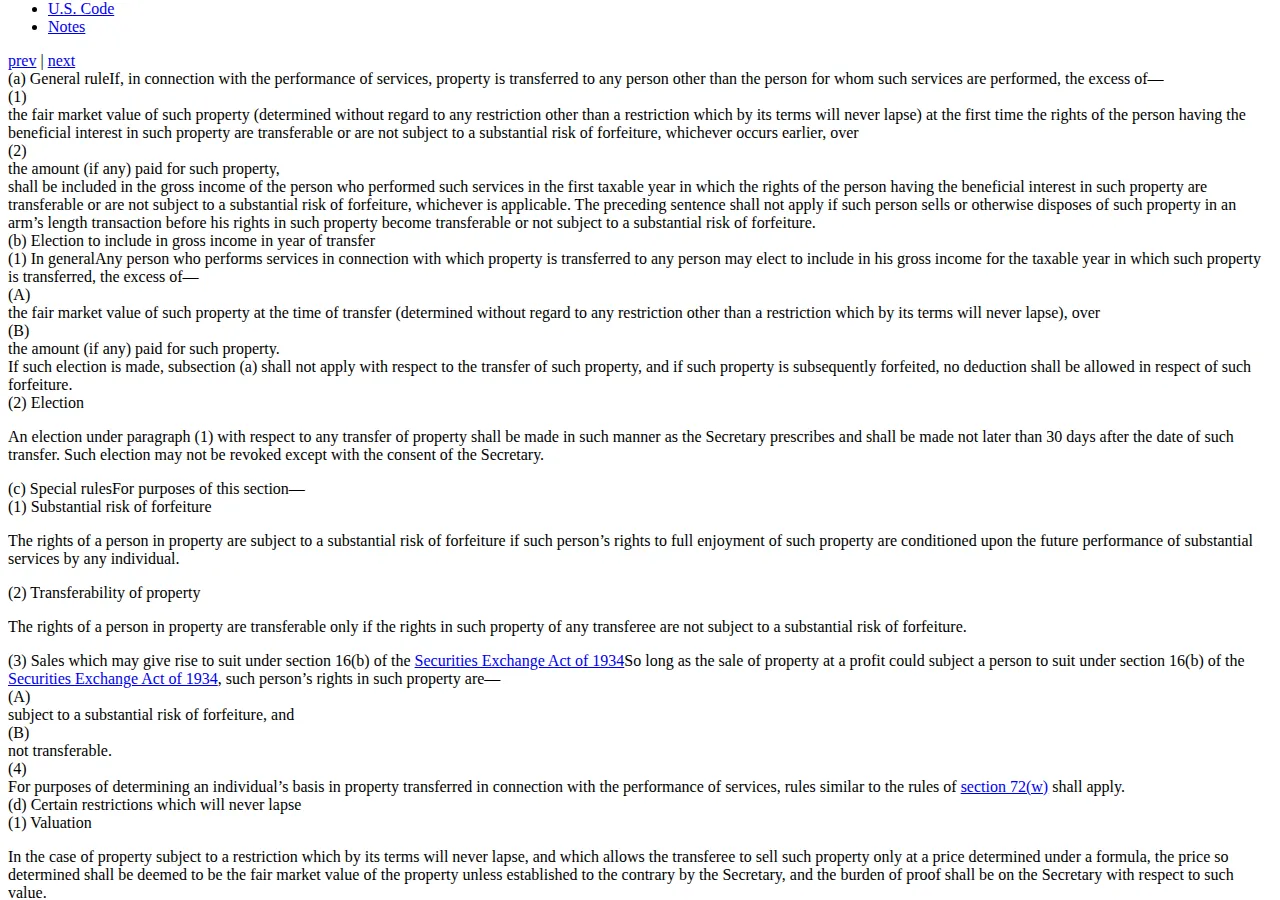 The section 83(b) election applies to restricted stock received up front, not to RSUs, and must be filed within 30 days of transfer — see the section 83(b) election early-exercise stock options playbook.
1,000 RSUs vest at 50 dollars, sell at 60:
The 16,000 dollar tax is due in the vesting year even if the price falls; the later gain is taxed at 15 percent.
NSOs: the spread is wages at exercise
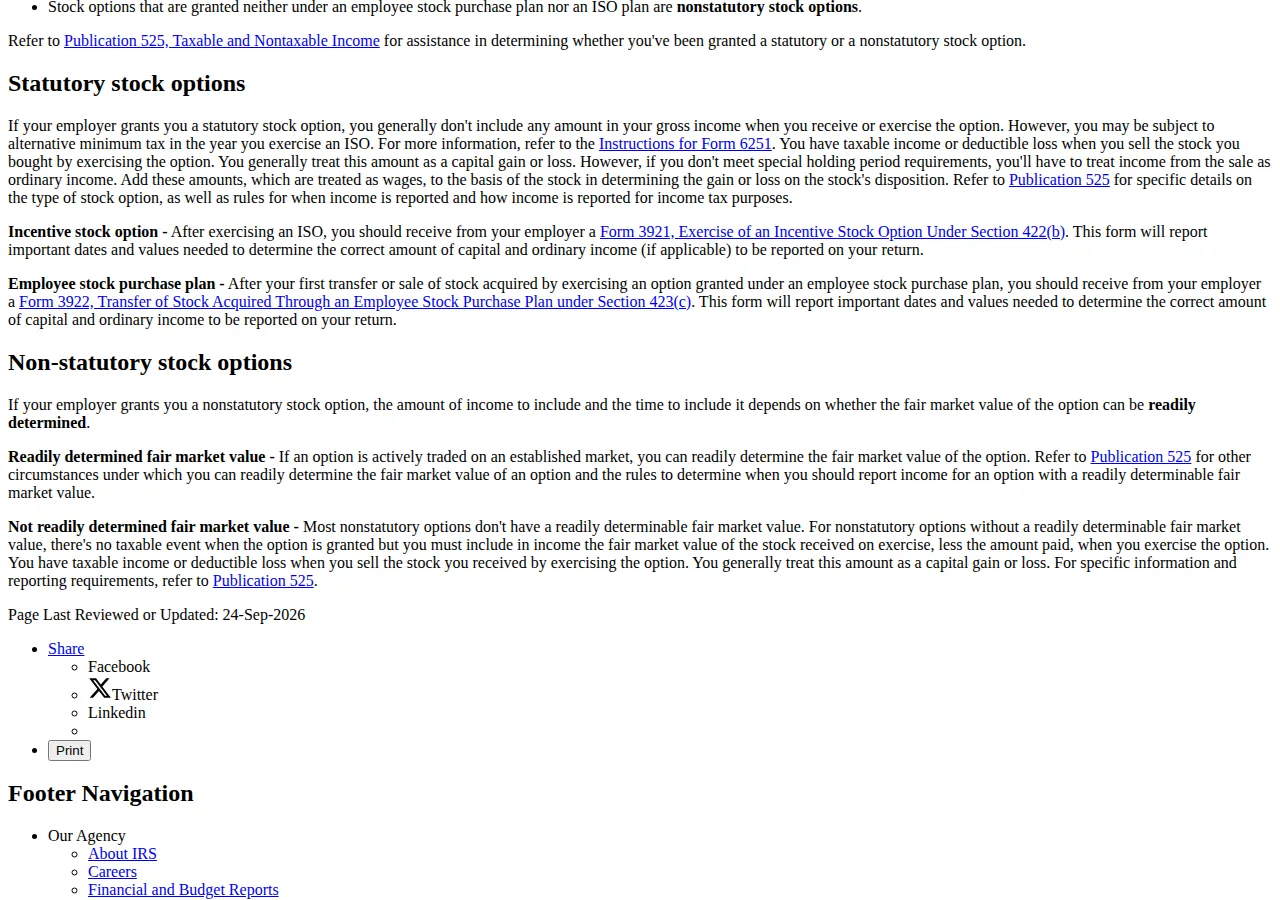
A nonstatutory stock option is the default option: any option not granted under an ISO plan or an ESPP is nonstatutory. Topic No. 427 states the rule: for most NSOs the fair market value of the option cannot be readily determined at grant, so there is no taxable event at grant, but at exercise the employee must include in income the fair market value of the stock received, less the amount paid. That spread is wages, appears on the Form W-2, and raises the employee's basis to the exercise-date value. Later gains are measured from that basis, and are capital gains if the shares are held over one year after exercise.
1,000 NSOs, 30 dollar strike, exercised at 50, sold at 60:
Exercising costs 30,000 dollars for the shares plus 6,400 dollars of tax on the spread.
ISOs: no regular tax at exercise, but the AMT is watching
An incentive stock option is the only instrument here that can turn the whole gain into long-term capital gain. Section 421(a) recognizes no income at grant or exercise of a qualifying ISO. The price is the holding period in section 422(a)(1): no disposition within two years of the grant date and no disposition within one year after the shares are transferred on exercise. Meet both dates and the entire gain is a capital gain. Two caps apply: section 422(d) limits ISOs first exercisable in any calendar year to 100,000 dollars of grant-date fair market value, with the excess taxed as an NSO; and section 422(b)(6) bars ISO treatment for an employee owning more than 10 percent of the employer's voting stock at grant, unless the strike is at least 110 percent of fair market value and the term is five years or less.
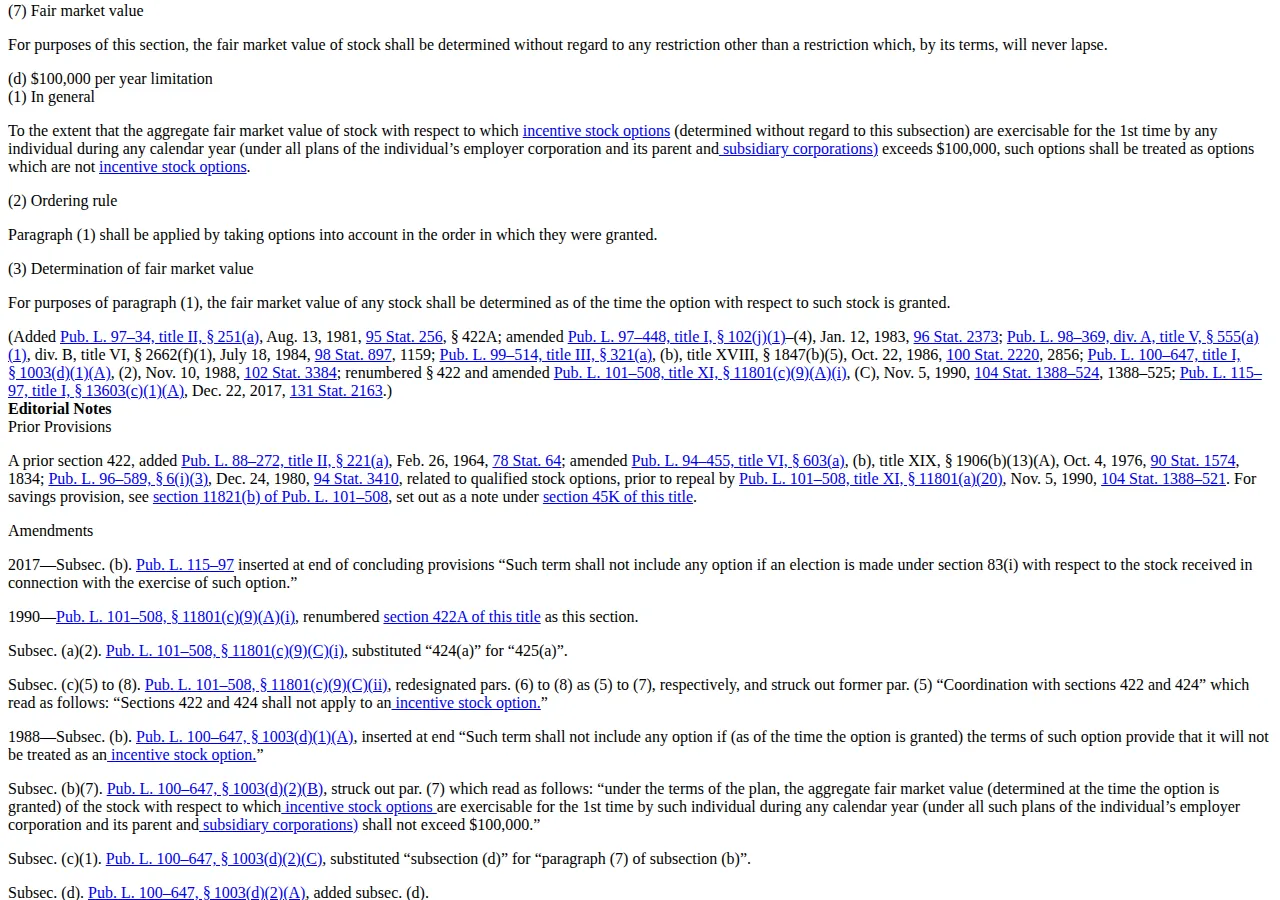
That is 3,400 dollars more after tax than the NSO on identical prices — the whole advantage is the holding period. But the exercise year carries a second tax system: the 20,000 dollar spread is an AMT preference item added to alternative minimum taxable income. For 2026 the AMT exemption is 90,100 dollars for unmarried filers, phasing out from 500,000 dollars, and the 26 percent rate applies to the first 244,500 dollars of the AMT base above the exemption (Rev. Proc. 2025-32). The added tentative minimum tax is at most 26 percent of the preference, or 5,200 dollars, and AMT is due only to the extent tentative minimum tax exceeds regular tax.
In that scenario — regular tax 28,000 dollars, tentative minimum tax 24,000 dollars before the ISO, plus 5,200 dollars from the preference — the AMT bill is 1,200 dollars, paid in the exercise year without selling shares; it becomes a minimum tax credit against later regular tax.
ESPPs: a 15 percent discount with a two-year clock
Section 423 caps the discount at 15 percent: the option price may not be less than 85 percent of fair market value at grant or at exercise. Most plans add a lookback: the price is 85 percent of the lower of the offering-date price and the purchase-date price. Accrual is capped at 25,000 dollars of grant-date value per calendar year, the offering period at five years, and the same two holding periods apply as for ISOs.
Offering 40 dollars, purchase 50 dollars, 100 shares, 15 percent discount with a lookback:
Sell immediately at 50 dollars and the whole 1,600 dollar gain is ordinary income, leaving 1,088 dollars after the 512 dollar tax. Hold through both holding periods and sell at 60 dollars, and the ordinary portion shrinks to the grant-date discount only — 100 shares times the 6 dollar gap between grant-date price and purchase price, or 600 dollars, taxed at 32 percent for 192 dollars. The remaining 2,000 dollars is capital gain at 15 percent, or 300 dollars. Total tax 492 dollars, after-tax cash 2,108 dollars — nearly double the immediate-sale result.
Disqualifying dispositions: the 3,400 dollar lesson
Sell ISO shares before both holding periods expire and section 421(b) recharacterizes the gain: ordinary income is the lesser of the exercise spread or the actual gain, and the rest is capital gain. On the shared price path the ordinary portion is the 20,000 dollar spread, taxed at 32 percent for 6,400 dollars, and the remaining 10,000 dollars is capital gain at 15 percent for 1,500 dollars.
That matches the NSO result — 22,100 dollars, 3,400 dollars less than the qualifying ISO result, an 11 percent swing on a calendar date. The same rule hits ESPP shares sold early, except the ordinary portion is measured from the purchase price. Both are reported on Forms 3921 and 3922, which carry the dates and values the return needs.
Head-to-head on the same price path
| Instrument | Cash out before sale | Total tax | After-tax cash |
|---|---|---|---|
| RSU (1,000 shares) | $0 | $17,500.00 | $42,500.00 |
| NSO (1,000 options) | $30,000.00 strike + $6,400.00 tax | $7,900.00 | $22,100.00 |
| ISO qualifying | $30,000.00 strike; AMT possible | $4,500.00 + AMT | $25,500.00 |
| ISO disqualifying | $30,000.00 strike + $6,400.00 tax | $7,900.00 | $22,100.00 |
| ESPP qualifying (100 shares) | $3,400.00 purchase | $492.00 | $2,108.00 |
| ESPP disqualifying (100 shares) | $3,400.00 purchase | $512.00 | $1,088.00 |
the RSU column starts from 50,000 dollars of value at vest while the option columns start from a 30,000 dollar strike payment, so the totals are not a ranking. What matters is tax character and timing: RSUs are certain value taxed as wages; NSOs are flexible and taxed as wages at exercise; ISOs are cheapest if the holding periods are met and the AMT is survivable; ESPPs reward patience with capital-gains treatment.
Run the grant in five steps:
- Record the instrument, dates, strike, and FMV.
- Send it to your CPA before vesting.
- Check FICA on the RSU value and NSO spread; the ISO spread is exempt at exercise.
- Keep Forms 3921 and 3922 as a PDF, EIN attached.
- Export the brokerage CSV before filing.
ISOs need a C-Corp or an S-Corp; a partnership-taxed LLC cannot grant them. GAAP expenses grants under ASC 718.
Checklists
Before accepting a grant:
- [x] Identify the instrument in writing — RSU, NSO, ISO, or ESPP; the tax rules follow the name.
- [x] Record the four dates: grant, vesting or first exercise, the two-year grant anniversary, the one-year transfer anniversary.
- [x] Price the exercise: strike times shares plus ordinary tax on the spread — if that cash is not available, the exercise is not available.
- [x] Check the ISO 100,000 dollar cap: grant-date value first exercisable above 100,000 dollars in a year is taxed as an NSO.
- [x] Confirm the ESPP lookback and discount: 85 percent of the lower of offering-date and purchase-date price is the best case.
Before exercising or selling:
- [x] Run the AMT estimate before any ISO exercise: add the spread to alternative minimum taxable income and compare tentative minimum tax with regular tax.
- [x] Check both holding periods before any ISO or ESPP sale: selling one day early converts the spread to ordinary income.
- [x] Match withholding to the marginal rate: flat-rate RSU and NSO withholding usually leaves a balance due at filing.
- [x] Keep Forms 3921 and 3922: the return needs their dates and values.
- [x] Set aside the vesting-year tax on RSUs: due whether the shares are sold or kept.
Who should avoid what
An employee who cannot fund the strike plus the exercise tax should not exercise NSOs or ISOs and hold — the spread is taxed at exercise. One who needs the money within a year should not chase ISO capital-gains treatment, and one with a large ISO exercise and no cash reserve should not exercise in December, when the AMT bill arrives four months later. An ESPP holder who cannot afford the holding period should still sell on the purchase date.
Founder & CEO Insight — Enow A. Jovial
The decision is which tax clock fits the employee's cash, horizon, and nerve. RSUs fit one who wants certain value and accepts wage treatment. NSOs fit one who wants control of timing and can fund the exercise. ISOs fit one who can hold two years and survive the AMT year. ESPPs fit almost every eligible employee — a 15 percent discount with a lookback is the closest thing in the Code to a guaranteed gain. For the retirement side, the solo 401(k) versus SEP IRA self-employed retirement playbook carries the same math into retirement accounts, the IRS Form W-2 employee wage reporting playbook shows where these amounts land as wages, and the ROI calculator turns the after-tax totals into a return comparison.
Related reading on Ibravra: the section 83(b) election early-exercise stock options playbook covers the 30-day election that changes restricted-stock timing; the solo 401(k) versus SEP IRA self-employed retirement playbook carries the same after-tax math into retirement accounts; the IRS Form W-2 employee wage reporting playbook shows where RSU and NSO amounts land as wages; and the ROI calculator turns the after-tax totals in this guide into a return comparison.