The form that closes the year
Every employee you paid in 2026 gets one document that settles the year: Form W-2. It has to reach two audiences on two different clocks — your employees, and the Social Security Administration. File late with the SSA and the penalty runs per form. Furnish late to an employee and a second penalty runs on the same form, with the same ladder. A payroll that ran cleanly all year can still cost thousands in January if the closing sequence is wrong — most often because the employer treats the W-2 as a print job instead of a filing.
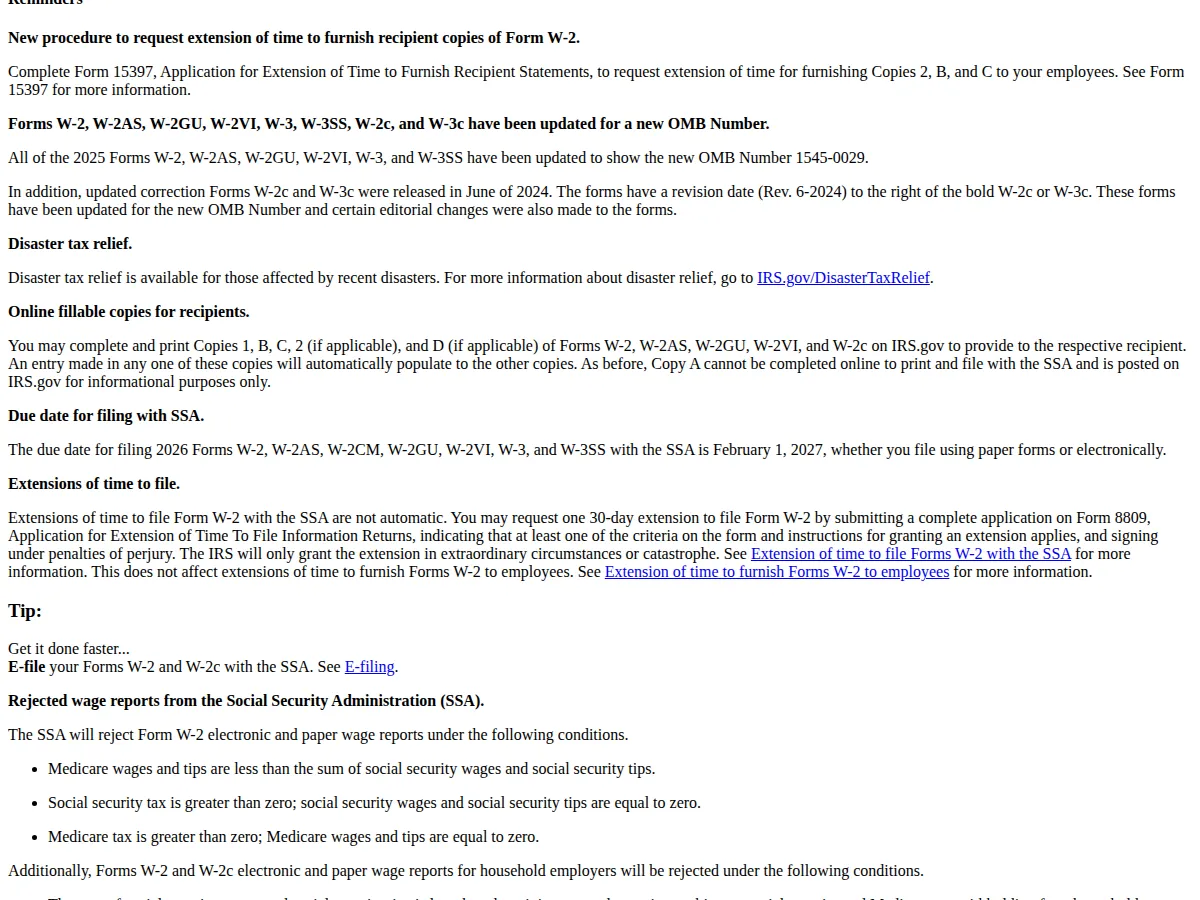
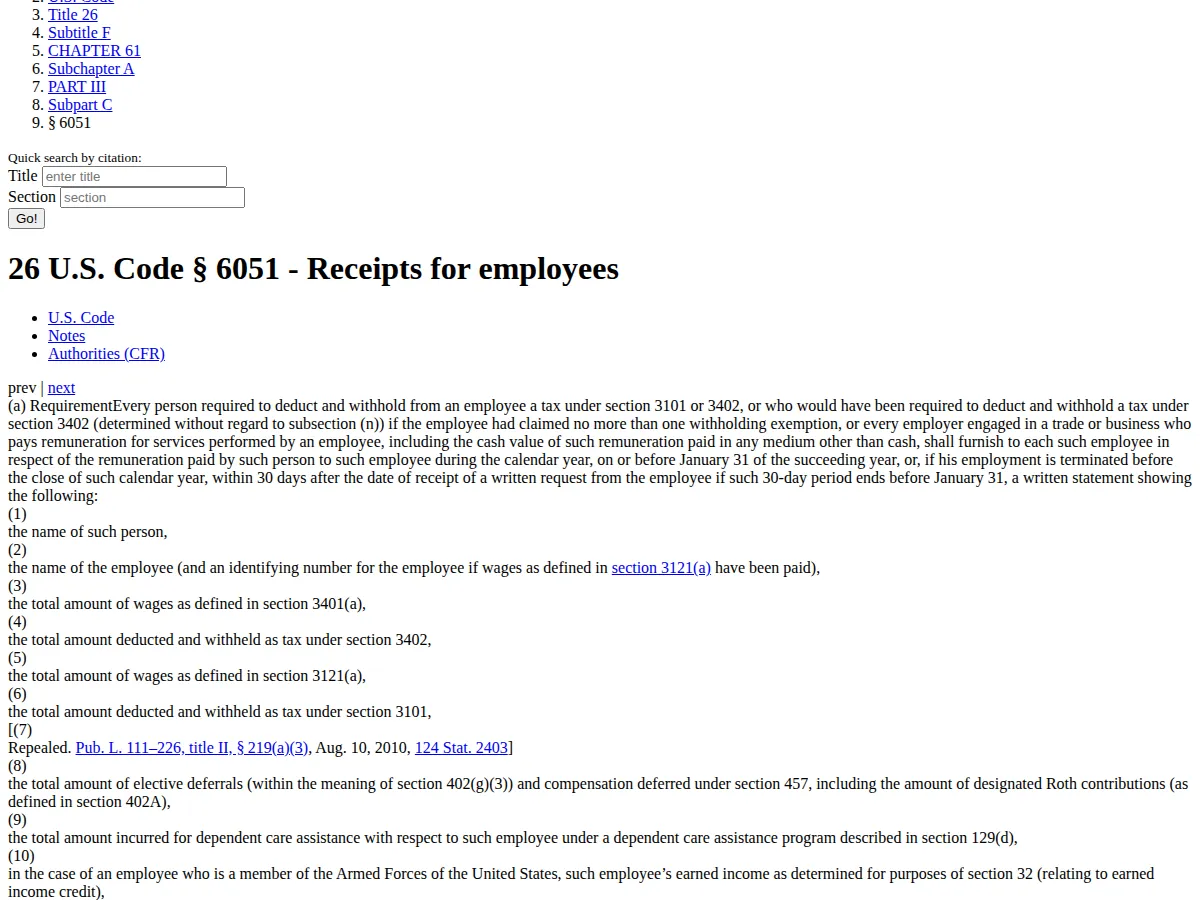
The statute is short. Section 6051(a) requires every employer who withholds tax, or pays remuneration for services performed by an employee, to furnish each employee a written statement of the remuneration paid during the year, on or before January 31 of the succeeding year — or, if employment ended early, within 30 days of a written request, if that period ends before January 31. For 2026 wages that January 31 falls on a Sunday, so the IRS General Instructions for Forms W-2 and W-3 (2026) move both deadlines to Monday, February 1, 2027: file Copy A with the SSA, and furnish Copies B, C, and 2 to employees, by that date. Mailing on or before the due date counts as furnishing.
> [!KEY TAKEAWAY]
> Form W-2 has two deadlines on the same date and two penalty ladders on the same form. For 2026 wages, file with the SSA and furnish to employees by February 1, 2027 — January 31 is a Sunday, and the IRS instructions move the date, not the obligation.
Who this guide is for, and who should stop here
This guide is for the employer who runs payroll for their own team and needs the exact sequence, boxes, and penalty math. It assumes you already withhold and deposit employment taxes and that your quarterly Form 941 filings exist, and it covers 2026 wages filed in early 2027. It is not for the household employer filing Schedule H, not for the employer with only contractors — contractors get Form 1099-NEC.
The two deadlines, and why January 31 became February 1
The statute says January 31; the calendar says January 31, 2027 is a Sunday. When a deadline falls on a weekend, the IRS moves it to the next business day: the due date for filing 2026 Forms W-2 with the SSA is February 1, 2027, paper or electronic.
Two details decide whether that extension helps you or hurts you. First, an extension of time to file is not an extension of time to furnish. You may request one 30-day extension to file on Form 8809, granted only in extraordinary circumstances or catastrophe, requested before the due date and signed under penalties of perjury — and even if granted, you must still furnish Forms W-2 by February 1, 2027. Second, furnishing has its own extension on a different form: Form 15397. File the wrong extension and you have extended nothing.
A terminated employee changes the furnishing clock. If employment ends before December 31, 2026, furnish copies at any time after employment ends, but no later than February 1, 2027. If the employee asks for the form, give the completed copies within 30 days of the request or of the final wage payment, whichever is later.
The boxes, line by line
A W-2 is a reconciliation, not a summary. Each box answers a different question, and the SSA rejects the report when the boxes contradict each other.
Box 1 is the federal income-tax wage figure: gross pay minus pre-tax deductions, plus taxable fringe benefits and reported tips. Box 2 is the federal income tax actually withheld. Box 3 is Social Security wages, capped at the annual wage base; Box 4 is the employee Social Security tax withheld. Box 5 is Medicare wages and tips, with no cap; Box 6 is the Medicare tax withheld, including any Additional Medicare Tax. Boxes 10 through 14 carry dependent care, nonqualified plans, coded items, checkboxes, and state detail.
The cap is where the arithmetic lives. For 2026 the maximum Social Security wage base is $184,500: Boxes 3 and 7 combined cannot exceed it, and Box 4 should not exceed $11,439 — $184,500 multiplied by 6.2 percent. Medicare has no ceiling, and the Additional Medicare Tax of 0.9 percent on wages over $200,000 is employee-only.
$
\text{Social Security Tax} = \min(\text{Box 3}, \$184{,}500) \times 6.2\%
$
$
\text{Medicare Tax} = (\text{Box 5} \times 1.45\%) + \max(\text{Box 5} - \$200{,}000, 0) \times 0.9\%
$
Worked example: an employee paid $250,000 owes Social Security tax only on the capped $184,500 — $11,439 — and Medicare tax on the full $250,000, which is $3,625, plus $450 of Additional Medicare Tax on the $50,000 above $200,000, for $4,075 total. The employer matches the Social Security and base Medicare amounts, but never the 0.9 percent. If your payroll system withholds Social Security tax above $11,439 for any employee, the system is wrong.
The 10-return rule: who must file electronically
Electronic filing is not a preference; for most employers it is a requirement. You must file Forms W-2 electronically if you are required to file at least 10 information returns, counted in aggregate: the information returns on the IRS list plus the Forms W-2 you must file in the year. Nine W-2s and two 1099-NECs is eleven returns, and eleven means e-filing. The same logic applies to corrections: if you were required to e-file the original, the W-2c must be filed electronically.
The SSA's Business Services Online, or BSO, is the free route: online forms create and submit W-2s and W-2cs, generate Form W-3 automatically under your EIN, and show submission status. The alternative is a waiver — Form 8508, submitted at least 45 days before the due date of Form W-2, or 45 days before your first Form W-2c.
Corrections: Form W-2c, and the 941-X that follows it
An error on a filed W-2 is corrected with Form W-2c, filed with the SSA, with a corrected copy furnished to the employee. It supersedes the original, and it can require a second correction on the quarterly return — Form 941-X, 943-X, 944-X, or CT-1X. File the W-2c and forget the 941-X, and the quarters still carry the wrong wages.
Three correction rules are routinely missed. First, if you furnished the original electronically, you must furnish the W-2c electronically as well. Second, a prior-year wage repayment is corrected narrowly: the W-2c corrects only Social Security and Medicare wages and taxes — not Box 1, not Box 2, and not Additional Medicare Tax on the repaid wages. Third, do not use Form W-2c for back pay; back pay goes through Publication 957 and Form SSA-131, Employer Report of Special Wage Payments.
The SSA rejects wage reports mechanically: an SSN mismatch, Medicare wages below Social Security wages plus tips, Social Security tax above zero on zero Social Security wages, or Medicare tax above zero on zero Medicare wages. A rejected report is not a filed report.
The penalty ladder, worked per form
The penalties for 2026 filings are the inflation-adjusted amounts in the 2026 instructions, applying to returns required to be filed after December 31, 2026. The ladder is the same for failure to file under section 6721 and failure to furnish under section 6722.
| When the correct form is filed or furnished | Penalty per Form W-2 | Maximum per year | Small-business maximum |
| :--- | :--- | :--- | :--- |
| Within 30 days after the due date | $60 | $698,500 | $244,500 |
| More than 30 days after, but by August 1 | $130 | $2,095,500 | $698,500 |
| After August 1, or not filed at all | $340 | $4,191,500 | $1,397,000 |
| Intentional disregard | $690 minimum, no maximum | No maximum | No maximum |
A small business, for the lower maximums, averages $5 million or less in gross receipts over the three most recent years. The authority is 26 U.S.C. sections 6721 and 6722.
Work the ladder for a 40-employee company. Filed 45 days late, the file penalty is 40 multiplied by $130, or $5,200. Filed after August 1, the same 40 forms cost $13,600.
$
\text{Penalty} = \text{Forms Late} \times \text{Per-Form Rate} \quad \text{(capped at the annual maximum)}
$
Two relief valves exist. Reasonable cause: the penalty will not apply to a failure due to reasonable cause and not willful neglect. De minimis: even without reasonable cause, the penalty will not apply to a certain number of returns if you filed them on time, included incorrect information, and filed corrections by August 1 — the greater of 10 returns or one-half of 1 percent of the total required. A safe harbor covers small dollar errors: no single amount in error differs by more than $100, and no tax withheld by more than $25.
> [!WARNING]
> The $60 tier is the cheapest penalty the IRS sells, and it expires 30 days after the due date. An error found on March 15 costs $60 per form; the same error found on August 2 costs $340. The difference is a calendar check in the first week of March — put the March 3 check on the calendar before you file, not after.
What changed for 2026 wages
Three changes from the One Big Beautiful Bill Act, Public Law 119-21, land on the 2026 W-2. First, qualified tips: for tax years beginning after 2024 and ending before 2029, certain employees may deduct up to $25,000 of qualified tips in occupations the IRS lists as customarily tipped — still subject to withholding and payroll tax at $20 or more per month, with cash tips and the Treasury Tipped Occupation Code on the W-2. Second, qualified overtime: the same window allows a deduction of up to $12,500, or $25,000 if married filing jointly, for the amount above the regular rate under section 7 of the Fair Labor Standards Act, reported in Box 12 under code TT. Third, Trump accounts: from July 4, 2026, employers may contribute up to $2,500 a year to the Trump account of an employee or a dependent, excluded from gross income under a contribution program, within a $5,000 annual limit, reported in Box 12 under code TA.
The penalty amounts themselves changed too: failure to file, failure to furnish, and intentional disregard penalties increased for inflation, applying to returns required to be filed after December 31, 2026. The $60, $130, $340, and $690 figures above are the increased amounts.
W-2 versus 1099-NEC: the classification boundary
The W-2 and the 1099-NEC are the two ends of the same workforce decision, and the boundary is classification, not convenience. An employee gets a W-2; an independent contractor gets a 1099-NEC.
| Question | Form W-2 (employee) | Form 1099-NEC (contractor) |
| :--- | :--- | :--- |
| Who receives it | Employee, including statutory | Nonemployee paid $2,000+ for 2026 services |
| Filed with | Social Security Administration, with Form W-3 | IRS, with Form 1096 |
| Furnish deadline | February 1, 2027 | February 1, 2027 |
| What is withheld | Income tax, Social Security, Medicare | Nothing; 24% backup withholding only if triggered |
| Wage-base cap | $184,500 Social Security wage base | No wage base; no FICA at all |
| Correction form | Form W-2c | Corrected 1099-NEC |
| Penalty sections | 6721 (file) and 6722 (furnish) | 6721 (file) and 6722 (furnish) |
Misclassification converts a contractor's invoice into back wages, back taxes, and penalties across every quarter of the relationship, and no payroll vendor makes the determination for you.
Operator boundaries: when to hand this to a CPA
Do the W-2 run in-house when the workforce is domestic, the payroll register exports as a CSV and reconciles gross-to-net, and the only corrections are transposed digits. Hand it to a CPA when any of these appear: multi-state withholding and SUI registration, third-party sick pay, a deceased employee's wages, or a prior-year correction touching a closed quarter. The deceased-employee rule traps employers: a payment made after the employee's death but in the same year is reported only as Social Security and Medicare wages — Boxes 3 and 5, taxes in Boxes 4 and 6 — never in Box 1.
> [!FOUNDER]
> "The W-2 is the one form where being a month early costs nothing and being a day late costs per form, per employee, twice. I file in the first week of January, when there is still time to fix a rejection, and I treat the March 3 check as part of the filing, not an afterthought. The employers who pay the $340 tier are not the ones who did not know the deadline. They are the ones who knew it and filed on the last day."
> — Enow A. Jovial, Founder & Chief Executive Officer
The closing checklist
> [!TIP]
> Run the penalty math before you run the payroll. A 40-employee company that files 45 days late pays $5,200; the same company that finds the error and files within 30 days pays $2,400. The $2,800 difference is the price of a calendar check — set one for March, and a second for July, before the August 1 cliff.
Related reading on this site: the IRS Form 941 quarterly filing playbook for the quarterly returns the W-2 must reconcile against; the IRS Form 1099-NEC contractor reporting playbook for the contractor side of the same workforce, including the $2,000 threshold that replaced the old $600 rule; and the Solo 401(k) vs SEP IRA retirement playbook for how the Box 12 deferral codes connect to the retirement plan. To price the payroll itself, run the figures through the tax estimator.