Prepaid Expenses & Deferred Charges: The Amortization Playbook
The $12,000 Check That Is Not a $12,000 Expense
On January 1, a founder wires $12,000 for a year of business insurance. If the profit-and-loss statement records the full payment as a January expense, it tells a lie: the business consumed $1,000 of coverage that month, not $12,000. By December, the same books show eleven months of insurance that cost nothing.
Prepaid expenses fix that distortion. Under accrual accounting, a payment made before its benefit arrives is an asset first and an expense second: record what you paid, then move it to the income statement month by month as the benefit is consumed. Get it wrong and the costs are misstated margins, dead money hiding in current assets, a tax deduction claimed a year early, and, for audited companies, a restatement.
This playbook covers what counts as a prepaid expense, what "deferred charges" means under GAAP, the journal entries, the amortization math, the IRS 12-month rule, the economic-performance rule, and ASC 340-40. Every figure below traces to a primary source opened on 2026-11-06.
> [!KEY TAKEAWAY]
> A prepaid expense is cash already spent for a benefit not yet received. It sits on the balance sheet as a current asset and becomes an expense only as each month of benefit passes — if the benefit has not been consumed, it is still an asset.
What Counts as a Prepaid Expense
A prepaid expense is an advance payment for goods or services your business has not yet received. Xero's guide, written by an IRS Enrolled Agent, states it plainly: prepaid expenses "appear as assets on your balance sheet because they represent future economic benefits your business has already paid for but hasn't yet consumed." For a founder-led LLC, S-Corp, or C-Corp filing under its own EIN, the common cases are insurance premiums paid annually, rent paid ahead, software and SaaS subscriptions billed annually, maintenance contracts, and advertising placed in future periods.
Most prepaid expenses are current assets, used within 12 months. Multi-year contracts split — the portion consumed within 12 months is current, the rest non-current — and a three-year prepay booked entirely as current overstates short-term liquidity.
Deferred Charges: The Other Side of the Same Coin
"Deferred charges" is the older term for costs paid now and recognized later. In modern GAAP it survives as a synonym for prepaid expenses in older charts of accounts, and — where it carries real weight — as deferred contract costs under FASB ASC 340-40, the standard for the costs of obtaining and fulfilling customer contracts under ASC 606.
The distinction matters. A prepaid expense is money paid for a benefit you will receive: insurance, rent, software. A deferred contract cost is money paid to win or deliver a customer contract: a sales commission, a setup cost, an implementation fee. Both are balance-sheet assets amortized over the period of benefit, but confusing them is how a SaaS company ends up expensing commissions GAAP requires it to capitalize.
The Bookkeeping: Two Entries, Then a Monthly Habit
Xero's guide gives the canonical entries. Pay $12,000 for annual insurance on January 1:
After four months, the prepaid balance is $8,000 and $4,000 of expense has been recognized. The schedule reconciles exactly — that reconciliation is the control: prepaid balance plus expense recognized must always equal the original payment. If the two numbers disagree, an amortization entry was missed, duplicated, or posted to the wrong account.
The Math: Straight-Line Amortization
Prepaid expenses amortize on a straight-line basis in almost every small-business case: the same amount each month, because the benefit arrives evenly.
$ \text{Monthly Amortization} = \frac{\text{Prepaid Amount}}{\text{Benefit Months}} = \frac{\$12{,}000}{12} = \$1{,}000 \text{ per month} $
$ B_t = P - t \times \frac{P}{n} = \$12{,}000 - 4 \times \$1{,}000 = \$8{,}000 \text{ remaining after 4 months} $
Here $P$ is the prepaid amount, $n$ the total benefit months, $t$ the months elapsed, and $B_t$ the balance still on the balance sheet. Xero's guide confirms the same arithmetic on smaller contracts: $1,200 for a year of software is $100 per month; $6,000 for six months of rent is $1,000 per month.
The Decision Table: Expense Now or Amortize?
| Situation | Book treatment | Tax treatment | Authority |
|---|---:|---|---|
| Insurance, $3,000 for 3 years from July 1 | Amortize over 36 months | $500 / $1,000 / $1,000 / $500 over 4 years | IRS Pub. 538, Example 1 |
| Advance rent, $12,000 at $1,000/month | Amortize $1,000/month | Accrual: $6,000 in year 1, $6,000 in year 2 | IRS Pub. 535 (2022), Ch. 3, Ex. 1 |
| Insurance, $10,000 for 1 year (cash method) | Amortize $833/month | Full $10,000 deductible in year 1 | IRS Pub. 538, Ex. 2; Treas. Reg. § 1.263(a)-4(f) |
| Sales commission, $24,000, 3-year contract | Capitalize as contract-cost asset | Follows book amortization | FASB ASC 340-40-25-1, -25-2 |
| Commission, amortization of 1 year or less | Expense immediately (expedient) | Deduct when incurred | FASB ASC 340-40-25-4 |
| 3-year lease prepaid in full, $18,000 | Amortize $6,000/year | $6,000 deductible per year | IRS Pub. 535 (2022), Ch. 3, Ex. 3 |
Note the asymmetry in the $10,000 row: books and tax return can disagree. A cash-method business may deduct the full $10,000 one-year policy in year 1 while its books still amortize $833 a month. That is not an error — the reconciliation belongs on the tax workpapers, not in the general ledger.
The 12-Month Rule: When Cash-Method Taxpayers May Deduct Everything at Once
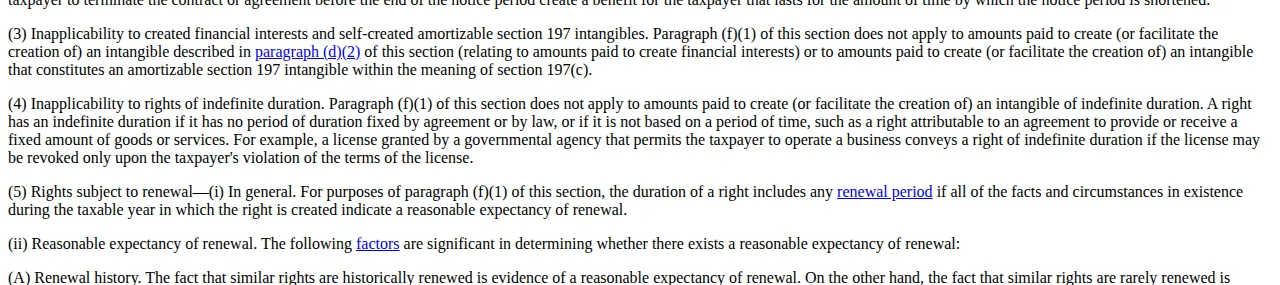
Treas. Reg. § 1.263(a)-4(f)(1) provides that a taxpayer need not capitalize amounts paid to create a right or benefit that does not extend beyond the earlier of (i) 12 months after the first date the taxpayer realizes the right or benefit, or (ii) the end of the taxable year following the year of payment. Both prongs must be satisfied.
IRS Publication 538 proves it with two examples. Example 1 — the rule fails. A calendar-year taxpayer pays $3,000 in 2021 for a business insurance policy effective for 3 years (36 months) from July 1, 2021. The benefit extends beyond 12 months, so the deduction follows it: $500 in 2021 (6/36 × $3,000), $1,000 in 2022, $1,000 in 2023, and $500 in 2024 — $500 + $1,000 + $1,000 + $500 = $3,000.
Example 2 — the rule applies. The same taxpayer pays $10,000 on July 1, 2021, for a business insurance policy effective for only 1 year from July 1, 2021. The benefit ends July 1, 2022 — within 12 months of its start and before the end of 2022, the tax year following payment. The full $10,000 is deductible in 2021.
The trap is the second prong: a 12-month policy starting December 1, 2026, ends November 30, 2027 — within 12 months of its start, but past December 31, 2027, the end of the tax year following payment. Prong two fails, and the payment must be capitalized.
!Treas. Reg. § 1.263(a)-4(f): the 12-month rule text
> [!WARNING]
> Claiming a full-year deduction for a prepayment that fails the 12-month rule is an incorrect deduction, not a timing preference. IRS Publication 538 states that a taxpayer who has not been applying the general rule and the 12-month rule to expenses paid in advance must obtain IRS approval before changing method, which means filing Form 3115, Application for Change in Accounting Method. Fix the schedule now; do not wait for the return to be examined.
Economic Performance: The Accrual-Method Gate
For accrual-method taxpayers, IRC § 461(h) — as explained in IRS Publication 538 — provides that a business expense generally cannot be deducted or capitalized until economic performance occurs. For property or services provided to you, economic performance occurs as they are provided or the property is used. Paying early does not accelerate the deduction; the deduction follows the delivery.
Publication 538 illustrates it with office supplies bought in December 2020, received with the bill in December, but paid for in January 2021. Economic performance occurred in December 2020 — so the deduction belongs to 2020 even though the cash moved in 2021. Reverse the facts and the answer reverses: supplies paid for in December but delivered in January are not deductible until January.
ASC 340-40: When a Commission Becomes an Asset
Deferred charges are governed by FASB ASC 340-40, the contract-costs companion to ASC 606. Deloitte's Technology Industry Accounting Guide quotes the Codification: ASC 340-40-25-1 states "An entity shall recognize as an asset the incremental costs of obtaining a contract with a customer if the entity expects to recover those costs." ASC 340-40-25-2 defines incremental costs as those the entity "would not have incurred if the contract had not been obtained (for example, a sales commission)." Costs that would have been incurred regardless — base salaries, travel, overhead — are expensed when incurred under ASC 340-40-25-3.
The practical expedient in ASC 340-40-25-4 allows immediate expensing if the amortization period would be one year or less. The one-year test measures the expected amortization period — including anticipated renewals — not just the initial term. A one-year contract the customer is reasonably expected to renew for three more years has a four-year amortization period, and the expedient is unavailable. Capitalized costs amortize on a systematic basis consistent with the transfer of the goods or services, under ASC 340-40-35-1:
$ \text{Immediate expensing: } \$24{,}000 \text{ commission hits Year 1 profit in full} $
$ \text{ASC 340-40 amortization: } \frac{\$24{,}000}{60 \text{ months}} = \$400 \text{ per month over a 5-year benefit period} $
A SaaS company that pays a $24,000 commission on a three-year contract with two expected renewal years and expenses it all in the signing month understates Year 1 profit by $19,200: with a January signing, only 12 × $400 = $4,800 belongs in Year 1.
The Mirror Image: Prepaid Expenses vs. Deferred Revenue
Prepaid expenses have an exact mirror: deferred revenue, the liability recorded when a customer pays before the service is delivered. A customer prepaying a $120,000 annual contract creates a $120,000 deferred-revenue liability, recognized at $10,000 of revenue per month. The same business prepaying its own $12,000 insurance policy records a $12,000 prepaid asset, recognized at $1,000 of expense per month. Reconciling both schedules monthly catches the two most common close errors in one pass: revenue recognized before delivery and expenses recognized before consumption. The deferred-revenue side is covered in our companion guide, deferred revenue and the SaaS balance sheet.
The Monthly Amortization Workflow
Run this checklist monthly on close day.
Step 1. Pull the prepaid schedule: every open prepaid asset with its original amount, start date, benefit months, and monthly charge.
Step 2. Confirm no new prepayments were posted directly to an expense account. Search the month's postings for annual, prepaid, deposit, and retainer; reclassify any that belong on the balance sheet.
Step 3. Post the monthly amortization entry for each open item: debit expense, credit the prepaid asset, dated the last day of the month.
Step 4. Reconcile each item: original amount minus amortization posted must equal the remaining balance.
Step 5. Split current from non-current: the portion consumed within 12 months stays current; the rest moves to non-current.
Step 6. Test the 12-month rule on every new prepayment before the tax workpapers are prepared, and record the answer.
Step 7. Review expirations: any item whose benefit period ended must have a zero balance.
Step 8. File the evidence: the invoice or contract, the payment confirmation, and the amortization schedule, together, for each item.
> [!TIP]
> Automate Step 3 before you hire for it: Xero, QuickBooks, and most modern ledgers support recurring journal entries — one template per prepaid item, posted automatically on the first of the month. A recurring entry cannot be forgotten or posted twice.
Three Errors That Break the Schedule
Expensing the whole payment on day one. A $12,000 annual software prepay expensed in January understates January profit by $11,000 and overstates the other eleven months by $1,000 each — which also corrupts the working-capital analysis in our cash conversion cycle playbook.
Amortizing from the payment date instead of the benefit start date. A policy paid June 30 for coverage starting July 1 amortizes from July, not June — starting a month early pulls $1,000 of expense into a month with no coverage.
Capitalizing commissions that should be expensed, or expensing commissions that must be capitalized. Base salaries and travel are never incremental under ASC 340-40-25-3. A commission paid only when the deal closes is incremental under ASC 340-40-25-2 and must be capitalized when recovery is expected. The test: would this cost exist if the customer had walked away?
Who Should Not Use the Shortcuts in This Guide
Cash-method sole proprietors with no inventory, no employees, and annual prepayments under a few thousand dollars will find most of this machinery unnecessary — the 12-month rule covers nearly every prepayment. Businesses with inventory or gross receipts above the IRC § 448 threshold cannot use the cash method. Public companies (SEC filers) and audited businesses must apply ASC 340-40 without exception. If you cannot produce a prepaid schedule that reconciles to the general ledger, the books are not ready for a lender, an investor, or a tax return — and a CPA's review stops being optional. The profit calculator can help estimate the timing difference first.
> [!FOUNDER]
> "Every founder I know has paid for a year of something on a Tuesday and felt richer on Wednesday because the expense never hit the books properly. Prepaid expenses are where optimism hides in the chart of accounts. The schedule is the discipline: if you cannot show me the remaining balance and the month it runs out, you do not know what your business costs." — Enow A. Jovial, Founder & Chief Executive Officer
The Bottom Line
A prepaid expense is a promise the business made to itself: cash out today, benefit over the coming months. The accounting honors that promise by moving the cost to the income statement exactly as the benefit arrives — $1,000 a month on a $12,000 policy, $100 a month on $1,200 of software, $6,000 a year on an $18,000 lease. The tax rules add a boundary: the 12-month rule lets a cash-method taxpayer deduct a short benefit immediately, but only when both prongs are met, and economic performance governs accrual-method taxpayers. The GAAP rules add a second: commissions that win or deliver a contract are assets under ASC 340-40, amortized over the period of benefit. Keep the schedule, reconcile it monthly, reconcile the bank account too — see our automated bank reconciliation playbook — and the balance sheet will tell the truth.