Mailchimp vs Constant Contact Email Marketing Pricing Playbook
Mailchimp vs Constant Contact Email Marketing Pricing Playbook
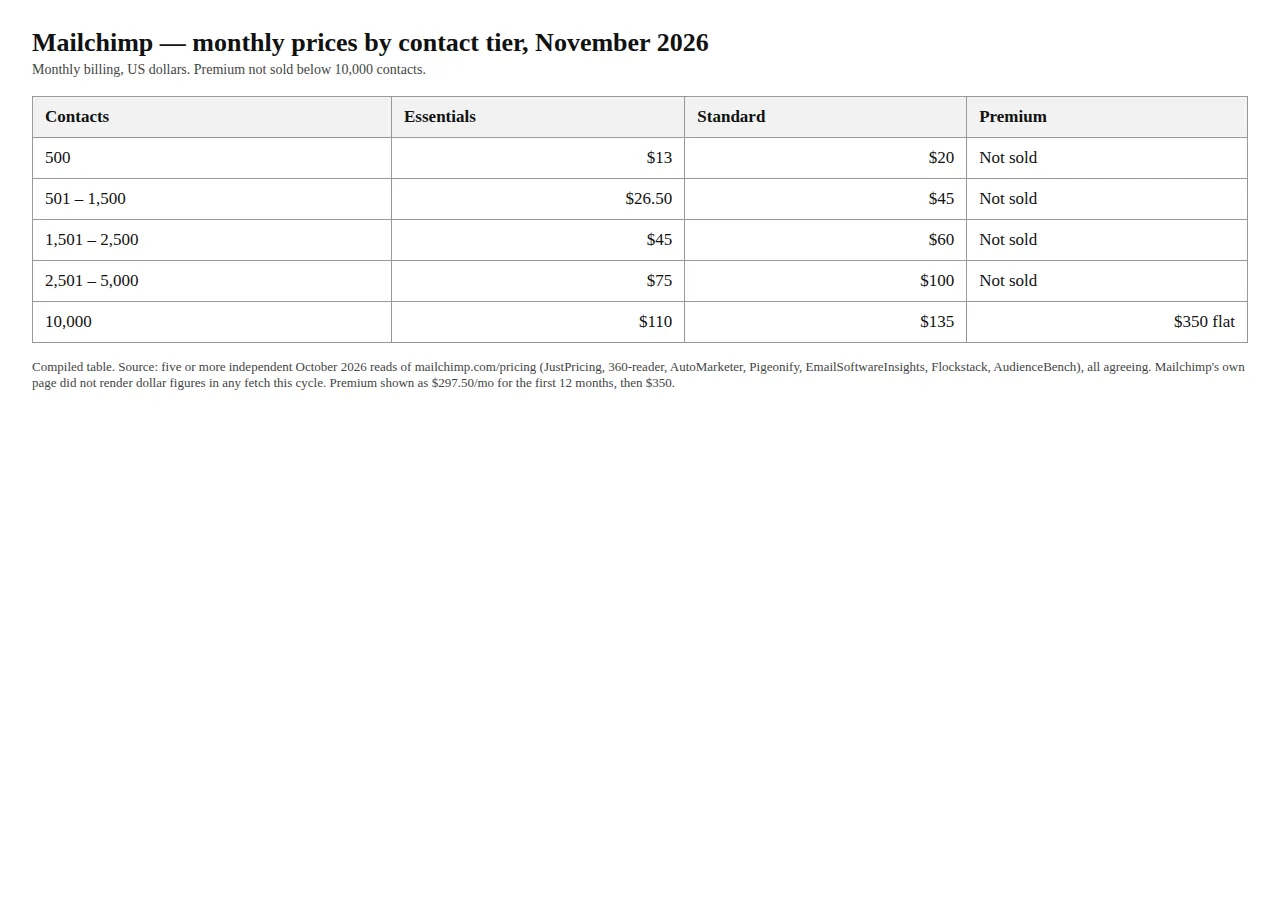
At 500 contacts the two oldest names in small-business email cost almost the same: Mailchimp Essentials at $13 a month, Constant Contact Lite at $12. The $1 gap is the least interesting number here. What matters is what happens at contact 501, at 2,500 contacts, at 10,000 — and when the list stops growing and the bill does not come back down. The pricing-strategy decision — value-based versus cost-plus versus competitor-based — sits in the value-based-pricing-playbook.
Step 1: What you are actually buying
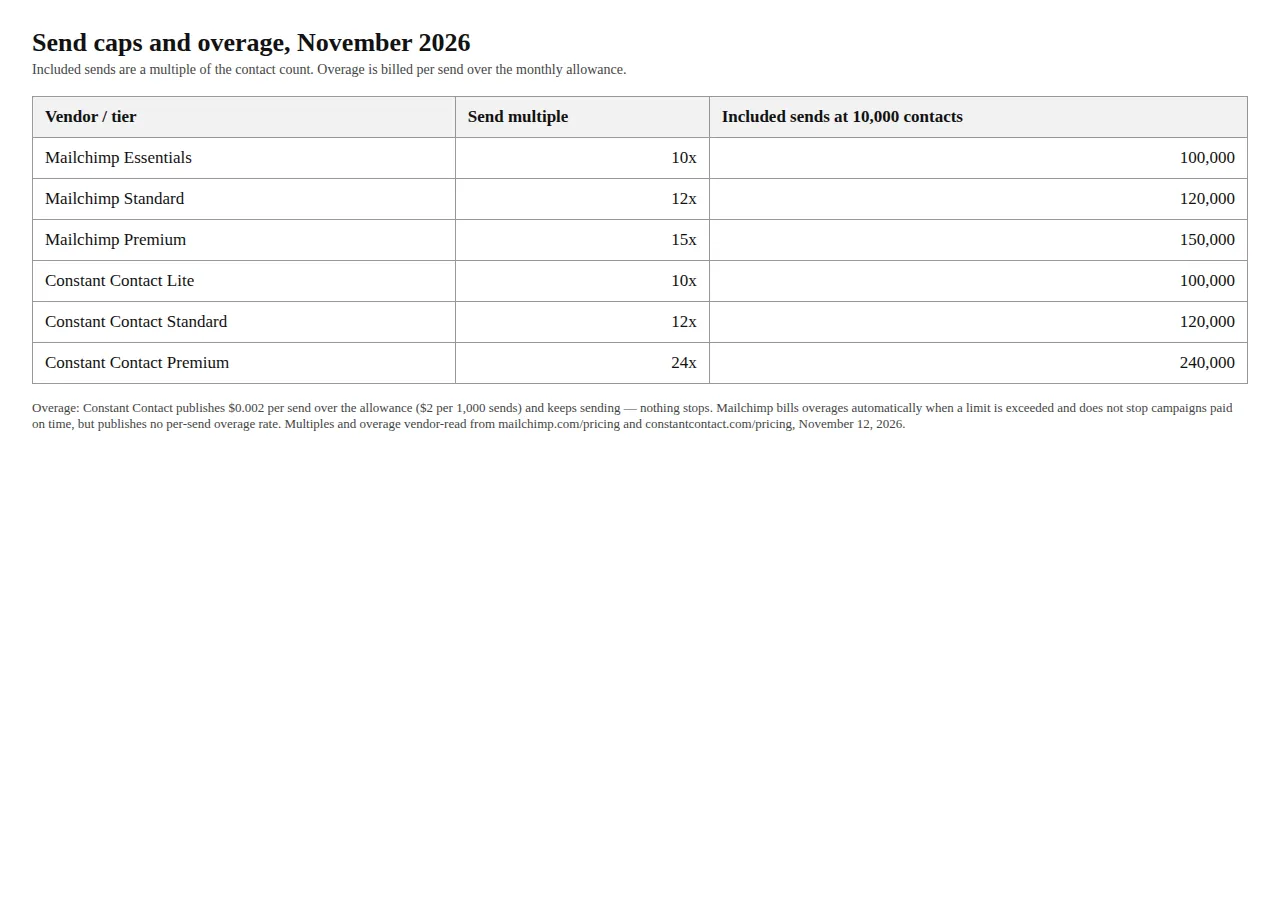
Neither vendor charges per email. Both charge per contact stored, and the send allowance is a multiple of that count. Mailchimp's Free plan holds 250 contacts and 500 sends a month with a 250-a-day cap; Essentials sends 10 times the contact count, Standard 12, Premium 15. Constant Contact has no free plan — a free trial only — and sends 10 times the contact count on Lite, 12 on Standard, 24 on Premium. At 500 contacts the two entry tiers buy the same 5,000 sends a month; at 10,000 the Premium tiers buy very different amounts.
The billing rules behind the meter are where the two vendors genuinely differ. Mailchimp counts subscribed, unsubscribed, and non-subscribed contacts — only archived or deleted contacts are excluded — and bills on the peak contact total for the period, according to the corroborated reads. Constant Contact counts active contacts only, but its tier is set by the highest number the account has ever reached, and deleting contacts does not lower it. A list with 30% dead addresses costs money on Mailchimp until the dead contacts are archived, and on Constant Contact forever.
Step 2: The 2026 vendor ladder, on the vendors' own pages
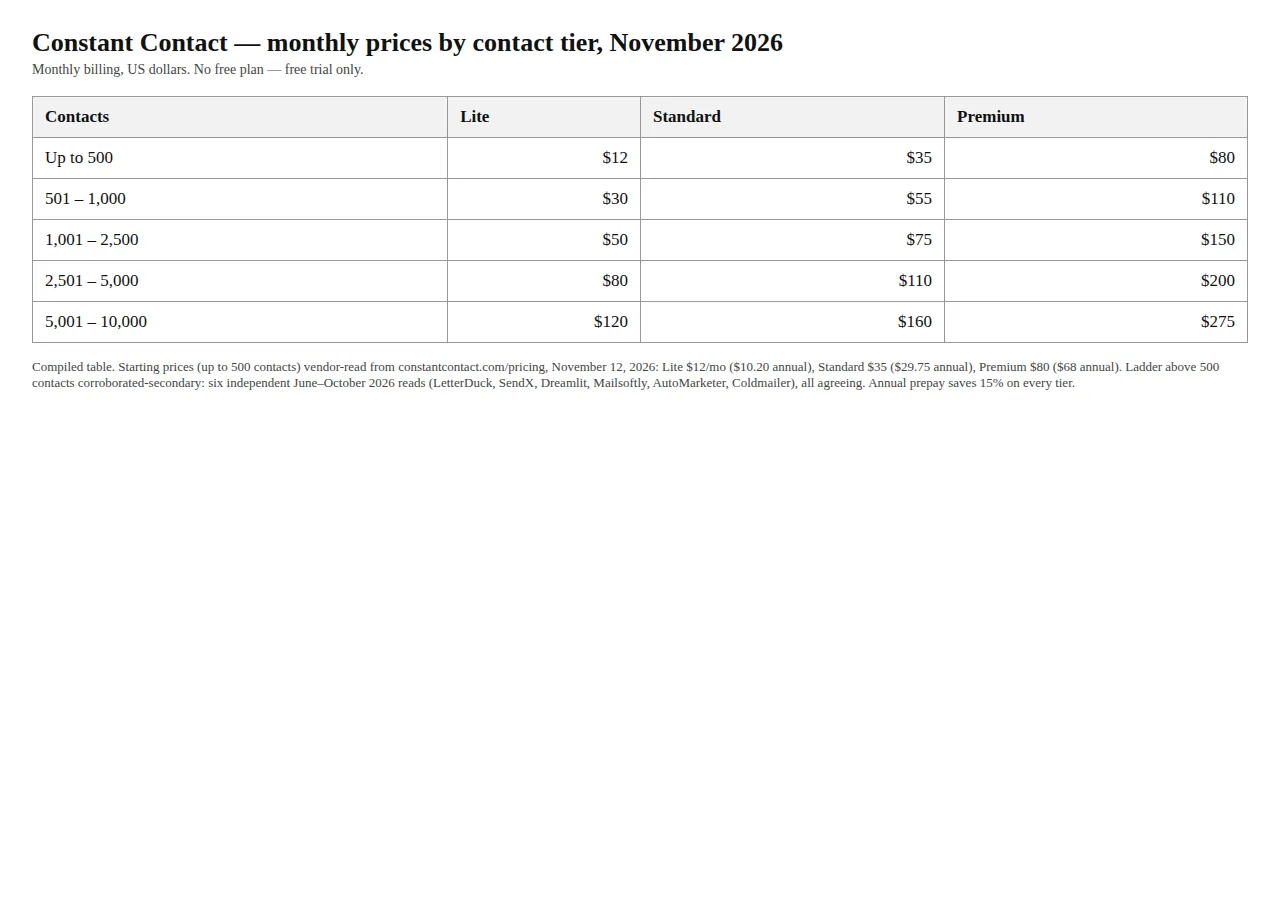
Constant Contact's starting prices were read from its own pricing page on November 12, 2026; the ladder above 500 contacts is corroborated-secondary, as are Mailchimp's dollars — see the sourcing note above. Both ladders are monthly billing in US dollars.
| Vendor | Free tier | Paid tiers (per month, monthly billing) | Authority |
|---|---|---|---|
| Mailchimp | $0, 250 contacts, 500 sends/mo | Essentials $13 at 500, $45 at 2,500, $110 at 10,000; Standard $20, $60, $135; Premium $350 flat to 10,000 | mailchimp.com/pricing (dollars corroborated-secondary, Oct 2026) |
| Constant Contact | None — free trial only | Lite $12 at 500, $50 at 2,500, $120 at 10,000; Standard $35, $75, $160; Premium $80, $150, $275 | constantcontact.com/pricing |
Step 3: Worked example — the ladder at 500, 2,500, and 10,000 contacts
Example: a neighbourhood bakery with 500 contacts on the entry tier. Mailchimp Essentials costs $13 a month, Constant Contact Lite $12 — a $1-a-month gap, $12 a year. On the middle tier the same bakery pays $20 on Mailchimp Standard against $35 on Constant Contact Standard — $15 a month, $180 a year, for the same 6,000 sends. At 500 contacts the entry tier is a coin toss and the middle tier is not: Mailchimp Standard is cheaper by 43%.
Example: the same bakery two years later, at 2,500 contacts. Mailchimp Essentials is $45 a month, Constant Contact Lite $50 — $5 a month cheaper, $60 a year. Mailchimp Standard is $60 against Constant Contact Standard at $75 — $15 a month cheaper, $180 a year. Both entry tiers include 25,000 sends a month at this size, both middle tiers 30,000 — the caps are identical, so the gaps are pure price. Over three years, Mailchimp Essentials costs $1,620 against $1,800 for Constant Contact Lite, a $180 gap.
Example: a regional retailer at 10,000 contacts. Mailchimp Essentials is $110 a month against Constant Contact Lite at $120 — $10 a month, $120 a year. Mailchimp Standard is $135 against Constant Contact Standard at $160 — $25 a month, $300 a year, $900 over three years. Then the Premium tiers flip: Constant Contact Premium is $275 a month against Mailchimp Premium at $350 — $75 a month cheaper, $900 a year, $2,700 over three years. Mailchimp's first-year Premium promo at $297.50 narrows the gap to $22.50 a month, $270 a year, but the promo ends after twelve months and the $350 list price returns.
Step 4: Annual billing and the 501-contact cliff
Constant Contact's annual prepay saves exactly 15% on every tier, printed on the vendor's own page: Lite $12 to $10.20 a month, Standard $35 to $29.75, Premium $80 to $68. At 500 contacts that is $21.60 a year on Lite, $63.00 on Standard, $144.00 on Premium. Mailchimp publishes no annual discount for Essentials or Standard at small list sizes — annual plans exist only for Premium and Standard at 10,000-plus contacts, priced on application. A 500-contact buyer who wants the annual discount gets one from Constant Contact and none, as published, from Mailchimp. Mailchimp's only published first-year saving at scale is 15% off Standard for 10,000-plus contacts: $135 a month becomes $114.75, a $20.25-a-month saving, $243.00 for the first year.
The cliff should decide the migration timing, not the headline price. Both ladders step at 501 contacts. Constant Contact Lite jumps from $12 to $30 a month for contact 501 — $18 a month more, 150%, $216 a year, for one extra contact. Mailchimp Essentials jumps from $13 to $26.50 — $13.50 more, 104%, $162 a year. The middle tiers step just as hard: Constant Contact Standard $35 to $55, Mailchimp Standard $20 to $45.
Step 5: Send caps, overage, and the per-send cost
The send cap is a multiple, and the multiple is the ceiling that bites first. At 2,500 contacts, the entry tiers both include 25,000 sends a month, the middle tiers 30,000. At 10,000 contacts the Premium multiples diverge: Mailchimp Premium includes 150,000 sends, Constant Contact Premium 240,000 — 90,000 more for $75 less a month.
At 10,000 contacts, Mailchimp Premium costs $350 for 150,000 included sends, $0.00233 per send; Constant Contact Premium costs $275 for 240,000, $0.00115 per send — half the cost per included send.
Overage is where the two vendors' tempers show. Constant Contact publishes its rate: $0.002 for every send over the monthly allowance, or $2 for every 1,000 sends over — and the emails still go out, nothing stops. A Lite account at 2,500 contacts, capped at 25,000 sends, that sends 30,000 emails in a month pays 5,000 times $0.002, or $10.00 extra. Mailchimp bills overages automatically when a limit is exceeded and does not stop the campaigns if paid on time — but it publishes no per-send overage rate, so the overage cost cannot be computed in advance. A buyer who regularly exceeds the cap can price the Constant Contact overage to the cent and cannot price Mailchimp's at all.
Step 6: Deliverability — authentication is the real price of admission
The cheapest plan that never reaches the inbox is the most expensive plan either vendor sells. Mailchimp's own help pages state the groundwork: Gmail and Yahoo require custom authentication and a published DMARC record for anyone sending more than 5,000 emails to their addresses in a 24-hour period. Authentication means two CNAME records for DKIM and one TXT record for DMARC in the domain's DNS records, and it applies only to a domain the business owns and controls — a free Gmail or Yahoo address cannot be authenticated as a From address. Mailchimp offers automated setup through Entri, which connects to the DNS provider and writes the records; the manual route is the same two CNAME records and one TXT record, verified first and authenticated second.
Constant Contact reports a 98% inbox rate from the 2025 Validity Everest qualified inbox test. Mailchimp's own account banners warn that emails from an unauthenticated domain may miss 74% of inboxes. The two numbers are not comparable — different tests, different years — but the direction is the same: authentication is not optional, and the buyer who picks a vendor before authenticating the domain is choosing a price for a product that does not work.
Who should pick which
Pick Mailchimp when the list is under 10,000 contacts and the middle tier matters: Standard is cheaper at every published contact count, by $15 a month at 500 and 2,500 contacts and $25 at 10,000, with the same send caps and 200 automation flows against Constant Contact's three templates. Pick Mailchimp when the free plan is the on-ramp: 250 contacts and 500 sends a month cost $0, against $12 a month on Constant Contact from the first contact.
Pick Constant Contact when the list is 10,000 contacts and Premium is in play: $275 a month against $350, with 240,000 included sends against 150,000, and the annual prepay takes Premium to $68 a month at 500 contacts. Pick Constant Contact when the buyer wants a person on the phone: live phone and chat support on every plan, while Mailchimp reserves phone and priority support for Premium. Pick Constant Contact when the overage must be priced in advance: $0.002 a send, published, against Mailchimp's unpublished rate.
Avoid Mailchimp Premium below 10,000 contacts — it is not sold that small, and the $350 entry price buys nothing a $135 Standard plan does not cover at that size. Avoid Constant Contact Lite past 500 contacts without checking the band: the jump to $30 at contact 501 is the steepest step on either ladder. The klaviyo-vs-mailchimp-vs-convertkit-email-marketing-pricing-automation playbook prices the three-way ladder, the mailchimp-vs-klaviyo-vs-activecampaign-email-automation-playbook runs the automation head-to-head, the hubspot-vs-mailchimp-email-marketing-automation-playbook prices the CRM-suite alternative.
Before the first charge, each platform collects the billing identity it needs: the business legal name and billing address, and the tax identity behind them. A nonprofit claiming Constant Contact's 20% or 30% prepay discount must send the federal Letter of Determination for a 501(c)(3) or 501(c)(6) — a Tax Pay ID document does not count, because the determination letter carries the EIN. An LLC or S-Corp signs up under the entity's legal name and EIN; a sole proprietor under a personal name and an SSN or ITIN. The contact list arrives as a CSV import, and the API syncs it after that — but the billing identity is fixed at signup, and a CPA should confirm the entity name on the invoice matches the entity on the tax return.
The build operation, start to finish
- Count the list honestly first: active, unsubscribed, and dead contacts in separate piles. Archive the dead on Mailchimp before the first invoice; on Constant Contact, confirm the peak count before importing.
- Price the ladder at the next band, not the current one: 501 contacts, 2,500, and 10,000, with the cliff cost at each step.
- Compute the send cap: contacts times the multiple — 10x entry, 12x middle, 15x Mailchimp Premium, 24x Constant Contact Premium — and check it against real monthly volume.
- Authenticate the domain before the first campaign: two CNAME records for DKIM, one TXT record for DMARC, verified first, authenticated second. Never send from a free Gmail or Yahoo address.
- Run the free tier or trial to the limit before paying: Mailchimp Free covers 250 contacts and 500 sends; Constant Contact's trial is 30 days and 100 test sends.
- Price the annual term against the monthly term: Constant Contact's 15% prepay saves $21.60 a year on Lite and $144.00 on Premium at 500 contacts; Mailchimp publishes no annual saving.
- [x] Archive dead contacts before importing, and confirm the peak count.
- [x] Price the ladder at 501, 2,500, and 10,000 contacts, cliff included.
- [x] Compute the send cap as contacts times the multiple, and check it against real volume.
- [x] Authenticate the domain with DKIM and DMARC before the first campaign.
- [x] Run the free tier or trial to its limit before the first invoice.
- [x] Compare the annual prepay saving against the monthly price before committing.
- [x] Run the switch through the roi-calculator before moving lists: the fee saving must beat the migration cost.
Founder & CEO Insight — Enow A. Jovial