Every email platform sells the same promise: set up a journey once and let it sell while you sleep. The promise is real, but the price is the ceiling inside the plan, not the number on the page. Mailchimp caps Essentials flows at 4 steps. ActiveCampaign caps Starter automations at 5 actions. Klaviyo publishes no step cap and charges by active profile.
This is the automation comparison, not the pricing comparison; the pricing head-to-head is the Klaviyo vs Mailchimp vs ConvertKit pricing guide. The question here: what can each platform automate, where does it stop, and what does the next rung cost.
Why the ceiling matters more than the sticker price
A welcome flow is the smallest serious automation a business runs, and it already exposes every ceiling here. A normal welcome series is three emails, two waits, one tag, and one branch for buyers versus non-buyers: seven steps. Mailchimp Essentials allows 4. ActiveCampaign Starter allows 5 actions, and the branch is not available at any action count because If/Else starts on Plus.
Hitting a ceiling costs a rebuild, not just an upgrade: a flow squeezed from seven steps into four loses its branch or its win-back timing. Our editorial analysis found the same pattern on all three: the entry tier is priced to look cheap and engineered to be outgrown.
> [!KEY TAKEAWAY]
> Judge a platform by the longest flow you will run, not by the cheapest plan on its page. Seven steps on a four-step plan buys a rebuild and an upgrade, in that order.
Mailchimp: the journey builder with a hard step ceiling
Mailchimp calls its builder Marketing Automation Flows: a visual map of triggers, rules, and actions. A trigger adds a contact to a flow; the steps after it send, wait, tag, split, or call a webhook.
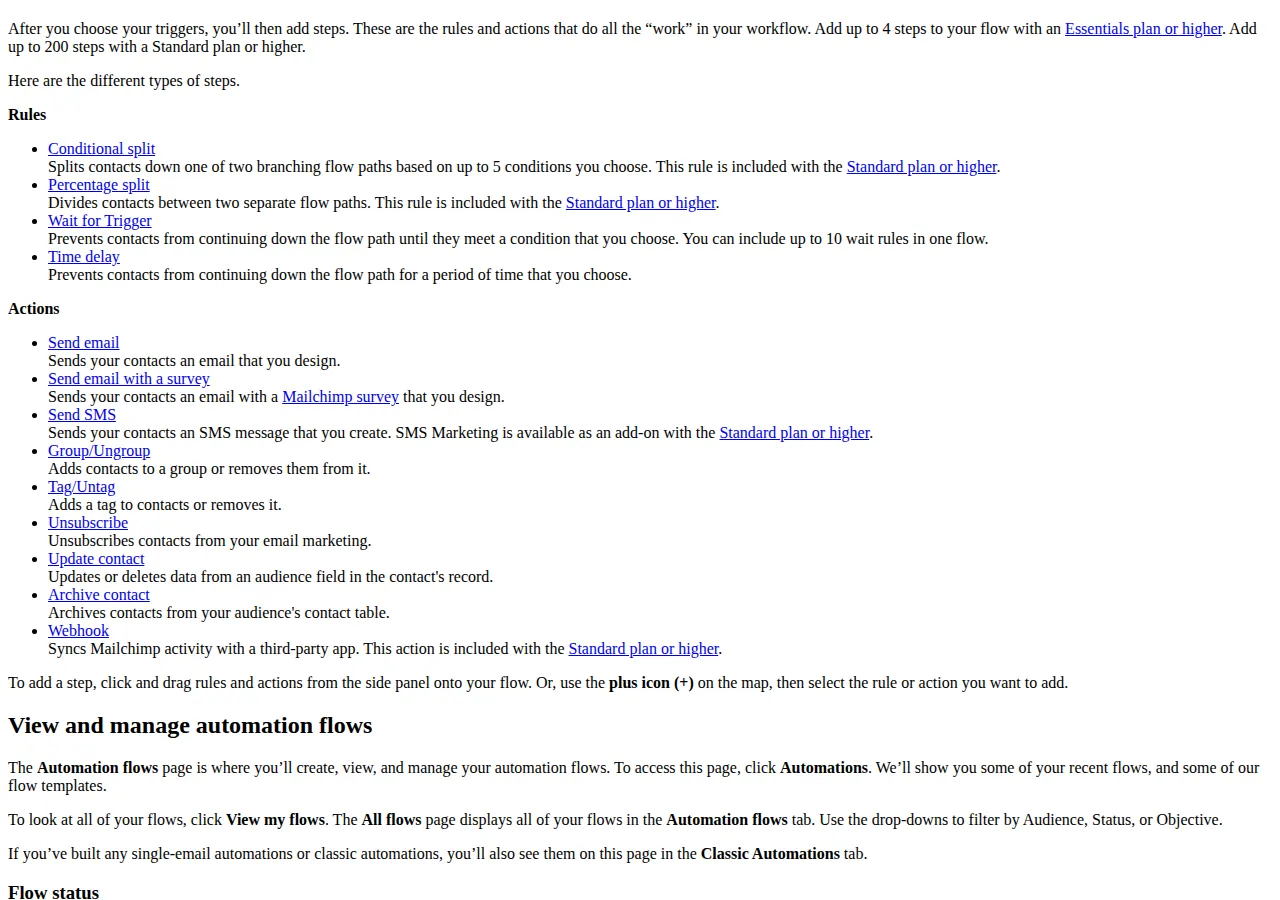
The ceilings are published in Mailchimp help documentation and confirmed on its pricing page. The Free plan includes no marketing automation flows; it holds up to 250 contacts and 500 sends a month. Essentials allows flows of up to 4 steps. Standard and Premium allow up to 200 steps per flow, up to 3 triggers, conditional splits, percentage splits, and webhook actions. Standard adds advanced segmentation, dynamic content, send-time optimization, and custom reports.
!Mailchimp help page: 4 steps on Essentials, 200 steps on Standard
The ladder runs on monthly billing, corroborated across October 2026 reads. Essentials costs $13 at 500 contacts, $26.50 at 1,500, $75 at 5,000, $110 at 10,000, and $385 at 50,000; Standard costs $20, $45, $100, $135, and $450 at the same bands. Mailchimp offers 15 percent off the first 12 months at 10,000 contacts and above.
Mailchimp bills on stored contacts, and unsubscribed and non-subscribed contacts count until archived or deleted. Sends run at 10, 12, or 15 times the contact count on Essentials, Standard, and Premium.
Klaviyo: no step cap, but every profile pays
Klaviyo is a customer data platform that sends email. Every contact is a profile carrying order history, browsing events, and predicted value. A flow can trigger on Started Checkout or Placed Order, split on cart value or order count, and report revenue per recipient. Its help documentation describes multi-branch splits routing profiles down up to 20 paths in a single split.
There is no published step cap for Klaviyo flows and no tier that unlocks deeper branching. The free plan covers up to 250 active profiles and 500 email sends a month, plus $5 of mobile messages and $5 of Composer usage. Every paid tier carries the same flow and segmentation capability; the tiers differ by list size, not automation depth. On Klaviyo you never pay an upgrade to unlock a branch. You pay for profiles.
The price of that structure is the active-profile billing model, adopted in February 2025. The bill counts every active profile, defined as any contact who can receive marketing. Suppressed profiles are not billed, but every browsing visitor and lapsed customer who can still receive marketing counts. The Email plan ladder, read from the pricing calculator and corroborated across October and November 2026 reads, is $20 a month for 251 to 500 profiles, $30 at 1,000, $100 at 5,000, $150 at 10,000, $400 at 25,000, and $720 at 50,000, with roughly 10 email sends per profile per month and no annual discount on self-serve plans. SMS starts at $15 a month for 1,250 credits.
> [!WARNING]
> Klaviyo bills on active profiles, not on emails sent. A store that imports 50,000 profiles and emails 5,000 pays for all 50,000.
ActiveCampaign: the deepest builder, gated by actions
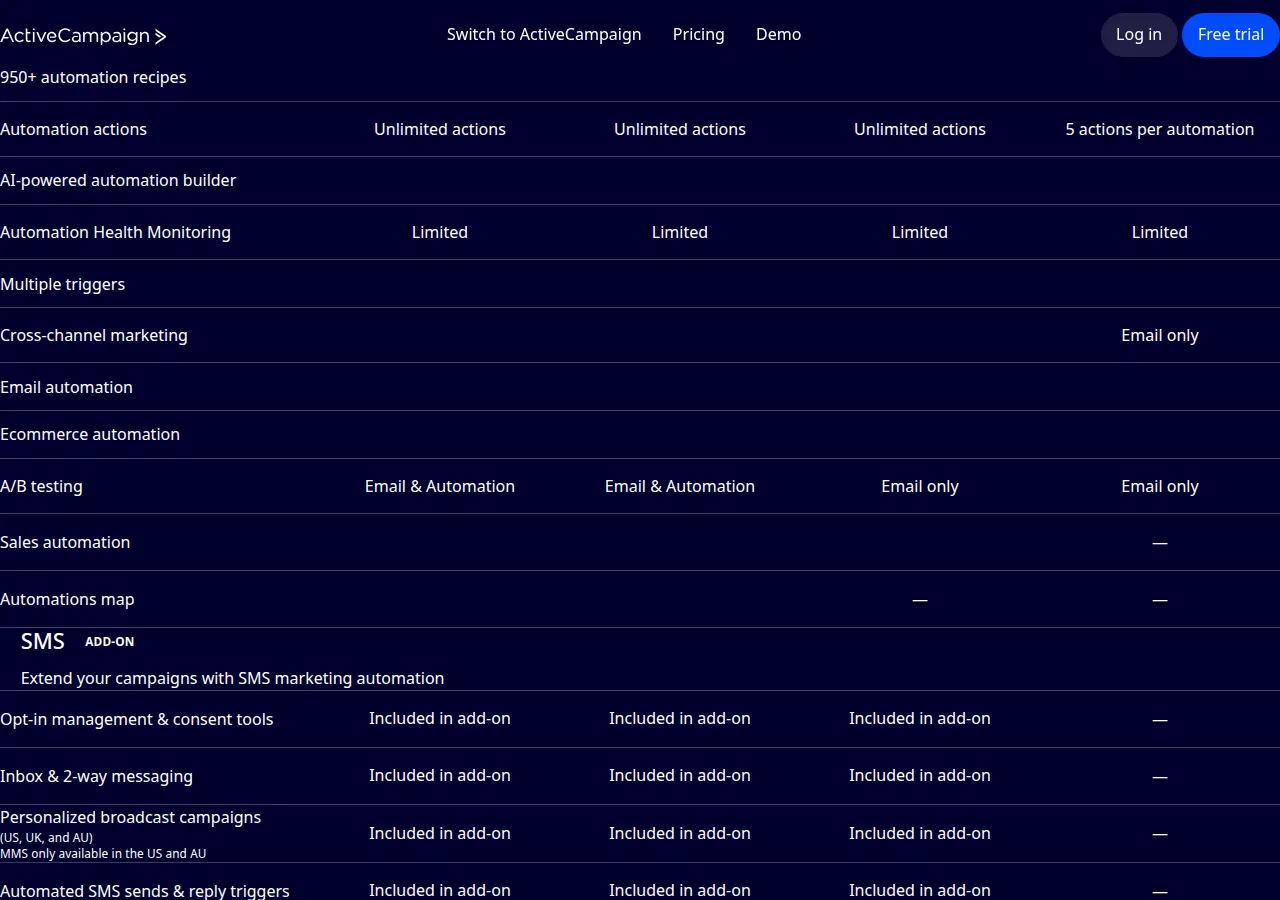
ActiveCampaign is the automation-first platform of the three. There is no free plan, only a 14-day trial on the Professional plan. Starter is priced for campaigns with light automation: 1 user seat with the ability to purchase one more, a maximum of 25,000 contacts, and 5 actions per automation. Plus adds unlimited actions, If/Else, webhooks, and landing pages. Professional adds split-path testing, predictive sending, conditional content, and attribution. Enterprise adds 5 seats, single sign-on, and HIPAA support.
A trigger does not count among the actions. A welcome sequence of subscribe trigger, wait one day, send email, wait two days, send second email uses four actions and fits Starter. Add one decision, if the contact opened the first email go to path A, if not go to path B, and the automation needs Plus, because If/Else is not a Starter action. Conditions, waits, and webhooks each count, so a standard onboarding flow passes the Starter limit before it is finished.
Prices are billed yearly on the pricing page, which shows only the yearly-billed figures. At 1,000 contacts Starter is $15 a month, Plus $49, Pro $79, and Enterprise $145. Monthly billing costs more: Starter $19 and Plus $59 a month at 1,000 contacts. At 10,000 contacts the billed-yearly prices are $149, $189, $375, and $589. At 50,000 contacts Plus is $609, Pro $969, and Enterprise $1,169, and Starter is not offered above 25,000 contacts.
For accounts created on or after November 3, 2025, every contact counts toward the limit whatever its list status, including unsubscribed and bounced contacts.
!ActiveCampaign pricing table: 5 actions per automation on Starter, unlimited on Plus and above
The decision table
| Dimension | Mailchimp | Klaviyo | ActiveCampaign | Authority |
| :--- | :--- | :--- | :--- | :--- |
| Entry-tier ceiling | 4 steps per flow, no flows on Free | No published step cap | 5 actions per automation, no If/Else | Vendor help pages |
| Mid-tier ceiling | 200 steps, 3 triggers, branching | Same as entry, unlimited segments | Unlimited actions, If/Else, no split-path | Vendor help pages |
| Branching depth | Conditional and percentage splits on Standard | Multi-branch splits, up to 20 paths | Split-path testing on Professional | Vendor help pages |
| Segmentation | Advanced on Standard | Unlimited, behavioural and predicted | Limited on Starter, advanced on Pro | Vendor pricing pages |
| Free tier | 250 contacts, 500 sends a month | 250 active profiles, 500 sends a month | No free plan, 14-day trial | Vendor pricing pages |
| Billing unit | Stored contacts, including unsubscribed | Active profiles, suppressed not billed | All contacts on new accounts | Vendor pricing pages |
The per-contact cost math
Price per contact is the only honest way to compare three vendors that bill on three different units: monthly price divided by contacts, at the automation-capable tier, meaning the cheapest tier holding a branched welcome flow: Mailchimp Standard, Klaviyo Email, and ActiveCampaign Plus.
$
\\text{Cost per contact per month} = \\frac{\\text{monthly price at the automation-capable tier}}{\\text{contacts}}
$
| Contacts | Mailchimp Standard | Klaviyo Email | ActiveCampaign Plus | Cheapest |
| :--- | :--- | :--- | :--- | :--- |
| 1,000 | $45/mo, $0.0450 per contact, $540/yr | $30/mo, $0.0300 per contact, $360/yr | $49/mo, $0.0490 per contact, $588/yr | Klaviyo |
| 10,000 | $135/mo, $0.0135 per contact, $1,620/yr | $150/mo, $0.0150 per contact, $1,800/yr | $189/mo, $0.0189 per contact, $2,268/yr | Mailchimp |
| 50,000 | $450/mo, $0.0090 per contact, $5,400/yr | $720/mo, $0.0144 per contact, $8,640/yr | $609/mo, $0.0122 per contact, $7,308/yr | Mailchimp |
The ranking flips between 1,000 and 10,000 contacts. Below roughly 5,000 Klaviyo is cheapest because its ladder starts low and its automation needs no upgrade. Above 10,000 Mailchimp Standard is cheapest because its ladder flattens while Klaviyo keeps climbing per profile. ActiveCampaign Plus is never the cheapest: its price buys branching and CRM behavior the other two do not offer at the same tier.
> [!TIP]
> Price the tier you will need in twelve months. The ROI calculator runs the same monthly-to-annual conversion against any price you enter.
The forced-upgrade break-even
The second calculation is the one vendors never print: what the ceiling costs when your flow outgrows it. Take a business with 1,000 contacts running a seven-step branched welcome flow. Mailchimp Essentials and ActiveCampaign Starter cannot hold it, so the business moves to Standard or Plus. On Klaviyo there is no move.
$
\\text{Forced upgrade premium} = \\text{price of the tier that fits} - \\text{price of the entry tier}
$
Mailchimp at 1,000 contacts: $45 minus $26.50 is $18.50 a month, or $222 a year. ActiveCampaign at 1,000 contacts: $49 minus $15 is $34 a month, or $408 a year. Klaviyo at 1,000 contacts: $30 minus $30 is $0, because the Email plan already holds the flow. That $408 is the honest price of ActiveCampaign for a small business, not $15. At 50,000 contacts the logic cuts the other way: Mailchimp Standard at $450 is $270 a month cheaper than Klaviyo at $720, or $3,240 a year.
Segmentation: where the three platforms actually differ
Mailchimp Standard adds advanced segmentation with nested conditions, plus dynamic content that changes blocks inside one email by segment, so one campaign can carry different offers for buyers and browsers.
Klaviyo segments on anything the profile holds: purchase count, product category, engagement recency, predicted lifetime value, and any custom event the store sends, with no segment limit and real-time updates. Klaviyo segments answer behavioral questions, such as who viewed a product three times without buying, while Mailchimp segments answer audience questions, such as who is tagged as a buyer.
ActiveCampaign segments by tier: limited on Starter, standard on Plus, advanced on Pro. For keeping segments clean enough to deliver, read the cold email deliverability guide on SPF, DKIM and DMARC, and for turning behavioral segments into scored leads, the AI lead scoring and CRM integration guide works through the scoring model.
Compliance: the law does not care which platform sent it
Every flow here sends commercial email, governed in the United States by the CAN-SPAM Act of 2003, enforced by the Federal Trade Commission. The FTC compliance guide states the rule plainly: each separate email in violation of the Act is subject to penalties of up to $53,088. The law makes no exception for business-to-business email. The guide lists eight requirements, including honest headers, a valid physical postal address, a clear opt-out, and honoring opt-out requests within 10 business days.
The exposure math is why automation needs a compliance step, not only a creative step. A single non-compliant campaign to a 1,000-contact list carries a theoretical maximum exposure of:
$
\\text{Maximum exposure} = 1{,}000 \\times \\$53{,}088 = \\$53{,}088{,}000
$
The penalty is per email, so an automation that sends the wrong message to the whole list multiplies the mistake by the list size and the send frequency. Build the opt-out and address blocks into the flow template before the first send.
Who should NOT buy each platform
Mailchimp fails a store whose revenue depends on behavioral triggers: Essentials cannot hold the flows. It also fails a list heavy with unsubscribed addresses.
Klaviyo fails a content business with no store: its entire advantage is order and browsing data on the profile. It also fails a list built by import rather than by consent.
ActiveCampaign fails a solo operator who sends a weekly newsletter and a welcome email: Starter fits that job at $15 a month billed yearly, but the moment the welcome email grows a branch, the bill is $49. It also fails a team of four: Plus includes 1 seat and Professional is the first tier with 3.
The seven-step build
Build in this order, on any of the three platforms.
1. Count the billable audience first. On Mailchimp count stored contacts including unsubscribed. On Klaviyo count active profiles and suppress the rest. On ActiveCampaign count every contact on accounts created after November 3, 2025.
2. Write the longest flow on paper. List every trigger, wait, email, tag, condition, and branch, and count the steps against the ceiling: 4 on Mailchimp Essentials, 5 actions on ActiveCampaign Starter, no cap on Klaviyo.
3. Build the four core flows first. Welcome, abandoned cart, post-purchase, and win-back. Measure revenue per recipient for each before adding a fifth.
4. Set the segment before the automation. Build engaged, lapsed, and never-purchased segments first.
5. Put compliance inside the template. Physical postal address, clear opt-out, honest subject line, accurate From name.
6. Run one live contact through each path. Enter as a test profile and confirm every email arrives and every tag applies.
7. Calendar the ceiling review. Every quarter, compare the longest flow against the plan ceiling and the list size against the next price band.
The pre-launch checklist
Run this checklist before any flow goes live.
> [!FOUNDER]
> Founders pick an email platform the way they pick a phone plan: by the cheapest monthly number. Then the welcome flow needs a seventh step, the branch needs a tier they did not buy, and the rebuild costs more than a year of the right plan. Count the steps before you count the dollars.
> — Enow A. Jovial, Founder & Chief Executive Officer
Our editorial analysis found the three platforms differ less on price than on where they put the wall: Mailchimp at 4 steps, ActiveCampaign at 5 actions with no branching, Klaviyo with no wall at all. Pick the wall you can live with, price the tier that removes it, and build the four flows that earn the price first.