Mailchimp, Brevo, and Omnisend all send email, and the headline price is the least useful number on each pricing page. The comparison that matters is the billing unit: Mailchimp and Omnisend charge per contact stored, Brevo per email sent. Every figure here was read from the vendors' own pricing pages on 15 November 2026, and every cost below is worked from a fixed workload of four emails per contact per month.
Three vendors, three billing theories
Mailchimp sells Free, Essentials, Standard, and Premium, priced by stored contacts, with a monthly send allowance set as a multiple of the contact count: 10 times on Essentials, 12 times on Standard, 15 times on Premium. The free plan covers 250 contacts and 500 sends a month, and Mailchimp offers 15 percent off the first 12 months for lists of 10,000 contacts or more. Mailchimp bills on stored contacts, and unsubscribed contacts count until archived.
Brevo sells Free, Starter, Standard, Professional, and Enterprise, priced by monthly email volume rather than list size. Starter starts at $9 a month and Standard at $18 a month, both for 5,000 emails; Professional starts at $499 a month for 150,000 emails, and annual billing saves 10 percent. The catch sits in Brevo's own pricing reference: each send tier caps stored contacts — 500 at 5,000 emails, 1,500 at 10,000, 2,500 at 15,000, and 500,000 only from 20,000 emails a month.
Omnisend sells Free, Standard, and Pro, priced by billable contacts. Standard starts at $16 a month for 500 contacts and 6,000 sends; Pro starts at $59 a month for up to 2,500 contacts with unlimited sends. Paying three months upfront cuts the first three months by 30 percent. Omnisend bills subscribers and non-subscribers who received automated messages; unsubscribed contacts are not billed. SMS is sold separately, from $0.007 per message at high volume.
Mailchimp: the broadest platform, the steepest contact ladder
Mailchimp Standard is the plan most buyers land on, because Essentials caps automation flows at 4 steps while Standard and Premium allow up to 200 steps per flow. Standard adds advanced segmentation, dynamic content, send-time optimisation, custom reports, and predictive segmentation. The contact ladder, read from the pricing calculator and corroborated across October and November 2026 reads, runs $20 at 500 contacts, $45 at 1,000, $100 at 5,000, $135 at 10,000, $310 at 25,000, and $450 at 50,000 a month.
Going from 1,000 to 50,000 contacts multiplies the Standard bill by exactly 10, from $45 to $450, while the list multiplies by 50. If a limit is hit, Mailchimp bills overages automatically rather than pausing the account. The 15 percent first-year discount at 10,000 contacts or more cuts Standard to $114.75 a month at 10,000 and $382.50 at 50,000.
Brevo: the cheapest sends, with a contact cap that bites early
Brevo Standard is the only plan here where the bill follows how much you send rather than how many people you store. The volume ladder, read from Brevo's pricing calculator and corroborated across September to November 2026 reads, runs $18 for 5,000 emails, $35 for 10,000, $69 for 20,000, $89 for 40,000, $97 for 50,000, $139 for 100,000, $179 for 150,000, $249 for 250,000, and $429 for 500,000 a month. Standard adds unlimited multi-step automated workflows, A/B testing, advanced reporting with click heatmaps, AI send-time optimisation, and one landing page.
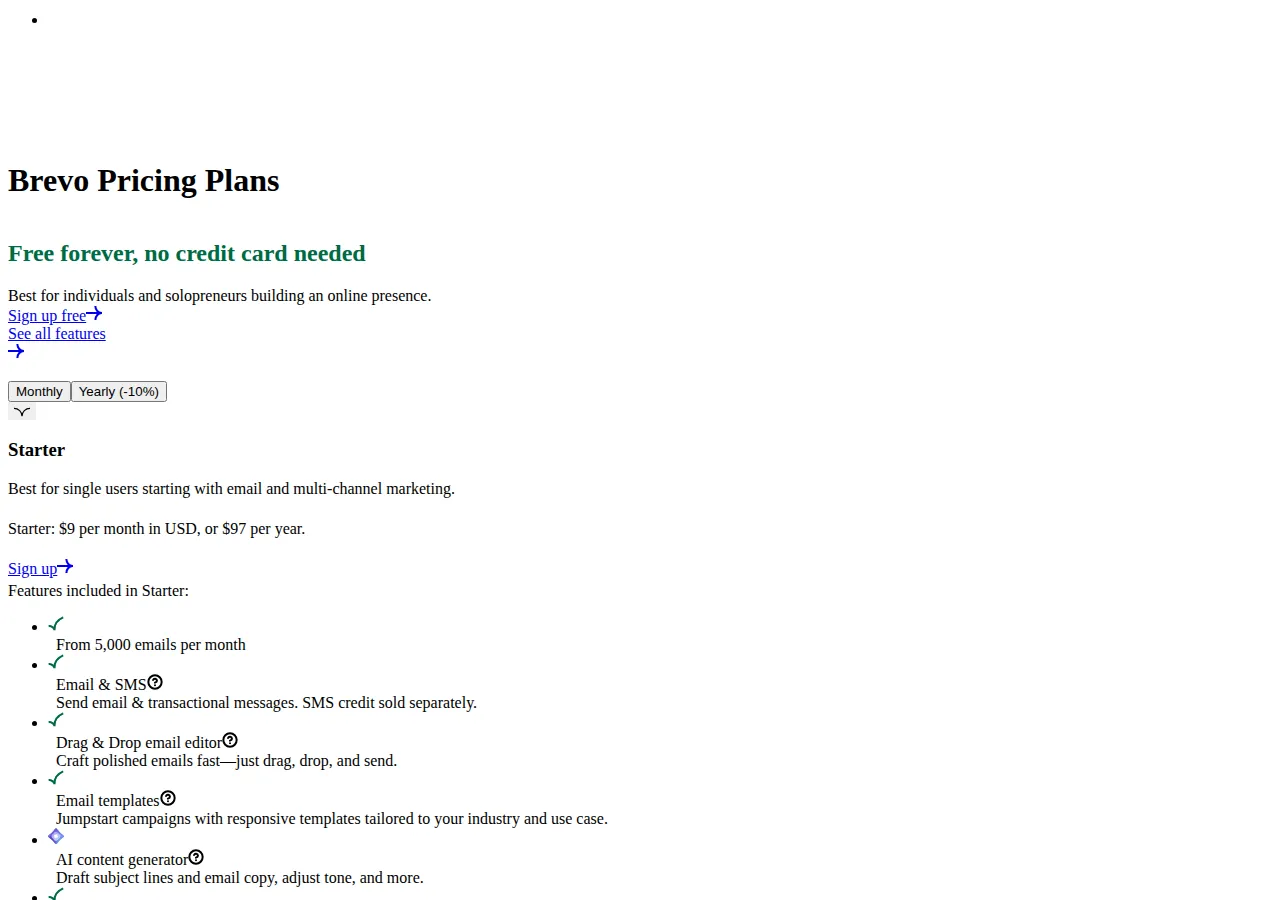
The contact cap is the trap most buyers miss. A 1,000-contact list cannot use the $18 tier at all, because that tier stores only 500 contacts — the buyer must pay $35 for the 10,000-email tier, even though the workload needs only 4,000 sends. The same logic turns generous at scale: once volume reaches 20,000 emails a month, the cap jumps to 500,000 contacts, so a 50,000-contact list pays for sends alone. Brevo's free plan stores up to 100,000 contacts but sends only 300 emails a day.
Omnisend: the ecommerce pick, priced to undercut at scale
Omnisend Standard is built for stores. Its ladder, read from the pricing slider and corroborated across September to November 2026 reads, runs $16 at 500 contacts, $20 at 1,000, $81 at 5,000, $132 at 10,000, $282 at 25,000, and $413 at 50,000 a month, with 12 times the contact count in sends. Pro starts at $59 a month for up to 2,500 contacts with unlimited sends, and runs $150 at 10,000 contacts and $715 at 50,000.
Omnisend undercuts Mailchimp Standard by $25 a month at 1,000 contacts, by only $3 at 10,000, and by $37 at 50,000. Pro is the interesting tier for a heavy sender: at 10,000 contacts it costs $150, only $15 more than Mailchimp Standard, and it removes the send cap entirely. SMS is priced separately, from $0.007 per message at high volume, and new accounts need Pro plus a separate SMS subscription. An account expert is provided free to anyone paying at least $400 a month.
The cost math: 1,000, 10,000, and 50,000 contacts at four sends a month
Method: four emails per contact per month, one weekly newsletter plus one automated message. Monthly billing, United States dollars, before tax, list prices with no promo applied. Brevo's tier is chosen by sends first, then checked against its contact cap.
At 1,000 contacts the workload is 4,000 sends a month. Mailchimp Standard costs $45, Omnisend Standard costs $20, and Brevo Standard costs $35 — not $18, because the $18 tier stores only 500 contacts. Over 12 months that is $540 for Mailchimp, $240 for Omnisend, and $420 for Brevo.
At 10,000 contacts the workload is 40,000 sends a month. Mailchimp Standard costs $135, Omnisend Standard costs $132, and Brevo Standard costs $89 for its 40,000-send tier. Over 12 months that is $1,620 for Mailchimp, $1,584 for Omnisend, and $1,068 for Brevo.
At 50,000 contacts the workload is 200,000 sends a month. Mailchimp Standard costs $450, Omnisend Standard costs $413, and Brevo Standard has no published 200,000-send step, so the buyer takes the next published step — 250,000 sends at $249 a month. Over 12 months that is $5,400, $4,956, and $2,988 respectively.
| Contacts | Sends /mo | Mailchimp Standard | Omnisend Standard | Brevo Standard | Cheapest |
|---|---|---|---|---|---|
| 1,000 | 4,000 | $45 /mo, $540 /yr | $20 /mo, $240 /yr | $35 /mo, $420 /yr | Omnisend |
| 10,000 | 40,000 | $135 /mo, $1,620 /yr | $132 /mo, $1,584 /yr | $89 /mo, $1,068 /yr | Brevo |
| 50,000 | 200,000 | $450 /mo, $5,400 /yr | $413 /mo, $4,956 /yr | $249 /mo, $2,988 /yr | Brevo |
Ranking flips once, between 1,000 and 10,000 contacts, because Brevo's price follows sends while the other two follow contacts.
Cost per 1,000 sends: the number that exposes the model
Cost per 1,000 sends is the honest unit when vendors bill on different things. At 4,000 sends: Mailchimp $11.25, Omnisend $5.00, Brevo $8.75. At 40,000 sends: $3.38, $3.30, $2.23. At 200,000 sends: $2.25, $2.07, $1.25 — or $1.00 on the 250,000 sends actually purchased. Brevo's curve is steepest, falling 86 percent from 1,000 to 50,000 contacts, against 80 percent for Mailchimp and 59 percent for Omnisend.
The break-even: how often you send decides the winner
Four sends a month is a moderate cadence. Raise it and Brevo's bill climbs while Mailchimp's and Omnisend's do not, because their price is set by contacts. At 10,000 contacts, six sends per contact per month is 60,000 sends: Brevo Standard costs $104, against $135 for Mailchimp and $132 for Omnisend. At eight sends the workload is 80,000 sends: Brevo Standard costs $139, against the same $135 and $132. The crossover sits between 6 and 8 sends per contact per month at 10,000 contacts.
For a quiet list the logic runs in reverse. At two sends per contact per month, 10,000 contacts need 20,000 sends: Brevo Standard costs $69, against $135 for Mailchimp and $132 for Omnisend, saving $792 a year against Mailchimp. The rule fits on a napkin: below seven sends per contact per month, Brevo wins; above seven, Mailchimp or Omnisend wins.
The decision table
| Factor | Mailchimp Standard | Brevo Standard | Omnisend Standard | Authority |
|---|---|---|---|---|
| Billing unit | Contacts stored | Emails sent | Contacts stored | Pricing pages |
| Price at 1,000 contacts | $45 /mo | $35 /mo | $20 /mo | Pricing pages |
| Price at 10,000 contacts | $135 /mo | $89 /mo | $132 /mo | Pricing pages |
| Price at 50,000 contacts | $450 /mo | $249 /mo | $413 /mo | Pricing pages |
| Send allowance | 12x contacts | Tier volume bought | 12x contacts | Pricing pages |
| Automation ceiling | 200 flow steps | Unlimited workflows | Ecommerce workflows | Pricing pages |
| Best for | Broad marketing teams | Light senders | Shopify and WooCommerce stores | Editorial analysis |
For the wider picture, automation ceilings are compared in Mailchimp vs Klaviyo vs ActiveCampaign Email Automation Playbook, the contact-based model is stress-tested in Klaviyo vs Mailchimp vs ConvertKit Email Marketing Pricing Automation, and the cheapest-contact alternative is priced in Mailchimp vs Constant Contact Email Marketing Pricing Playbook. Run the revenue side through the ROI calculator before committing — a vendor costing $552 more a year is cheap if its automation recovers one abandoned cart a month.
Deliverability and compliance are part of the price
The monthly fee is not the whole cost of sending. SPF, DKIM and DMARC records on your DNS decide whether the sends you pay for reach the inbox at all, and GDPR consent rules decide whether the contact may be mailed. All three vendors expose an API for list sync, accept a CSV import, and sell as SaaS, so the fee is the floor — and the CAC of rebuilding a burned sending domain is the ceiling no pricing page prints.
The free tiers and the caps that actually bind
The caps that bind on paid plans differ on each vendor. Mailchimp's is the contact count: every unsubscribed contact still counts until archived, and the same person in two audiences counts twice. Brevo's is the contact cap inside each send tier: the $18 tier stores only 500 contacts. Omnisend's is the send allowance on Standard: 12 times the contact count sounds generous until a store runs daily sends plus five automated flows.
Who should NOT use this
Brevo is the wrong buy for a store that sends daily. At 10,000 contacts and 12 sends per contact per month, Brevo Standard costs $179 for the 150,000-send tier, against $135 for Mailchimp Standard and $150 for Omnisend Pro with unlimited sends. Brevo is also the wrong buy for a team that needs phone support on a small plan — that arrives at Professional, from $499 a month. Mailchimp is the wrong buy for a list that grows fast but sends rarely: a 50,000-contact list sending one newsletter a month pays $450 on Mailchimp Standard against $35 on Brevo Standard, a $4,980-a-year difference. Omnisend is the wrong buy for a business that is not a store: its pricing and automation are built around orders, carts, and products. None of the three is the right buy for cold outreach — CAN-SPAM covers commercial email including business-to-business messages. The cold-email stack is priced separately in Lemlist vs Instantly vs Smartlead Cold Email Pricing Playbook.
The execution sequence
- Export last month's send total and divide by list size. That number decides whether the send-based or contact-based vendor wins.
- Price the three vendors at your actual list size, not the entry price.
- Check Brevo's contact cap. A list over 500 contacts cannot use the $18 tier; over 1,500 cannot use the $35 tier.
- Check the send allowance. Mailchimp Standard and Omnisend Standard include 12 times the contact count; Omnisend Pro removes the cap for $150 at 10,000 contacts.
- Apply the promos honestly. All three expire, so price year two, not month one.
- Clean the list before migrating. Archive unsubscribed contacts on Mailchimp, because they count toward the bill until archived.
- Verify CAN-SPAM compliance. Working opt-out, valid postal address, truthful headers, and a 10-business-day opt-out process, before the first campaign.
- Run the revenue side through the ROI calculator.
Pre-purchase checklist
- [x] Sends per contact per month computed from last month's send total.
- [x] Monthly price read at the real list size, not the entry price.
- [x] Brevo contact cap checked against list size.
- [x] Send allowance checked — 12 times contacts on Mailchimp Standard and Omnisend Standard, unlimited on Omnisend Pro.
- [x] Promo expiry noted for all three vendors.
- [x] Unsubscribed contacts archived before migration.
- [x] CAN-SPAM verified: opt-out, postal address, 10-business-day honouring.
- [x] Free-tier limits confirmed too small for the real list.
Founder & CEO Insight — Enow A. Jovial