LaunchDarkly vs Split vs Flagsmith: Feature Flag Pricing at 20K & 100K Users
Feature flag pricing is three models under one name. LaunchDarkly meters architecture — server-side SDK connections and client-side users. Flagsmith meters traffic — API requests and team members. Split, now part of Harness, publishes no dollar figure at all. This playbook prices all three from their own pricing pages, read on 2026-11-13, at two volumes: a small B2B product (10 connections, 20,000 users) and a growing consumer product (40 connections, 100,000 users).
What each vendor actually meters
A feature flag turns a feature on or off without a new deploy; the vendors disagree on what you pay for — and the meter, not the headline price, decides the bill.
LaunchDarkly meters two things: a service connection — one server-side SDK in one environment, time-averaged over the month, every replica, worker, and dev or staging environment counting — and a client-side MAU, one unique client-side user or device in a month. Developer is free forever: 5 connections, 1,000 MAU, 5,000 AI runs, replays, and errors, 10 million trace spans and log lines a month, unlimited seats and flags, capped at 1 project and 3 environments, 14-day retention. Foundation is pay as you go past those free amounts: unlimited projects and environments, 30-day retention, 17% off usage rates on yearly billing. Enterprise is custom pricing: SCIM, SSO/SAML, custom roles, unlimited audit history, mandatory approvals, scheduling and workflows, named CSM, 100+ day retention.
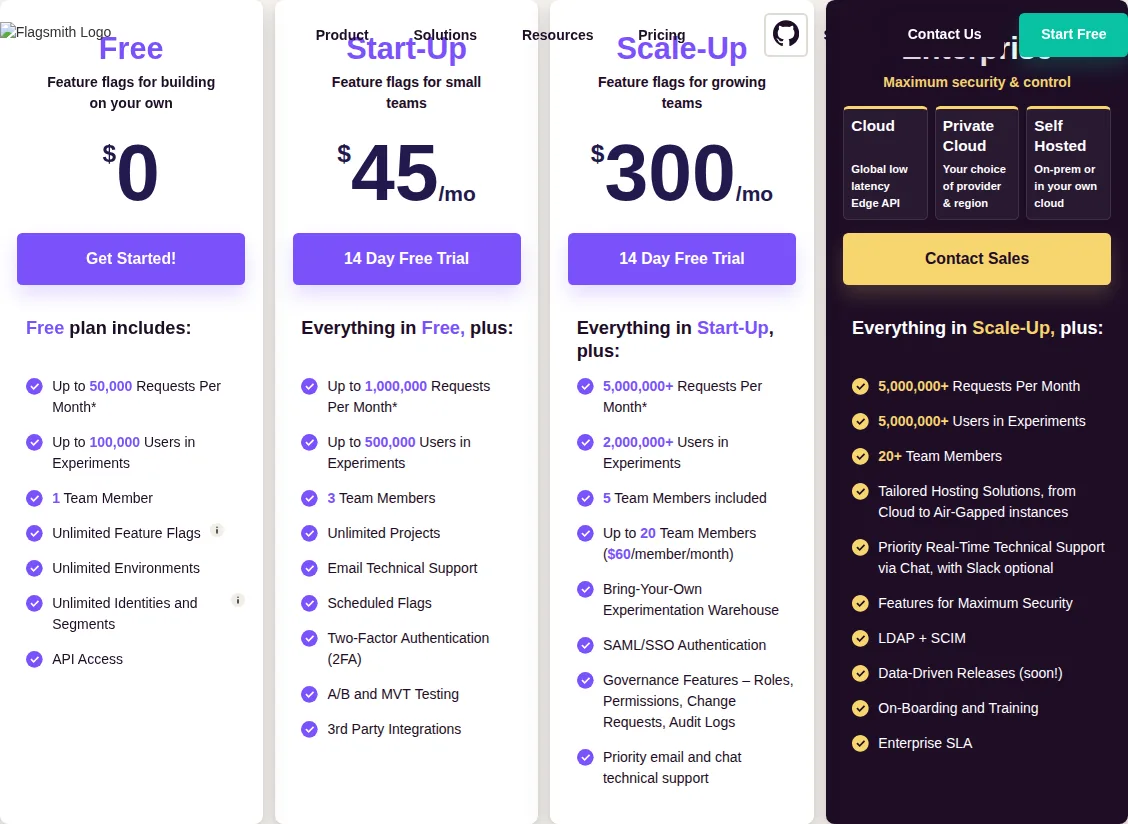
Flagsmith meters API requests and team members: one request is one call to the flags, identities, traits, or environment-document endpoints in a calendar month — a single-page app makes roughly one per user session, server-rendered pages roughly one per page view. Free costs $0: 50,000 requests a month, 100,000 users in experiments, 1 team member, unlimited flags, environments, identities, segments, API access. Start-Up is $40 a month on annual billing ($45 monthly): 1 million requests, 500,000 users in experiments, 3 team members, unlimited projects, scheduled flags, two-factor authentication, A/B and multivariate testing, integrations, email support. Scale-Up is $250 a month on annual billing ($300 monthly): 5 million or more requests, 2 million or more users in experiments, 5 members included, up to 20 at $50 a member a month on annual billing ($60 monthly), bring-your-own experimentation warehouse, SAML and SSO, governance (roles, permissions, change requests, audit logs), priority support. Enterprise is contact sales: 5 million or more requests, 20 or more members, private cloud or self-hosted, LDAP and SCIM, enterprise SLA.
Split is the outlier: its pricing page, now hosted under Harness, lists Free, Essentials, and Enterprise with no dollar figure on any of them. Free includes Harness Open Source and community support. Essentials is an all-in-one DevOps bundle — CI, CD, code repository, security testing orchestration, infrastructure-as-code management — capped at 500 users. Enterprise lets you pick any modules, including Feature Management & Experimentation, with unlimited users, premier support, and a dedicated account manager. Feature management is not listed inside Essentials, so flags and experiments from Split mean buying the Enterprise module, at a price that exists only in a quote.
Founder & CEO Insight — Enow A. Jovial
The decision table
| Factor | LaunchDarkly | Split (Harness) | Flagsmith |
|---|---|---|---|
| Pricing model | Per connection + per 1K MAU | Quote only | Per request + per seat |
| Entry paid tier | Foundation, pay as you go | Essentials, no price | Start-Up $40/mo yearly |
| 20K users, 10 connections, annual | $208.27/mo | Quote only | $40/mo Start-Up |
| 100K users, 40 connections, annual | $1,174.67/mo | Quote only | $250/mo Scale-Up |
| Flags | Unlimited | Module, Enterprise | Unlimited |
| Seats | Unlimited, no fee | 500 max | 3 / 5 included, +$50 |
| Request ceiling | None published | None published | 1M / 5M+ |
| Experimentation | Included | Enterprise module | Included Start-Up+ |
LaunchDarkly wins on meter transparency and experimentation; Flagsmith wins on flat cost — the bill moves only when requests or seats cross a ceiling. Split wins on nothing verifiable from its pricing page; its strength is the bundle for teams already buying Harness CI and CD.
Worked cost math: LaunchDarkly Foundation
Rates are from LaunchDarkly's pricing page, read 2026-11-13: 5 connections free, then $10 each on annual billing ($12 monthly); 1,000 MAU free, then $8.33 per 1,000 on annual billing ($10 monthly). AI runs beyond 5,000 cost $5 per 1,000; session replays beyond 5,000 cost $2.92 per 1,000 on annual billing ($3.50 monthly); the scenarios assume zero of either beyond the free allowance.
Scenario A — small B2B product: 10 connections, 20,000 MAU.
Annual saving: $500.76 a year.
Scenario B — growing consumer product: 40 connections, 100,000 MAU.
Annual saving: $2,823.96 a year.
At both volumes the MAU charge is roughly three quarters of the bill — $158.27 of $208.27 in Scenario A, $824.67 of $1,174.67 in Scenario B — because every user who opens the app is a billable context. LaunchDarkly prices your audience, not your team.
Watch the connection count: every replica, worker, and environment counts, averaged over the month — six backend services in production and staging are 12 connections, not 6, or 7 billable at $70 a month on annual billing.
Worked cost math: Flagsmith
Flagsmith's arithmetic is flatter; the interesting number is where the flat tiers stop being flat. Start-Up is $40 a month on annual billing ($45 monthly), 1 million requests included; Scale-Up is $250 ($300 monthly), 5 million or more included. Annual billing saves $60 a year on Start-Up and $600 on Scale-Up.
At 3 million requests a month, Start-Up with overage undercuts Scale-Up: $7 per 100,000 requests over the allowance, with a 30-day grace period the first time you exceed it within 200% of the plan limit.
Start-Up saves $70 a month at 3 million requests — but caps the team at 3 members, omits SAML, SSO and governance, and offers email support only. Need a fourth seat or an audit log and the $70 saving is gone. Price the tier on the features, not only the requests.
At 6 million requests a month, Scale-Up is the only honest tier. Additional API calls start at $50 per million per month and decrease with volume, so at the published starting rate:
Seats move the Flagsmith bill the way users move LaunchDarkly's: a 10-member team on Scale-Up pays for 5 extra members:
Run either total through the Break-Even Analysis Calculator: a $1,174.67-a-month bill that rolls back a bad release in minutes is cheap against one lost enterprise renewal.
Split: what quote-only actually costs you
Split publishes no price, so there is no reproducible math to print — and that absence is itself a cost. You cannot budget the module without a sales conversation, so the evaluation cannot finish on a spreadsheet; you cannot compare it honestly against vendors that do publish rates, so any Split dollar figure is an estimate dressed as a fact; and the quote depends on the rest of your Harness relationship — a team already buying CI and CD has leverage a flag-only buyer does not.
What the page does publish is structure: Essentials caps at 500 users, Enterprise is unlimited, and Feature Management & Experimentation sits inside Enterprise. Under 500 users and already on Harness CI and CD, ask for the module added to Essentials in writing — the page does not list it there.
Experimentation: included, capped, or bundled
LaunchDarkly includes experimentation on every plan — A/B tests, multi-armed bandits, Bayesian and frequentist analysis, CUPED, sequential testing, SRM detection, holdouts, warehouse-native metric import — with no stated limit on the free Developer plan. Experimenting costs the underlying usage, not a separate fee.
Flagsmith includes A/B and multivariate testing on Start-Up and above, metering the audience: 100,000 experiment users a month on Free, 500,000 on Start-Up, 2,000,000 or more on Scale-Up. A large-audience team can hit the experiment-user ceiling while its request allowance still has room, so check both meters; Scale-Up adds a bring-your-own experimentation warehouse for data that must stay inside your own cloud.
Split sells experimentation inside the Feature Management & Experimentation module, an Enterprise-plan module: not on the free tier, not listed in Essentials. Without Harness Enterprise, the flag decision and the experimentation decision are the same purchase, at the same quote.
For the analytics side, the PostHog vs Mixpanel vs Amplitude playbook prices the event and replay meters behind the same decisions, and the Sentry vs Rollbar vs Bugsnag comparison prices the error monitoring that tells you whether an experiment broke anything. The PagerDuty vs OpsGenie vs incident.io playbook prices the incident tooling that catches the bad release the flag was supposed to prevent.
Operator boundaries: who should not buy which
LaunchDarkly is the wrong buy for a consumer product with a large free audience and a small team: the MAU meter charges for every user who opens the app, so a free tier with 500,000 monthly users costs $4,156.67 a month in MAU charges alone on annual billing, before connections. It is the right buy for a B2B product with a modest user count, a known service count, and governance features — approvals, audit history, SCIM — required by the customer's security review.
Flagsmith is the wrong buy for a team that will grow past 5 members quickly without paying $50 a member a month, and for a product whose requests are dominated by server-rendered page views — each page view is roughly one request — rather than single-page sessions. It is the right buy for a small team with a large audience and a low request rate, where the bill stays flat while the audience grows, and for any team that wants a self-hosted option, which only Flagsmith offers outside an enterprise add-on.
Buying it through the business: entity, tax, and procurement
Flag spend is usually operating expenditure, but the paperwork decides whether finance approves it in a day or a quarter. The buying entity — LLC, C-Corp, or S-Corp — signs under its legal name; the vendor asks for the EIN before the first invoice. A CPA treats the subscription as an operating expense under GAAP, but a multi-year annual commitment needs sign-off above the team's authority, so get the annual figure approved. Ask for the SOC 2 report and a GDPR data-processing addendum before the security review — flag evaluations can carry user identifiers across borders, which is why LaunchDarkly's 100+ day Enterprise retention and Flagsmith's self-hosted Enterprise tier matter.
Run the decision
- Count connections the vendor way: services times environments, counting every replica.
- Count MAU honestly: the highest of the last three months in your analytics, not the average.
- Count Flagsmith requests the same way: daily page views times 30 for server-rendered pages, sessions for single-page apps.
- Price both published vendors at your numbers, on annual billing, from the rates and tier table above — and keep the arithmetic.
- Get Split in writing: module price, user count, experimentation scope, and renewal uplift in the order form.
- Check the ceilings before the features: 1 project and 3 environments on LaunchDarkly Developer, 3 members on Flagsmith Start-Up, 500 users on Harness Essentials.
- Test the kill switch before launch: flip a flag off in staging, confirm the feature disappears and the audit log records who flipped it.
- Re-price every quarter at the current connection, MAU, and request counts: a tier cheap at 20,000 users can be expensive at 100,000.