PagerDuty vs Opsgenie vs incident.io: The Incident Management Pricing Playbook
It is 3:12 a.m. and the checkout API is returning 500 errors. The alert fires, the on-call engineer gets paged, and the next forty minutes decide whether the company loses a night of revenue or a week of trust. Three products have owned this job: PagerDuty, Opsgenie, and incident.io. One is being switched off — and that changes every price here, because the cheapest option on paper is worthless if the vendor deletes your data in April 2027.
Founder & CEO Insight — Enow A. Jovial
The decision in one table
| Your position | The move | Cost at 25 / year | Authority |
|---|---|---|---|
| Proven standard | PD Professional | $6,300 | PagerDuty pricing page |
| Workflows + analytics | PagerDuty Business | $12,300 before add-ons | 2026 corroboration |
| Slack-native, response + on-call | incident.io Pro + on-call | $13,500 | incident.io pricing page |
| Small team, lowest bill | incident.io Team + on-call | $7,500 | incident.io pricing page |
| On Opsgenie now | Migrate; price JSM | $6,000 Standard list | Atlassian migration page |
What incident management software does
Incident management software answers four questions: who gets woken, how fast they respond, who else joins, what the record shows. The alerting layer watches monitoring tools, groups duplicates, and routes them to the person on call. The on-call layer holds the rotation and escalates when nobody acknowledges in five minutes. Coordination opens the incident channel; review produces the postmortem and the metrics: time to acknowledge, time to resolve (MTTR), pages per person. Those metrics are why this purchase differs from other SaaS: a slow CRM costs patience; an incident tool that fails costs revenue and sleep. The service level agreement (SLA) a company signs is only as strong as the paging path behind it: a 99.9 percent uptime promise needs a tool that wakes a human in under five minutes.
Opsgenie is being switched off
Atlassian's own Opsgenie page is now a migration page, "Migrate Opsgenie with no downtime." Its FAQ states the dates plainly: end of sale June 4, 2025; end of support April 5, 2027, when Atlassian shuts off access and deletes data not moved to Jira Service Management (JSM). Existing customers can still buy seats until then; new customers cannot buy Opsgenie, change editions, or add sites. The destination is JSM, where Opsgenie's alerting and on-call now live. The migration tool moves schedules, escalation policies, and incident workflows automatically, with 120 days of parallel access to validate the new setup.
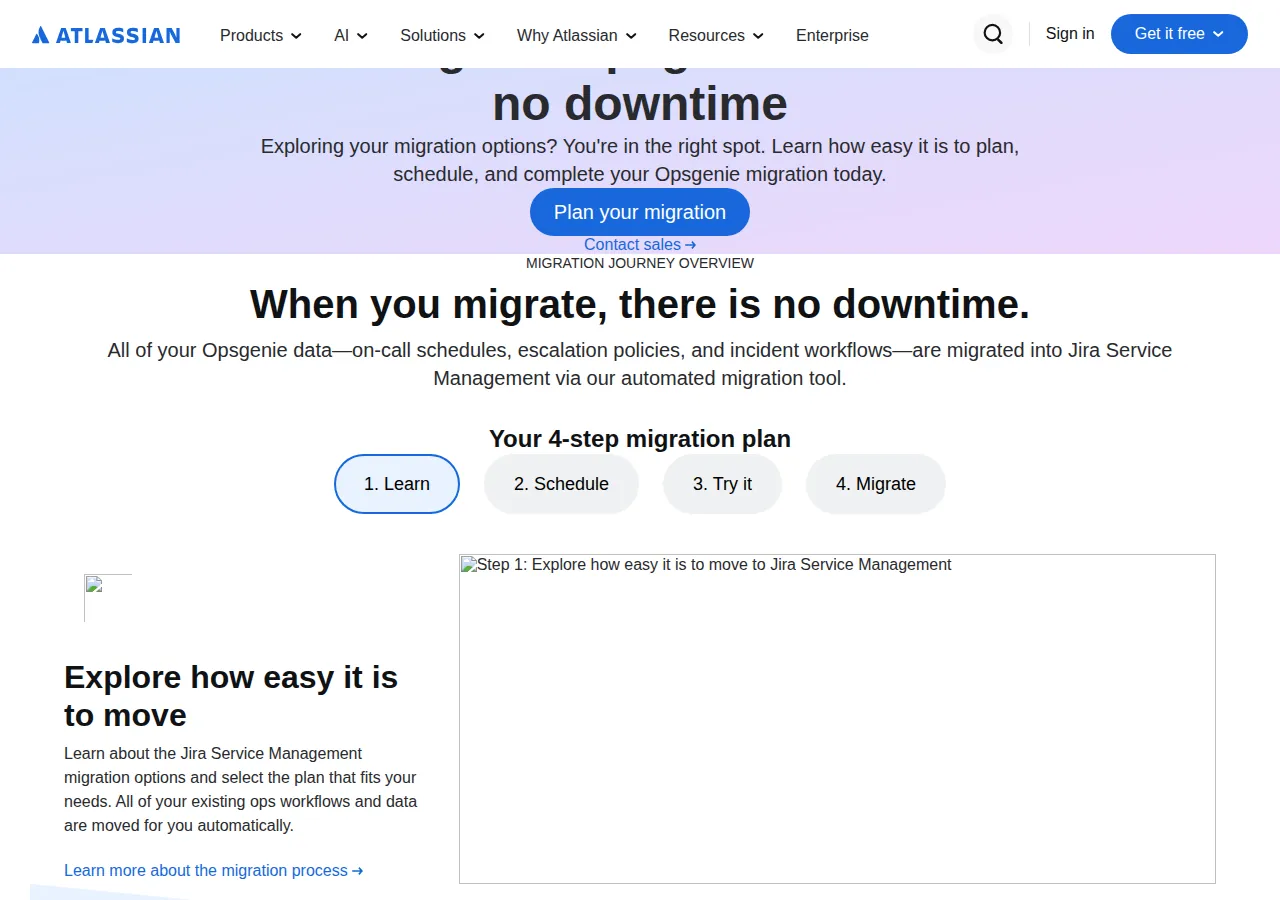
Opsgenie has no current price: there is nothing left to buy. Its historical pricing, $9.45 to $31.90 per user per month, is only a baseline — at 25 responders, $2,835 to $9,570 a year. The honest third chair is JSM, priced per agent.
PagerDuty: two products, one page
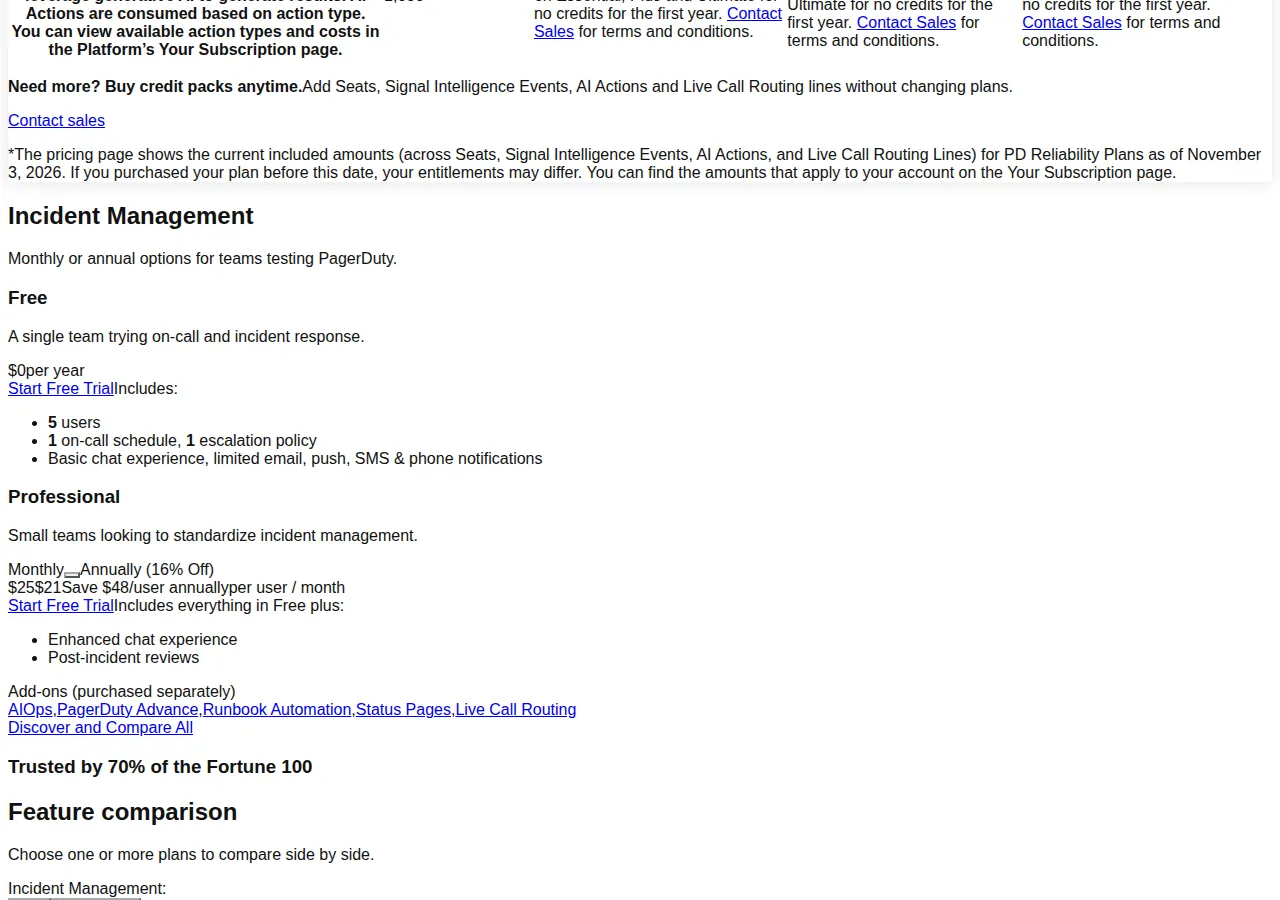
PagerDuty sells incident management two ways on one pricing page, and confusing them is the most common budgeting mistake here. Incident Management, the per-user product, has a Free tier at $0 a year for up to 5 users with one on-call schedule and one escalation policy, and Professional at $21 per user per month on annual billing ($25 month to month), adding post-incident reviews and an enhanced chat experience. The PD Reliability Platform is a flat annual bundle — Starter $2,800, Essential $12,000, Plus $48,000, Ultimate custom — bundling seats with Signal Intelligence Events and AI Actions. Starter works out to $23.33 per included seat per month, Essential to $40, Plus to $80: the higher tiers sell event and AI capacity, not seats. The Datadog vs Grafana Cloud vs New Relic pricing playbook prices the monitoring side that feeds these events.
The Business tier at $41 per user per month on annual billing ($49 month to month) does not appear on the vendor page this cycle. The $41 figure is corroborated across independent 2026 reads and is used in the math below, flagged as corroborated-secondary. PagerDuty is mid-transition from per-user pricing to platform bundles: get the quote in writing.
The add-ons are where PagerDuty's bill grows. AIOps starts at $699 a month; PagerDuty Advance is priced at $415 a month in 2026 comparisons; Status Pages are sold in 1,000-subscriber packs at $1,068 a year. None of the three appears on the public pricing page; all are corroborated-secondary. A team that needs all three pays on top of the license — and that changes the ranking.
incident.io: the transparent bill
incident.io publishes the simplest pricing of the three. Basic is free forever: Slack or Teams incident response, a single-team on-call schedule, a status page, and essential automation. Team is $15 per user per month on annual billing ($19 month to month), with multi-team on-call. Pro is $25, adding advanced insights, custom dashboards, and customizable postmortems. Enterprise is custom, with a dedicated success manager and a 99.99 percent SLA. On-call is an add-on: $10 per user per month on Team, $20 on Pro, or $20 standalone. Status pages are included on every tier — one public page on Basic, Team, and Pro, unlimited on Enterprise. Every tier includes SSO; SAML, SCIM, SOC 2, and HIPAA arrive at Enterprise. Like-for-like, that is incident.io Pro plus on-call at $45 per user per month, or Team plus on-call at $25.
JSM: the migration price
JSM is priced per agent, and the per-agent price falls as the team grows. The annual list is $20 per agent per month on Standard and $51.42 on Premium; Free covers up to 3 agents and includes on-call schedules. The list price is blended for a larger team: 2026 reads of Atlassian's pricing calculator put Standard at $25 per agent per month for teams of 1 to 15 agents on monthly billing, and $26.90 at 10 agents — $3,228 a year against $2,400 at the $20 list, an $828 gap a small team discovers only at checkout. Premium runs $57.30 for the same small-team band. Status pages are not included: JSM customers need a separate Statuspage.io subscription. SSO and SCIM need a separate Atlassian Guard subscription.
Monthly cost math at 5, 25, and 100 responders
All figures are annual billing, like-for-like.
| Vendor and tier | Per responder/mo | 5 / month | 25 / month | 100 / month |
|---|---|---|---|---|
| PD Professional | $21 | $105 | $525 | $2,100 |
| PD Business | $41 | $205 | $1,025 | $4,100 |
| incident.io Team + on-call | $25 | $125 | $625 | $2,500 |
| incident.io Pro + on-call | $45 | $225 | $1,125 | $4,500 |
| JSM Standard | $20 | $100 | $500 | $2,000 |
| JSM Premium | $51.42 | $257.10 | $1,285.50 | $5,142 |
At 25 responders a year: PD Professional $6,300; Business $12,300; incident.io Team + on-call $7,500; Pro + on-call $13,500; JSM Standard $6,000; Premium $15,426. PD Professional is the cheapest of the three incident vendors at every size; JSM Standard undercuts it, and JSM Premium is the most expensive line in the table. But the license is not the bill. Monthly billing costs more: Professional $21 to $25, Team $15 to $19 — $1,200 a year each at 25 responders.
Three-year totals and two break-evens
The three-year total at 25 responders is the honest comparison.
PD Professional: $18,900. PD Business: $36,900. incident.io Team plus on-call: $22,500. incident.io Pro plus on-call: $40,500. JSM Standard: $18,000. JSM Premium: $46,278. PagerDuty Reliability Essential is $36,000 over three years.
Business plus AIOps at $699 a month is $20,688 a year, $62,064 over three years. Add a Status Pages pack at $1,068 a year and the bill is $21,756 a year, or $65,268 over three years — against incident.io Pro plus on-call at $40,500 with status pages and postmortems included. The gap is $24,768: incident.io bundles what PagerDuty sells separately.
At what team size does PagerDuty Business plus AIOps become cheaper than incident.io Pro plus on-call? Set the two monthly bills equal.
Below 175 responders it costs more; above 175, it wins. The second break-even is smaller: PagerDuty Professional plus a $89-a-month status page against incident.io Team plus on-call.
Below 23 responders, PD Professional plus a status page is cheaper; above 23, incident.io Team plus on-call is.
What each dollar buys
| Capability | PagerDuty | JSM (Opsgenie successor) | incident.io |
|---|---|---|---|
| On-call schedules | Templates, mobile | Included, Free | Flexible rotations |
| Escalation policies | Sequential | Included | Included, WhatsApp Pro |
| Incident coordination | Web UI + Slack | Web UI, Slack commands | Slack-native, auto-created channels |
| Security | SSO/SAML/SCIM, higher tiers | SSO/SCIM via Atlassian Guard | SSO all tiers, SAML/SCIM Enterprise, SOC 2 |
PagerDuty leads on breadth: its integration catalogue spans monitoring, chat, and ticketing tools. incident.io leads on coordination: the incident runs inside Slack, with channels, roles, and timelines created automatically, and the postmortem drafted from the captured timeline. JSM leads on ecosystem: if the company already runs Jira, on-call arrives inside the tools the team already opens, priced per agent.
How each choice breaks
Every vendor here has a failure mode the pricing page never mentions. PagerDuty's is add-on creep: the renewal arrives with AIOps, Advance, and Status Pages attached, and the $21 license becomes a $60-plus effective cost per responder before anyone notices. The guard is a renewal escalation cap and a line-item review. incident.io's is scope: it is Slack-native, and a team on Microsoft Teams gets a thinner product, while a team with no chat-ops culture gets little of the $45 value. JSM's is scope in the other direction: on-call is bundled with a full ITSM suite — ticketing, change management, asset management — and a team that only wants paging pays for a service desk it never opens. Opsgenie's failure mode is terminal: the product stops. A team that misses the December 6, 2026 parallel-window date migrates under pressure, and a forced migration is where escalation policies get rebuilt wrong.
Worked example: 25 responders, year one
Worked example: a SaaS company with 25 responders, all on Slack, running Datadog, with a public status page. On PagerDuty Professional the license is $6,300 a year; add AIOps at $8,388 and a Status Pages pack at $1,068, and the year-one bill is $15,756. On Business the license is $12,300; with the same add-ons, $21,756. On incident.io Pro plus on-call the bill is $13,500, with status pages and AI-drafted postmortems included; on Team plus on-call, $7,500, with status pages included. Cheapest standalone: incident.io Team plus on-call at $7,500; most expensive: PD Business with add-ons at $21,756. The team picks incident.io Pro plus on-call: the $45 per responder buys coordination and postmortem automation a 25-person team otherwise pays an SRE to do by hand.
The migration playbook: four moves
- Inventory the Opsgenie estate: every schedule, escalation policy, integration, and alert rule. Note which phone numbers are in use, and confirm with Atlassian whether they move to JSM.
- Pick the destination by who is on call. If the responders live in Jira, migrate to JSM with Atlassian's automated tool and the 120-day parallel window. If they live in Slack, evaluate incident.io and PagerDuty on the break-even math.
- Run both systems in parallel. Validate that pages fire on the new system, and keep Opsgenie live until the new rotation has survived a real incident.
- Rebuild what the tool does not move: incident command roles, conference bridges, email templates, response roles. Test with a synthetic page; keep the export until the first full rotation cycle completes.
The Linear vs Jira vs ClickUp comparison helps a team decide whether Jira is the right home before committing its paging to JSM, and the Slack vs Teams vs Discord pricing comparison prices the chat layer both build on.
The pre-purchase checklist
- [x] Opsgenie status confirmed: date chosen, export taken.
- [x] Price locked in writing: annual billing, renewal cap set.
- [x] Add-ons priced: quoted as line items.
- [x] Status page cost included: bundled or separate, count checked.
- [x] On-call included or added: response plus on-call, not response alone.
- [x] Break-even computed: bundled-vendor break-even vs headcount.
- [x] Three-year total computed: license + add-ons, ×3, before signing.
- [x] Security checked: SSO, SAML, SCIM, SOC 2, residency, deletion confirmed.
- [x] Mobile path tested: phone on silent, escalation when nobody answers.
- [x] Exit priced: export format, deletion on contract end, cost of moving.
Run the three-year total through our break-even calculator with the team's real responder count.