Two tax systems in one grant
Every employee stock option is taxed under one of two regimes, chosen at grant, not at exercise. A nonstatutory stock option — NSO — is taxed under 26 U.S.C. § 83: the bargain element, the spread between the FMV at exercise and the price paid, is ordinary income in the year of exercise. An incentive stock option — ISO — is taxed under §§ 421 and 422: no income at exercise under the regular tax, no employer deduction, and long-term capital gain at sale if the holding periods are met. The same shares and prices — and the tax bill differs by thousands, because the two regimes measure the gain at different times and rates.
The trap is that the ISO regime is two tax systems, not one. Section 421 governs the regular tax; § 56(b)(3) switches § 421 off for the alternative minimum tax, and the bargain element becomes an AMT adjustment in the exercise year. An employee who exercises an ISO and holds the shares can owe AMT on money they have not received, in shares they cannot sell without breaking the holding periods.
ISO qualification: the § 422(b) checklist
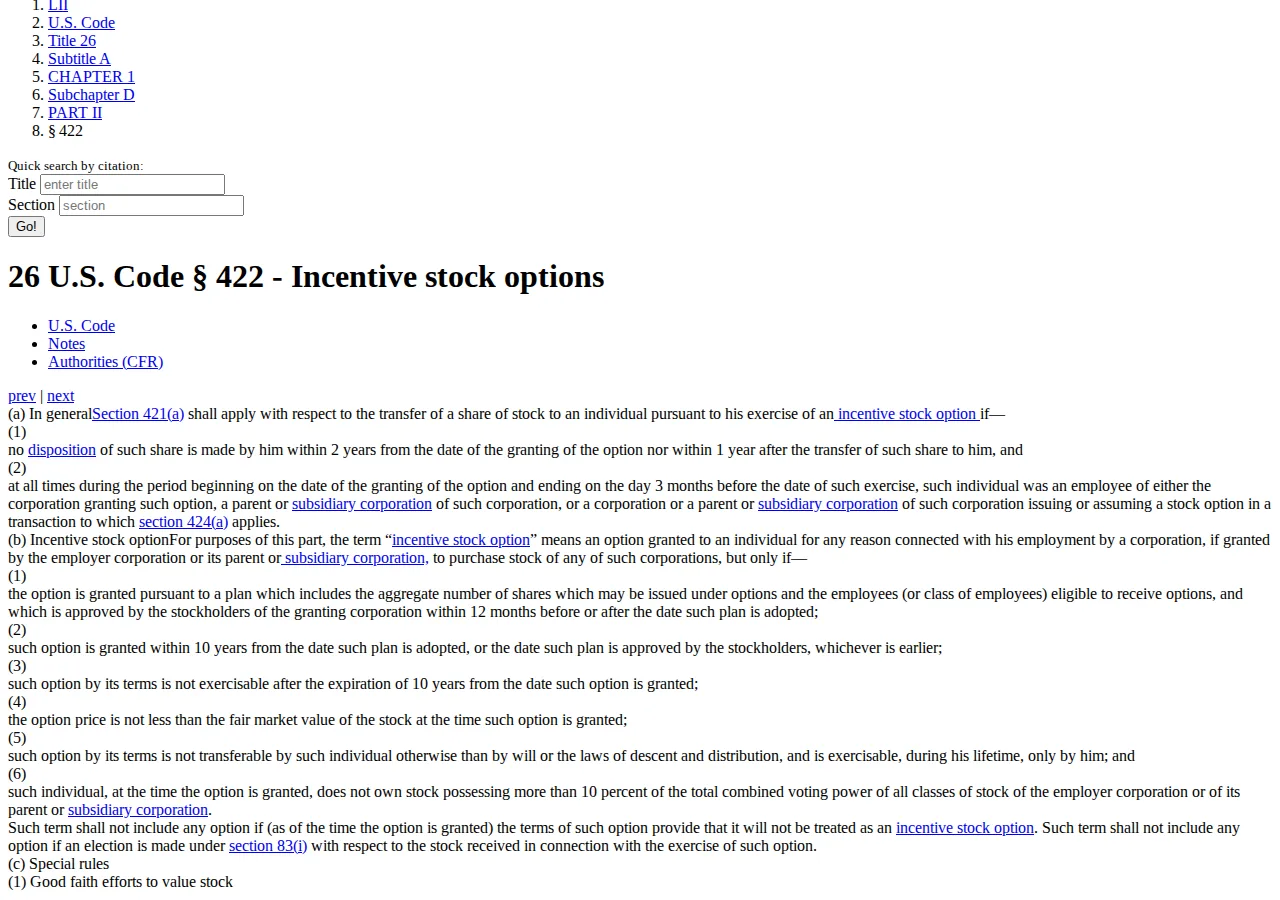
An option is an ISO only if it meets every requirement of 26 U.S.C. § 422(b). Miss one, and the option is an NSO by operation of law, whatever the grant paperwork calls it.
- The plan. The option must be granted under a plan stating the shares issuable and the employees eligible, approved by stockholders within 12 months before or after adoption.
- The grant window. The option must be granted within 10 years from the plan's adoption, or stockholder approval, whichever is earlier.
- The exercise window. The option must not be exercisable after 10 years from the date of grant.
- The price. The exercise price must not be less than the FMV of the stock at grant. A discounted ISO is not an ISO.
- Nontransferable. The option must not be transferable except by will or descent, and must be exercisable during the employee's lifetime only by the employee.
- The 10% owner rule. At grant, the employee must not own more than 10% of the total combined voting power — unless the exercise price is at least 110% of FMV and the option expires within 5 years.
Employment matters too: § 422(a)(2) requires the individual to have been an employee from the grant date until 3 months before exercise — 1 year before, if disabled. A consultant, advisor, or board member who is not an employee cannot receive an ISO at all — and neither can an LLC taxed as a partnership: only a C-Corp or an S-Corp can grant ISOs, because § 422(b) requires a corporation. An LLC that wants ISO treatment must convert to a C-Corp first. The good-faith valuation rule in § 422(c)(1) softens the price requirement — if a good-faith attempt to value the stock missed the FMV, the requirement is treated as met. That is why a 409A valuation matters.
The $100,000 rule: § 422(d)
Even a perfectly drafted ISO plan hits a ceiling. Under § 422(d), the aggregate fair market value of stock for which ISOs are first exercisable by any individual during any calendar year cannot exceed $100,000. The FMV is measured at grant, options are counted in the order granted, and the limit applies across all plans of the employer and its parents and subsidiaries. Any option above the ceiling is treated as an NSO.
Take a grant of 15,000 shares at a $10 FMV, all first exercisable in one calendar year: $150,000 of aggregate value. The first $100,000 — 10,000 shares — qualifies as ISO. The remaining $50,000 — 5,000 shares — is an NSO, taxed under § 83 at exercise, whatever the grant letter says. The earliest grants consume the ceiling first, so a second grant in the same year can be entirely NSO even if the paperwork calls it an ISO. Founders who grant generously in a single year create NSOs by accident, discovered at exercise when the W-2 shows ordinary income nobody planned for.
The holding periods: 2 years from grant, 1 year from transfer
Section 422(a)(1) sets two holding periods, both required for capital-gain treatment: no disposition within 2 years from grant, nor within 1 year after transfer. Sell early and the disposition is disqualifying.
A qualifying disposition — both periods met — produces long-term capital gain on the full spread between sale price and exercise price, and the employer gets no deduction. A disqualifying disposition produces ordinary income in the year of disposition, and the employer gets a matching deduction. Section 421(b) moves the income into the year of disposition, and § 422(c)(2) caps it where the sale price is below the exercise-date value: the compensation cannot exceed the amount realized over the adjusted basis. You are never taxed on more gain than you actually made.
| Outcome | Holding periods | Tax at exercise (regular) | Tax at sale | Employer deduction | Authority |
|---|---|---|---|---|---|
| ISO, qualifying | 2 years from grant + 1 year from transfer | $0 | Long-term capital gain on full spread | None | §§ 421(a), 422(a) |
| ISO, disqualifying | Either period broken | $0 at exercise; ordinary income in year of sale, capped at actual gain | Capital gain or loss on the remainder | Yes, equal to the compensation | §§ 421(b), 422(c)(2) |
| NSO | None apply | Ordinary income on the bargain element | Capital gain or loss after exercise | Yes, equal to the compensation | § 83(a); IRS Pub. 525 |
The AMT trap: § 56(b)(3) and Form 6251
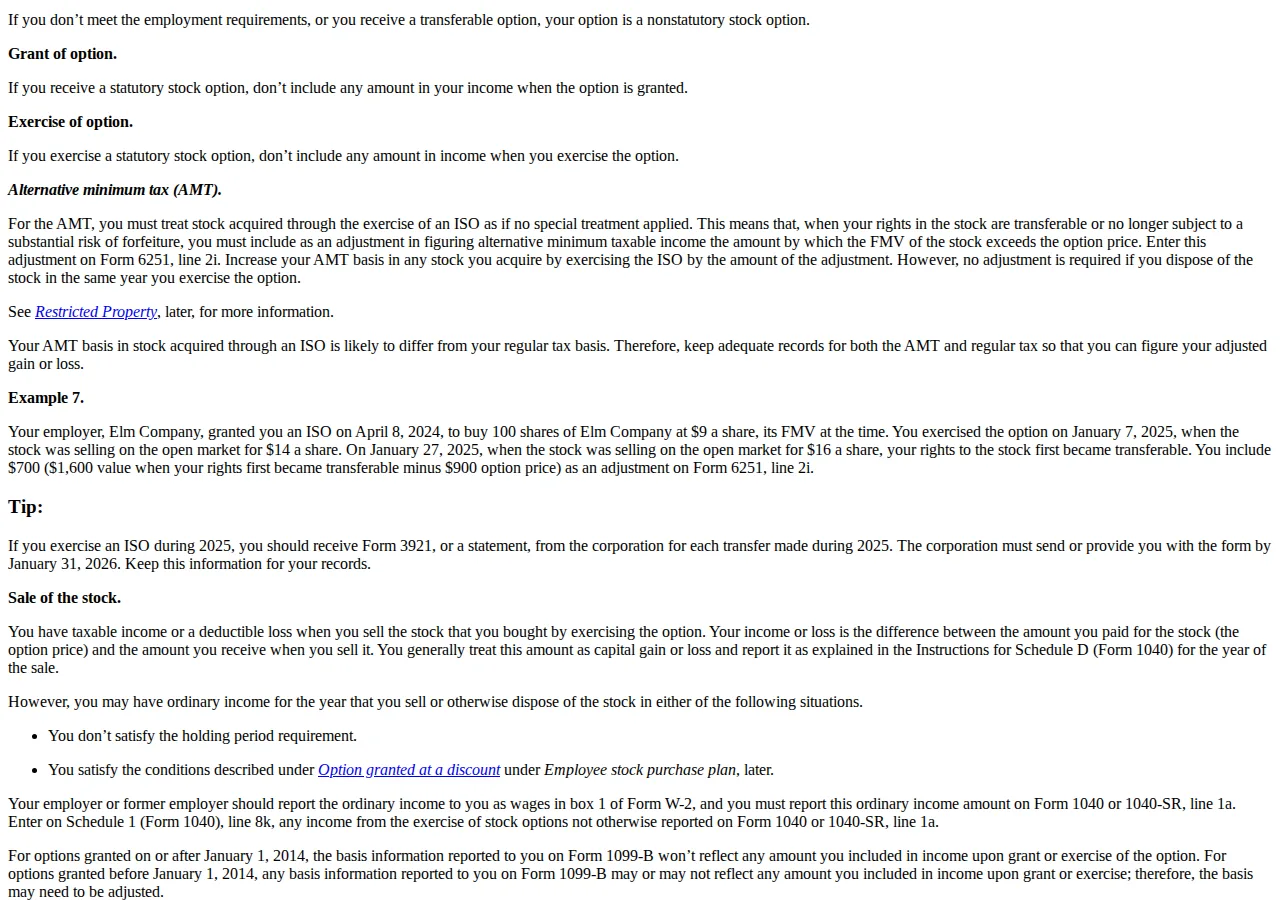
Under 26 U.S.C. § 56(b)(3), § 421 does not apply for the alternative minimum tax. The bargain element — the FMV at exercise minus the price paid — is an adjustment in figuring alternative minimum taxable income, reported on Form 6251, line 2i. The AMT basis increases by the adjustment, so the same dollars are not taxed twice, and no adjustment is required if the stock is disposed of in the same year it is exercised.
IRS Publication 525, Example 7: an employer grants an ISO on April 8, 2024, to buy 100 shares at $9 a share. The employee exercises on January 7, 2025, when the stock sells for $14 a share. On January 27, 2025, when the stock sells for $16 a share, the employee's rights first become transferable. The AMT adjustment is $700 — 100 shares times the $7 difference between the $16 value and the $9 exercise price — due in the exercise year whether or not the employee sells a single share.
The adjustment is the reason ISOs create tax bills without cash. An employee who exercises 10,000 shares with a $30 bargain element has a $300,000 AMT adjustment. If their AMT exceeds their regular tax, the difference is due in cash, in the exercise year, while the shares sit unsold — and selling the shares to pay the tax breaks the holding periods. The escape hatch is the same-year rule: dispose of the stock in the same year you exercise, and no AMT adjustment is required — but that disposition is disqualifying, so the bargain element becomes ordinary income anyway.
The NSO: taxed at exercise, and the employer deducts
The NSO has no qualification checklist and no holding periods, because it has no special treatment to protect. Under § 83(a), the bargain element is ordinary income in the year the option is exercised — or, if the shares are subject to a substantial risk of forfeiture, in the year the risk lapses. The employer reports the amount on the W-2 under its EIN and deducts the same amount. The bargain element is also wages for FICA: Social Security and Medicare are withheld at exercise, so the cash cost of an NSO exercise is the income tax plus FICA. At sale, the employee's basis is the exercise price plus the amount already taxed, and the post-exercise appreciation is capital gain or loss.
That simplicity is the NSO's advantage and its cost. The advantage: no AMT adjustment, no holding-period clocks, no $100,000 ceiling, no plan paperwork. The cost: the bargain element is taxed as ordinary income at the marginal rate, in the exercise year, whether or not the shares are sold. In the 37% bracket, a $30,000 bargain element costs $11,100 at exercise; under a qualifying ISO the same spread costs 20% at sale — $6,000 — plus whatever AMT the exercise year produced.
The worked example: one grant, two tax bills
One grant, two tax bills: options on 1,000 shares at a $10 exercise price. Three years later she exercises at a $40 FMV, paying the $10,000 exercise price by wire transfer, and two years later sells at $60. She is in the 37% ordinary bracket and the 20% long-term capital gains rate, and her AMT does not exceed her regular tax.
The ISO saves $5,100 — $15,100 against $10,000 — because the whole $50,000 spread is taxed at 20% instead of splitting $30,000 at 37% and $20,000 at 20%. Now change one fact: her AMT exceeds her regular tax by $8,000 in the exercise year. The ISO's true cost becomes $10,000 at sale plus $8,000 of AMT — $18,000 in total, with the § 53 AMT credit recovering the $8,000 only in a later year. The ISO is still cheaper in the long run, but $2,900 more expensive in cash terms across the two years, and the $8,000 is due before the sale produces a dollar. That timing gap is the decision, not the rate difference.
The decision matrix
| Factor | ISO | NSO | Authority |
|---|---|---|---|
| Who can receive it | Employees only | Employees, consultants, advisors | 26 U.S.C. § 422(b) |
| Tax at exercise (regular) | $0 | Ordinary income on the bargain element | §§ 421(a), 83(a) |
| Tax at exercise (AMT) | Bargain element is an adjustment, Form 6251 line 2i | None — already taxed | § 56(b)(3); IRS Pub. 525 |
| Tax at sale (qualifying) | Long-term capital gain on full spread | Capital gain after exercise only | §§ 421(a), 422(a) |
| Annual ceiling | $100,000 FMV first exercisable per year | None | § 422(d) |
| Holding periods | 2 years from grant + 1 year from transfer | None | § 422(a)(1) |
| Employer deduction | None on qualifying disposition | Equal to the compensation | §§ 421(a)(2), 83(h) |
| Exercise price floor | FMV at grant, 110% for 10% owners | No statutory floor | § 422(b)(4) |
The exercise decision, as a checklist
- [x] Confirm the option type. Read the grant agreement: does it say ISO, and does the plan meet § 422(b)?
- [x] Check the $100,000 ceiling. Add the FMV at grant of all options first exercisable this year. Anything over $100,000 is NSO.
- [x] Price the AMT before you exercise. Have a CPA run the Form 6251 projection with the bargain element included. If AMT exceeds regular tax, decide now whether to hold or sell in the same year.
- [x] Mark the two holding-period clocks. Two years from grant, one year from transfer.
- [x] Decide the sale before the exercise. If you will sell to cover the tax, the ISO gives you nothing the NSO does not.
- [x] Keep two bases. Your regular-tax and AMT bases differ by the adjustment. Track both.
Founder & CEO Insight — Enow A. Jovial
The RSU vs stock options vs ESPP guide puts ISOs and NSOs alongside the other three instruments on one shared price path; the § 83(b) election playbook covers the early-exercise election, and the § 409A deferred compensation playbook covers the valuation rules that keep a discounted option from becoming deferred compensation. For the cash side, run the numbers through the tax estimator with the bargain element included as ordinary income.