Form 990 is the annual information return that keeps a tax-exempt organization exempt. Most filers owe no income tax on it. It is a public disclosure document, a governance record, and a compliance test in one filing. The IRS uses it to confirm the organization still deserves exemption; donors and regulators read it too. A late return draws a daily penalty under section 6652(c). Three consecutive missed years end the exemption automatically, and an incomplete return draws the same penalty as a late one. Because the return is public, an error sits on a public database for anyone to read.
The Paperwork Reduction Act table in the 2025 Instructions for Form 990 projects 371,700 Form 990 returns, 215,600 Form 990-EZ returns, and 796,200 Form 990-N notices, with an average burden of 108 hours and 3,000 dollars for the full form, against 71 hours and 700 dollars for 990-EZ and 5 hours and 20 dollars for 990-N.
> [!FOUNDER]
> "Every small nonprofit I have worked with treats Form 990 as a chore for the accountant in May. Then the board reads the public copy and asks why it tells a different story from the one told to donors all year. The friction is not the form. The friction is that nobody owns the numbers between January and May. If the treasurer, the program director, and the board chair each held one page of this return through the year, the filing would take a weekend." — Enow A. Jovial, Founder and CEO
Which form the organization files
Three rungs, decided by gross receipts and total assets. Gross receipts means total amounts received from all sources during the tax year, without subtracting costs or expenses. The Instructions for Form 990 (2025) state the full-form trigger plainly: an organization exempt under section 501(a) must file Form 990 if it has either gross receipts of 200,000 dollars or more, or total assets of 500,000 dollars or more at year end. Either trigger alone is enough.
| Form | Who files it | Threshold test | Authority |
| --- | --- | --- | --- |
| Form 990 | Larger exempt organizations | Gross receipts of 200,000 dollars or more, OR total assets of 500,000 dollars or more | Instructions for Form 990 (2025) |
| Form 990-EZ | Smaller exempt organizations | Gross receipts under 200,000 dollars AND total assets under 500,000 dollars | Instructions for Form 990 (2025) |
| Form 990-N (e-Postcard) | Smallest organizations | Gross receipts normally 50,000 dollars or less | Instructions for Form 990 (2025) and Appendix B |
The word "normally" in the 990-N test carries real weight. Appendix B measures it over three years: an organization three years old or more qualifies when it averaged 50,000 dollars or less over the preceding three tax years, including the filing year. A single good year does not push a small charity onto the long form, and a single bad year does not let a mid-size charity drop to the e-Postcard.
> [!KEY TAKEAWAY]
> Measure both triggers before choosing a form. Gross receipts of 200,000 dollars or total assets of 500,000 dollars each independently require the full Form 990, and the 990-N test uses a three-year average.
The statute behind the form: section 6033
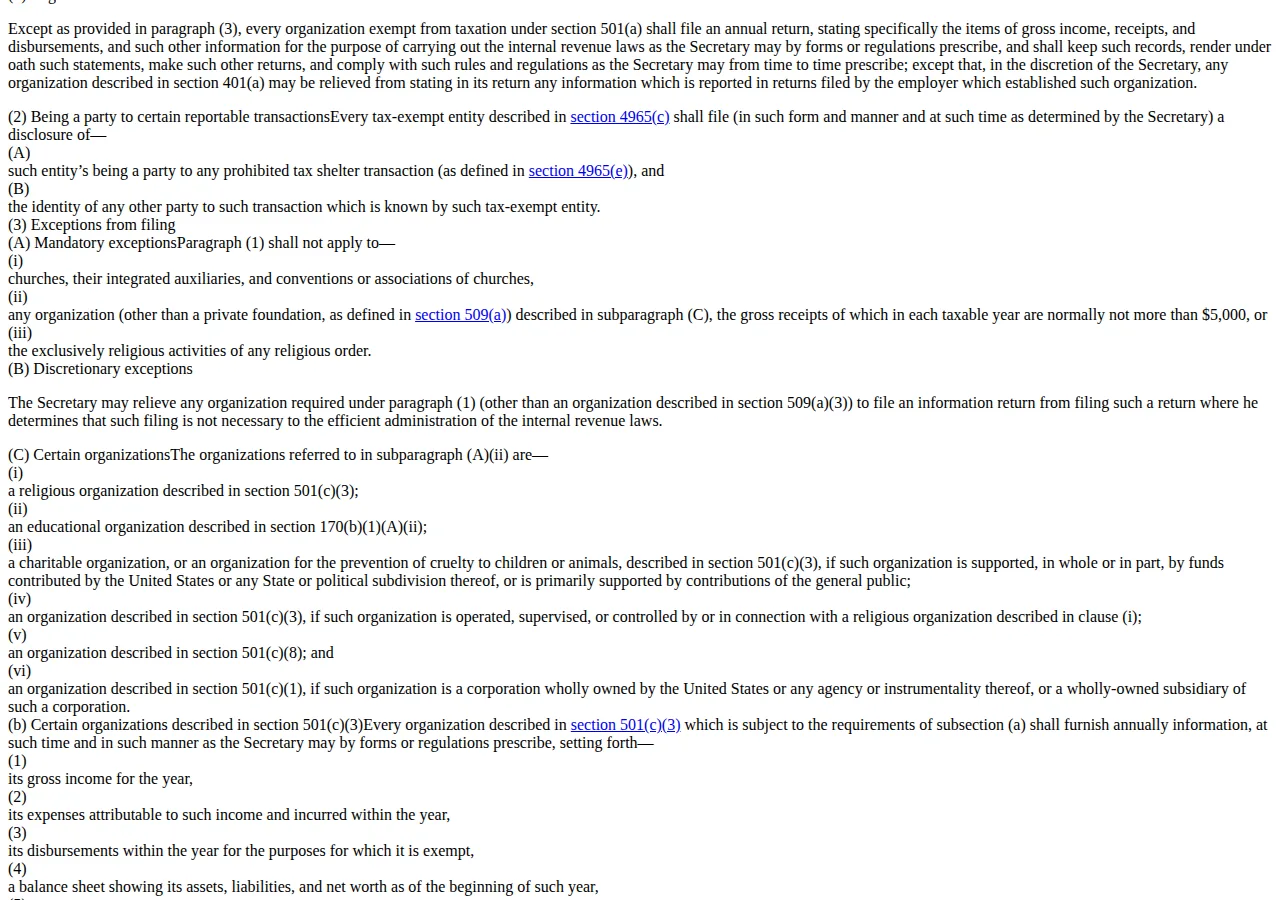
Form 990 exists because Congress ordered it. Section 6033(a)(1) requires every organization exempt under section 501(a) to file an annual return stating gross income, receipts, and disbursements, and to keep the records the Secretary prescribes. Paragraph (3) carves out the mandatory exceptions — churches, their integrated auxiliaries, and conventions or associations of churches; the exclusively religious activities of any religious order; and certain organizations whose gross receipts are normally not more than 5,000 dollars. That 5,000-dollar figure is not the 50,000-dollar 990-N threshold: the statute excuses the smallest organizations from filing at all.
The due date follows the accounting period. Form 990 is due by the 15th day of the 5th month after the organization's accounting period ends — May 15 for a calendar-year filer, and the next business day if that date falls on a weekend or legal holiday. An organization that cannot meet the date files Form 8868, the route to an automatic 6-month extension. The extension moves the filing deadline, not any tax due with a related Form 990-T. For 2025, the full Form 990 must be e-filed; an organization required to e-file that submits paper instead is deemed to have failed to file.
Schedule A and the public-support test
For a section 501(c)(3) organization, the most consequential schedule is Schedule A, which proves the organization is a public charity rather than a private foundation. Schedule A, Part II, applies the section 170(b)(1)(A)(vi) test over five years, reported on line 14 rounded to the nearest hundredth — the instructions give 58.3456 percent reported as 58.35 percent. If line 14 is 33 1/3 percent or more, line 16a qualifies the organization as publicly supported for the current year and the next. If the current year fails but the prior year, on line 15, reached 33 1/3 percent, line 16b preserves the status for one more year.
Take a community arts organization with five-year total support of 800,000 dollars, of which 272,000 dollars came from governmental units, the general public, and other public charities:
$
\text{Public support percentage} = \frac{272{,}000}{800{,}000} \times 100 = 34.00\%
$
The organization passes by 5,333.33 dollars — 272,000 against a 266,666.67-dollar one-third floor — one lost grant away from failing. The instructions warn that an organization fails both public-support tests if almost all of its support is gross receipts from related activities and only an insignificant amount comes from governmental units and public contributions.
| Test | Threshold | What it measures | Authority |
| --- | --- | --- | --- |
| 33 1/3 percent test, Schedule A Part II line 16a | Public support of 33 1/3 percent or more of total support over five years | Broad public and government funding | Schedule A instructions (2025), line 16a |
| 10 percent facts-and-circumstances test, Schedule A Part II line 17a | Public support of 10 percent or more, plus facts and circumstances showing public support | Public character at a low percentage | Schedule A instructions (2025), line 17a |
| First-five-years rule, Schedule A Part II line 13 | Organization in its first five years as a 501(c)(3) | Test deferred while the base is built | Schedule A instructions (2025), line 13 |
An organization that misses 33 1/3 percent still has the 10 percent facts-and-circumstances test on line 17a, a qualitative judgment on governance, fundraising, and community, explained in Part VI. A first-five-years organization checks line 13 and takes no test yet; it must compute its percentage before its sixth year. Failing both tests with no other public-charity category available means private foundation status, and private foundation status means Form 990-PF instead of Form 990. Our IRS Form 1099-NEC contractor reporting playbook applies here too: payments on Schedule A and Part VII must reconcile to the books behind its 1099s, or the return contradicts itself in public.
Unrelated business income and Form 990-T
Exemption from income tax is not exemption from all tax. An exempt organization still may owe tax on unrelated business income: income from a trade or business, regularly carried on, that is not substantially related to the purpose behind the organization's exemption. The IRS states the trigger plainly: 1,000 dollars or more of gross income from an unrelated business requires Form 990-T, in addition to the annual information return. It must also pay estimated tax if it expects its tax for the year to be 500 dollars or more. The classic patterns are program-book advertising, a gift shop selling unrelated goods, and regular commercial hall rentals; a volunteer-run bake sale is not, because the law excludes activities carried on substantially by volunteers and sales of donated merchandise.
Section 511 imposes tax on unrelated business taxable income (UBTI) as provided in section 11 — the corporate rate of 21 percent. Section 512 defines UBTI as gross income from the unrelated business minus directly connected deductions, and section 512(b)(12) allows a specific deduction of 1,000 dollars. A worked example: a museum earns 48,000 dollars of gross income from renting its hall for commercial events and incurs 18,000 dollars of directly connected deductions:
$
\text{UBTI} = 48{,}000 - 18{,}000 - 1{,}000 = \$29{,}000 \quad ; \quad \text{Tax} = 29{,}000 \times 21\% = \$6{,}090
$
At 48,000 dollars, Form 990-T is required, and at 6,090 dollars of tax, so are estimated payments. Each unrelated business is computed separately. The partnership-return mechanics in our IRS Form 1065 partnership tax return playbook matter here too: an exempt organization holding a partnership interest must report its share of the partnership's unrelated business income, so a joint venture entered for program reasons can still create a 990-T obligation.
The late-filing penalty ladder
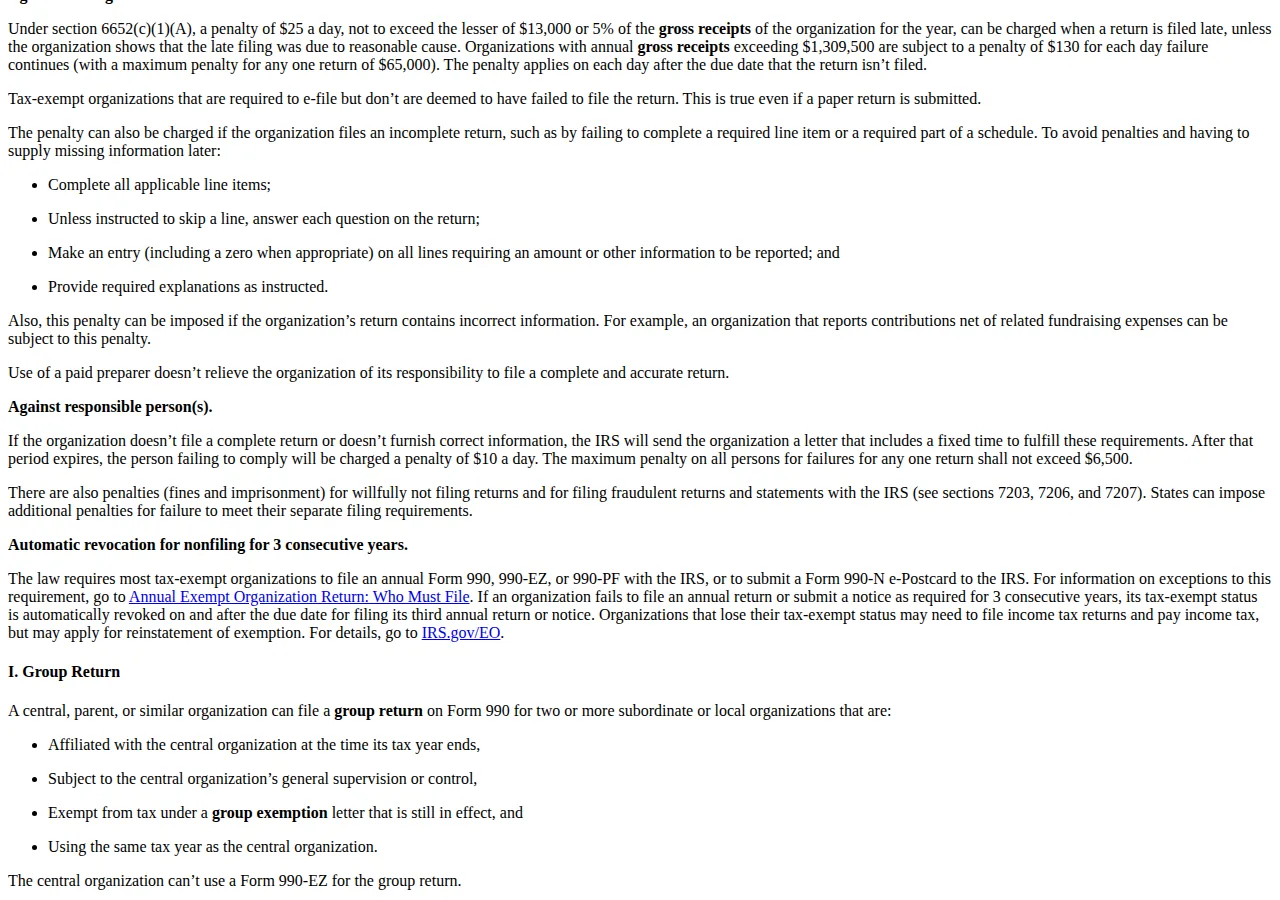
Section 6652(c)(1)(A) sets the penalty at the inflation-adjusted figures in the 2025 instructions. A late return draws 25 dollars a day, capped at the lesser of 13,000 dollars or 5 percent of the organization's gross receipts for the year, unless the organization shows reasonable cause. Organizations with annual gross receipts over 1,309,500 dollars pay 130 dollars a day, capped at 65,000 dollars per return. It runs on each day after the due date, and it also applies to an incomplete return — an uncompleted line item or schedule part counts as a failure to file. For a mid-size charity with 400,000 dollars of gross receipts, 40 days late:
$
\text{Penalty} = 40 \times \$25 = \$1{,}000 \quad ; \quad \text{Cap} = \min(13{,}000,\ 5\% \times 400{,}000) = \min(13{,}000,\ 20{,}000) = \$13{,}000
$
The 1,000-dollar penalty sits far below the 13,000-dollar cap, which would bind only after 520 days; a large organization with 2,000,000 dollars of receipts hits its 65,000-dollar cap after 500 days at 130 dollars a day. The responsible-person penalty runs separately: after the IRS sends a letter giving a fixed time to comply, the person failing to comply is charged 10 dollars a day, up to 6,500 dollars on all persons for any one return. Failure to file for three consecutive years revokes the exemption automatically, on and after the due date for the third return, and reinstatement requires a new application.
> [!WARNING]
> A filed-but-incomplete return is penalized the same as a late one. A blank required schedule, contributions reported net of fundraising expenses, or a skipped line all trigger the daily penalty — file complete, or file the extension.
The public-disclosure rule
Form 990 is a public document by design. The organization must make its annual return available for public inspection for three years, and an amended return for three years from filing or from the original due date, whichever is later. In-person requests get a copy at once; written requests must be answered by mail within 30 days of receipt, or within 30 days of receiving payment when payment in advance is required. Copying fees may be charged, and donor names may be withheld from the public Schedule B. Whatever the return says about executive pay and program spending is visible to donors and reporters, so the board should read the public copy first.
The identifiers behind the return
Every figure on Form 990 ties to an identifier the IRS already holds. The return is filed under the organization EIN, the same number on its exemption letter and on any Form 990-T it files. A CPA-prepared audit under GAAP is the cleanest source for Parts VIII and IX, because the return revenue and expense lines must match the audited statements the board approved. The public copy the organization posts is a PDF of the filed return, and any single-member LLC the organization owns as a disregarded entity must be listed on Schedule R, with its own EIN if it has one.
The filing workflow, step by step
1. Close the books and reconcile every account, so Part VIII revenue and Part IX expenses tie to the general ledger.
2. Measure both filing triggers and pick Form 990, 990-EZ, or 990-N on the numbers, not on habit.
3. Complete Schedule A first if the organization is a 501(c)(3), because the public-support percentage decides public-charity or private-foundation status.
4. Work the Part IV checklist line by line, and attach every schedule the answers trigger, including Schedule B for contributions and Schedule L for related-party transactions.
5. Test unrelated business income against the 1,000-dollar threshold, and prepare Form 990-T and estimated payments if met.
6. Have the board review the near-final return, sign under penalties of perjury, and e-file by the 15th day of the 5th month.
> [!TIP]
> Run the penalty math before the due date, not after it. A 40-day delay on a 400,000-dollar organization costs 1,000 dollars; a Form 8868 extension costs nothing and moves the deadline six months. Model any 990-T tax with our tax estimator before the estimated-payment dates pass.
Who should NOT file Form 990
Not every exempt organization belongs on this form. Churches, their integrated auxiliaries, and conventions or associations of churches are excused from filing under section 6033(a)(3), as are the exclusively religious activities of a religious order. Private foundations and section 4947(a)(1) trusts treated as private foundations file Form 990-PF instead. Organizations normally at 5,000 dollars or less fall within the statutory exception, though most still submit Form 990-N to keep the exemption record current. Section 527 political organizations have their own thresholds — 25,000 dollars generally, 100,000 dollars for a qualified state or local one — and need not submit Form 990-N. The pass-through analysis in our Section 199A QBI deduction SSTB phaseout playbook states the same principle: the form follows the classification, and a wrong classification makes every line that follows wrong.