Form 926 is the notice a U.S. person files when property leaves the United States for a foreign corporation. Under 26 U.S.C. § 367(a)(1), the foreign corporation is not treated as a corporation for gain measurement, so gain that would have been deferred in a domestic §351 contribution is recognized immediately. Form 926 is the paper trail proving the transfer happened, what was transferred, and whether an exception or a gain recognition agreement saved the gain. Every figure below is from the Instructions for Form 926 (November 2018), 26 U.S.C. §§ 367 and 6038B, or Treas. Reg. § 1.367(a)-3 — read November 16, 2026.
The §367(a) general rule
Section 367(a)(1) applies to exchanges under §§ 332, 351, 354, 356, or 361. In a domestic §351 contribution, a founder contributes appreciated property and recognizes no gain. Cross the border and the rule flips: the foreign corporation is not treated as a corporation for gain measurement, so the gain is recognized now.
A founder contributes a patent portfolio — $400,000 basis, $1,000,000 fair market value — to a newly formed Irish company in a §351 exchange. Under §367(a)(1), the $600,000 of built-in gain is recognized in the transfer year even though no cash changed hands. The same transfer to a domestic corporation would have deferred all $600,000.
| Transfer | §367(a)(1) treatment | Authority |
|---|---|---|
| Appreciated tangible property | Gain recognized currently | §367(a)(1) |
| Stock/securities of a foreign corporation party | Excepted | §367(a)(2) |
| Partnership interest | Pro-rata share of assets | §367(a)(3) |
| Intangible property | §367(d) super-royalty applies instead | §367(d)(1) |
| Paid-in surplus / capital contribution | Sale at fair market value | §367(f) |
The §367(a)(2) exception is narrow: stock or securities of a foreign corporation that is a party to the exchange or reorganization — not domestic stock. A domestic-stock transfer is tested under Treas. Reg. § 1.367(a)-3(c): U.S. transferors must receive no more than 50% of the transferee's stock, with no control group, and a 5% transferee shareholder needs a five-year gain recognition agreement under § 1.367(a)-8.
Who must file
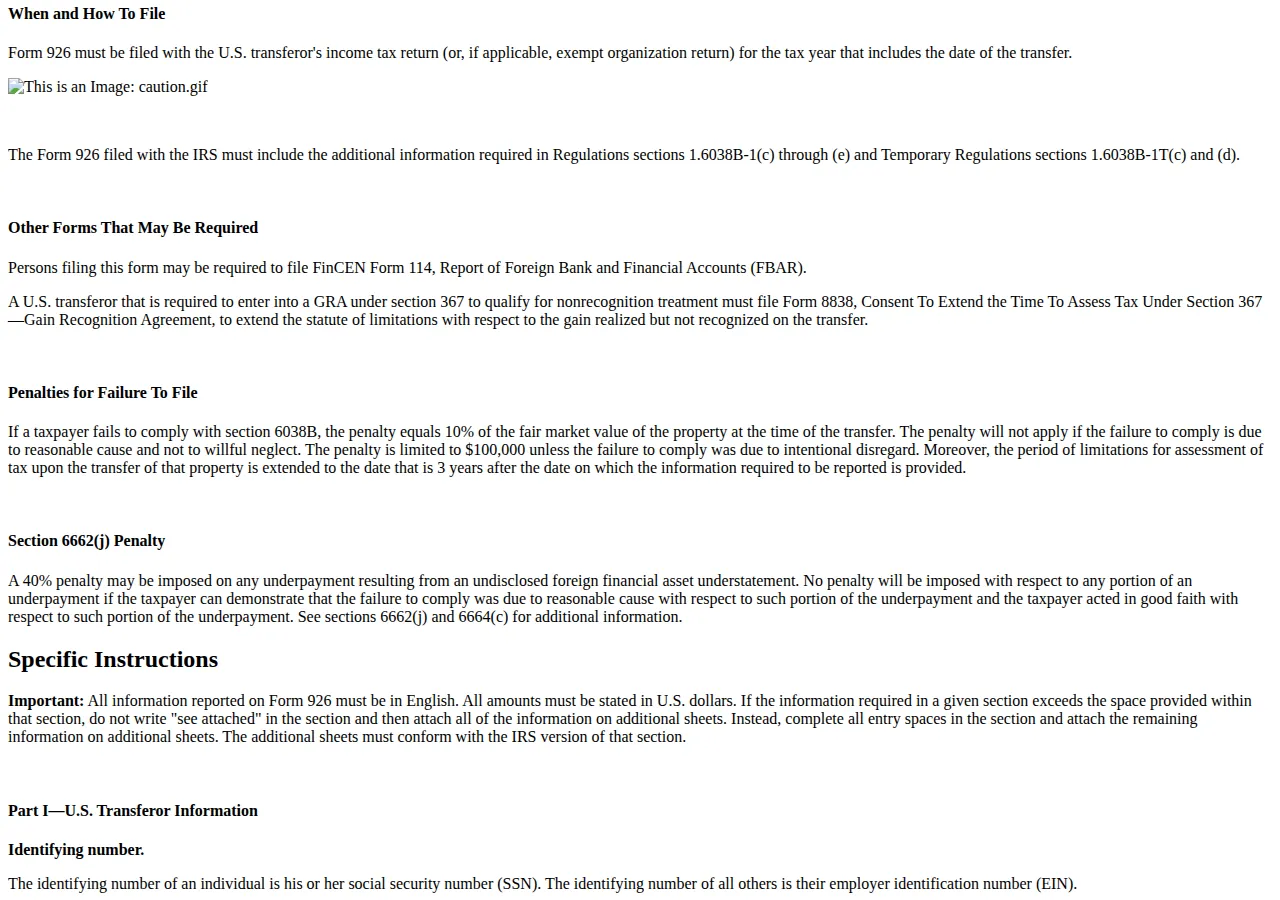
Who must file is broad: a U.S. citizen or resident, a domestic corporation, or a domestic estate or trust must file Form 926 for transfers under §6038B(a)(1)(A), §367(d), or §367(e). Two special rules catch filers who assume someone else files for them.
First, partnerships: if the transferor is a partnership — domestic or foreign — the domestic partners, not the partnership, file Form 926, each for its proportionate share. A three-member domestic LLC taxed as a partnership produces three filings, one per member.
Second, cash: a U.S. person transferring cash must report it if either test is met — at least 10% of voting power or value immediately after the transfer, or more than $100,000 in the 12 months ending on the transfer date (Reg. § 1.6038B-1(b)(3)). The test aggregates the transferor and related persons:
Neither transfer alone crosses the line; together they trigger the filing. The same aggregation applies to the §6038B(b) foreign-partnership exception: a contribution is excepted only if the transferor holds under a 10% interest immediately after and the value transferred (plus related-person transfers in the 12-month window) does not exceed $100,000.
The exceptions that excuse a filing
Not every cross-border transfer needs Form 926 — each exception has a condition that must actually hold:
| Exception | Condition | Authority |
|---|---|---|
| §354/§356 recapitalization | U.S. person exchanges stock of a foreign corporation in a §368(a)(1)(E) recapitalization | Instructions; §367(a) |
| Asset reorganization | Exchange of stock under §368(a)(1), not an indirect stock transfer under Reg. § 1.367(a)-3(d) | Instructions; Reg. § 1.367(a)-3(d) |
| §355 distribution | Domestic corporation distributes domestic-corporation stock/securities — except foreign controlled-corp stock to a non-U.S. distributee | Instructions; §367(e)(1) |
| Under 5%, nonrecognition | Transferor owned under 5% of voting power and value after the transfer, with nonrecognition | Instructions |
| Under 5%, taxable and reported | Transfer taxable under Reg. § 1.367(a)-3(c), properly reported on a timely filed return | Instructions |
| 5% or more, taxable and reported | Transfer taxable and properly reported on a timely filed return | Instructions |
| §1.83-6(d)(1) transfer | FMV transferred did not exceed $100,000 | Instructions |
The under-5% and 5%-or-more exceptions turn on one point: a transfer that was fully taxable and properly reported on a timely filed return does not need a second notice. A transferor that recognized the gain, reported it, and filed on time has already given the IRS what Form 926 exists to collect. One that deferred the gain and never filed has not.
Spouses may file jointly only on a joint income tax return. A domestic corporation distributing property in a complete §332 liquidation to a foreign distributee meeting the §332(b) stock-ownership requirements must file Form 926, unless the distribution qualifies for the Reg. § 1.367(e)-2(b)(2)(i) or (iii) exception and the liquidation documents were timely filed.
The §367(d) super-royalty
Intangible property is carved out of §367(a) entirely. Under §367(d)(1), a U.S. person transferring intangibles to a foreign corporation in a §351 or §361 exchange is treated as having sold the property for payments contingent on its productivity, use, or disposition. The annual inclusion must be commensurate with the income attributable to the intangible, is ordinary income, and is treated as a royalty for §904(d) foreign tax credit purposes.
The §367(d)(4) definition, widened by the TCJA, covers patents, copyrights, trademarks, franchises and licenses, methods and technical data, customer lists — plus goodwill, going concern value, and workforce in place — and any other item whose value is not attributable to tangible property or the services of an individual. Worked: a SaaS company transfers its platform code and customer list to a foreign subsidiary, with a valuation supporting a $50,000 annual commensurate inclusion over a 10-year useful life — $500,000 total before discounting, ordinary income each year. Part III, Section C reports the property, useful life, arm's-length price, basis, and first-year inclusion. Our §367(d) super-royalty guide runs the full valuation analysis; our Form 5471 guide covers the annual reporting.
Form 926, part by part
Form 926 has four parts plus a supplemental section:
| Part | Contents | Key lines |
|---|---|---|
| Part I — U.S. transferor information | Identifying number (SSN/EIN), name, address | Line 1: specified 10%-owned foreign corporation flag (§245A) |
| Part II — Transferee foreign corporation | Name, address, reference ID, country of organization | Lines 5b–9 |
| Part III — Information regarding transfer | §A line 10; §B stock and securities; §C §367(d)(4) property | Line 11 GRA check; lines 12a–12d; line 13; lines 14c–14d |
| Supplemental Part III | Reg. §§ 1.6038B-1(c)–(e) and 1.6038B-1T(c)–(d) information | Line 11 GRA detail; lines 12b–d; §C columns (d) and (f) |
| Part IV — Additional information | §367(e) facts, §367(d) detail, related-party and GRA questions | Lines 17–21 |
Part III, Section B reports stock and securities — (a) date, (b) description, (c) fair market value, (d) basis, (e) gain recognized. Section C reports §367(d)(4) property — (a) date, (b) description, (c) useful life, (d) arm's-length price, (e) basis, (f) first-year inclusion. Line 1 is new after 2017: whether the transferee is a non-controlled specified 10%-owned foreign corporation under §245A.
All information must be in English and all amounts in U.S. dollars — test any foreign-currency value in our Multi-Currency Exchange Rate Converter before entering it. If a section's space is exceeded, complete every entry space and attach the remainder on sheets conforming to the IRS version of that section — never write "see attached".
The penalty math: 10% of FMV, capped at $100,000
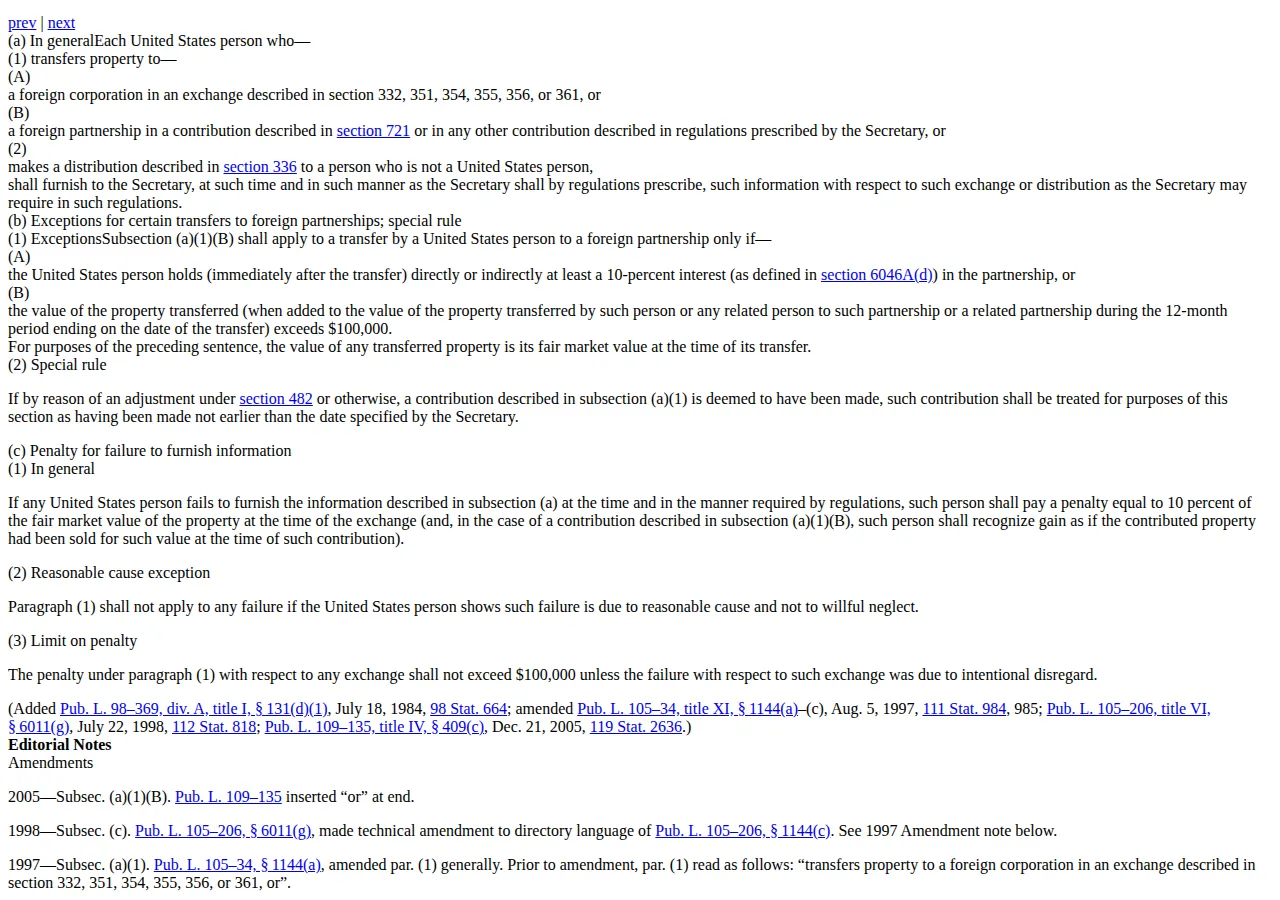
Section 6038B(c) sets the penalty: 10% of the fair market value of the property at the time of the exchange, with a reasonable-cause defense and a $100,000 cap per exchange unless the failure was due to intentional disregard. For a contribution to a foreign partnership under §6038B(a)(1)(B), the transferor also recognizes gain as if the property had been sold for its fair market value at contribution.
| FMV transferred | 10% of FMV | Penalty actually due |
|---|---|---|
| $600,000 | $60,000 | $60,000 |
| $1,000,000 | $100,000 | $100,000 |
| $2,000,000 | $200,000 | $100,000 (cap) |
| $5,000,000 | $500,000 | $100,000 (cap) |
The cap is per exchange, not per form or per year: three separate unreported $2,000,000 transfers carry three $100,000 penalties — $300,000. Intentional disregard removes the cap entirely. The limitations period for assessing tax on the transfer is also extended to 3 years after the required information is finally provided.
Worked example: the $2,000,000 IP transfer
A Delaware C-Corp owns a customer list and platform code with a $300,000 basis. In 2026 it contributes both to a new Irish subsidiary in a §351 exchange, at a $2,000,000 arm's-length valuation with a 10-year useful life. The transfer is §367(d) property, so no §367(a) gain is recognized — instead the super-royalty applies at $200,000 a year ($2,000,000 divided by 10 years), ordinary income, for 10 years. Part III, Section C reports the $2,000,000 arm's-length price, the $300,000 basis, and the $200,000 first-year inclusion. If the founder files nothing, the §6038B penalty is 10% of $2,000,000 — $200,000 — capped at $100,000, plus a 40% §6662(j) penalty on any underpayment the unreported inclusion creates, and the limitations period stays open until 3 years after the information is finally provided. The same transfer at a $600,000 valuation would have cost a $60,000 penalty.
A second penalty sits behind the first. Under §6662(j), a 40% penalty applies to any underpayment from an undisclosed foreign financial asset understatement — a $100,000 underpayment costs $40,000 — with no penalty on any portion shown to be reasonable cause and good faith. The two stack: §6038B punishes the missing notice, §6662(j) the missing tax.
Founder & CEO Insight — Enow A. Jovial
What changed after 2017
Three TCJA changes still govern every Form 926 filed today. First, §14102(e) repealed the active trade or business exception under §367: tangible-property transfers after 2017 face full gain recognition under §367(a)(1) — a pre-2018 guide is now repealed law. Second, §14102(d) added §91, the transferred loss amount for foreign branch assets. Third, §14221 widened the intangible definition — now §367(d)(4) — to goodwill, going concern value, and workforce in place.
Filing checklist
- [x] Step 1 — Identify the transfer: confirm §6038B(a)(1)(A), §367(d), or §367(e) applies; test the exceptions first.
- [x] Step 2 — Measure the property: fair market value and adjusted basis at the transfer date, in U.S. dollars; for intangibles, arm's-length price and useful life.
- [x] Step 3 — Test the cash rule: aggregate all cash to the same foreign corporation and related persons in the 12 months ending on the transfer date against $100,000.
- [x] Step 4 — Decide on a GRA: if a 5% transferee-shareholder position applies to stock or securities, file the five-year gain recognition agreement under Reg. § 1.367(a)-8 and Form 8838 to extend the assessment statute.
- [x] Step 5 — Complete the form: Parts I and II, Part III Sections A–C, Supplemental Part III, and Part IV lines 17–21.
- [x] Step 6 — File with the return: attach Form 926 to the transferor's return for the year of the transfer; calendar the FBAR (FinCEN Form 114) if the transfer creates a reportable account.
- [x] Step 7 — Keep the records: maintain the valuation, transfer documents, and GRA for the extended period — 3 years after the information is provided.
When not to file
The exceptions are real and a qualifying transferor should use them — but they are tested on facts the IRS can re-derive: post-transfer ownership, whether the gain was actually reported, whether the return was timely. A transferor unsure whether the 5% or taxable-and-reported test is met should file: the form costs an afternoon, the penalty for guessing wrong is 10% of the property, and the limitations clock does not start until the information is provided. Our transfer-pricing playbook covers the §482 valuation disputes that most often follow.