An investor sells stock for a $100,000 capital gain in 2021, invests it in a qualified opportunity fund within 180 days, and pays no tax on that gain in 2021. The gain does not vanish. It sits on a ledger the Internal Revenue Service watches every year, and the instrument that keeps it visible is a two-page form most investors have never heard of.
Form 8997 is the investor-side annual statement for qualified opportunity fund investments: anyone holding a QOF investment during the tax year files it with their timely filed return. It tracks deferred gain through four parts — opening holdings, current-year deferrals, inclusion events, and year-end holdings — until the gain is included at an inclusion event or December 31, 2026.
The deferral, in one statute paragraph
The Tax Cuts and Jobs Act added sections 1400Z-1 and 1400Z-2 to the Code. Section 1400Z-2 supplies the benefit: a taxpayer who sells property to an unrelated person for a gain may elect to exclude the gain invested in a qualified opportunity fund within 180 days of the sale. The excluded gain is then included in the year that includes the earlier of the sale or December 31, 2026.
Three features of that paragraph drive everything on the form. First, the deferral is an election made on the return for the year the tax would otherwise be due — you elect when filing, and the deferral is reported on Form 8949. Second, the investment must be an equity interest in the fund acquired within the window. Third, the gain is not forgiven at the backstop; it is merely postponed, and the amount included depends on fair market value and the basis adjustments. The qualified opportunity zone fund strategy guide covers the fund side.
Who must file, and when
The 2025 instructions state the filing rule without qualification: an eligible taxpayer holding a QOF investment during the tax year must file Form 8997 with the timely filed return, including extensions. If you are not otherwise required to file a return — with the exception of grantor trusts — but held a QOF investment during the year, attach Form 8997 to an appropriate return carrying your name, address, and TIN: your SSN or ITIN as an individual, or the entity's EIN.
The form attaches to the return you already file: Form 1040, 1040-SR, 1040-NR, 1041, 1065, 1120, 1120-F, 1120-REIT, 1120-RIC, 1120-S, or 990-T. The form is timely when the return is timely, and an extension of the return extends the form. For a calendar-year individual the 2025 form rides the 2025 return, due April 15, 2026, or October 15, 2026 on extension.
The four parts and the columns they share
The form is two pages and four parts. Each part is a table with the same six columns: (a) the QOF's EIN, (b) the acquisition date, (c) a description of the investment, (d) a special gain code, (e) short-term deferred gain, and (f) long-term deferred gain.
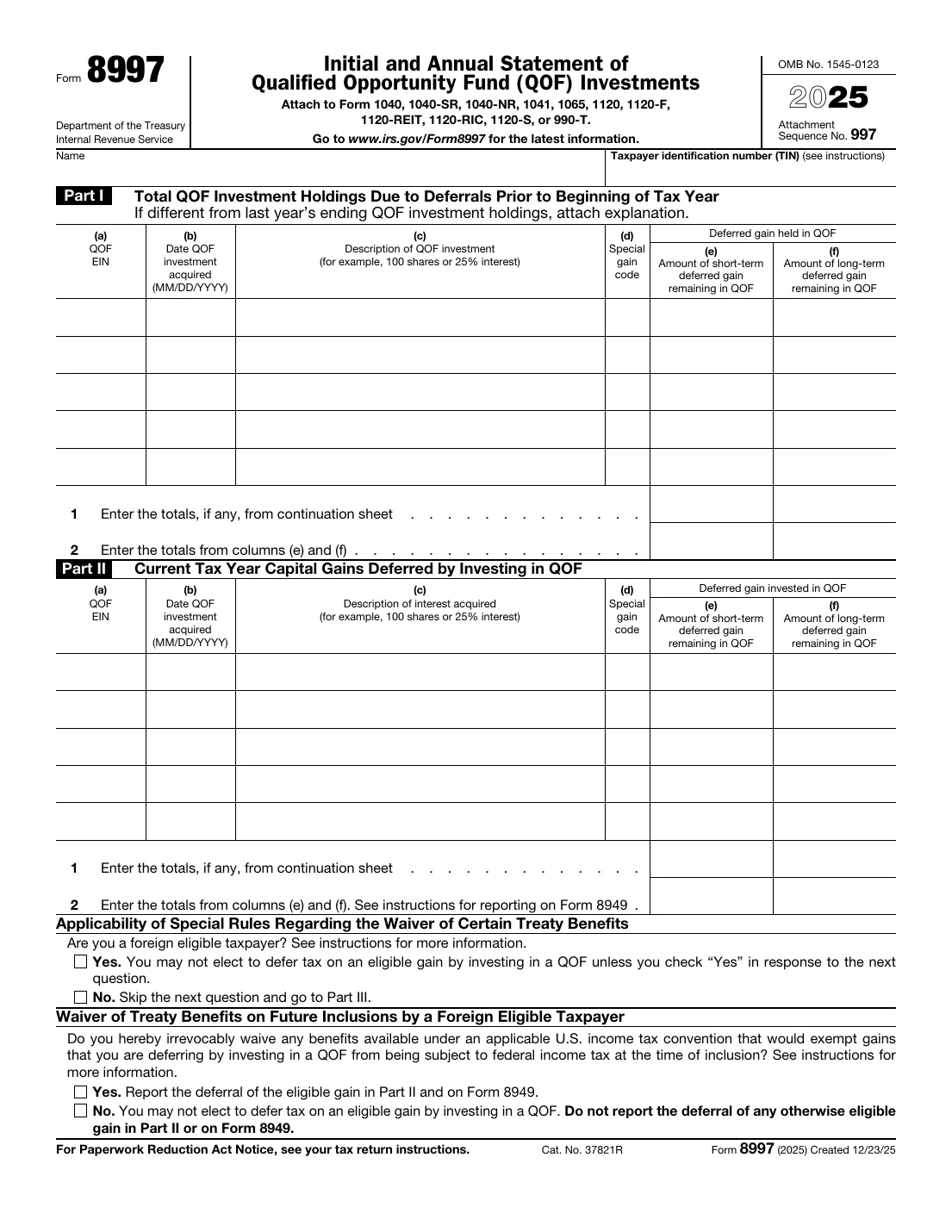
Part I reports QOF holdings due to deferrals before the tax year — for an individual, generally January 1, 2025. Part II reports the current tax year's gains deferred by investing in a QOF. Part III reports inclusion events and certain other transfers during the year. Part IV reports QOF investments due to deferrals at year end — for an individual, generally December 31, 2025. The four parts must reconcile:
If Part IV does not equal that sum, something is wrong — a disposition in Part III not removed from Part IV, a deferral in Part II never added, or an opening balance not matching last year's closing balance. Part I anticipates the mismatch and requires an explanation when the opening figure differs from the prior year's ending figure.
| Part | Reports | Period covered | Authority |
|---|---|---|---|
| I | QOF holdings due to deferrals before the tax year | Opening — Jan 1, 2025 | Form 8997 |
| II | Current-year gains deferred by investing in a QOF | Current year | Form 8997; § 1400Z-2(a) |
| III | Inclusion events and other transfers | Current year | Form 8997; § 1400Z-2(b) |
| IV | QOF investments due to deferrals at year end | Closing — Dec 31, 2025 | Form 8997 |
The 180-day window and the special gain codes
The deferral only works if the money reaches the fund inside the window: the 180-day period beginning on the date the gain would be recognized without the election. Section 1231 gains — generally gains reported on Form 4797, Part I — are eligible too. The Form 8949 capital gains reporting playbook covers the return-side reporting the election depends on. Column (d) carries a special gain code whenever the deferred gain originated from one of the listed sources:
| Code | Source of deferred gain | Authority |
|---|---|---|
| A | Section 1256 contract gain | Form 8997 |
| B | Form 4797 gain (section 1231 gain) | Form 8997 |
| C | Gain from straddle(s) | Form 8997 |
| D | Gain from collectibles | Form 8997 |
| E | Gain exempt by treaty | Form 8997 |
| F | Noninclusion transfer gain | Reg. § 1.1400Z2(b)-1(c) |
| G | 5-year basis adjustment | § 1400Z-2(b)(2)(B)(iii) |
| H | 7-year basis adjustment | § 1400Z-2(b)(2)(B)(iv) |
Code F is the one preparers miss. If you acquired the QOF investment in a transaction that was, in whole or in part, not an inclusion event under Regulations section 1.1400Z2(b)-1(c) — for example, a noninclusion transfer — you must identify the transferor in column (c) by name, TIN, and the date the investment was transferred to you, and enter code F in column (d). If a transaction falls under a regulatory exception so that no deferred gain is included, enter "Exception" in column (c) with a citation to the applicable regulation, and leave columns (d) through (f) blank.
Foreign eligible taxpayers face an extra gate. A foreign eligible taxpayer — a non-U.S. person under section 7701(a)(30), or a person treated as a resident of another country under a treaty — must irrevocably waive any treaty benefits that would exempt the deferred gains from federal income tax at inclusion, by checking "Yes". Answering "No" means the taxpayer may not elect to defer at all.
The basis math and the cutoff dates it creates
The basis rule is the reason the deferral is valuable. A taxpayer's basis in the QOF investment starts at zero. It increases by the gain recognized at inclusion, by 10% of the deferred gain if the investment is held at least 5 years, and by a further 5% — 15% total — if held at least 7 years.
Work it with a $100,000 gain deferred in 2019, included on December 31, 2026, when the investment is worth $130,000. Held more than 7 years, the basis is $0 + $10,000 + $5,000 = $15,000. The included gain is min($100,000, $130,000) − $15,000 = $85,000. At an illustrative 20% rate, the tax on inclusion is $17,000 — $3,000 less than the $20,000 due on the full $100,000.
Now run the same numbers for a 2024 investment. The basis is $0 — neither milestone can be reached before the December 31, 2026 backstop. The included gain is min($100,000, $130,000) − $0 = $100,000, and the illustrative tax is $20,000. The late entry costs $3,000 of extra tax on the same $100,000 of deferred gain. That is the arithmetic behind the cutoff dates: invest by December 31, 2021 to reach 5 years, and by December 31, 2019 to reach 7.
The 10-year rule survives the backstop differently. If the investment is held at least 10 years and the taxpayer elects under section 1400Z-2(c), the basis is stepped up to the fair market value on the date it is sold or exchanged — so the appreciation in the investment is never taxed. A 2019 investment sold in 2029 at $200,000, after the $85,000 inclusion in 2026, produces no further tax.
Inclusion events: when the deferral ends early
The backstop is December 31, 2026, but most deferrals end sooner, on an inclusion event — one that reduces or terminates the investment. The IRS FAQ lists the pattern: selling the investment, giving it away, the fund liquidating, or a distribution that reduces the investment. A gift of the investment to a child before December 31, 2026 is an inclusion event: the donor reports the deferred gain in the year of the gift, and the child receives a non-qualifying investment with no deferral attached.
Part III has two mechanical duties. First, if you disposed of an investment and received no Form 1099-B reporting the disposition, check the box in Part III Second, a basis adjustment on an inclusion event is reported in Part III: enter "Adjustment to basis 5-year" or "Adjustment to basis 7-year" in column (c), enter code G or H in column (d), and the adjustment in column (e) or (f) by the character of the previously deferred gain.
The December 31, 2026 backstop is not a planning horizon — it is a wall. Every remaining deferred gain is included in the 2026 tax year, computed on the fair market value at that date. An investor whose fund has appreciated sharply owes tax on the deferred gain in 2026 whether or not any cash was distributed.
The fund side: Form 8996 and the 90% test
The fund files Form 8996, and its December 2024 instructions state its purpose: a corporation or partnership uses the form to certify that it is organized to invest in qualified opportunity zone property, and files it annually to report that it meets the 90% investment standard — or to figure the penalty if it fails. A qualified opportunity zone business does not file Form 8996. A fund may be organized as a C-Corp, an S-Corp, or an LLC taxed as a partnership.
The 90% standard is the average of the percentage of qualified opportunity zone property held on the last day of the first 6-month period and on the last day of the tax year. Cash contributed but not yet invested can be excluded if the requirements are met, and the working capital safe harbor protects cash held under a written plan for up to 31 months. The fund values its property under the applicable financial statement method (generally GAAP) or the alternative valuation method. The penalty for failure is set by the statute, not by the instructions:
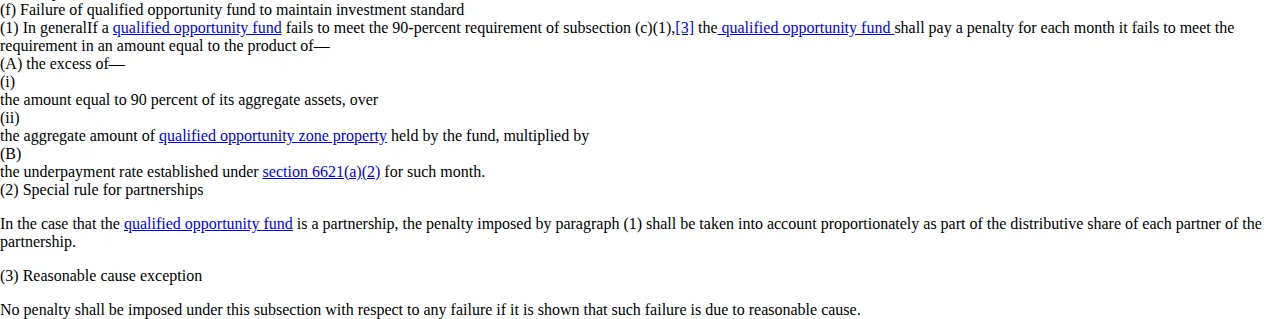
The penalty formula is:
Take a fund with $10,000,000 of assets holding $8,400,000 of QOZ property. The shortfall is $9,000,000 − $8,400,000 = $600,000. At an illustrative 8% annual underpayment rate — the actual rate is set quarterly under section 6621(a)(2) — the monthly penalty is $600,000 × 0.08 / 12 = $4,000, or $24,000 over six months. If the fund is a partnership, the penalty is taken into account proportionately as part of each partner's share.
Who should not use this deferral
The deferral is the wrong tool in four situations. A taxpayer with no capital gain to defer gains nothing — the election only shelters eligible gain actually invested. A taxpayer who needs the cash before December 31, 2026 should not lock it in a fund whose exit is an inclusion event. A taxpayer who will not file the annual statement should not elect at all: the audit trail is the chain of 8997s, and a missing year is the first thing an examiner asks about. The like-kind exchange playbook covers the older deferral route for real property, with no December 31, 2026 backstop and no annual statement.
Keep a one-page deferral ledger: the original gain, the 180-day investment date, the fund's EIN, and the running basis with the 5- and 7-year milestones dated. When the 2026 inclusion arrives, the ledger produces the numbers for Part III, and a CPA reviewing the file can verify the chain in minutes.
Execution checklist
- Confirm the gain is eligible and the clock: capital gain from a sale to an unrelated person; 180 days from the recognition date.
- Elect on the right return: elect on the return for the year the tax would otherwise be due; report the deferral on Form 8949.
- File Form 8997 with the timely filed return, including extensions: attach to the applicable return.
- Complete all four parts every year: Part I opening, Part II deferrals, Part III inclusions, Part IV year-end — reconcile Part IV.
- Split short-term and long-term in columns (e) and (f): never mix the characters.
- Enter special gain codes and transferor identification: codes A through H; code F with name, TIN, and date on noninclusion transfers.
- Diary the basis milestones: 5-year 10% and 7-year 5% bumps, with the December 31, 2021 and December 31, 2019 cutoffs.
- Check the fund's Form 8996 before investing and each year after: the 90% standard and any penalty in Part IV.
Founder & CEO Insight — Enow A. Jovial
Related reading: the qualified opportunity zone fund strategy guide covers the fund side; the Form 8949 capital gains reporting playbook covers the return-side reporting; and the like-kind exchange playbook covers the older route for real property. Estimate the tax on the 2026 inclusion with the tax estimator before the backstop.