A rental building bought for $350,000 is now worth $600,000. Sell it outright and the $250,000 gain is taxed. Exchange it for another rental building of equal value under § 1031 and the tax waits — deferred into the replacement property's basis until a taxable sale. One missed deadline, or one dollar of cash in the wrong hands, and the gain is current.
> [!FOUNDER]
> "A § 1031 exchange is a closing with a stopwatch taped to it. The investors who lose the deferral rarely pick the wrong replacement property — they let the 45th day pass, or let sale proceeds touch their own account for one night."
> — Enow A. Jovial, Founder & Chief Executive Officer
1. The statute: what § 1031(a) actually says
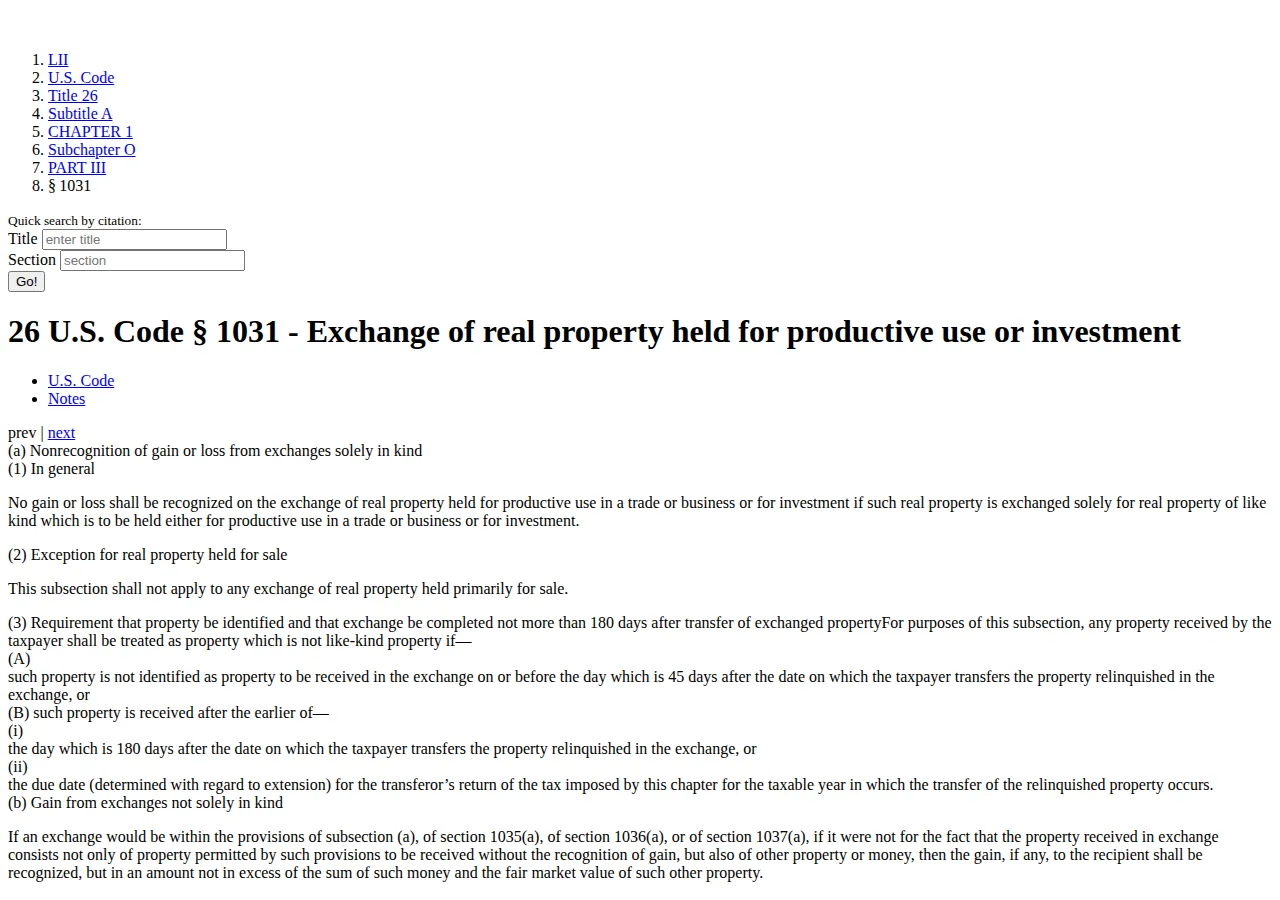
Section 1031(a)(1) provides that no gain or loss shall be recognized on the exchange of real property held for productive use in a trade or business or for investment if such real property is exchanged solely for real property of like kind which is to be held either for productive use in a trade or business or for investment. Four conditions: real property, held for business use or investment, exchanged for like-kind real property, held for the same purpose. Section 1031(a)(2) excludes real property held primarily for sale.
!26 U.S.C. § 1031 statute text
> [!KEY TAKEAWAY]
> Section 1031 defers gain; it never forgives it. The deferred gain survives inside the replacement property's basis.
2. The like-kind standard: nature and character, not grade or quality
Treasury Regulation § 1.1031(a)-1(b): like kind turns on the nature or character of the property, not its grade or quality — improved or unimproved is not material. The regulation's examples: city real estate for a ranch or farm, a 30-year-or-more leasehold for real estate, improved for unimproved real estate. What does not qualify is a change of class — real property for personal property, or US real property for foreign real property. Section 1031(h): real property located in the United States and real property located outside the United States are not property of a like kind.
3. The TCJA change: real property only since 2018
Before the Tax Cuts and Jobs Act, § 1031 covered personal property — aircraft, trucks, equipment. Public Law 115-97, § 13303, substituted "real property" for "property" throughout, applying to exchanges completed after December 31, 2017, with a transition rule for 2017 transfers. Machinery, vehicles, artwork, and equipment no longer qualify — a business trading in a fleet of trucks now recognizes gain on each sale; see the related guide on depreciation recapture.
4. The two clocks: 45 days to identify, 180 days to close
Section 1031(a)(3) is the timing test that ends more exchanges than any other rule: property received is not like-kind property if it is not identified within 45 days of the transfer of the relinquished property, or if it is received after the earlier of 180 days after that transfer or the return due date, determined with regard to extension, for the year of the transfer. Neither clock pauses for weekends, holidays, or title defects; identification must be written, signed, and delivered to a person involved in the exchange who is not the taxpayer or a disqualified person.
Transfer on Monday, March 2, 2026: day 45 is Thursday, April 16, 2026; day 180 is Saturday, August 29, 2026 — no weekend extension. Transfer on Sunday, November 1, 2026: the 180th day is Friday, April 30, 2027, but a calendar-year return is due Thursday, April 15, 2027 — with no extension filed, the exchange period ends April 15, 2027, fifteen days early. Filing Form 4868 or Form 7004 first restores the full 180 days.
Under the 3-property rule in Regulation § 1.1031(k)-1(c)(4), up to three properties of any fair market value may be identified. Under the 200-percent rule, any number of properties may be identified as long as their aggregate fair market value does not exceed 200 percent of the relinquished properties' value — the regulation's example: relinquished property worth $100,000 permits identification totalling $180,000, within the $200,000 cap.
5. The qualified intermediary and the safe-harbor escrow
Almost no modern exchange is simultaneous: the seller closes weeks before the replacement property is ready, and the proceeds must sit in escrow without touching the taxpayer's hands — receipt of the cash, even for a day, is a taxable sale. Regulation § 1.1031(k)-1(g) supplies four safe harbors; the qualified intermediary safe harbor in paragraph (g)(4) is the one nearly every deferred exchange uses. Under it, the intermediary is not the taxpayer's agent — but only if the agreement expressly limits the taxpayer's rights to the money held, as paragraph (g)(6) requires. The qualified escrow and qualified trust safe harbor in paragraph (g)(3) works the same way, provided the escrow holder is not the taxpayer or a disqualified person. Per the Instructions for Form 8824, related parties and agents cannot be qualified intermediaries — Regulation § 1.1031(k)-1(k) defines a disqualified person as one who acted as the taxpayer's agent within the two years before the transfer, or a person related to the taxpayer under § 267(b) or § 707(b)(1).
> [!WARNING]
> Constructive receipt is the silent killer of § 1031 exchanges: if the agreement lets the taxpayer draw on the proceeds, pledge them, or direct the intermediary to pay a personal bill, the IRS treats the taxpayer as having received the money when the right arose.
6. Boot and mortgage boot: the math that taxes part of the exchange
Section 1031(b): if the property received consists not only of like-kind property but also of other property or money, the gain shall be recognized, but not in excess of the sum of such money and the fair market value of such other property. Cash and non-like-kind property are called boot; § 1031(c) adds the asymmetry that no loss shall be recognized — boot taxes gains but never shelters losses.
$
\text{Recognized gain} = \min(\text{Boot received}, \text{Gain realized})
$
$
\text{Gain realized} = (\text{FMV received} + \text{Boot received}) - \text{Adjusted basis given up}
$
Relinquished property: fair market value $600,000, adjusted basis $350,000; replacement property worth $560,000 plus $40,000 cash received. Gain realized is $250,000; boot is $40,000; recognized gain is $40,000, and $210,000 is deferred. Mortgage boot follows the same logic: § 1031(d) treats another party's assumption of the taxpayer's liability as money received. Debt relief is boot; debt assumed is consideration given; only the net matters. A $400,000 mortgage given up against a $380,000 mortgage assumed leaves $20,000 of mortgage boot, unless $20,000 of cash is paid in to offset it. The deferred gain also changes the depreciation base — see the companion guide on rental income reporting.
7. Worked example: the IRS's own numbers
The Instructions for Form 8824 carry a worked example with two apartment buildings, computed line by line. Taylor owns a building: fair market value $220,000, adjusted basis $100,000, mortgage $80,000. Finley owns a building: fair market value $250,000, adjusted basis $175,000, mortgage $150,000. Taylor transfers the building to Finley and receives Finley's building plus $40,000 cash. Taylor assumes Finley's $150,000 mortgage; Finley assumes Taylor's $80,000 mortgage.
For Taylor, cash boot on line 15 is the $40,000 received; the $80,000 Finley assumed is not included, because it does not exceed the $150,000 Taylor assumed. Line 16 is the $250,000 fair market value received; line 17 totals $290,000. Line 18 is the $100,000 basis plus the $70,000 excess of liabilities Taylor assumed over liabilities Finley assumed, so $170,000. Line 19 gain realized is $120,000; line 20 recognized gain is $40,000; Taylor defers $80,000.
Taylor's basis follows § 1031(d): the same as the property exchanged, decreased by money received and increased by gain recognized — $100,000 + $40,000 + $150,000 − $40,000 − $80,000 = $170,000.
$
\text{Taylor replacement basis} = \$100{,}000 + \$40{,}000 + \$150{,}000 - \$40{,}000 - \$80{,}000 = \$170{,}000
$
Finley: line 15 is $30,000 — $150,000 assumed by Taylor minus $80,000 assumed by Finley and $40,000 cash paid. Finley's gain realized is $75,000, recognized gain $30,000, deferred $45,000. Re-checked: $40,000 plus $30,000 is the gain recognized now; $125,000 deferred is the gain postponed.
8. Choosing the route: five structures, one statute
| Exchange route | When it fits | Clock that governs | Authority |
| :--- | :--- | :--- | :--- |
| Simultaneous exchange | Same-day closing | None — no deferral gap | § 1031(a)(1) |
| Deferred exchange with QI | Time to find property | 45-day identification, 180-day closing | Reg. § 1.1031(k)-1(g)(4) |
| Reverse exchange, EAT parks | Replacement property bought first | QEAA: 45-day identification, 180-day transfer | Rev. Proc. 2000-37, § 4.02 |
| Improvement exchange, EAT builds | Replacement property under construction | QEAA: 45-day identification, 180-day transfer | Rev. Proc. 2000-37, § 4.02 |
| DST interest | Passive stake, no management | 45-day identification, 180-day closing | Rev. Rul. 2004-86 |
9. Reverse exchanges: buying first under Rev. Proc. 2000-37
A deferred exchange assumes the old property sells first. When the replacement property will not wait, the taxpayer must buy first — and § 1031 has no mechanism for holding property the taxpayer already owns. Revenue Procedure 2000-37 supplies the safe harbor: a qualified exchange accommodation arrangement, or QEAA, under which an exchange accommodation titleholder, the EAT, takes qualified indicia of ownership of the parked property and is treated as its beneficial owner, so it can later be transferred to the taxpayer. Section 4.02 sets the conditions: a written QEAA within five business days of the indicia transfer; identification of the relinquished property within 45 days; transfer of the parked property to the taxpayer, or of the relinquished property to a non-disqualified person, within 180 days; combined QEAA holding under 180 days. Miss any mark and the procedure does not apply.
10. The DST route: a passive replacement interest
A taxpayer who wants out of management can take a Delaware statutory trust interest instead. Revenue Ruling 2004-86 holds that the Delaware statutory trust described in the ruling is an investment trust under § 301.7701-4(c), and that a taxpayer may exchange real property for an interest in that trust without recognition of gain or loss under § 1031, if the other requirements of § 1031 are satisfied. The trade is control for passivity: the trustee cannot renegotiate leases freely, refinance, or raise new capital. The head-to-head on DSTs versus Series LLCs maps the vehicle choice.
11. Related parties: the two-year rule in § 1031(f)
Exchanging with a related person invites basis shifting, so § 1031(f)(1) removes nonrecognition if, within two years after the last transfer in the exchange, the related person disposes of the property received, or the taxpayer disposes of the property received from the related person. Either disposition inside the two years triggers recognition as of the date of that disposition. Related person means any person bearing a relationship described in § 267(b) or § 707(b)(1). Section 1031(f)(2) excepts dispositions after the death of either party, compulsory or involuntary conversions under § 1033, and dispositions shown not to have tax avoidance as a principal purpose.
12. The identifiers behind every exchange file
No exchange closes without the paper trail identifying each party to the IRS. The taxpayer's Employer Identification Number, the EIN issued on Form SS-4, identifies an LLC or corporation; an individual files under a Social Security Number, an SSN; a nonresident alien who cannot obtain one files under an Individual Taxpayer Identification Number, an ITIN, issued on Form W-7. The exchanger is usually a limited liability company, an LLC, but the same exchange can sit inside an S-Corp or a C-Corp. A Certified Public Accountant, a CPA, should reconcile the exchange against Generally Accepted Accounting Principles, GAAP. The same return may also carry Federal Insurance Contributions Act, FICA, withholding and Self-Employment Contributions Act, SECA, tax — keep the exchange gain on Form 8824.
13. The five-step exchange workflow
1. Confirm qualification before marketing. Verify the relinquished property is real property held for business or investment, not inventory, and the replacement property is US real property of like kind. Get the CPA's confirmation and the engagement letter signed first.
2. Engage the qualified intermediary and sign the exchange agreement, assigning the sale contract to the intermediary and expressly limiting the taxpayer's rights to the proceeds, per Regulation § 1.1031(k)-1(g)(6).
3. Close the relinquished property and start the clocks. Day zero is the transfer date: calendar the 45th and 180th days, file the return extension if needed, and deliver the written identification before day 45 expires.
4. Acquire the replacement property through the intermediary, which applies the escrowed proceeds; the taxpayer places financing to avoid mortgage boot, and any cash out is priced as boot before closing.
5. Report on Form 8824 and carry the basis forward. File Form 8824 with the return for the year of the exchange, record the replacement property's § 1031(d) basis, and keep the identification notice, exchange agreement, and closing statements.
14. Who should not use § 1031
A taxpayer who needs the sale proceeds to live on should not exchange — the cash-out is boot, taxed as if no exchange happened. A taxpayer whose gain is small relative to the intermediary, legal, and title costs should sell and pay the tax; a $30,000 gain does not justify $8,000 of fees and six months of deadline risk. A taxpayer with a loss should never exchange, because § 1031(c) denies recognition of the loss — sell the property, recognize the loss, and use it.
> [!TIP]
> File the return extension the week the relinquished property closes, not the following April — it keeps the 180-day period from being cut short, and costs nothing.
15. Reporting: Form 8824
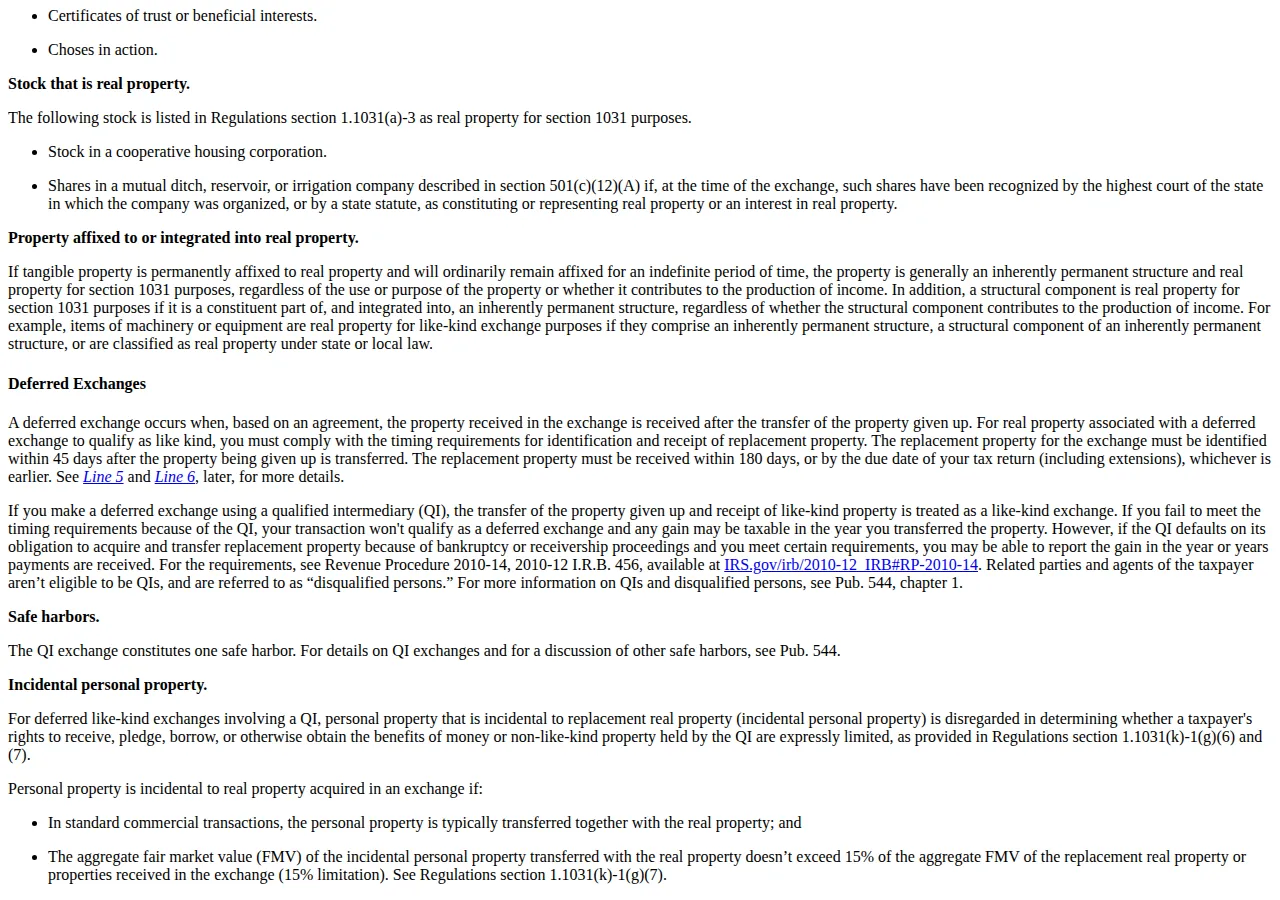
Form 8824 is filed with the return for the year the taxpayer transferred property in a like-kind exchange, and for the two years following a related party exchange. Parts I and II report each exchange; Part III figures the gain reportable when boot is involved, and the basis of the like-kind property received. The Instructions warn that failing the timing requirements because of the intermediary means the gain may be taxable in the year the property was transferred.
!Form 8824 deferred exchange instructions
Section 1031 rewards the taxpayer who plans the exchange before the sale, not after it — the statute is narrow, the clocks are absolute, and the paperwork is the transaction. For a fast estimate of what the deferred gain is worth, run the numbers through the tax estimator before signing the exchange agreement.