A brokerage sends a Form 1099-B showing $19,000 of proceeds and a basis the broker reported to the IRS. Form 8949 exists for the hard cases: a wrong basis, a disallowed wash-sale loss, a small-business stock exclusion, a sale with no 1099-B at all. Form 8949 reconciles what the broker told the IRS with what the taxpayer actually owes.
> [!FOUNDER]
> "The 1099-B is the broker's version of your year. Form 8949 is your version. When the two disagree, the IRS believes the broker until your form proves otherwise — so the form is not paperwork, it is your evidence."
> — Enow A. Jovial, Founder & Chief Executive Officer
1. What Form 8949 is and where it sits
Form 8949, Sales and Other Dispositions of Capital Assets, reports capital-asset sales and exchanges. The Instructions for Form 8949 (2025) state its purpose: the form lets the taxpayer and the IRS reconcile amounts reported on Form 1099-B, Form 1099-DA, or Form 1099-S with the amounts on the return.
The copy rule governs the whole form. If a Form 1099-B, 1099-DA, or 1099-S was received, always report its proceeds in column (d), and if it shows basis was reported to the IRS, always report that basis in column (e) — even when wrong. Corrections never overwrite columns (d) or (e); they go in column (g), explained by a code in column (f).
2. What counts as a capital asset, and the one-year line
The property sold must first be a capital asset. Section 1221(a) defines the term broadly, then carves out eight categories, including inventory, depreciable business property, and a self-created copyright. A stock portfolio is capital assets; a rental building is § 1231 property, reported on Form 4797.
Section 1222 sets the rate line: short-term means a capital asset held for not more than 1 year; long-term means held for more than 1 year. Holding period runs from the day after acquisition through the disposition day. Buy on March 3, 2025 and sell on March 3, 2026, and the gain is short-term; sell on March 4, 2026 and it is long-term. One day changes the rate.
> [!KEY TAKEAWAY]
> Form 8949 sorts every sale twice: by holding period into Part I or Part II, then by whether the broker reported basis. Get the sort wrong and the gain lands in the wrong bucket at the wrong rate.
3. Parts I and II: the box system
Part I is short-term; Part II is long-term. Short-term: box A, 1099-B with basis reported to the IRS; box B, 1099-B without basis reported; box C, no 1099-B at all. Long-term sales use the parallel boxes D, E, and F. For 2025, digital assets get their own boxes — G, H, I short-term; J, K, L long-term. Never use box C for short-term digital assets, or box F for long-term ones.
!Form 8949 Part I boxes for short-term sales
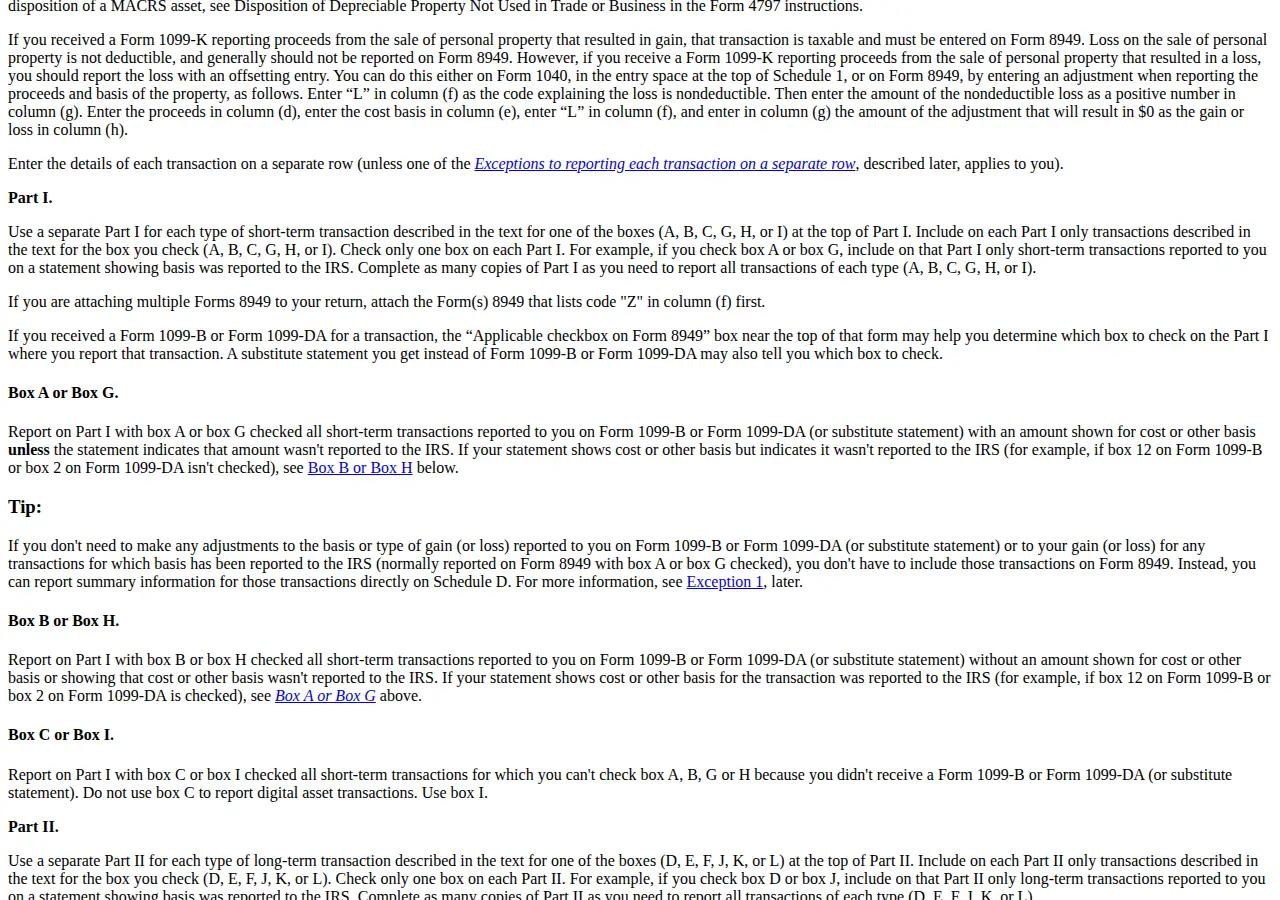
The box tells the IRS how much verification the return already carries. Box A and box D rows are pre-matched: the broker already told the IRS the basis. Box B and box E rows are the taxpayer's word on basis, with the broker's proceeds as the anchor. Box C and box F rows rest entirely on the taxpayer's records.
4. The 1099-B reconciliation: columns (d) through (h)
Each row is one transaction. Columns: (a) property, (b) date acquired, (c) date sold, (d) proceeds, (e) basis, (f) code, (g) adjustment, (h) gain or loss. The formula: proceeds minus basis, plus adjustments.
$
\text{Gain (or loss) in column (h)} = \text{Proceeds (d)} - \text{Basis (e)} + \text{Adjustment (g)}
$
The sign convention in column (g) is the trap. A positive adjustment increases the gain; a negative adjustment, shown in parentheses, decreases it. A basis that is too high gets a positive adjustment; a selling expense gets a negative one. IRS examples: $6,000 proceeds, $2,000 basis — $4,000 gain; $6,000 and $8,000 — ($2,000) loss; a ($1,000) adjustment on the first — $3,000 gain.
Basis is the amount paid plus acquisition costs (Topic 703); stock bought at various times enters "Various" in column (b), one row per part.
5. The adjustment codes: one letter per correction
Most rows leave columns (f) and (g) blank. Multiple codes go in alphabetical order with no spaces — "BOQ", not "B, O, Q". The complete 2025 table (I-8949 = Instructions for Form 8949, 2025):
| Code | What it corrects | Column (g) entry | Authority |
| --- | --- | --- | --- |
| B | Wrong 1099-B/1099-DA basis | Worksheet amount | I-8949 |
| C | Collectibles sold | -0- | I-8949 |
| D | Accrued market discount | Worksheet amount | I-8949 |
| E | Selling expenses, premiums, digital costs | Paid amounts negative | I-8949 |
| H | Main-home gain excluded | Excluded gain, negative | I-8949 |
| L | Nondeductible loss, not a wash sale | Loss, positive | I-8949 |
| M | Multiple trades, one row | -0- | I-8949 |
| N | Nominee reporting for the owner | Makes column (h) zero | I-8949 |
| O | Adjustment no other code explains | Appropriate amount | I-8949 |
| P | Foreign seller, partnership interest | Reg. § 1.864(c)(8)-1 | I-8949 |
| Q | QSBS excluded | Excluded gain, negative | I-8949; § 1202 |
| R | Gain rollover postponed | Postponed gain, negative | I-8949 |
| S | Section 1244 loss over ordinary max | See Schedule D | I-8949 |
| T | Wrong gain type on the form | -0- | I-8949 |
| W | Nondeductible wash-sale loss | Disallowed loss, positive | I-8949; § 1091 |
| X | DC Zone/community asset excluded | Excluded gain, negative | I-8949 |
| Y | Gain deferred in a QOF | See QOF instructions | I-8949 |
| Z | Electing QOF deferral | See QOF instructions | I-8949 |
No code A or F exists in the 2025 instructions; column (g) signs run exclusions and selling expenses negative, disallowed losses positive.
6. Worked example: three sales reconciled to Schedule D
Three short-term sales show the reconciliation. Sale 1: $12,000 proceeds, $9,000 basis — gain $3,000. Sale 2: $6,000 proceeds, $8,000 basis — loss ($2,000). Sale 3 is the IRS's own Example 4: stock sold for $1,000 after three months, correct basis $100, but the 1099-B shows a $900 basis reported to the IRS. Keep $900 in column (e), enter code B in column (f), and work the basis worksheet: $900 minus $100 equals an $800 positive adjustment in column (g). The gain is $900.
$
\text{Part I totals} = \$19{,}000 - \$17{,}900 + \$800 = \$1{,}900 \text{ net short-term gain}
$
Proceeds total $19,000, basis $17,900, and the single $800 adjustment brings the Part I total to a $1,900 net short-term gain, flowing to Schedule D line 7.
7. Wash sales: the loss that is not a loss yet
Section 1091(a) disallows a loss on stock or securities when, within a period beginning 30 days before the sale and ending 30 days after it, the taxpayer acquires substantially identical stock or securities — a 61-day window in total. The loss is deferred into the replacement shares' basis under § 1091(d), which also inherit the old holding period.
Example. Buy 100 shares at $50 ($5,000 basis). Sell at $40 ($4,000) — a $1,000 loss. Repurchase 100 at $42 within 30 days ($4,200). The loss is disallowed: report on Part I with code W and a +$1,000 adjustment in column (g), so column (h) shows zero.
$
\text{New basis} = \$4{,}200 + \$1{,}000 = \$5{,}200
$
The $1,000 loss sits inside the replacement shares until they are sold outside the window — see tax-loss harvesting and the wash-sale rule for timing strategies.
> [!WARNING]
> Any acquisition of substantially identical stock in the 61-day window triggers a wash sale — including a purchase in a spouse's account or an IRA, or a dividend reinvestment. The broker sees one account; the rule looks at the taxpayer.
8. Netting, the $3,000 limit, and the carryforward
Short-term gains and losses combine into the net short-term gain or loss on line 7; long-term gains and losses combine into the net long-term gain or loss on line 15; the two combine into the total net gain or loss on line 16. A net short-term loss offsets a net long-term gain dollar for dollar.
A net loss caps the deduction at the lesser of $3,000 ($1,500 married filing separately) or the total net loss on line 16, claimed on Form 1040 line 7a. The excess carries forward indefinitely, keeping its character; short-term losses are used first. Publication 550: Bob and Shelly sold securities in 2025 at a $7,000 capital loss on $26,000 of taxable income. They deduct $3,000 jointly; the unused $4,000 carries to 2026.
$
\text{Deductible loss} = \min(\$3{,}000, \text{Net loss on line 16}) \quad \text{Carryforward} = \text{Net loss} - \text{Deductible loss}
$
9. Qualified small business stock: code Q and the 100% exclusion
Public Law 119-21 rewrote the § 1202 percentages in 2025. Stock acquired after the applicable date (July 4, 2025) and held at least 3 years excludes 50% at 3 years, 75% at 4 years, 100% at 5 years or more. Stock acquired after September 27, 2010, held more than 5 years, keeps the classic 100% exclusion under § 1202(a)(4). Claim it on Form 8949 with code Q in column (f) and the excluded gain as a negative number in column (g).
The per-issuer cap is the greater of the dollar limit or 10 times the aggregate adjusted bases of QSBS disposed of during the year. The dollar limit is $10,000,000 for stock acquired on or before the applicable date and $15,000,000 for stock acquired after it, each reduced by prior-year eligible gain.
10. What rate applies to the gain
Long-term gains are taxed at preferential rates; short-term gains are taxed as ordinary income. For 2025, the 0% rate applies at taxable income of $48,350 or less (single and married filing separately), $96,700 or less (married filing jointly), and $64,750 or less (head of household). The 15% rate applies up to $533,400 (single), $300,000 (married filing separately), $600,050 (married filing jointly), and $566,700 (head of household). Above those thresholds the rate is 20%. Collectibles gains and the taxable part of a § 1202 gain cap at 28%; unrecaptured § 1250 gain caps at 25%. Schedule D, not Form 8949, decides the rate. See Schedule D for the rate computation.
11. Who must file Form 8949 — and who may skip it
Exception 1 decides whether the form is needed at all. A taxpayer may aggregate transactions onto Schedule D line 1a (short-term) or 8a (long-term), skipping Form 8949 entirely, but only when every condition holds: no collectibles; a 1099-B showing basis reported to the IRS, no adjustments in box 1f or 1g, Ordinary box unchecked; no QOF election or termination.
Everyone else files the form: any wash sale, incorrect basis, QSBS or home-sale exclusion, sale with no 1099-B, or digital asset transaction must be reported on Form 8949. Exception 2 is the middle path for high-volume filers: attach a statement with the same information, enter combined totals on Parts I and II, and mark the row with code M. Never write "Available upon request" — the instructions forbid it for individuals.
An individual files under an SSN or ITIN; a business files under its EIN — a single-member LLC reports on its owner's return, while an S-Corp or C-Corp files its own. Capital gains are investment income, not wages, so no FICA or SECA tax applies; a CPA checks the 8949 against the 1099-B before signing.
12. The five-step filing workflow
1. Collect every information return. Gather all 1099-B, 1099-DA, and 1099-S forms, plus confirmations for sales with no information return.
2. Sort every sale by holding period and box. Short-term to Part I, long-term to Part II; sort by basis reporting. One row per transaction unless Exception 2 applies.
3. Copy columns (d) and (e), then correct in column (g). Never overwrite a broker-reported figure. Code B uses the basis worksheet; code E, selling expenses; code W, wash sales; codes H or Q, exclusions.
4. Total each part and carry the totals to Schedule D. Part I totals go to Schedule D lines 1b, 2, 3; Part II to lines 8b, 9, 10. Finish Form 8949 before Schedule D.
5. File and keep the evidence. E-file with the form attached; if e-filing without one row per transaction, attach Form 8949 to Form 8453 and mail it. Keep the confirmations, basis worksheet, and wash-sale calculations.
13. Execution checklist
14. The mistakes that cost money
The most expensive mistake is silent: filing with a wrong broker basis in column (e), which overstates the gain. The second is the wash sale discovered in April: the January repurchase already disallowed the December loss, and the return must carry code W whether the broker flagged it or not. The third is reporting a sale with no 1099-B in box A or D instead of box C or F. The fourth is the carryforward forgotten: a $4,000 unused loss from last year is a $4,000 asset this year — but only if the carryover worksheet was kept.
> [!TIP]
> Run the basis worksheet the week the 1099-B arrives, not in April. A broker corrects a wrong basis free before the return is filed; after filing, the correction is an amended return.
Form 8949 rewards the filer who treats it as a reconciliation, not a transcription: copy what the broker reported, correct what is wrong with a code and a signed adjustment, and let Schedule D do the netting and the rate math. To estimate the tax on the gain, run the numbers through the tax estimator — and for business sales, the Schedule C profit and loss playbook covers the business side.