Qualified Opportunity Zone Fund Playbook: Defer the Gain, Exclude the Appreciation
A $1,000,000 gain realized in October 2026 and invested in a QOF in November 2026 is deferred for 51 days — the statute fixes the inclusion date at December 31, 2026. Held ten years, it can still exclude $1,600,000 of appreciation entirely. The deferral is nearly worthless this late; the exclusion is the prize. From January 1, 2027, the One Big Beautiful Bill Act replaces the regime: rolling five-year deferral, a returning 10 percent step-up, a 30-year cap on the exclusion.
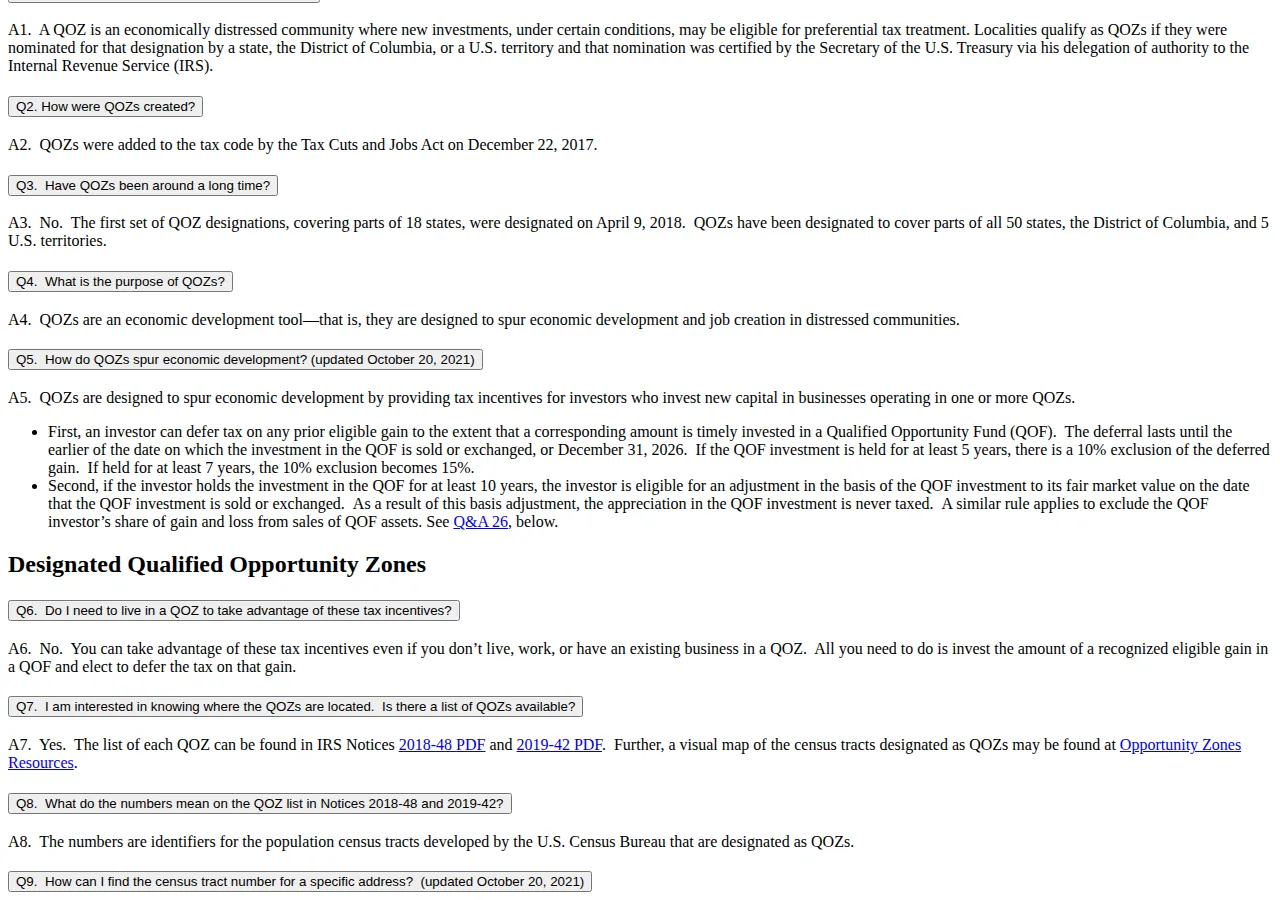
An opportunity zone is a Treasury-certified distressed census tract; a QOF turns a capital gain into three benefits — defer, step up, exclude — each on a different clock, two already gone for new money in November 2026.
The statute: three benefits, one fixed deadline
Section 1400Z-2(a)(1) lets a taxpayer elect to exclude from gross income a capital gain from a sale to an unrelated person, up to the amount invested in a QOF during the 180-day period beginning on the sale date. Subsection (b) sets the inclusion date: the earlier of the sale or December 31, 2026. Subsection (a)(2)(B) adds the hard stop: no election for any sale or exchange after December 31, 2026. Only gains recognizable before January 1, 2027 qualify, and only if not from a related-person transaction.
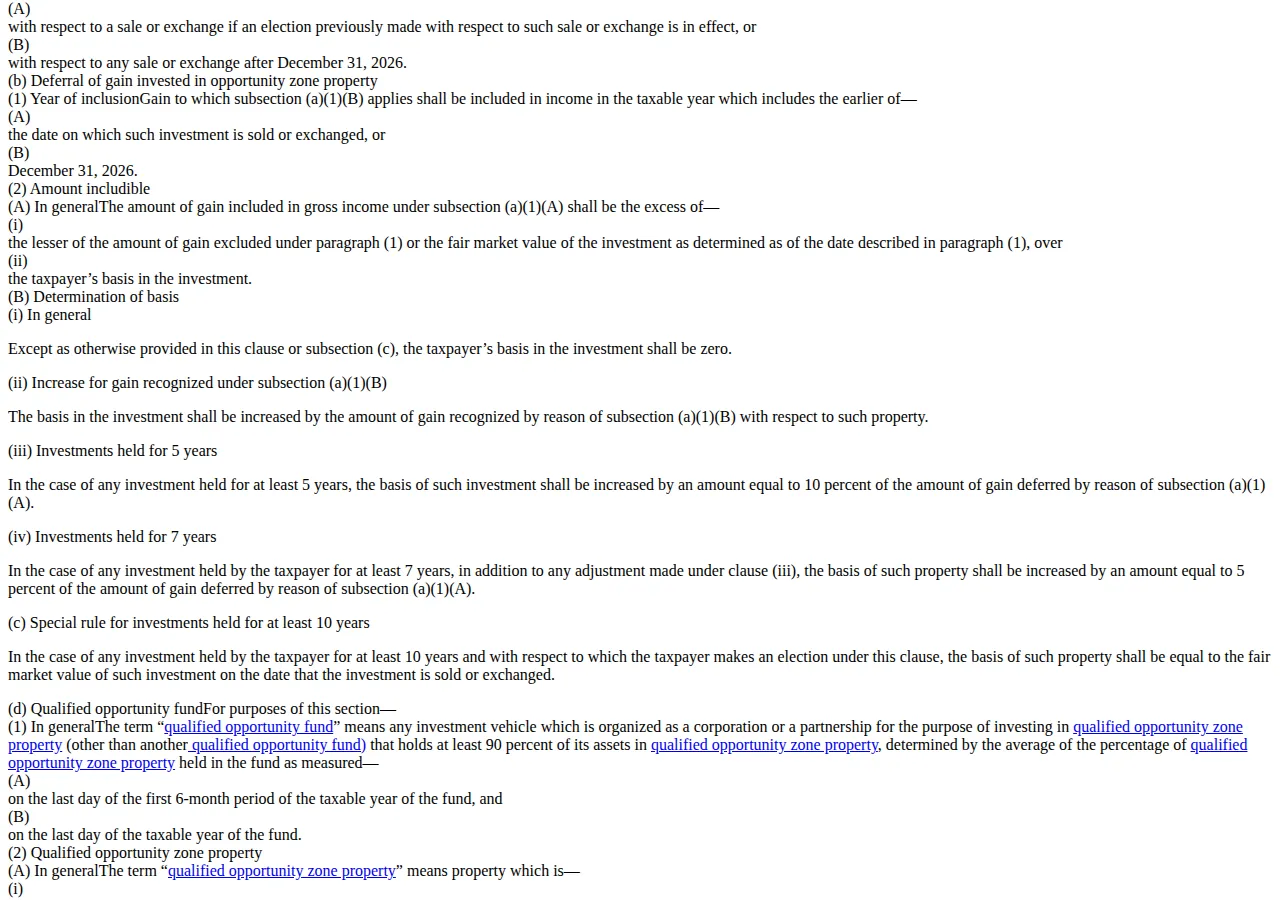
The amount included is the lesser of the gain excluded or the investment's fair market value on the inclusion date, minus basis. Basis starts at zero, then rises by the gain recognized and by the step-ups: 10 percent of the deferred gain at five years, plus 5 percent more — 15 percent total — at seven. Subsection (c) is the exclusion: an investment held at least ten years, with an election, takes a basis equal to its fair market value on the sale date.
Capital gains and qualified section 1231 gains both qualify, per the IRS FAQ, and installment-sale gains qualify too — the 180-day period for an installment payment begins on the day the payment is received. Ordinary gain does not qualify: invest it in a QOF and the investment is non-qualifying, with no deferral and no exclusion.
The November 2026 investor: 51 days of deferral, $320,000 of exclusion
Take a $1,000,000 long-term capital gain realized October 15, 2026, invested November 10, 2026. The 180-day period runs to April 13, 2027, so the investment is timely — but the deferral ends December 31, 2026, 51 days after the money went in. The 180-day window times the investment; it does not extend the deferral past December 31.
At December 31, 2026 the fund interest is worth $1,050,000. The amount included is the lesser of the $1,000,000 excluded or that $1,050,000 value, minus a zero basis:
The 20 percent rate is the top federal long-term capital-gains rate used here, before any net investment income tax. The investor pays the full $200,000 for tax year 2026.
Hold ten years to November 2036 and sell at $2,600,000. With the subsection (c) election, basis steps up to the $2,600,000 sale-date fair market value, so the gain is zero and the $1,600,000 of appreciation is never taxed:
Total tax with the QOF: $200,000 in 2026, $0 in 2036. Without it: $520,000. The net saving is $320,000 — every dollar from the exclusion.
The step-ups are already dead for new money
The 10 percent and 15 percent step-ups are still printed in every summary of the law — and they are unreachable for anyone investing now. The step-up applies against the gain included on December 31, 2026: the 5-year step-up required investing by December 31, 2021, the 7-year by December 31, 2019. A November 2026 investment cannot reach five years before that date, so its basis at inclusion is zero and the full deferred gain comes back into income.
A 2019 investor with seven years held would have had a $150,000 step-up — 15 percent of $1,000,000 — so only $850,000 came back into income and the tax was $170,000. The step-up saved $30,000. That $30,000 is gone for new money; it returns, in a smaller form, under the 2027 regime.
Our 1031 exchange playbook covers the other deferral route, where the clock runs on the exchange — and our cost segregation study playbook covers acceleration instead.
The 90 percent test and the monthly penalty
Section 1400Z-2(d)(1) requires a QOF to hold at least 90 percent of its assets in qualified opportunity zone property, averaged across the last day of the first six-month period and the last day of the tax year. The fund self-certifies by filing Form 8996 annually — an LLC taxed as a partnership or corporation can be a QOF — and the test is computed on Form 8996, Part II.
A $5,000,000 fund holds $4,600,000 of QOZ property on June 30 — 92 percent — and $4,400,000 on December 31 — 88 percent. The average is 90 percent, and the fund passes exactly:
Change December 31 to $4,300,000 — 86 percent — and the average falls to 89 percent: fail. The shortfall is 90 percent of $5,000,000 minus $4,300,000, or $200,000, and § 1400Z-2(f) charges a penalty for each month of failure equal to the shortfall times the § 6621(a)(2) underpayment rate, divided by 12 because the rate is annualized. At the fourth-quarter 2026 rate of 7 percent, per Revenue Ruling 2026-15:
The penalty is charged to the fund; for a partnership QOF the cost comes out of the fund's assets, so the partners bear it. Two details soften the test: cash contributed within six months before a testing date and held in cash or cash equivalents may be excluded from the first test after the contribution.
Qualified opportunity zone property is QOZ stock, a QOZ partnership interest, or QOZ business property acquired after December 31, 2017, with substantially all of its use in the zone.
Substantial improvement: double the basis in 30 months
The test decides whether buying an existing building in a zone counts: during any 30-month period beginning after acquisition, additions to basis must exceed the adjusted basis at the start of that period. Land is generally not part of the test — if the building is used in an active trade or business, the land need not be substantially improved.
A QOF buys an apartment building for $2,000,000 — $400,000 land, $1,600,000 building. Additions must exceed the building's $1,600,000 basis within 30 months, so the project totals at least $3,600,000. In a rural zone the bar is halved: additions above 50 percent of basis, or $800,000, for a $2,800,000 total. The 50 percent rural figure took effect July 4, 2025, so it is already in force.
The operating business must itself qualify as a QOZ business: at least 50 percent of gross income from active conduct in the zone, a substantial portion of its intangible property used in that conduct, and less than 5 percent of assets in nonqualified financial property, under § 1397C(b)(2), (4), and (8). Sin businesses are out — golf courses, country clubs, massage parlors, hot tubs and suntan facilities, racetracks and gambling, and liquor stores. Reasonable working capital is protected: cash designated in writing for a zone business, on a reasonable written schedule and consumed within 31 months, is not nonqualified financial property. The safe harbor can stack to 62 months, and a federally declared disaster area adds 24 months.
Filing identity: who files what, and under whose number
The fund files Form 8996 with its own return and self-certifies. The investor reports on Form 8997 with the investor's own return — Form 1040, 1041, 1065, 1120, or 1120-S — listing each investment by the fund's EIN, the acquisition date, and the deferred gain held. Form 8997 has four parts: holdings at year start and end, gains deferred during the year, and inclusion events. The election itself is made on Form 8949.
The audit trail runs on numbers, not names: the QOF is identified by its EIN on every investor's Form 8997, and the investor's return carries the investor's SSN or the entity's EIN, signed by the preparing CPA. An LLC taxed as a partnership reports on Form 1065 and the deferral flows to members on their K-1s; an S-corp owner reports through the K-1 the same way, and a C-corp takes the position at the entity level. A foreign investor must irrevocably waive treaty benefits to elect deferral. There is no standalone Instructions for Form 8997 — the form carries its own instructions. Mixed funds are split into two investments, and gifts, non-grantor trust transfers, and distributions above basis are inclusion events that end the deferral early.
The 2027 regime: rolling deferral, rural step-up, 30-year cap
The One Big Beautiful Bill Act (P.L. 119-21, signed July 4, 2025) rewrites § 1400Z-2 for amounts invested after December 31, 2026. The fixed inclusion date is gone; gain is included at the earlier of the sale or five years after the investment — a rolling five-year deferral. The 5-year step-up returns at 10 percent, and at 30 percent for a qualified rural opportunity fund: a QOF holding at least 90 percent of its assets in zone property used in a zone comprised entirely of a rural area.
The same $1,000,000 gain, invested in February 2027, with inclusion in February 2032; assume the interest is worth $1,300,000 then. The step-up is $100,000, so the amount included is $900,000 and the tax is $180,000 — $20,000 less than the no-step-up bill. Hold ten years to February 2037 and sell at $2,600,000, and the exclusion still zeroes the appreciation — but hold past 30 years and basis is the fair market value on the 30-year date, not the sale date, so appreciation after year 30 is taxable.
| Feature | Old regime (invest by Dec 31, 2026) | New regime (invest after Dec 31, 2026) | Authority |
|---|---|---|---|
| Deferral ends | December 31, 2026, fixed | 5 years after investment, rolling | § 1400Z-2(b); P.L. 119-21 § 70421 |
| Step-up | 10% / 15% — unreachable for new money | 10% at 5 years; 30% rural | § 1400Z-2(b)(2)(B); P.L. 119-21 § 70421 |
| 10-year exclusion | FMV at sale, no cap | FMV at sale, capped at FMV at 30 years | § 1400Z-2(c); P.L. 119-21 § 70421 |
| Election deadline | No election after Dec 31, 2026 | Bar removed | § 1400Z-2(a)(2); P.L. 119-21 § 70421 |
Founder & CEO Insight — Enow A. Jovial
Who should not do this
Ordinary gain cannot be deferred — the election covers capital gains and qualified section 1231 gains only, and a sale to a related person is barred, with related defined at a 20 percent threshold. Needing the money back inside ten years gives up the exclusion, where the value lives. The exclusion is federal — check state conformity before assuming the state treatment matches. Run the tax estimator at your own rate before deciding — the 20 percent math assumes long-term capital gain.
Execution checklist: invest in a QOF in one pass
- Step 1 — Confirm the gain qualifies. Capital gain or qualified section 1231 gain, recognized before January 1, 2027, from an unrelated sale.
- Step 2 — Start the 180-day clock. Day one is the date the gain would be recognized without the election; K-1 recipients have three start dates — entity year-end, entity start date, or return due date.
- Step 3 — Vet the fund before wiring. Self-certifies on Form 8996, at least 90 percent of assets in QOZ property on both testing dates, working-capital schedule and improvement plan shown.
- Step 4 — Invest inside the window, before December 31, 2026. Within 180 days — and, for any deferral, before the fixed inclusion date.
- Step 5 — Elect on the return. Deferral on Form 8949; investment on Form 8997 with the fund's EIN, acquisition date, and deferred gain.
- Step 6 — Report every year and hold ten. File Form 8997 annually, report inclusion events, hold ten years to elect FMV basis on sale.
- [x] Gain qualified: capital or section 1231 gain, pre-2027, unrelated buyer.
- [x] 180-day window: investment inside the period, before December 31, 2026.
- [x] Fund vetted: Form 8996 self-certification, 90 percent test, improvement plan.
- [x] Election filed: Form 8949 deferral, Form 8997 with the fund's EIN.
- [x] Annual reporting: Form 8997 every year the investment is held.
- [x] Ten-year hold: exclusion elected on sale at FMV basis.
The home-sale exclusion works the same way: our section 121 primary residence exclusion playbook erases up to $250,000.