The one-page form behind a 20 percent deduction
Form 8995 is the short form for the qualified business income deduction: one page, seventeen lines, no wage schedule. If your taxable income before the deduction sits at or below the threshold for your filing status, and you are not a cooperative patron, this is the form that computes it.
The three-condition test: 8995 or 8995-A
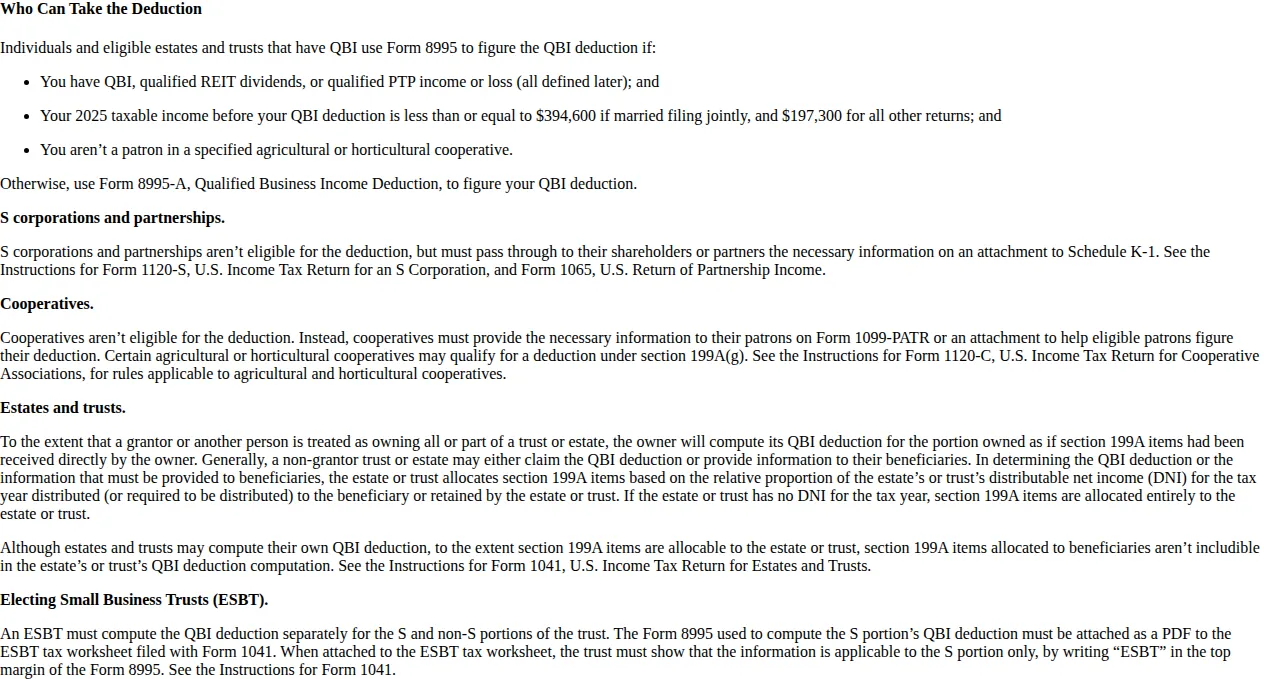
The Instructions for Form 8995 (2025) state three conditions: QBI, qualified REIT dividends, or qualified PTP income or loss; 2025 taxable income before the QBI deduction of $394,600 or less if married filing jointly, $197,300 or less for all other returns; and not a patron in a specified agricultural or horticultural cooperative. Otherwise, use Form 8995-A. The 2026 figures come from Revenue Procedure 2025-32 below.
The test turns on taxable income before the deduction, not business profit: $250,000 of taxable income files Form 8995; $450,000 files Form 8995-A.
| Situation | Form | Authority |
|---|---|---|
| Taxable income at or below the threshold, not a cooperative patron | Form 8995 | Instr. for Form 8995 (2025) |
| Taxable income above the threshold | Form 8995-A | § 199A(b)(2)–(3), (d)(3) |
| Patron of a specified agricultural or horticultural cooperative | Form 8995-A | § 199A(g) |
The thresholds: 2025 against 2026
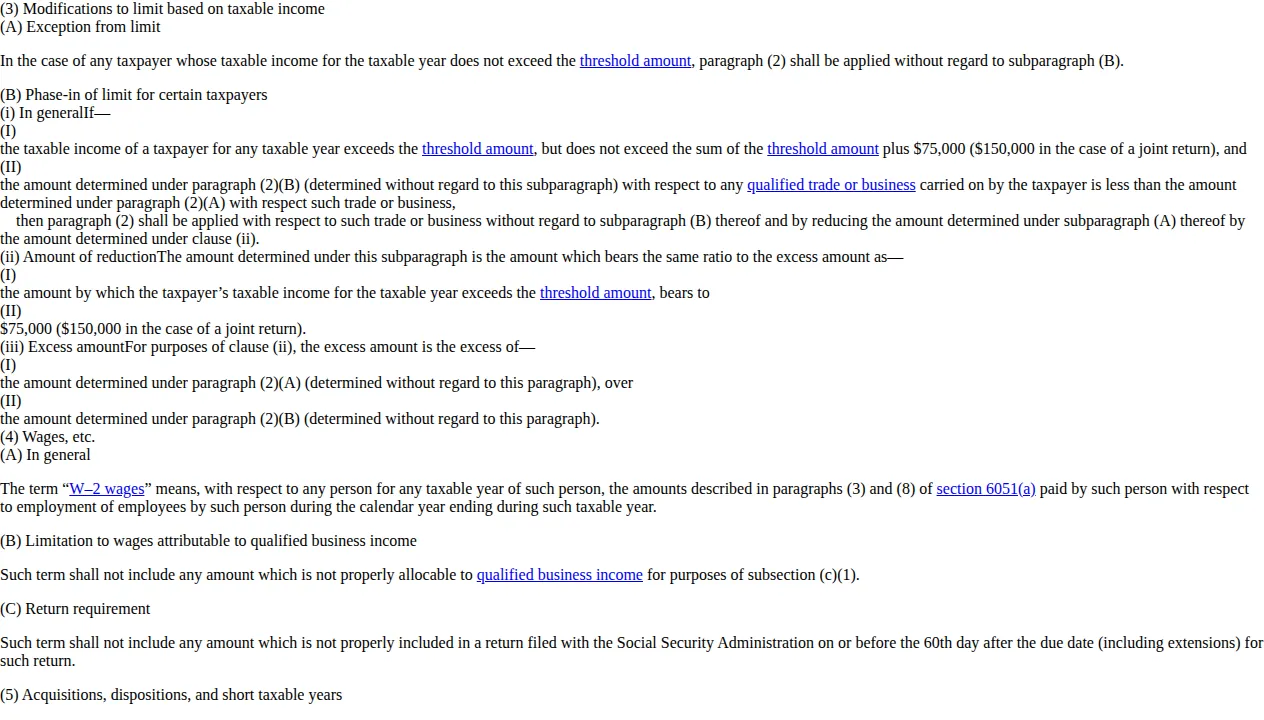
The threshold starts at $157,500 under section 199A(e)(2)(A), doubled for a joint return, inflation-adjusted yearly. Revenue Procedure 2025-32 sets the 2026 figures; the 2025 Instructions set the 2025 figures. The One Big Beautiful Bill Act (Public Law 119-21, section 70105) widened the 2026 phase-in range to $150,000 for joint returns and $75,000 for all other returns, up from $100,000 and $50,000. The table gives the threshold and the corridor top — threshold plus range — because the top decides whether an SSTB keeps any deduction.
| Filing status | 2025 threshold | 2025 corridor top | 2026 threshold | 2026 corridor top | Authority |
|---|---|---|---|---|---|
| Married filing jointly | $394,600 | $494,600 | $403,500 | $553,500 | Instr. 8995; RP 2025-32 §.26 |
| Married filing separately | $197,300 | $247,300 | $201,775 | $276,775 | Instr. 8995; RP 2025-32 §.26 |
| All other returns | $197,300 | $247,300 | $201,750 | $276,750 | Instr. 8995; RP 2025-32 §.26 |
Married filing separately gets its own 2026 threshold, $201,775 — $25 above the single-filer $201,750 — and the 2026 joint corridor top jumped $58,900 in one year, from $494,600 to $553,500, as the threshold rose $8,900 and the range widened $50,000.
The form line by line
Form 8995 (2025) has three blocks: lines 1–5 QBI, lines 6–9 REIT and PTP, lines 10–15 the combination and cap, lines 16–17 carryforwards.
| Line | What goes there |
|---|---|
| 1 | Business name, EIN (or SSN/ITIN), net QBI/loss, rows i–v |
| 2 | Lines 1i–1v, column (c) |
| 3 | Prior-year business net loss carryforward |
| 4 | Total QBI: lines 2 + 3; floor -0- |
| 5 | QBI component: line 4 × 20% |
| 6 | Qualified REIT dividends and PTP income/loss (1099-DIV, line 5) |
| 7 | Prior-year REIT/PTP loss carryforward |
| 8 | Total REIT/PTP income: lines 6 + 7; floor -0- |
| 9 | REIT/PTP component: line 8 × 20% |
| 10 | Lines 5 + 9 |
| 11 | Taxable income before QBI: 1040 11a − 12e − 13b |
| 12 | Net capital gain + qualified dividends (1040 3a) |
| 13 | Line 11 − line 12; floor -0- |
| 14 | Line 13 × 20% |
| 15 | QBI deduction: min(lines 10, 14); to 1040, line 13a |
| 16 | QBI loss carryforward: lines 2 + 3, if below zero |
| 17 | REIT/PTP loss carryforward: lines 6 + 7, if below zero |
Line 11 is the number owners most often compute wrong: line 11a minus lines 12e and 13b, with the QBI deduction itself excluded. Line 12 adds qualified dividends to net capital gain, so a large capital gain shrinks the cap.
Worked example 1: the clean sole-proprietor return
A sole proprietor files Schedule C, reports $120,000 of net QBI and $160,000 of taxable income before the QBI deduction, with no REIT shares, no PTP interest, no capital gain, and no qualified dividends. The business is a single-member LLC, so line 1(b) carries the LLC's EIN — or the owner's SSN or ITIN if the LLC has none. That $120,000 is built on Schedule C; see our IRS Form 1040 Schedule C playbook.
Line 5 is $24,000, line 10 is $24,000, line 14 is $32,000, so line 15 is $24,000 — on Form 1040, line 13a, saving $5,280 at a 22 percent marginal rate. The cap never binds here.
Below the threshold the form never asks for W-2 wages or the unadjusted basis of qualified property: section 199A(b)(3)(A) switches the wage-and-capital limit off, so a sole proprietor with no employees still gets the full 20 percent.
Worked example 2: when the income cap binds
A married couple filing jointly in 2026 reports $200,000 of QBI from a design studio, $10,000 of qualified REIT dividends, $180,000 of taxable income before the deduction, a $20,000 net capital gain, and $5,000 of qualified dividends — well below the 2026 joint threshold of $403,500.
Line 5 is $40,000 on $200,000 of QBI. Line 6 is $10,000 of qualified REIT dividends; line 9 is $2,000, so line 10 is $42,000. Line 11 is $180,000, line 12 is $25,000, line 13 is $155,000, and line 14 is $31,000. Line 15 is the smaller of $42,000 and $31,000: $31,000.
The cap cut $11,000 off the tentative deduction: at a 24 percent marginal rate the $31,000 deduction saves $7,440, and the $11,000 removed would have saved another $2,640. The cap is driven by everything on the return: the gain and dividends shrank line 13 by $25,000. REIT dividends are not limited by W-2 wages or qualified property, but the income cap still applies.
Losses: the carryforward that follows you
A loss on Form 8995 does not vanish. If lines 2 + 3 are below zero, line 4 is zero, there is no QBI component for the year, and line 16 carries the loss forward, where it offsets QBI even if the business that generated it no longer exists. The same rule holds separately for REIT and PTP losses on lines 6, 7, and 17: a REIT/PTP loss carryforward offsets only future REIT and PTP income, never business QBI.
The SSTB edge: one dollar over the threshold
Below the threshold, a specified service trade or business is a qualified trade or business in full: the Instructions for Form 8995 say all or part of an SSTB may qualify at or below the threshold or within the phase-in range. A law practice or consulting practice with $180,000 of taxable income therefore files Form 8995 and claims the full 20 percent. The companion Section 199A QBI deduction playbook works the phaseout in full.
One dollar over the threshold changes the form, not the deduction by one dollar. A married couple filing jointly in 2026 with $410,000 of taxable income is $6,500 above the $403,500 threshold and inside the $150,000 phase-in range, so the return moves to Form 8995-A and the SSTB's applicable percentage is 1 minus $6,500 divided by $150,000 — 95.67 percent. On $300,000 of consulting QBI, applicable QBI is $287,000 and the tentative deduction is $57,400. At $553,500 the applicable percentage reaches zero — the cliff is at the corridor top, not the threshold.
At $400,000 — $3,500 below the threshold — the same couple claims the full $60,000, so $10,000 of extra income costs $2,600.
Aggregation on the simplified form
An owner with more than one trade or business may elect to aggregate them for section 199A purposes if the owner or a group owns 50 percent or more of each business for most of the tax year including the last day, all use the same tax year end, none is an SSTB, and at least two of three coordination factors hold: the same or customarily paired products or services; shared facilities or centralized elements; or operation in coordination or reliance. On Form 8995 the aggregation is entered by group name — Aggregation 1, Aggregation 2 — on line 1, with line 1(b) blank and Schedule B (Form 8995-A) or a similar schedule attached.
Below the threshold the election changes almost nothing, but it binds later years: report aggregations consistently unless a significant change in facts disqualifies them.
What comes out of QBI before line 1
Line 1(c) is net QBI — after the items the statute strips out: capital gains and losses, interest income not properly allocable to the trade or business, wage income, reasonable compensation from an S corporation, guaranteed payments from a partnership, and payments to a partner for services other than in a capacity as a partner. The deductible part of self-employment tax, the self-employed health-insurance deduction, and contributions to qualified retirement plans come out of QBI before any percentage applies. Schedule SE computes the self-employment tax; see our IRS Form 1040 Schedule SE playbook.
The S corporation salary is the exclusion owners fight most: a shareholder-employee's reasonable compensation is excluded from QBI, so every dollar of salary shrinks the base before the 20 percent applies and still costs FICA payroll tax — and on a Form 8995 return there is no wage limit, so the salary buys nothing and costs 20 percent of itself in lost deduction. A CPA should show the client both numbers: payroll tax saved by a lower salary against QBI deduction lost by the same dollar.
What changed for 2026
The One Big Beautiful Bill Act made section 199A permanent by removing the post-2025 sunset, and added two provisions that matter on a Form 8995 return. First, section 199A(i) adds a $400 minimum deduction for tax years beginning after December 31, 2025: an applicable taxpayer with at least $1,000 of QBI from an active trade or business gets the greater of the computed deduction or $400, inflation-adjusted after 2026 — so a side business with $1,500 of QBI computes $300 and the floor lifts it to $400. Second, for tax years beginning after 2025, an active qualified trade or business is one in which the taxpayer materially participates under section 469(h), meeting one test in Treasury Regulation section 1.469-5T(a).
One honest limitation: the Form 8995 and instructions on irs.gov now are the 2025 edition and carry no line for the $400 minimum — the floor is in the statute, in Revenue Procedure 2025-32 section .12, and on the IRS QBI page, but the 2026 form revision will show where it is claimed.
Filing sequence: from Schedule C to line 13a
- Compute net QBI per business. Build each business's net qualified items from Schedule C, Schedule K-1, or the entity return, strip the exclusions above, and carry each net figure to line 1(c) with the EIN, SSN, or ITIN.
- Apply the prior-year carryforwards. Enter business loss carryforward on line 3 and REIT or PTP loss carryforward on line 7, from the prior year's lines 16 and 17.
- Compute both components. Take 20 percent of line 4 for line 5 and of line 8 for line 9, then add them on line 10.
- Compute taxable income before the deduction. Line 11 is Form 1040 line 11a minus lines 12e and 13b; line 12 is net capital gain plus qualified dividends.
- Apply the income limitation. Line 13 is line 11 minus line 12; line 14 is 20 percent of line 13; line 15 is the smaller of lines 10 and 14.
- Carry the total to the return. Enter line 15 on Form 1040, line 13a, and keep the completed Form 8995 attached; estates and trusts use Form 1041, line 20. Before promising any figure to a partner or a lender, run it through the tax estimator.
- Record the carryforwards. If lines 2 + 3 are below zero, record the loss on line 16; if lines 6 + 7 are below zero, record it on line 17.
Before the return is signed, run the threshold test one final time on the finished line 11 — 8995 at or below, 8995-A above.
Founder & CEO Insight — Enow A. Jovial
An extension buys time to compute the deduction: Form 4868 extends the filing deadline six months — the QBI math still has to be right when the return lands.