IRS Form 1040 Schedule SE: The Self-Employment Tax Playbook
Schedule SE is where self-employment stops being a Schedule C number and becomes a tax. A sole proprietor, a partner, or a freelancer with a Schedule C net profit pays no Social Security and Medicare tax through withholding — there is no employer to split the bill. Schedule SE computes the whole charge, both halves, on one page, then sends the tax to Schedule 2 and half of it back as a deduction on Schedule 1.
Section 1401(a) imposes 12.4 percent for old-age, survivors, and disability insurance, and § 1401(b)(1) imposes 2.9 percent for hospital insurance, both "on the self-employment income of every individual." Employees pay the same two rates under FICA, split with an employer; the self-employed pay both halves under SECA, which is why the combined rate is 15.3 percent. The IRS states it the same way: "The self-employment tax rate is 15.3%. The rate consists of two parts: 12.4% for social security (old-age, survivors, and disability insurance) and 2.9% for Medicare (hospital insurance)."
Dating note: Publication 334 is still the 2025 edition, so its dollar examples are 2025 amounts.
Who must file, and the $400 line
You must file Schedule SE if line 4c is $400 or more, or if you had church employee income of $108.28 or more — the whole filing test, under "Who Must File" in the instructions. The $400 is measured on net earnings after the 92.35 percent cut on line 4a, not on gross receipts or Schedule C net profit. A net profit of $433 produces $399.88 of net earnings and owes nothing; $434 produces $400.80 and owes tax on the full amount.
The tax applies at any age, even if you are already getting Social Security or Medicare benefits. Schedule SE is also the Social Security Administration's earnings record: the SSA uses it to figure benefits, so underreporting cuts the benefit record, not just this year's tax. Publication 334 adds a deadline: the SSA will generally give credit only for income reported on a return filed within 3 years, 3 months, and 15 days after the tax year — past that window it may change its record only to remove or reduce the amount, never to increase it.
> [!WARNING]
> The $400 threshold is measured on net earnings after the 92.35 percent cut, not on gross receipts: $433 of net profit owes nothing, $434 owes tax on the full $400.80. The exception is church employee income, with its own $108.28 threshold and lines 5a and 5b.
What is at stake beyond the tax
Two numbers on this page follow the filer for decades: the tax, and the earnings record. For 2026 you receive one Social Security credit, up to four, for each $1,890 of income subject to Social Security tax — $7,560 of combined wages and net earnings buys all four credits for the year.
The operation, line by line
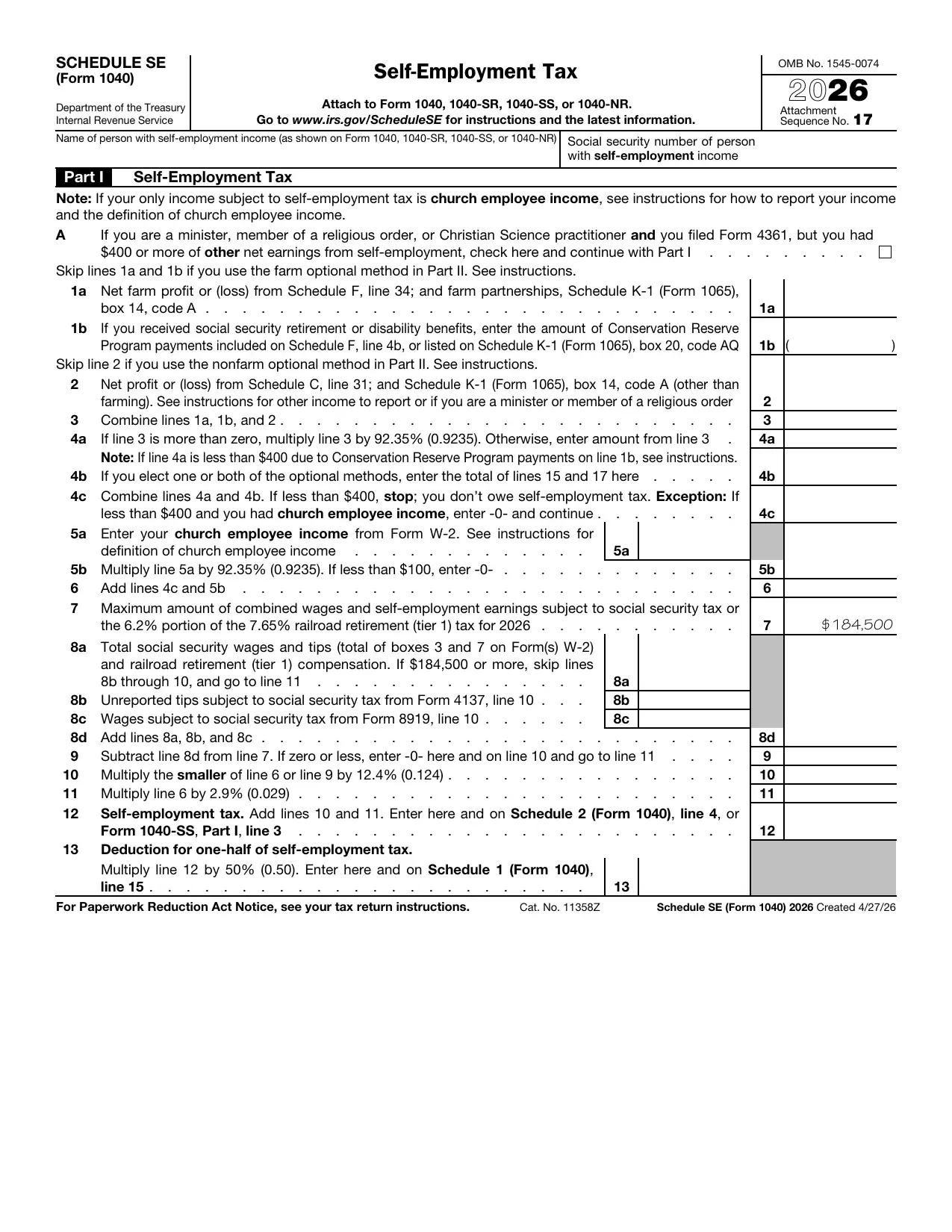
Schedule SE Part I runs thirteen lines, each with one job. The header asks for the filer's SSN or ITIN, distinct from the business EIN on Schedule C. Line 1a takes net farm profit from Schedule F, line 34, plus farm partnership income from Schedule K-1 (Form 1065), box 14, code A; line 1b subtracts Conservation Reserve Program payments on Schedule F when the filer receives Social Security retirement or disability benefits. Line 2 takes the net profit or loss from Schedule C, line 31, plus nonfarm partnership income from Schedule K-1, box 14, code A; line 3 combines them. For most filers line 2 is the only input; the Schedule C playbook runs it from gross receipts to net profit.
Line 4a is the 92.35 percent cut: if line 3 is more than zero, multiply by 92.35 percent (0.9235). The reason is statutory: § 1402(a)(12) allows a deduction of net earnings multiplied by half of the combined § 1401 rates — half of 15.3 percent is 7.65 percent — so net earnings are 100 percent minus 7.65 percent, or 92.35 percent. Publication 334 states the regular method the same way: "multiply your self-employment earnings by 92.35% (0.9235)."
$
\text{Net earnings} = \text{Net profit} \times (1 - 7.65\%) = \text{Net profit} \times 92.35\%
$
Line 4b takes the total from the optional methods in Part II, if elected. Line 4c combines 4a and 4b; below $400, stop — no tax is owed, unless there is church employee income. Lines 5a and 5b handle church employee income from Form W-2, again multiplied by 92.35 percent, with a floor: line 5b under $100 enters zero. Line 6 adds lines 4c and 5b — the net earnings figure later lines use.
> [!KEY TAKEAWAY]
> Schedule SE converts a Schedule C net profit into two things: a tax on line 12 to Schedule 2, line 4, and a deduction on line 13 to Schedule 1, line 15.
Lines 7 through 11 are the wage-base coordination. Line 7 prints the 2026 maximum: $184,500 of combined wages and self-employment earnings subject to the Social Security part. Line 8a takes Social Security wages and tips from all Forms W-2, boxes 3 and 7, plus railroad retirement tier 1 compensation; line 8d adds unreported tips from Form 4137 and wages from Form 8919. Line 9 subtracts line 8d from line 7 — the wage base left after the W-2 wages. Line 10 multiplies the smaller of line 6 or line 9 by 12.4 percent; line 11 multiplies line 6 by 2.9 percent, uncapped. Line 12 adds them: the self-employment tax, entered on Schedule 2 (Form 1040), line 4.
$
\text{Social Security part} = \text{Smaller of net earnings or remaining wage base} \times 12.4\%
$
$
\text{Medicare part} = \text{Net earnings} \times 2.9\%
$
Line 13 is the deduction for one-half of self-employment tax: multiply line 12 by 50 percent, enter it on Schedule 1 (Form 1040), line 15. Section 164(f)(1) allows a deduction "equal to one-half of the taxes imposed by section 1401," expressly excluding § 1401(b)(2) — the 0.9 percent additional Medicare tax. The deductible half covers the 15.3 percent tax only — never the additional Medicare tax. The Schedule 1 playbook shows where line 15 lands in adjusted gross income, and the Schedule 2 playbook shows where line 4 lands in total tax.
!Schedule SE Part I self-employment tax computation, 2026 form
Worked example: one sole proprietor, 2026
A consultant operates as a sole proprietor under a single-member LLC that has not elected corporate treatment, so the business reports on Schedule C: gross receipts $120,000, expenses $40,000, net profit $80,000 on line 31. No farm income, no church employee income, no W-2 wages.
Net earnings are $80,000 × 0.9235 = $73,880. The Social Security part is $73,880 × 12.4% = $9,161.12; the Medicare part is $73,880 × 2.9% = $2,142.52. The self-employment tax on line 12 is $11,303.64, rounded to $11,304. The deduction on line 13 is half of that, $5,651.82, rounded to $5,652. Check the arithmetic in the tax estimator.
Now give the same consultant a W-2 job paying $140,000 in Social Security wages. The remaining wage base on line 9 is $184,500 − $140,000 = $44,500. The Social Security part becomes the smaller of $73,880 or $44,500, times 12.4 percent: $44,500 × 12.4% = $5,518.00. The self-employment tax falls to $7,660.52, rounded to $7,661, and the deductible half to $3,830.26, rounded to $3,830.
The additional Medicare tax is a separate charge on Form 8959 — not on Schedule SE. A 0.9 percent tax applies when wages, compensation, or self-employment income exceed $250,000 married filing jointly, $125,000 married filing separately, or $200,000 single, head of household, or qualifying surviving spouse. With both wages and self-employment income, the threshold for the self-employment income is reduced, but not below zero, by the wages subject to additional Medicare tax. Here the consultant is single: $140,000 of wages, $73,880 of net earnings. The threshold left is $200,000 − $140,000 = $60,000; the excess is $73,880 − $60,000 = $13,880, and the additional Medicare tax is $13,880 × 0.9% = $124.92, rounded to $125.
The decision table: which lines apply to you
| Situation | Schedule SE treatment | Authority |
| --- | --- | --- |
| Sole proprietor, Schedule C net profit of $434 or more | Regular method, lines 1–13; tax to Schedule 2, line 4 | § 1402(a); Schedule SE lines 4a, 12 |
| Single, wages plus SE income over $200,000 | 0.9% on the excess, on Form 8959 | § 1401(b)(2); Schedule SE instructions |
| Church employee income of $108.28 or more | Lines 5a–5b; $100 floor on 5b | Instructions, "Who Must File" |
| Minister with approved Form 4361 | Ministerial earnings exempt; other earnings $400+ taxed | Instructions; Form 4361 |
| Loss or small profit, needs Social Security credits | Optional method, Part II | Schedule SE Part II; Pub. 334 ch. 10 |
The optional methods: buying credits in a thin year
Part II offers two optional methods, both to manufacture net earnings — and therefore Social Security credits and earned-income-linked credits — in a year when the real profit is a loss or nearly nothing. The farm method applies only if gross farm income was not more than $11,340 or net farm profits were less than $8,186. The nonfarm method applies only if net nonfarm profits were less than $8,186 and less than 72.189 percent of gross nonfarm income, and the filer had net earnings of at least $400 in 2 of the prior 3 years. The nonfarm method may be used no more than five times.
Either method reports the smaller of two-thirds of gross income or $7,560 — line 15 farm, line 17 nonfarm — entering line 4b. Three limits bind the choice: never report less than actual net earnings; using a method means paying the SE tax due under it; and the methods figure SE tax only — income tax still uses actual earnings. Using them may also qualify the filer for the earned income, additional child tax, or child and dependent care credits when net earnings without the methods are less than $7,560.
> [!TIP]
> Run the optional-method comparison before filing whenever net profit is small. A few hundred dollars of SE tax in a loss year can buy a year of Social Security credits and raise the earned income credit.
Ministers, church employees, and the exemptions
Ministers, members of religious orders, and Christian Science practitioners sit outside the normal pattern. Their ministerial earnings are not church employee income: they go on line 2. A minister who filed Form 4361 and received IRS approval is exempt from SE tax on ministerial earnings — but $400 or more of other net earnings still runs through Part I via line A. A member of a religious sect who filed Form 4029 and received approval may not need to file Schedule SE at all. Both exemptions require IRS approval, and a Form 2031 election for Social Security coverage on ministerial earnings cannot be revoked.
Church employee income is different: wages for work as a church employee, reported on Form W-2, taxed on lines 5a and 5b at the $108.28 threshold. A notary writes "Exempt—Notary" with the net profit on the dotted line left of line 3 and subtracts it. For a statutory employee, the Schedule C net profit stays off line 2, but the W-2 Social Security wages still count on line 8a.
What is not self-employment income
Not everything on a return is SE income. Real estate rentals go to Schedule E unless the filer is a real estate dealer. Dividends and interest are excluded when not received in the course of a trade or business as a dealer in securities. Gain or loss from a capital asset or other property not held for sale to customers is excluded. A limited partner's distributive share is excluded under § 1402(a)(13), except for guaranteed payments for services actually rendered. The test throughout is § 1402(a): net earnings from a trade or business carried on by the individual. An S-Corp owner's salary arrives on a W-2 and FICA applies to the salary; a C-Corp shareholder's dividends are not trade-or-business earnings. What reaches Schedule SE is the individual's own business profit: Schedule C, Schedule F, or a partnership share.
Cross-border and household edges
The instructions print a list of totalization agreements — the United States has them with France, Germany, Japan, the United Kingdom, and others named there — and a worker covered by a foreign social security system under an agreement is generally exempt from SE tax on those earnings, though a CPA should confirm the agreement applies. Community property adds a household edge: income from a trade or business other than a partnership that is community property under state law is included in the earnings of the spouse carrying on the trade or business — one Schedule SE, not two.
The risk layer: underpayment, estimates, and the audit trail
Self-employment tax has no withholding to catch errors, so the failure mode is underpayment. Estimated tax goes with Form 1040-ES, paid quarterly through EFTPS or Direct Pay, and the SE tax belongs in those estimates from the first quarter the profit appears — waiting until April concentrates a full year of 15.3 percent into one payment. Records may follow GAAP, but Schedule C reports on the method elected, cash or accrual, and Schedule SE inherits it. Keep every Schedule C, K-1, W-2, and Schedule SE: the SSA record is built from these pages and the posting window closes silently.
Execution checklist
> [!FOUNDER]
> "Schedule SE punishes the operator who treats self-employment tax as an April surprise. The math is thirteen lines — but only if Schedule C is finished first and the estimates were paid while the money was coming in. File the profit, pay the tax as you earn it, and the form is arithmetic."
> — Enow A. Jovial, Founder & Chief Executive Officer