Form 8995 is the short form. Form 8995-A is the form for everyone the short form cannot hold: owners above the threshold, specified service businesses, patrons of agricultural cooperatives, and anyone whose deduction survives only after the wage-and-property limit. This playbook runs that computation on the Instructions for Form 8995-A (2025), 26 U.S.C. § 199A, and Treas. Reg. §§ 1.199A-1 through 1.199A-4, all read November 16, 2026. The simplified method is covered in our IRS Form 8995 simplified playbook; the deduction itself is explained in our §199A QBI deduction guide.
The three-condition test: 8995 or 8995-A
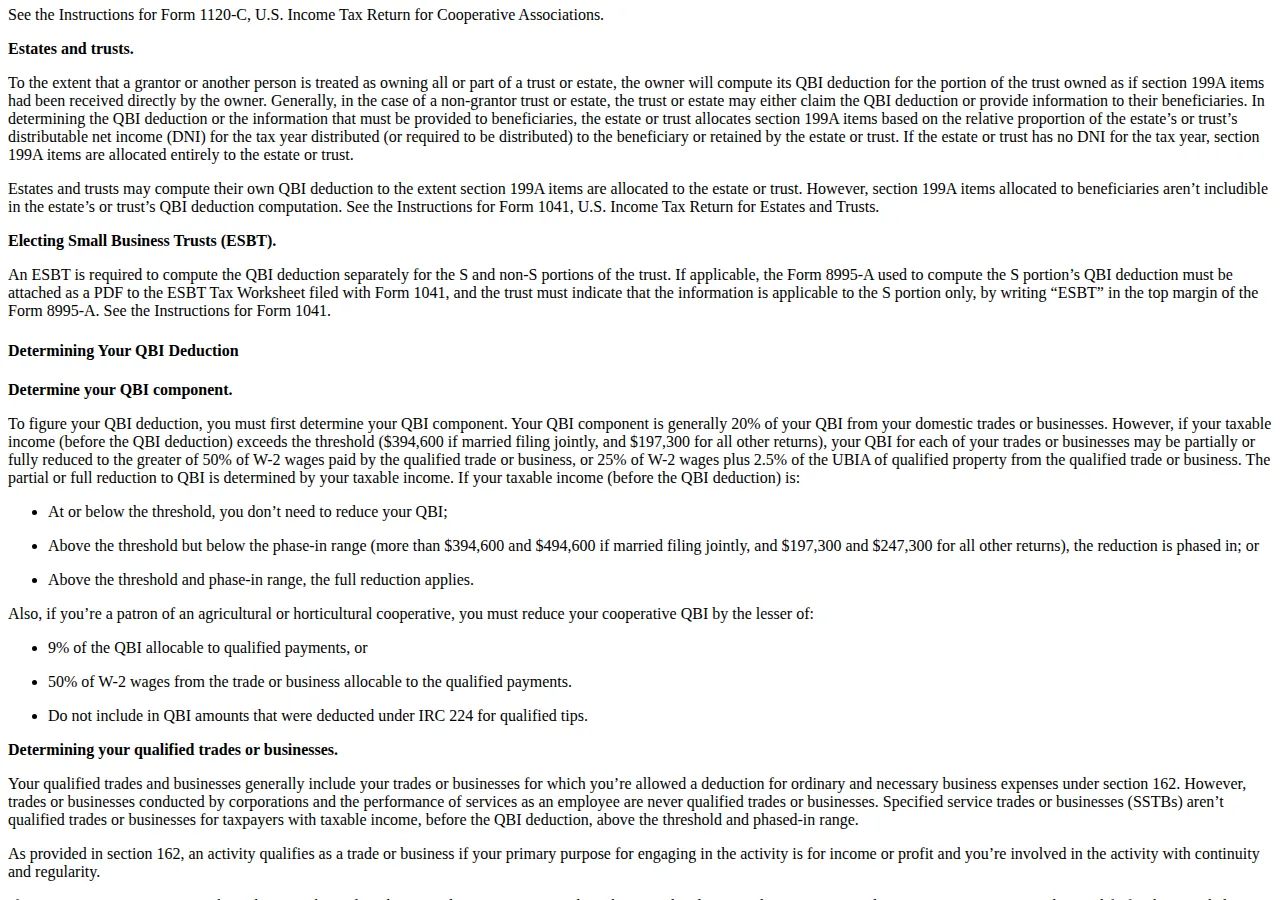
The Instructions for Form 8995 (2025) state three conditions for the short form: qualified business income, qualified REIT dividends, or qualified PTP income or loss; taxable income before the QBI deduction at or below the threshold; and not a patron in a specified agricultural or horticultural cooperative. Fail any one and the return uses Form 8995-A. The threshold is the hinge of the whole regime, and it moves every year with inflation.
| Tax year | Joint threshold | Joint phase-in top | Other returns threshold | Other returns phase-in top |
|---|---|---|---|---|
| 2025 | $394,600 | $494,600 | $197,300 | $247,300 |
| 2026 | $403,500 | $553,500 | $201,750 | $276,750 |
The 2025 figures come from the Instructions for Form 8995-A; the 2026 figures come from Rev. Proc. 2025-32. Married filing separately has its own 2026 pair, $201,775 and $276,775. The phase-in range is $100,000 for joint returns and $50,000 for all others in both years. Below the threshold, no reduction applies. Above the threshold but inside the range, the reduction is phased in. Above the range, the full reduction applies.
The W-2 wages and UBIA limit
Section 199A(b)(2) caps the deduction for each qualified trade or business at the greater of two amounts. The tentative deduction is 20% of QBI. Above the threshold and phase-in range, the deduction cannot exceed the limit, and the excess is lost for that year — it does not carry forward as a deduction, though the underlying QBI loss rules in Schedule C are separate.
Take a founder with one qualified business: QBI $400,000, W-2 wages $100,000, UBIA of qualified property $200,000, taxable income $600,000 on a joint 2025 return — above the $494,600 phase-in top, so the full limit applies. The tentative deduction is 20% of $400,000, or $80,000. The limit is the greater of 50% of $100,000 ($50,000) and 25% of $100,000 plus 2.5% of $200,000 ($25,000 + $5,000 = $30,000). The limit is $50,000, so the deduction is $50,000 and $30,000 of tentative deduction is lost. The UBIA leg only wins when UBIA exceeds four times W-2 wages.
W-2 wages are not whatever the payroll run says. Treas. Reg. § 1.199A-2 prescribes three methods: the unmodified box method (Box 1 less Box 12 codes D, DD, E, F, G, S, and W), the modified box 1 method, and the tracking wages method. Short tax years, acquisitions, and dispositions each have their own allocation rules in the same regulation. Guaranteed payments to partners and reasonable compensation to S-corporation shareholders are excluded from QBI itself, so the wage figure rarely matches the payroll total. The W-2 wages that feed this limit are reported on Form 941 each quarter, so a 941 that understates wages understates the deduction a year later.
The phase-in: partial reduction inside the corridor
Inside the phase-in range, the reduction is prorated. The fraction is the distance travelled through the range: taxable income minus the threshold, divided by the range width. The reduction is that fraction of the excess of the tentative deduction over the limit.
Use the same founder, but with taxable income of $444,600 on a joint 2025 return — exactly halfway through the $394,600-to-$494,600 corridor. The phase-in fraction is ($444,600 − $394,600) / $100,000 = 50%. The tentative deduction is $80,000, the limit is $50,000, the excess is $30,000, and the reduction is 50% of $30,000 = $15,000. The deduction is $65,000. At the bottom of the corridor the deduction is the full $80,000; at the top it is $50,000. That slope is the planning lever: a $50,000 retirement contribution that pulls taxable income to the threshold restores the full $15,000 of phased-out deduction on top of its own tax saving.
Schedule A: specified service businesses
A specified service trade or business — health, law, accounting, actuarial science, performing arts, consulting, athletics, financial services, brokerage services, or any business whose principal asset is the reputation or skill of its employees or owners — is not a qualified trade or business at all once taxable income is above the threshold and phase-in range. Inside the range, only an applicable percentage of its QBI, W-2 wages, and UBIA counts, and the applicable percentage falls linearly from 100% at the threshold to 0% at the top of the range.
At the $444,600 midpoint, the applicable percentage is 50%: half the SSTB's QBI counts, half its wages count toward the limit, and half its UBIA counts. Above $494,600 the applicable percentage is zero and the SSTB contributes nothing — no QBI, no wages, no UBIA. Schedule A computes this business by business, because a taxpayer can own an SSTB and a non-SSTB side by side, and only the SSTB phases out. The regulation's de minimis rule — an SSTB with gross receipts of $25 million or less can earn up to 10% of receipts from specified services without tainting the whole business — is the escape hatch most operators use.
Schedule B: aggregation
Aggregation lets related businesses pool their W-2 wages and UBIA so a wage-heavy business can shelter a property-heavy one, or a high-QBI business with no wages can use a sister business's payroll. Treas. Reg. § 1.199A-4 permits it when the same person or group owns 50% or more of each trade or business for the majority of the tax year, and the businesses meet two of three tests: the same or similar products or services, shared facilities or centralized business elements, or coordinated and interdependent operations. The aggregated group is treated as a single trade or business for the limit, and the deduction is computed on the pooled wages and pooled UBIA.
The election is reported on Schedule B and is generally binding in later years unless the facts change materially. That binding character is the trap: aggregating to win a limit in a good year locks the group together in a bad year, when a loss-making member's negative QBI would have been isolated. Run the aggregation both ways before electing it.
Schedule C: loss netting and carryforwards
A net QBI loss does not vanish. Schedule C nets losses against positive QBI from other trades or businesses, and any remaining loss carries forward to the next tax year on the QBI Loss Tracking Worksheet, where it offsets the following year's QBI before the 20% is applied. Losses are tracked business by business on a first-in, first-out basis, so the oldest loss is used first, and a loss carried into a year in which the taxpayer is below the threshold still offsets QBI before the simplified computation. A founder with a $120,000 loss in a new venture and $200,000 of QBI from a mature business nets to $80,000 of QBI in the current year; if the loss were $250,000 instead, $50,000 carries forward and the current-year QBI is zero.
The overall limit sits above all of this. Under §199A(a), the deduction is the lesser of the combined QBI amount and 20% of the excess of taxable income over net capital gain and qualified cooperative dividends. A taxpayer with large capital gains and modest ordinary income can have a QBI computation that produces a large number and an overall limit that produces a small one — the overall limit wins. Model the business profit that feeds the computation with our Profit Calculator before assuming the 20% applies to the whole QBI figure.
Schedule D and the patron deduction
Schedule D is for patrons of specified agricultural or horticultural cooperatives. The patron deduction under §199A(g) is the lesser of 9% of the QBI allocable to qualified payments from the cooperative, or 50% of the W-2 wages from the trade or business allocable to those payments. The 9% rate is the number most filers get wrong — it is not 20%, and it is not the cooperative's rate.
The $400 minimum deduction
The One Big Beautiful Bill Act added §199A(i): for tax years beginning after December 31, 2025, an applicable taxpayer's deduction is the greater of the computed amount or $400. An applicable taxpayer is one whose aggregate QBI from all active qualified trades or businesses is at least $1,000, and an active trade or business is one in which the taxpayer materially participates within the meaning of §469(h). Both the $400 and the $1,000 are indexed for inflation for tax years beginning after 2026.
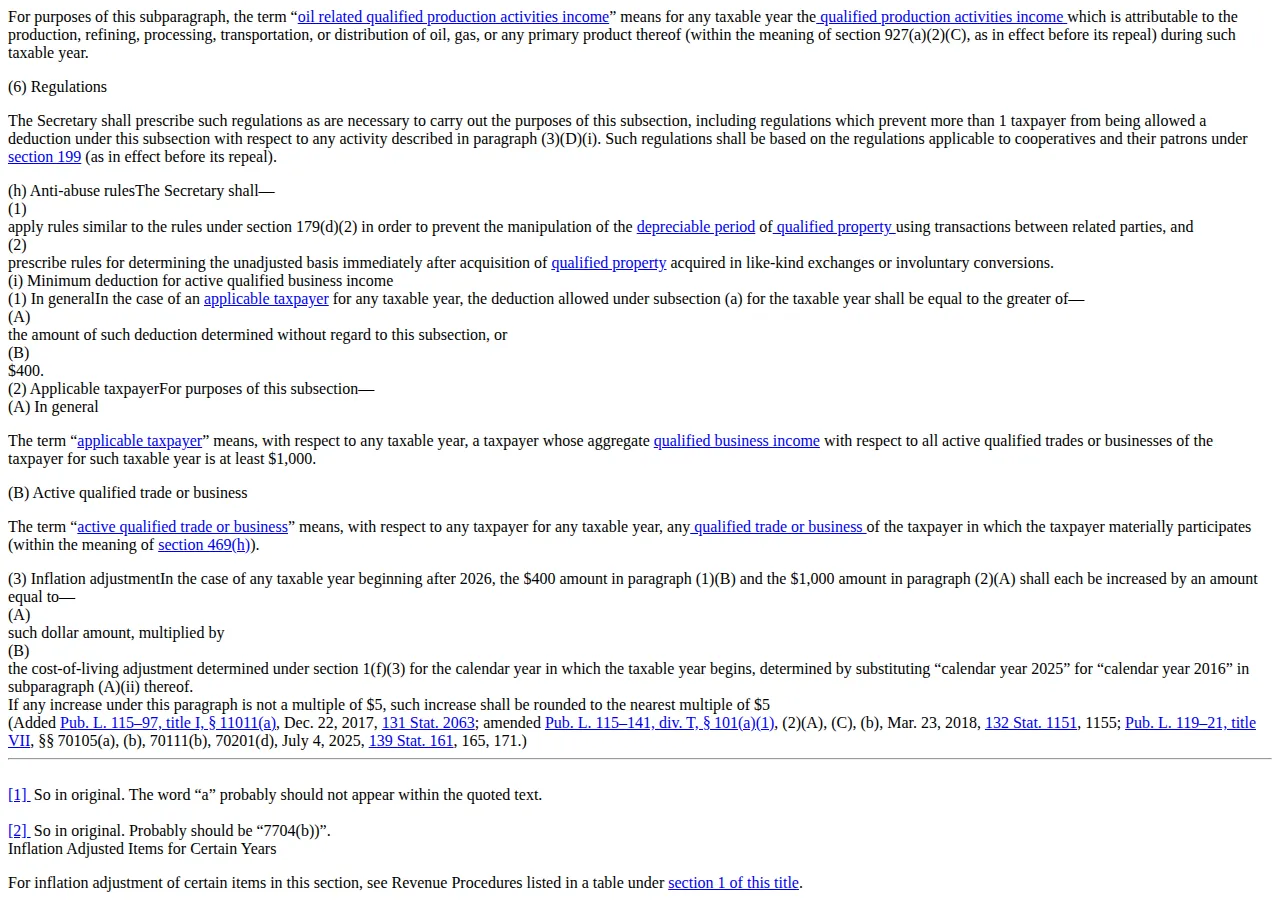
The floor matters most for small operators: a part-time founder with $1,200 of QBI from a materially-participated business gets a $400 deduction rather than the computed $240. It does not rescue a passive investor — material participation is the gate. The floor is per taxpayer, not per business.
Founder & CEO Insight — Enow A. Jovial
The decision matrix
| Taxpayer situation | Correct form | Why | Deduction at stake |
|---|---|---|---|
| Below threshold, no SSTB, no cooperative | Form 8995 | All three short-form conditions met | Full 20% of QBI |
| Above threshold, non-SSTB with wages | Form 8995-A | W-2/UBIA limit applies | Capped at the greater-of limit |
| Inside the corridor, non-SSTB | Form 8995-A | Phase-in prorates the reduction | Between full 20% and the limit |
| Above threshold, SSTB | Form 8995-A, Schedule A | SSTB phases out across the corridor | Zero above the phase-in top |
| Multiple related businesses | Form 8995-A, Schedule B | Aggregation pools wages and UBIA | Pooled limit, binding election |
| Net QBI loss in any business | Form 8995-A, Schedule C | Loss netting and carryforward | Loss offsets future QBI |
| Cooperative patron | Form 8995-A, Schedule D | §199A(g) patron deduction | Lesser of 9% or 50% of wages |
| Small active operator, 2026+ | Form 8995-A | §199A(i) $400 floor | Greater of computed amount or $400 |
Filing checklist
- [x] Step 1 — Run the three-condition test: compare taxable income before the QBI deduction to the threshold for the filing status and year; check for an SSTB and for cooperative patronage.
- [x] Step 2 — Pull W-2 wages by business: use the method in Treas. Reg. § 1.199A-2 (unmodified box, modified box 1, or tracking wages) and reconcile to the four quarterly Forms 941.
- [x] Step 3 — List UBIA by business: tangible property, unadjusted basis immediately after acquisition, depreciable period unexpired at year-end; exclude land.
- [x] Step 4 — Compute the limit per business: greater of 50% of wages or 25% of wages plus 2.5% of UBIA; apply the phase-in fraction if inside the corridor.
- [x] Step 5 — Phase out any SSTB on Schedule A: applicable percentage by business; zero above the phase-in top.
- [x] Step 6 — Decide aggregation on Schedule B: test 50% common ownership and two of the three coordination tests; document the election.
- [x] Step 7 — Net losses on Schedule C: carry any remainder forward on the QBI Loss Tracking Worksheet, oldest first.
- [x] Step 8 — Apply the overall limit: 20% of taxable income less net capital gain and qualified cooperative dividends; then apply the $400 floor for 2026 and later years.
Who should not use Form 8995-A
Do not file Form 8995-A if all three short-form conditions are met — the instructions direct those taxpayers to Form 8995. Do not use it for a C corporation: §199A excludes C corporations, and employees performing services as employees are never a qualified trade or business. Do not aggregate to manufacture wages where the ownership and coordination tests are not genuinely met — a failed aggregation unwinds the whole limit computation.