Form 8962 is the reconciliation, not the application
The premium tax credit is paid twice: once in advance and once on the return. When you enroll through a Health Insurance Marketplace, the Marketplace estimates your household income, computes an advance payment — APTC — and sends it to your insurer, so your monthly bill drops. Form 8962 settles it against the year's actual income: for tax years other than 2020, if advance payments were made in any amount, or if you plan to claim the credit, you must file a federal return and attach Form 8962, identified by your SSN or ITIN.
The credit lives in 26 U.S.C. § 36B. Subsection (a) allows a refundable credit for coverage months in a qualified health plan. Subsection (b)(2) fixes the monthly amount as the lesser of the premiums for the plans covering the tax family, or the excess of the adjusted monthly premium for the applicable second lowest cost silver plan — the SLCSP — over one-twelfth of the applicable percentage times household income. Subsection (c)(1)(A) caps eligibility at household income between 100 and 400 percent of the poverty line, and subsection (f) reconciles the credit against advance payments.
The three inputs: income, poverty line, SLCSP
Household income is defined in § 36B(d)(2) as modified adjusted gross income — MAGI — summed across the tax family. Start with AGI, then add back tax-exempt interest, § 911 excluded income, and non-taxable Social Security under § 86. Then add the MAGI of other family members required to file. The most common error is entering your own AGI and forgetting a dependent's MAGI or tax-exempt interest. It is MAGI, not FICA wages.
The poverty line used, under § 36B(d)(3)(B), is the most recently published poverty line as of the first day of the regular enrollment period — which is why the 2025 return uses the 2024 guidelines and 2026 coverage uses the 2025 guidelines.
| Family size | 2024 FPL | 2025 FPL |
|---|---|---|
| 1 | $15,060 | $15,650 |
| 2 | $20,440 | $21,150 |
| 3 | $25,820 | $26,650 |
| 4 | $31,200 | $32,150 |
| 5 | $36,580 | $37,650 |
| Each additional person | +$5,380 | +$5,500 |
The 2024 figures are from Table 1-1 of the Form 8962 instructions; the 2025 figures from the HHS guidelines, Federal Register, January 17, 2025 (Vol. 90, No. 11). Line 5 is line 3 divided by line 4, times 100, with everything after the decimal point dropped. A result of 199.9 becomes 199, not 200, and a result over 400 is entered as 401. Below 100 percent the credit is generally unavailable, with two narrow exceptions preserved for 2025.
The SLCSP is the benchmark the statute prices the credit against, and it is not the plan you bought. Under § 36B(b)(3)(B), the applicable SLCSP is the second lowest cost silver plan in the rating area where the taxpayer resides, offered through the same Exchange. Your enrollment premium caps the credit, but the SLCSP sets the ceiling the contribution is subtracted from. Form 1095-A is the source document, due from the Marketplace by January 31, 2026 for 2025 coverage.
| Form 1095-A, Part III | Reports | Lands on Form 8962 |
|---|---|---|
| Column A, lines 21–32 | Monthly enrollment premiums | Line 11 or lines 12–23, column (a) |
| Column B, lines 21–32 | Monthly SLCSP premium | Line 11 or lines 12–23, column (b) |
| Column C, lines 21–32 | Monthly APTC paid | Line 11 or lines 12–23, column (f) |
| Line 33 | Annual totals | Line 11, columns (a), (b), and (f) |
Column B is the one that goes wrong: when no APTC was paid it may be wrong, blank, or zero, and when a change in circumstances was never reported it may be wrong for the affected months. The filer must then determine the correct SLCSP premium from Publication 974 or the HealthCare.gov tax tool. Take column B from one 1095-A form only.
Parts I and II: the monthly math
Part I runs lines 1 through 8: family size, MAGI (line 2a your own, line 2b other family members required to file), the poverty line from Table 1, the percentage, the applicable figure from Table 2, and the contribution — line 8a multiplies line 3 by line 7, line 8b divides by 12, each rounded to the nearest dollar.
Work it with a family of four: household income $62,400, family size four, 2024 poverty line for four $31,200. Line 5 is 62,400 divided by 31,200, times 100 — exactly 200 — and Table 2 gives an applicable figure of 0.0200 at 200 percent.
Part II computes the credit. With full-year coverage and unchanged premiums, line 10 is "Yes" and the annual totals go on line 11; otherwise line 10 is "No" and lines 12 through 23 are used month by month. The columns work the same either way: (a) enrollment premium, (b) SLCSP premium, (c) monthly contribution, (d) (b) minus (c), floored at zero, (e) the lesser of (a) or (d), and (f) APTC paid.
Continue the family of four. The SLCSP premium is $1,100 a month, $13,200 for the year; the plan they bought costs $950 a month, $11,400 for the year. The monthly credit is the lesser of $950 and $1,100 minus $104 — so $950 a month, because the enrollment premium is the cap.
Line 24 is the total credit, line 25 the total APTC from column (f). If line 24 is larger, line 26 is the difference — the net premium tax credit, entered on Schedule 3, line 9. If line 25 is larger, line 26 is blank and Part III computes the repayment. With APTC of $800 a month — $9,600 for the year — the family is owed $1,800:
With APTC of $1,200 a month — $14,400 for the year — the advance exceeded the credit by $3,000, and Part III decides how much comes back.
Part III: the repayment, and the cap that expires
Line 27 is the excess: line 25 minus line 24. Line 28 is the repayment limitation from Table 5, entered only if line 5 is under 400. Line 29 is the smaller of the two, on Schedule 2, line 1a. If line 5 is 400 or more, line 28 is left blank and the whole excess is repaid. Table 5 for the 2025 return:
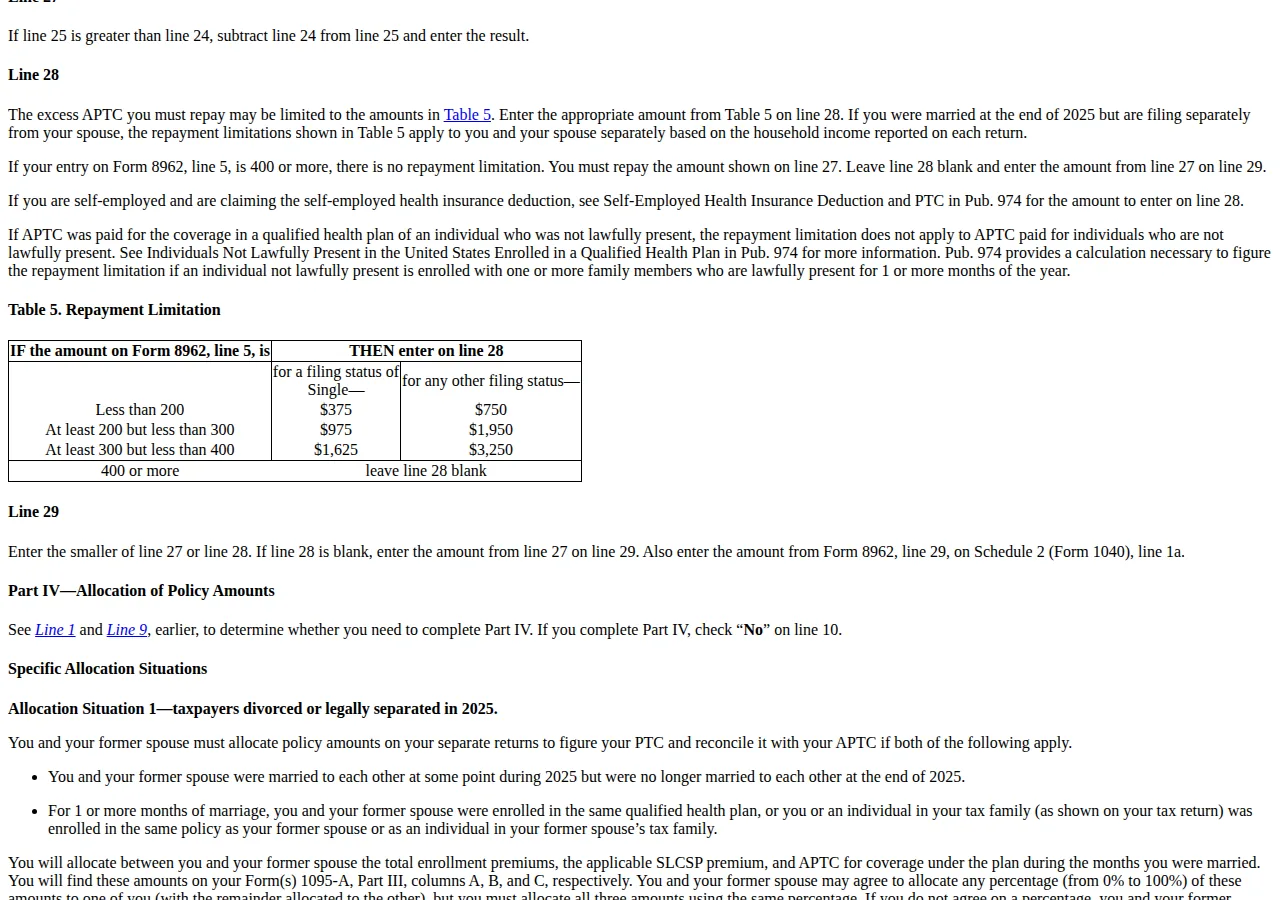
| Line 5 (% of FPL) | Single, line 28 | Other status, line 28 |
|---|---|---|
| Less than 200 | $375 | $750 |
| At least 200 but less than 300 | $975 | $1,950 |
| At least 300 but less than 400 | $1,625 | $3,250 |
| 400 or more | Repay in full | Repay in full |
Our family of four sits at 200 percent, filing jointly, so the Table 5 limit is $1,950. The excess was $3,000:
The cap absorbs $1,050 of the excess — but only for 2025. Pub. L. 119-21, § 71305, struck § 36B(f)(2)(B), applicable to taxable years beginning after December 31, 2025. For 2026, the same $3,000 excess is repaid in full.
The 2026 posture: three reversions in one year
The enhanced premium tax credits were always temporary. Section 36B(b)(3)(A)(iii) is headed "Temporary percentages for 2021 through 2025" and applies only to taxable years beginning after December 31, 2020 and before January 1, 2026. Under that table, a household under 150 percent contributed nothing, and a household over 400 percent still qualified, capped at 8.5 percent of income, because § 36B(c)(1)(E) removed the 400 percent ceiling for the same window. Both provisions expire together, and the base table in § 36B(b)(3)(A)(i) takes over — 2.0 percent up to 133 percent, sliding to 9.5 percent at 300 to 400 percent, indexed under § 36B(b)(3)(A)(ii).
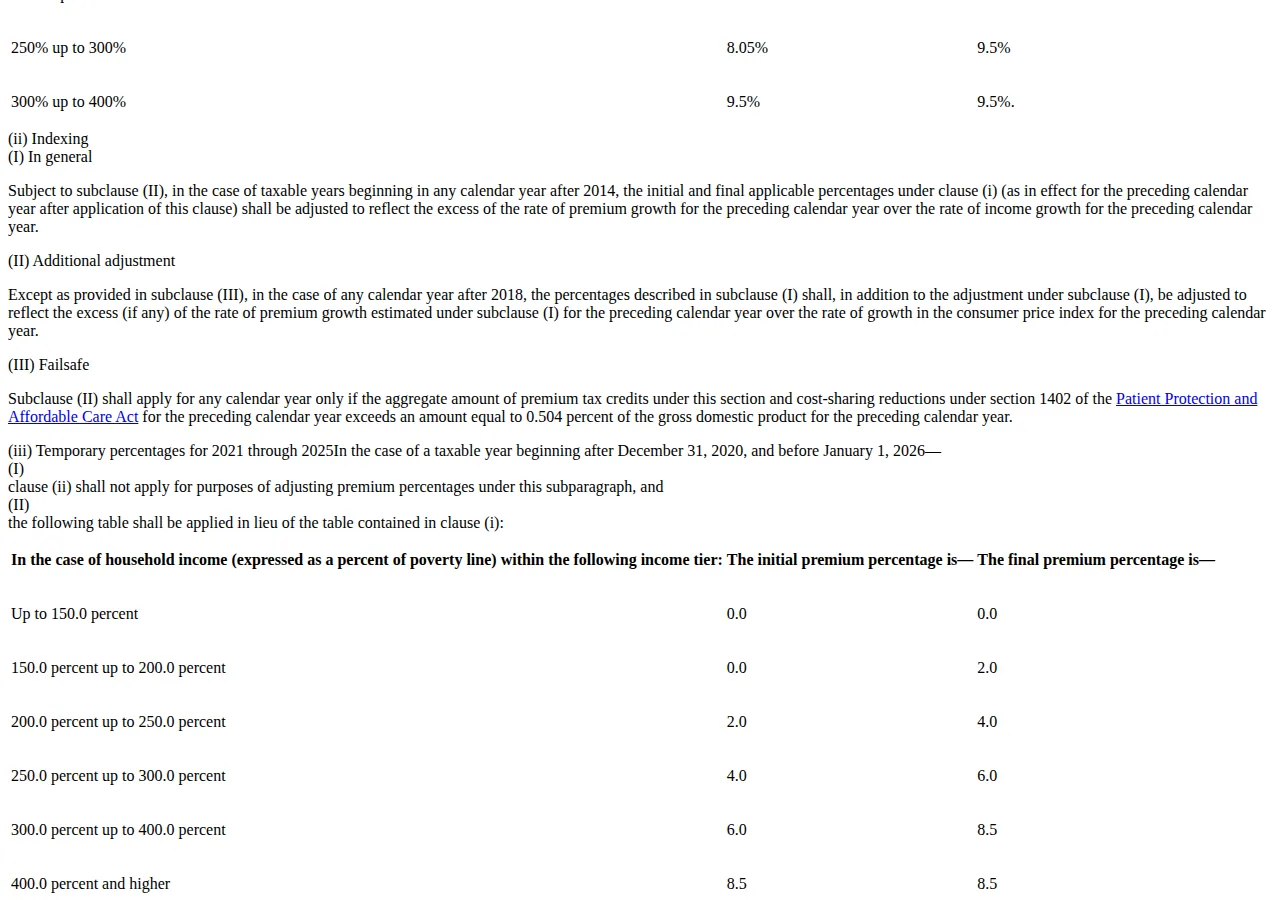
- The contribution rises at the bottom. A household at 150 percent of the poverty line contributed 0 percent of income under the temporary table; under the base table it contributes 3.0 to 4.0 percent, sliding with income.
- The 400 percent cliff returns. Section 36B(c)(1)(A) again reads "equals or exceeds 100 percent but does not exceed 400 percent." A household of four at $130,000 illustrates it: against the 2025 poverty line of $32,150, that income is 404 percent. For 2025 the temporary rule still applied — the applicable figure was 0.0850, the annual contribution $11,050, about $921 a month. For 2026 the same income is over the cliff: the credit is zero, and any advance payment must be repaid in full.
- The repayment cap is repealed. Section 36B(f)(2) for 2026 contains no Table 5 equivalent.
This article does not print indexed 2026 percentages — no IRS revenue procedure publishing the 2026 table was verified in this cycle — so use the base table above and the IRS Table 2 for the year you file. Two more changes land later: Pub. L. 119-21, § 71302(a), struck § 36B(c)(1)(B), the lawfully-present route below 100 percent of the poverty line, for 2026; and § 71303 adds pre-enrollment verification to § 36B(c) for taxable years beginning after December 31, 2027.
Choosing how much APTC to take
The one decision the filer controls during the year is how much of the credit to take in advance. The Marketplace lets you take some, all, or none of the credit each month, and HealthCare.gov's guidance is to take less when income is rising. The trade-off is cash flow now against a tax bill later.
| APTC election | Monthly effect | Risk | Authority |
|---|---|---|---|
| Take the full advance | Lowest monthly premium | Full repayment with no cap for 2026 | § 36B(f)(2); § 1412 ACA |
| Take a partial advance | Higher premium, smaller swing | Capped by Table 5 for 2025; uncapped for 2026 | Form 8962 instructions, Table 5 |
| Take no advance, claim at filing | Full premium each month | No repayment risk; the credit arrives as a refund | Form 8962, line 26 |
The conservative election is the partial advance: take enough to keep the premium affordable and leave a margin for an income surprise. The aggressive election — full APTC on an estimate that assumes no bonus, no overtime, and no capital gain — is the one that produces the $3,000 excess in the worked example. For a self-employed filer the risk is sharper: the instructions direct those filers to Publication 974 for the amount to enter on line 28. That coordination applies whether the filer is a single-member LLC owner, an S-Corp shareholder-employee, or a sole proprietor, and a CPA should review the first year it is claimed.
Run the form
- Collect the documents: every Form 1095-A, the Form 8962 PDF, the prior-year return, Schedule B, the § 86 worksheet, and the W-2 box 12 code FF amount, identified by the employer's EIN, if a QSEHRA reimbursed premiums.
- Build household income: AGI plus the three MAGI add-backs and each dependent's MAGI.
- Set the poverty line: Table 1 for the return year; the higher table for Alaska or Hawaii.
- Compute lines 5 and 7: divide, multiply by 100, drop the decimals; take the figure from Table 2.
- Compute lines 8a and 8b: multiply and divide by 12, rounding each to the nearest dollar.
- Decide line 10: "Yes" and line 11 only for an unchanged full year; otherwise lines 12 through 23.
- Verify column B: if the SLCSP premium is blank, zero, or stale, get the correct figure from Publication 974.
- Reconcile: line 26 to Schedule 3, line 9; line 29 to Schedule 2, line 1a; Table 5 for 2025 only.
- Check the traps: married filing separately, a dependent claiming the credit, or an unpaid premium month.
- [x] Every 1095-A collected; VOID discarded, CORRECTED used.
- [x] Household income built from MAGI, not AGI alone.
- [x] Poverty line from the correct year's table.
- [x] SLCSP premium verified.
- [x] Line 10 shortcut only for an unchanged full year.
- [x] Line 26 to Schedule 3, line 9; line 29 to Schedule 2, line 1a; Table 5 for 2025 only.
Most failures are input failures. Copying AGI onto line 3: the dependent's MAGI and tax-exempt interest never enter the form. Filing separately: married filing separately forfeits the credit and triggers full repayment. Taking full APTC on a rising income: the 2025 cap forgave part of the excess; the 2026 statute forgives none.
Founder & CEO Insight — Enow A. Jovial
The additional credit lands on Schedule 3 and the repayment on Schedule 2 — see our Schedule 3 playbook and Schedule 2 playbook — and the MAGI-driven tax alongside the credit is in our NIIT playbook. Run the numbers through our pricing calculator first.