IRS Form 1040 Schedule 3: Additional Credits & Payments — The Operator's Playbook
Schedule 3 is the funnel. Every credit and payment with no line of its own on Form 1040 passes through this one page, and the page produces exactly two numbers: a nonrefundable-credit total that cuts tax, and a refundable-credit-and-payments total that counts as money already paid.
Dating note: as of November 7, 2026, the IRS has not posted a 2026 Schedule 3 form. The file served is still the 2025 edition (last modified January 2, 2026). This playbook follows the 2025 line structure and prices every dollar in 2026 amounts.
Who this is for, and who should stop
This playbook is for a filer whose 2026 return carries at least one of these: foreign taxes paid, child or dependent care expenses, college tuition, retirement contributions at a modest income, a carried-forward clean energy credit from a 2025 installation, a Marketplace health plan, an extension payment, or excess Social Security tax withheld.
Hand the return to a CPA if you claim the general business credit through a partnership or S corporation, or hold credits that interact with the alternative minimum tax.
Identification and entity boundaries: Schedule 3 carries the same identification as Form 1040 — your SSN, or an ITIN if you are not eligible for an SSN. A sole proprietor reports on Schedule C under the owner's SSN; a partnership or S-Corp files under its own EIN and passes credits through on a Schedule K-1. An LLC is not a tax classification: a single-member LLC reports on Schedule C, and a C-Corp claims its credits on Form 1120, never on Schedule 3. Employees pay FICA tax through withholding; the self-employed pay SECA tax on Schedule SE. These are tax-basis numbers, not GAAP — a CPA prepares the return, but the taxpayer signs it.
> [!WARNING]
> Part I credits are nonrefundable. A $3,000 credit against $2,000 of tax does not produce a $1,000 refund — it produces $2,000 of credit and $1,000 that vanishes, except for the residential clean energy carryforward. Size a Part I credit on the tax left to absorb it.
The authority frame: two totals, two lines
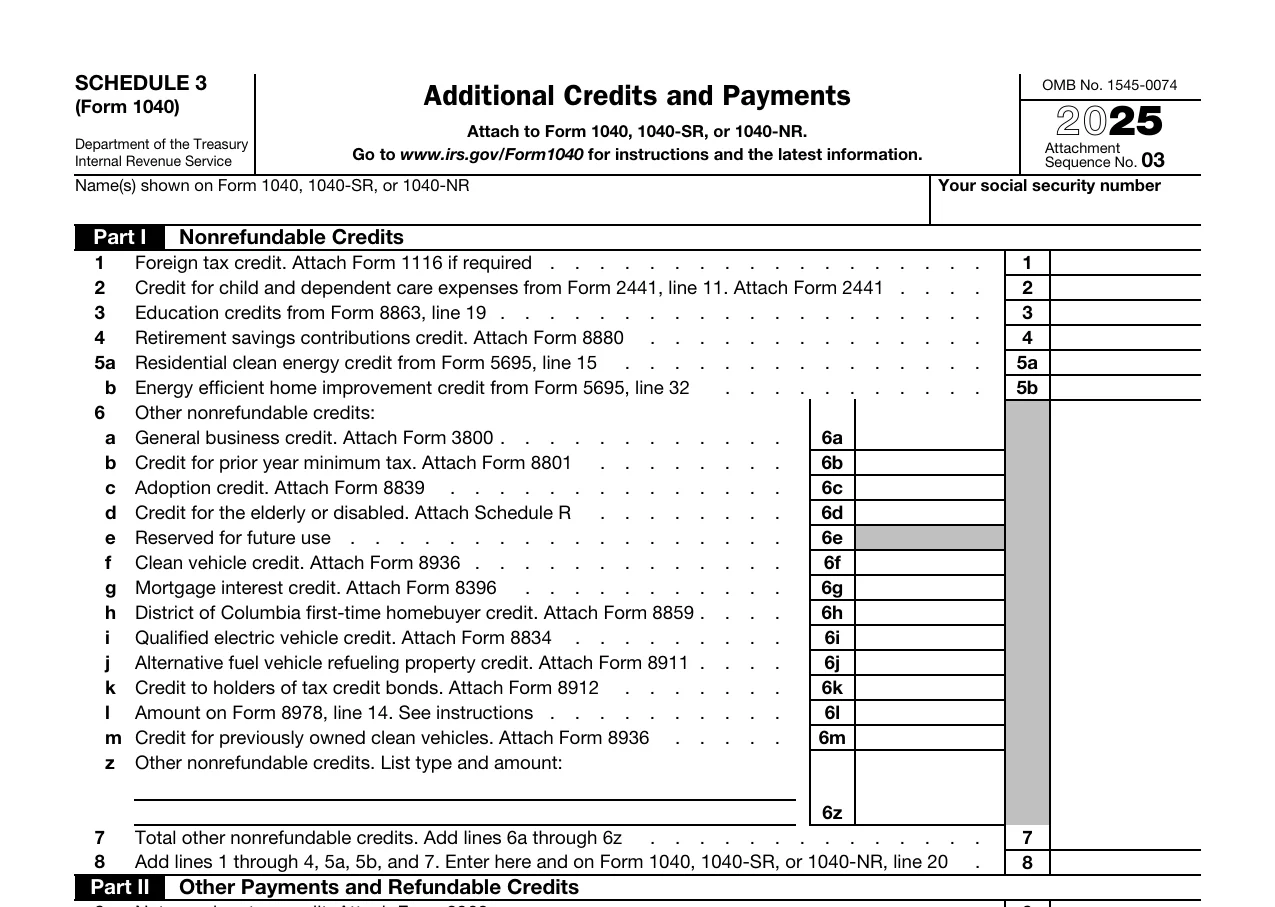
Schedule 3 has two parts: Part I (lines 1 through 8) collects nonrefundable credits, and Part II (lines 9 through 15) collects other payments and refundable credits.
$
\text{Schedule 3, line 8} = \text{lines 1 + 2 + 3 + 4 + 5a + 5b + 7} \rightarrow \text{Form 1040, line 20}
$
$
\text{Schedule 3, line 15} = \text{lines 9 + 10 + 11 + 12 + 14} \rightarrow \text{Form 1040, line 31}
$
!Schedule 3 Part I credits section, 2025 form
> [!KEY TAKEAWAY]
> Schedule 3 never computes a credit. It adds up credits computed elsewhere and hands the totals to Form 1040.
Part I: nonrefundable credits, line by line
Line 1 — foreign tax credit. Section 901 allows a credit for income tax paid to a foreign country, capped by § 904(a) at "the same proportion of the tax against which such credit is taken which the taxpayer's taxable income from sources without the United States ... bears to his entire taxable income."
$
\text{FTC limit} = \text{U.S. tax} \times \frac{\text{Foreign-source taxable income}}{\text{Total taxable income}}
$
Compute it on Form 1116. The instructions excuse you from Form 1116 only when all five conditions hold: all foreign-source gross income was interest and dividends on a 1099, total foreign taxes were $300 or less ($600 joint), you held the stock or bonds at least 16 days, the taxes were legally owed, and the country is recognised by the United States.
Line 2 — credit for child and dependent care expenses. Form 2441, line 11, feeds this line: a percentage of employment-related expenses for a qualifying individual — a dependent under 13, a disabled spouse, or another disabled person — paid so the taxpayer could work. Expenses are capped at $3,000 for one qualifying individual and $6,000 for two or more. The percentage changed for 2026: Pub. L. 119-21, § 70405, rewrote § 21(a)(2), so the rate is now 50 percent, falling one point per $2,000 of AGI above $15,000 to a 35 percent floor, then one point per $2,000 above $75,000 ($4,000 joint, above $150,000) to a 20 percent floor. At a joint AGI of $150,000 the rate is still 35 percent.
Line 3 — education credits. Form 8863, line 19, feeds this line, and it carries two different credits. The American Opportunity Tax Credit pays 100 percent of the first $2,000 of qualified expenses plus 25 percent of the next $2,000 — a $2,500 maximum per eligible student — for the first four years of postsecondary education. The Lifetime Learning Credit pays 20 percent of up to $10,000, a $2,000 maximum per return, with no four-year limit. Both phase out from modified AGI of $180,000 joint or $90,000 for any other status, over a $20,000 joint or $10,000 other range:
$
\text{Phase-out factor (joint)} = \frac{200000 - \text{MAGI}}{20000}
$
At a joint MAGI of $190,000 the factor is 0.500, so a $2,500 AOTC becomes $1,250. You cannot claim both credits for the same student in the same year, or either one if you file married filing separately, or either for a student claimed as a dependent on someone else's return.
Line 4 — retirement savings contributions credit, the saver's credit. Form 8880 computes it: 50, 20, or 10 percent of up to $2,000 of retirement contributions per person ($4,000 joint), maximum $1,000 per person. For 2026, IRS Notice 2025-67 sets the 50/20/10 percent AGI ceilings at $48,500/$52,500/$80,500 joint, $36,375/$39,375/$60,375 head of household, and $24,250/$26,250/$40,250 single. The credit is closed entirely if the contributor was born after January 1, 2008, is claimed as a dependent, or was a full-time student for five calendar months. Form 8880 states the credit is replaced by the saver's match for 2027 returns.
Lines 5a and 5b — residential energy credits. Section 25D allowed a 30 percent credit for solar, wind, geothermal, fuel cells, and battery storage; § 25C allowed 30 percent for energy efficient home improvements, capped at $1,200 a year, $2,000 for heat pumps. Pub. L. 119-21 ended both: § 25C "shall not apply with respect to any property placed in service after December 31, 2025" and § 25D "shall not apply with respect to any expenditures made after December 31, 2025." No new 2026 installation qualifies. Only a § 25D carryforward from a pre-2026 installation can still land on line 5a.
Lines 6a through 6z — other nonrefundable credits. Line 6a takes the general business credit (Form 3800), 6b the prior-year AMT credit (Form 8801), 6c the adoption credit (Form 8839), 6d the elderly or disabled credit (Schedule R), 6f and 6m the clean vehicle credits (Form 8936), 6g the mortgage interest credit (Form 8396), 6h the DC homebuyer credit (Form 8859, carryforward only), 6i the qualified EV credit (Form 8834, carryforward only), 6j the refueling property credit (Form 8911), 6k tax credit bonds (Form 8912), and 6l Form 8978, line 14. Line 6z is the list-it-yourself line.
What is not on Schedule 3
Two credits look like Schedule 3 items and are not. The child tax credit — $2,200 per qualifying child under 17 for 2026, up to $1,700 of it refundable as the additional child tax credit, with a $500 credit for other dependents — is computed on Schedule 8812 and enters Form 1040 on line 19. Its phase-out starts at modified AGI of $200,000, or $400,000 joint. The refundable part of the AOTC — 40 percent, up to $1,000 — is computed on Form 8863, line 8, and enters Form 1040 on line 29.
> [!TIP]
> Price the child tax credit first. On a joint return with two children the $4,400 on line 19 absorbs tax first, and the Schedule 3 credits only get what is left.
Part II: other payments and refundable credits, line by line
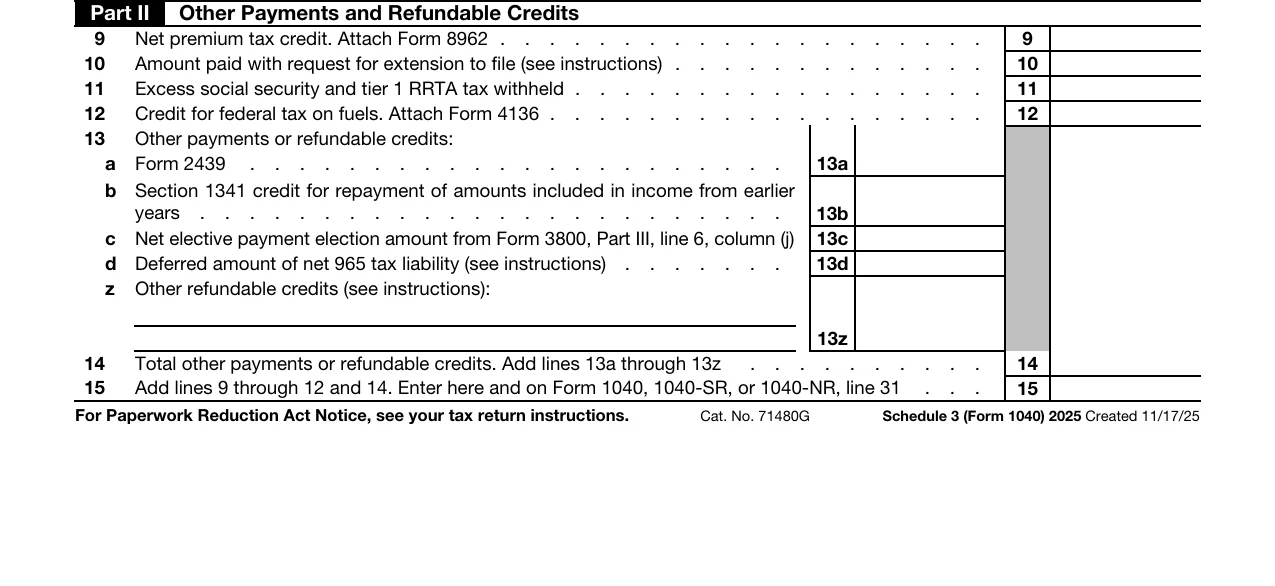
Part II is money, not tax reduction. Every line here counts as a payment already made or a credit that refunds even when tax is zero.
Line 9 — net premium tax credit. Form 8962 reconciles the premium tax credit for Marketplace coverage; when the credit allowed exceeds the advance payments, the net amount lands here. When advance payments exceeded the credit, the excess is repaid — and for 2026 the repayment cap is gone, so the full excess is added to tax on Schedule 2, line 1a.
Line 10 — amount paid with request for extension to file. The payment sent with Form 4868 is a payment of 2026 tax, credited here in full. Forgetting it is the commonest way a filer overpays.
Line 11 — excess Social Security and tier 1 RRTA tax withheld. For 2026 the wage base is $184,500, so the maximum any employee should have withheld is 6.2 percent of $184,500, or $11,439. Anything above $11,439 across all W-2s is a credit on this line.
Line 12 — credit for federal tax on fuels. Form 4136 computes it for nontaxable uses of fuel, usually farm or off-highway use.
Lines 13a through 13z — other payments or refundable credits. Line 13a takes the amount from Form 2439, line 13b the § 1341 credit for repayments of amounts included in income in earlier years, line 13c the net elective payment election amount from Form 3800, Part III, and line 13d the deferred net § 965 tax liability. Line 13z is the list-it-yourself line. Line 14 adds 13a through 13z, and line 15 adds lines 9 through 12 and 14. That total goes to Form 1040, line 31, and from there into line 32.
!Schedule 3 Part II other payments and refundable credits
Worked example: one joint return, 2026
A married couple files jointly for 2026. Wages $130,000, taxable interest $4,000, dividends $16,000 — $12,000 of it foreign-source — for gross income and AGI of $150,000. They take the 2026 standard deduction of $32,200, leaving taxable income of $117,800. Regular tax: 10 percent of the first $24,800 is $2,480; 12 percent of the next $76,000 is $9,120; 22 percent of the remaining $17,000 is $3,740; total tax $15,340.
Line 1 — foreign tax credit. They paid $1,800 of foreign tax. The § 904(a) limitation is $15,340 × $12,000 ÷ $117,800 = $1,562.65, rounded to $1,563. The credit is the lesser of tax paid and the limit: $1,563 on line 1.
Line 2 — child and dependent care. They paid $8,000 for care for two children under 13 so both spouses could work. Expenses counted are capped at $6,000. The § 21 rate at a joint AGI of $150,000 is 35 percent. Credit: $6,000 × 35% = $2,100 on line 2.
Line 3 — education. One child in the second year of college, $4,000 of qualified expenses. AOTC: 100 percent of the first $2,000 plus 25 percent of the next $2,000 is $2,500. Joint MAGI of $150,000 is below the $180,000 phase-out start. Refundable 40 percent — $1,000 — goes to Form 1040, line 29. Nonrefundable $1,500 goes on line 3.
Line 4 — saver's credit. AGI of $150,000 is above the $80,500 joint ceiling, so the rate is zero and line 4 is $0. The same couple at a joint AGI of $48,000, each putting $2,000 into a 401(k), would show a tentative credit of 50 percent of $4,000, or $2,000 — but the credit is nonrefundable, so it stops at the tax available: their tax is $1,580.
Line 5a — energy carryforward. Their solar array was installed in 2025 and the 2025 credit exceeded their 2025 tax by $3,000. The § 25D(c) carryforward brings that $3,000 onto line 5a in 2026.
The Part I total. Line 8 is $1,563 + $2,100 + $1,500 + $0 + $3,000 + $0 + $0 = $8,163, to Form 1040, line 20. The child tax credit is $4,400 — two children at $2,200 — on line 19. Line 21 adds lines 19 and 20: $12,563, leaving $2,777 of tax on line 24.
The Part II total. They paid $2,000 with their extension request, line 10. Line 15 is $2,000, to Form 1040, line 31. Line 32 adds lines 27, 28, 29, and 31: $0 + $0 + $1,000 + $2,000 = $3,000. With $4,500 withheld, total payments are $7,500 against $2,777 of tax — a $4,723 refund on line 34. Check it in the tax estimator.
> [!FOUNDER]
> "Schedule 3 rewards the filer who finishes the feeder forms first and punishes the one who starts here. The child tax credit is not on this page, the refundable half of the college credit is not on this page, and the energy credits for new work are gone. Add it last, route each total, and read both back."
> — Enow A. Jovial, Founder & Chief Executive Officer
The decision table: which lines apply to you
| Situation | Schedule 3 lines | Authority |
| --- | --- | --- |
| Foreign dividends, tax withheld abroad | Line 1 | §§ 901, 904(a) |
| Two children in paid care | Line 2 | § 21(a)(2) |
| Student in first four years of college | Line 3 | § 25A(b), (i) |
| Retirement saving, joint AGI under $80,500 | Line 4 | § 25B; Notice 2025-67 |
| Solar installed in 2025, credit unused | Line 5a | § 25D(c), (h) |
| Solar or heat pump installed in 2026 | Neither energy line | §§ 25C(i), 25D(h) |
| Two employers, wages over $184,500 combined | Line 11 | § 3101(a) |
The 3-step filing workflow
1. Complete the feeder forms first. Forms 1116, 2441, 8863, 8880, 5695, and Schedule 8812 first. The Schedule 2 playbook runs the taxes above these credits; the Schedule E rental income playbook runs the rental income behind the AGI.
2. Price the child tax credit on line 19 first.
3. Check the energy dates, not the invoice dates. § 25C turns on placed-in-service date, § 25D on installation completion.