Giving up U.S. citizenship or a long-held green card does not end the tax bill. It accelerates it. Under IRC § 877A, a covered expatriate is treated as having sold every asset they own — worldwide, at fair market value — on the day before the expatriation date, and the gain is taxed in that year whether anything was actually sold or not. The form that decides whether that deemed sale applies at all is Form 8854, Initial and Annual Expatriation Information Statement. File it wrong, file it late, or fail its five-year certification, and a person who owed nothing can become a covered expatriate by paperwork alone.
That inversion is the whole playbook: the exit tax is not a tax on leaving. It is a tax on the unrealized gain you carry out the door, collected by a form most people meet for the first time after the decision is already made.
Founder & CEO Insight — Enow A. Jovial
Who must file Form 8854
Form 8854 is required of two groups. The first is any U.S. citizen who relinquishes citizenship — by renunciation before a diplomatic or consular officer, by voluntary relinquishment approved with a certificate of loss of nationality, or by court cancellation of naturalization. The second is any long-term resident who ceases to be a lawful permanent resident: under IRC § 877(e)(2), a long-term resident is a person who held a green card in at least 8 of the 15 tax years ending with the expatriation year. A green card holder who surrenders the card after 7 years is not a long-term resident and is outside § 877A entirely; at 8 years, the form is mandatory.
The initial Form 8854 attaches to the income tax return for the year that includes the expatriation date — Form 1040, 1040-SR, or 1040-NR — and is due by that return's due date, including extensions. A person not required to file a return still files Form 8854 by the date the return would have been due. After the initial filing, an annual Form 8854 is required for each year the person remains subject to § 877 or § 877A reporting under § 6039G. The cross-border reporting does not end with the exit: the PFIC reporting playbook covers the foreign funds a former resident often still holds, and the FIRPTA withholding playbook covers the later sale of U.S. real property.
The three covered-expatriate tests
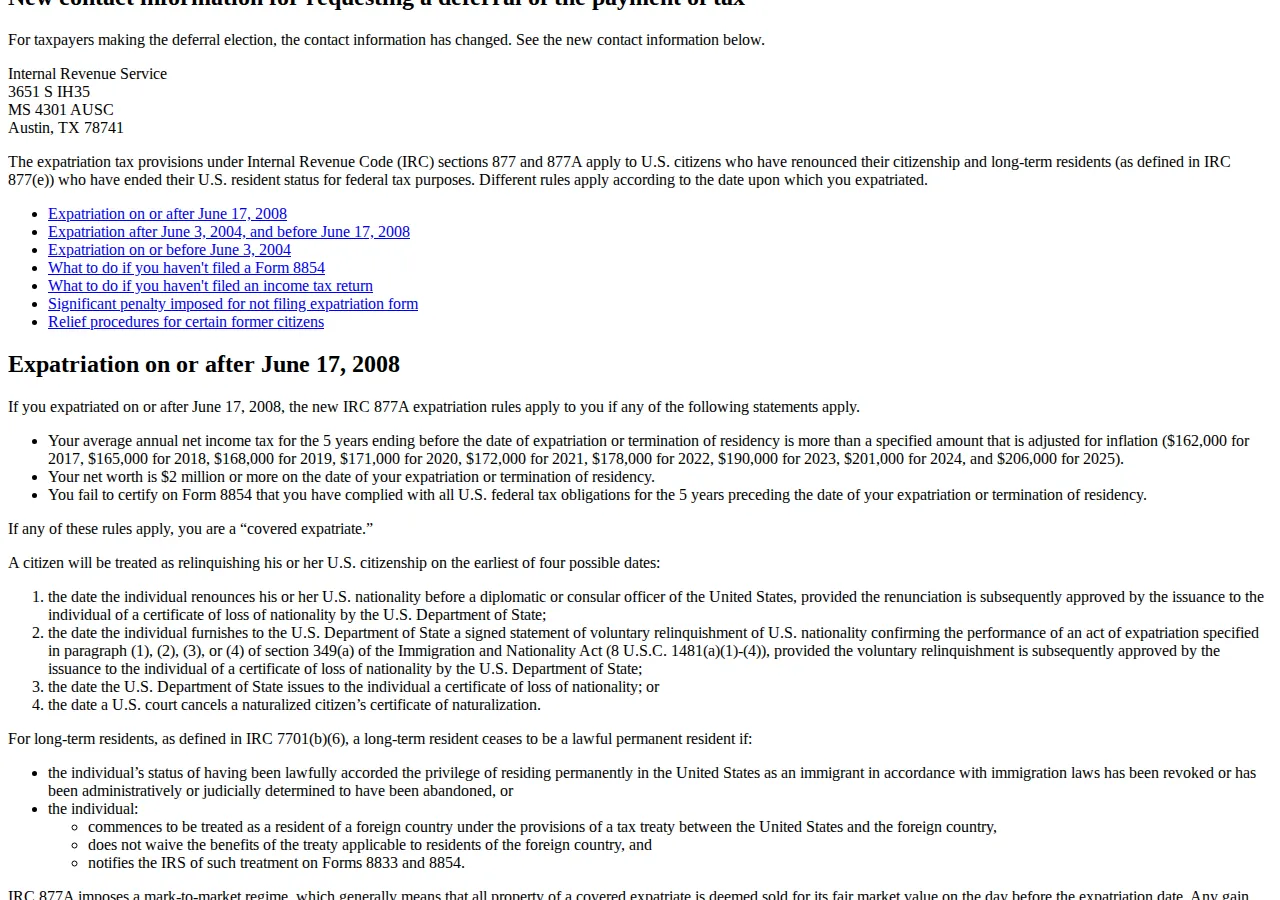
Section 877A(g)(1) defines a covered expatriate as an expatriate who meets any of the three tests in § 877(a)(2). Meeting one is enough. The tests are measured on the expatriation date, and the dollar figures are indexed annually except the net worth test, which is fixed in statute at $2,000,000 and never moves.
| Test | 2024 | 2025 | 2026 | Authority |
|---|---|---|---|---|
| Average annual net income tax, 5 years before expatriation | More than $201,000 | More than $206,000 | More than $211,000 | § 877(a)(2)(A); Rev. Proc. 2025-32 § 4.37 |
| Net worth on the expatriation date | $2,000,000 or more | $2,000,000 or more | $2,000,000 or more | § 877(a)(2)(B) |
| Five-year compliance certification on Form 8854 | Failed | Failed | Failed | § 877(a)(2)(C) |
The tax-liability test is an average, not a single year. Five years of liability at $190,000, $200,000, $210,000, $220,000, and $240,000 average $212,000 — above the 2026 threshold of $211,000, so the test is met even though three of the five years were below it. The same five years at $190,000, $200,000, $210,000, $220,000, and $230,000 average $210,000, below the threshold, so the test is not met. One large capital-gains year can therefore push a person over the line by itself, which is why the test is computed before any renunciation appointment is booked.
The net worth test is a balance sheet, not an income statement: worldwide assets minus worldwide liabilities on the expatriation date. Assets of $2,400,000 against liabilities of $500,000 give net worth of $1,900,000 — below the threshold, so the test is not met. But the same person with $2,400,000 of assets and $300,000 of liabilities is at $2,100,000 and covered. Mortgages, margin loans, and business debts all reduce net worth, so the test rewards a person who measures before the date and not after. The $2,000,000 figure is not indexed: as prices rise, more people cross a line Congress set in 2008 and never adjusted.
The certification test is the trap. Section 877(a)(2)(C) requires the person to certify, under penalties of perjury on Form 8854, that they complied with all U.S. federal tax obligations for the five years preceding expatriation. A person who cannot certify — because a return was never filed, because a foreign account was never reported on Form 8938 or an FBAR, because a Form 5471 foreign corporation return was missed — is a covered expatriate even if net worth is $400,000 and the five-year tax average is $12,000. The certification test has no dollar floor.
Two narrow exceptions in § 877A(g)(1)(B) remove the liability and net worth tests — not the certification test — for dual citizens from birth who remain citizens of and taxed as residents of the other country and were U.S. residents for no more than 10 of the 15 years before expatriation, and for persons who relinquish before age 18½ with no more than 10 years of U.S. residence. The exceptions never excuse a missing certification.
The mark-to-market calculation
Once a person is a covered expatriate, § 877A(a)(1) treats all property as sold on the day before the expatriation date for its fair market value. Gain is recognized in the year of the deemed sale; losses are recognized too, but only to the extent the Code otherwise allows them. Section 877A(a)(3) then reduces the gain — but not below zero — by an exclusion amount that started at $600,000 in 2008 and is indexed: $866,000 for 2024, $890,000 for 2025, and $910,000 for 2026 under Rev. Proc. 2025-32 § 4.38.
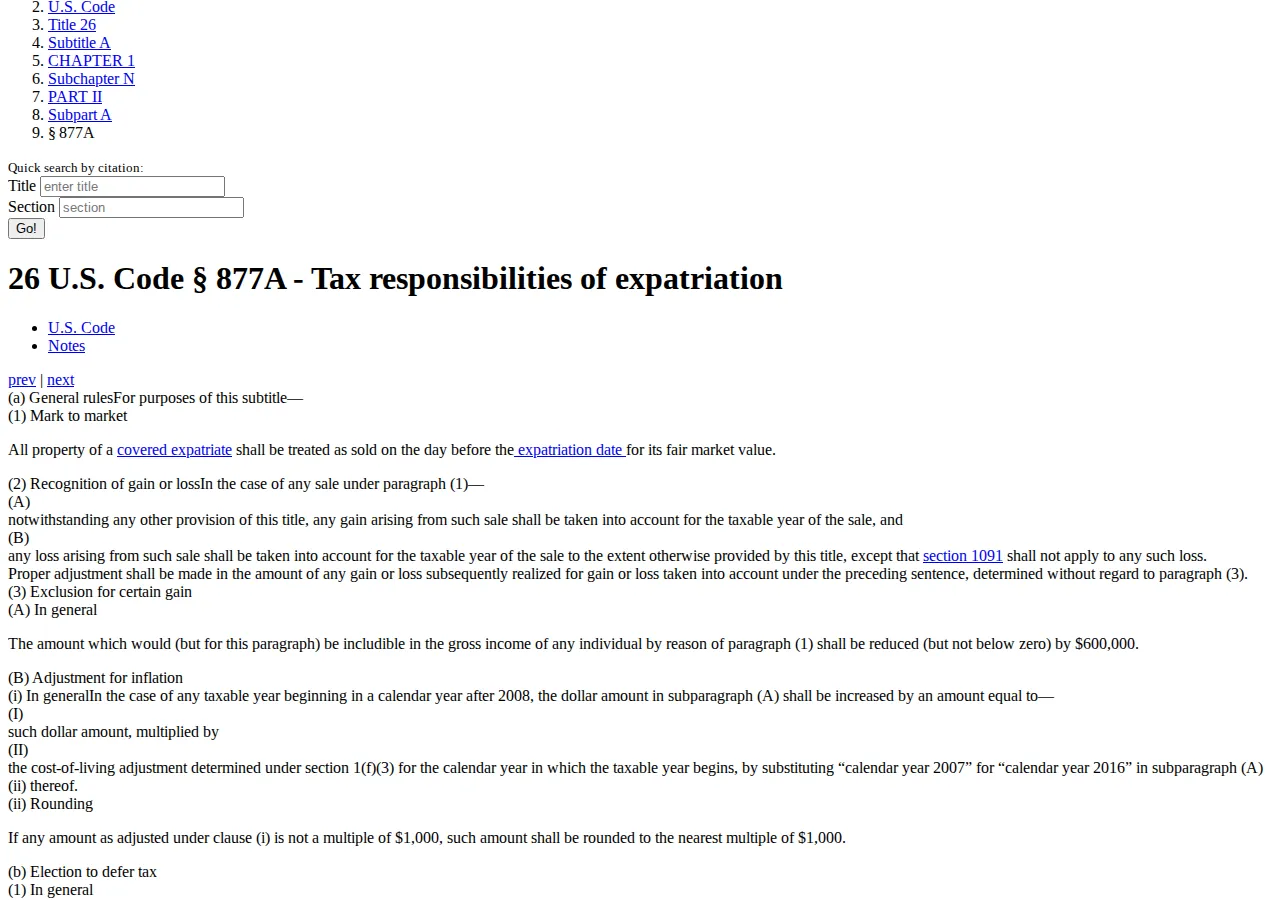
Worked example for a 2026 expatriation. A portfolio with fair market value of $4,910,000 and adjusted basis of $3,000,000 produces a deemed gain of $1,910,000. Less the 2026 exclusion of $910,000, the taxable gain is $1,000,000. At a 20 percent long-term capital gains rate, the exit tax is $200,000 — due in the expatriation year on a sale that never happened, with no cash proceeds to pay it from unless the person sells something real or holds cash in reserve.
The character of the gain follows the property: long-term capital gain rates apply to capital assets held more than a year, ordinary rates to the rest. The exclusion is a single aggregate per person, applied against net gain after netting losses within the same asset class — it is not $910,000 per asset, and a married couple who both expatriate each claim their own exclusion. Property covered by the deemed sale is everything the person owns worldwide: U.S. and foreign real estate, brokerage accounts, business interests, and personal property above the reporting thresholds on Form 8854 Part II, Section C.
Three categories are carved out of the deemed sale by § 877A(c) and taxed under their own rules instead. An eligible deferred compensation item — a 401(k), pension, or stock-option plan that meets the statutory conditions — is not deemed sold; instead, § 877A(d)(1)(A) requires the payor to deduct and withhold 30 percent from every taxable payment to the covered expatriate. A $100,000 annual pension payment therefore arrives as $70,000, with $30,000 withheld:
A specified tax-deferred account — an IRA, a health savings account, an Archer MSA — is treated under § 877A(e)(1) as distributed in full on the day before the expatriation date, with no early-distribution tax by reason of that treatment, and later distributions are adjusted to reflect it. An interest in a nongrantor trust is not deemed sold either; under § 877A(f)(1)(A) the trustee must deduct and withhold 30 percent of the taxable portion of every distribution to the covered expatriate. The three carve-outs mean the exit tax is never a single number: part is a deemed-sale gain, part is a 30 percent withholding stream that can run for decades.
The second tax: § 2801 on gifts and bequests
Expatriation does not end the U.S. tax system's reach over the covered expatriate's wealth. Under IRC § 2801, when a U.S. citizen or resident receives a covered gift or bequest — property from a person who is a covered expatriate at the time of the transfer, or by reason of the death of a person who was a covered expatriate immediately before death — a tax is imposed on the recipient equal to the highest rate in the § 2001(c) estate tax table multiplied by the value of the covered gift or bequest. The top § 2001(c) rate is 40 percent. The tax applies only to the extent the value received in the calendar year exceeds the § 2503(b) annual exclusion, $19,000 for 2025, and it is reduced by any foreign gift or estate tax paid on the same transfer.
A covered expatriate who gives $500,000 to a U.S.-resident child therefore hands the child a $192,400 tax bill, payable by the child, not the donor. There is no lifetime exemption on the § 2801 side — the annual exclusion is the only shelter — which is why estate planning for a covered expatriate is planned before expatriation, not after. The IRS has not issued a final Form 708 for reporting § 2801 tax, so recipients report on the forms and procedures the IRS prescribes at the time; the liability itself is statutory and does not wait for the form.
Deferral, relief, and the filing sequence
Section 877A(b) allows a covered expatriate to elect to defer payment of the mark-to-market tax until the property is actually disposed of, but the deferral is not free: the person must post adequate security, pay interest on the deferred amount, and file an annual Form 8854 for as long as the deferral runs. The deferral agreement request goes to the IRS in Austin, Texas.
Filing checklist
- [x] Step 1: Run the three tests 12 months before the renunciation appointment — five-year average tax, net worth balance sheet, and a five-year compliance review covering returns, FBARs, Form 8938, the LLC's Form 1065, the S-Corp's Form 1120-S, the C-Corp's Form 1120, FICA and SECA payroll filings, and EIN and ITIN records.
- [x] Step 2: Fix the certification before the date — file any missing returns and information returns first, because an unfiled year cannot be certified and an uncertifiable year makes the filer covered.
- [x] Step 3: Value everything at fair market value — obtain appraisals for real estate and business interests, and broker statements for securities, dated to the day before expatriation.
- [x] Step 4: Compute the deemed gain and the exclusion — apply the exclusion for the expatriation year ($910,000 for 2026) against net gain, and reserve cash or a sale to pay the tax in the expatriation year.
- [x] Step 5: Map the carve-outs — identify every deferred compensation item, specified tax-deferred account, and nongrantor trust interest, and confirm the 30 percent withholding mechanics with each payor and trustee.
- [x] Step 6: File the initial Form 8854 with the expatriation-year return — attach it to Form 1040, 1040-SR, or 1040-NR by the return's due date including extensions, and keep a complete copy with the valuation workpapers.
- [x] Step 7: Calendar the annual Form 8854 — for every year § 877A reporting continues, and for every year a § 877A(b) deferral runs, until the obligation ends.
Who should not use this playbook
This playbook is for a person who has already decided to expatriate and needs the mechanics. It is not a reason to expatriate: the exit tax is designed to make departure expensive for exactly the people who can afford to leave, and a person whose only motive is a lower tax rate abroad will usually find the deemed sale, the 30 percent withholding streams, and the § 2801 tax on later gifts cost more than the move saves.