IRS Form 8822 Change of Address Playbook: The Last-Known-Address Rule, the 90-Day Clock, and the Cost of a Missed Notice
Maya and Daniel both move on November 10, 2026. Maya files Form 8822 the same day; Daniel trusts his post-office change of address. By Christmas, the IRS has Maya's new address. Daniel's file still shows the old one — and when the IRS mails his notice of deficiency on December 1, 2026, the 90-day clock starts running anyway.
Who this guide is for
This guide is for the individual who moved after filing; the founder who moved the business or changed who runs it; the executor handling an estate; and the separated spouse who no longer shares an address with a joint filer.
The two forms, and which one is yours
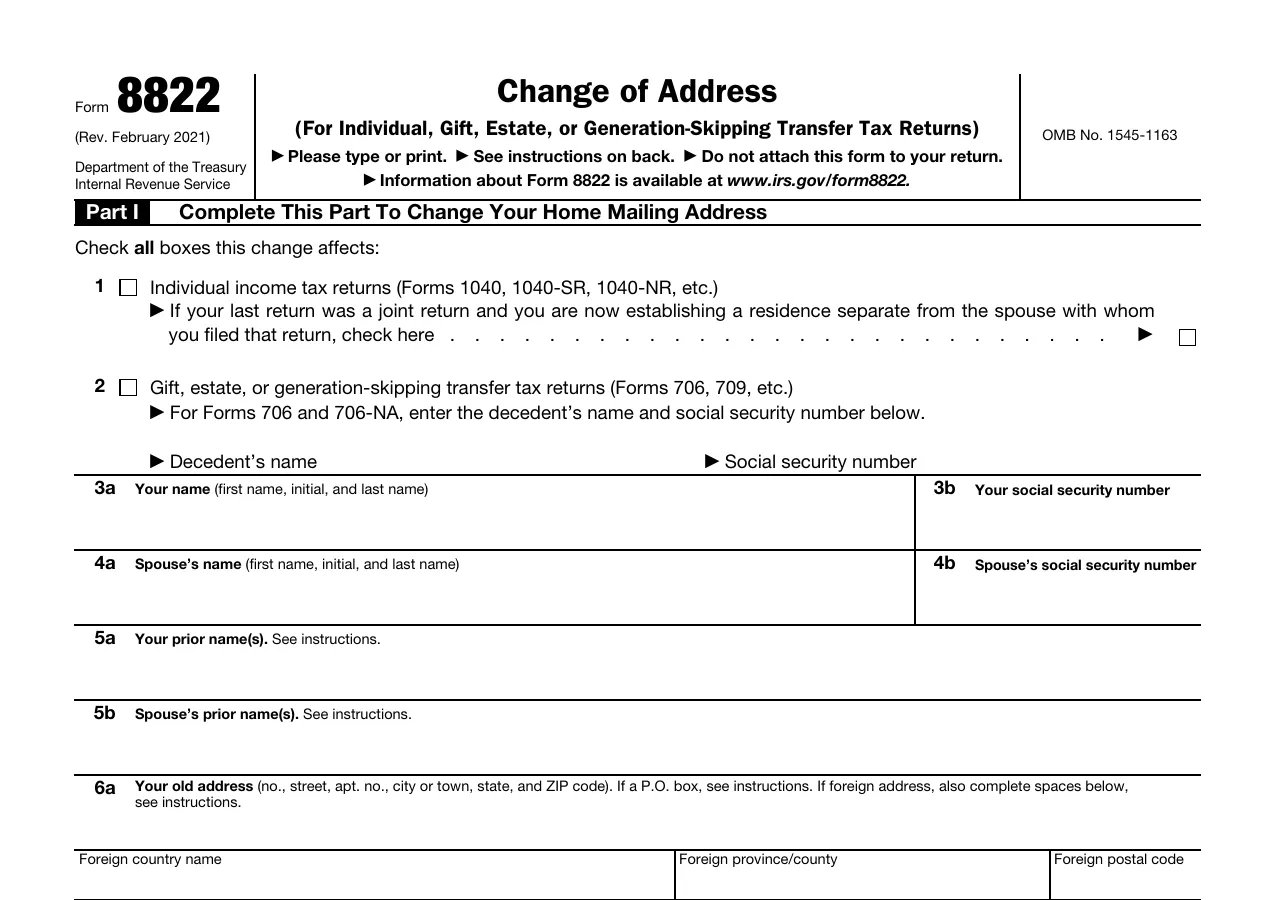
Form 8822 covers a home mailing address; Form 8822-B covers a business mailing address, location, and responsible party. Changing both takes both forms.
| Your situation | File this | What it changes | Authority |
|---|---|---|---|
| You moved; your home mailing address changed | Form 8822 | Home mailing address — individual, gift, estate, generation-skipping transfer returns | Form 8822 (Rev. 2-2021), Purpose of Form |
| Your business moved, or its mailing address changed | Form 8822-B | Business mailing address and location | Form 8822-B (Rev. 12-2019), Purpose of Form |
| The person who controls your entity changed | Form 8822-B, lines 8–9 | Responsible party, within 60 days | Form 8822-B; Treas. Reg. § 301.6109-1(d)(2)(ii) |
The five ways to tell the IRS you moved
IRS Topic 157 lists five methods. Form 8822 is one of them. The right method depends on timing: a move before filing differs from a move after filing.
- On your next return. Enter the new address on the return before filing; the IRS updates its records when it is processed. Tell your preparer too.
- At the post office. Notify the post office serving your old address. Topic 157 warns: "Because not all post offices forward government checks, you should also directly notify the IRS as described below."
- By form. Complete Form 8822 and/or Form 8822-B and mail them to the address shown on the form.
- In writing. Send your full name, old and new addresses, SSN, ITIN, or EIN, and your signature; joint filers provide both spouses' information and signatures.
- By phone. Call with your full name, old and new addresses, and SSN, ITIN, or EIN; the IRS may request more to verify your identity.
Two details carry real weight: if you filed a joint return and now have separate residences, each joint taxpayer should notify the IRS separately. And when the change relates to an employment tax return, the IRS issues confirmation notices — Notices 148A and 148B — to both addresses.
The statute: a notice mailed to your last known address is sufficient
Section 6212(a) authorizes a notice of deficiency by certified or registered mail. Section 6212(b)(1) then provides that a notice for income, gift, and certain excise taxes, "if mailed to the taxpayer at his last known address, shall be sufficient" — even if the taxpayer is deceased, under a legal disability, or, for a corporation, terminated. The notice need not reach you; it must reach the address the law treats as yours.
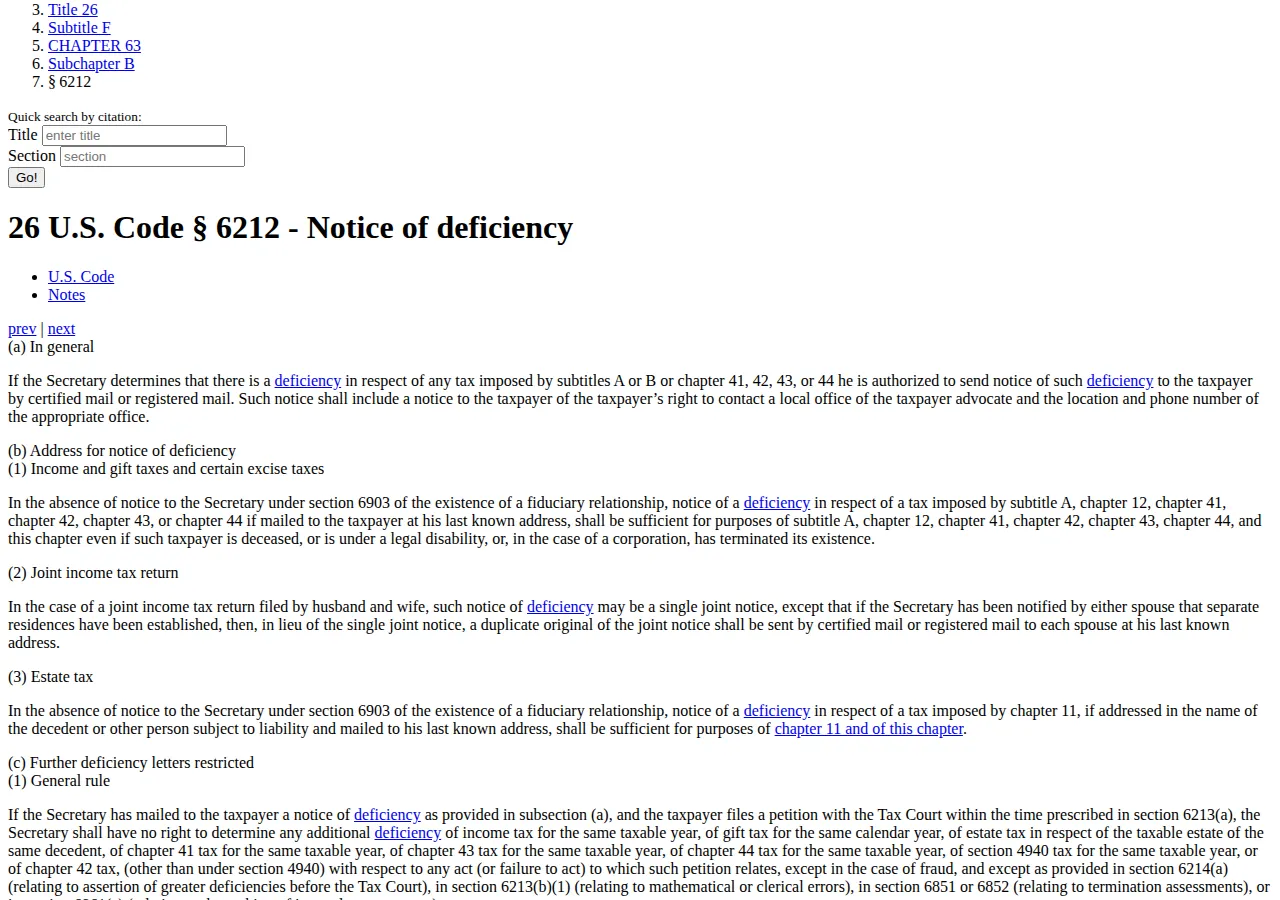
Treasury Regulation § 301.6212-2(a) defines the term: a taxpayer's last known address "is the address that appears on the taxpayer's most recently filed and properly processed Federal tax return, unless the Internal Revenue Service (IRS) is given clear and concise notification of a different address." Form 8822 is that notification, as is a letter with the four items Topic 157 lists, and as is a new return showing the new address. Telling someone else is not: paragraph (b)(1) provides that change-of-address information given to a third party, "such as a payor or another government agency, is not clear and concise notification of a different address."
One exception makes the post-office method treacherous, not useless. Paragraph (b)(2)(i) provides that the IRS updates taxpayer addresses from the USPS National Change of Address database, which retains change-of-address information for thirty-six months: if the taxpayer's name and last known address in IRS records match the name and old mailing address in the NCOA database, the new address in the database becomes the taxpayer's last known address. So a USPS change of address can update the IRS record — when the match is exact. But it is conditional in three ways the form is not: the match must be exact, the NCOA data lasts thirty-six months, and Topic 157 warns that not all post offices forward government checks. A refund check sent to an old address may never arrive, and a deficiency notice sent there is still legally delivered. The form costs sixteen minutes and removes all three conditions at once.
The 90-day clock runs from mailing, not from receipt
Section 6213(a) sets the window: "Within 90 days, or 150 days if the notice is addressed to a person outside the United States, after the notice of deficiency authorized in section 6212 is mailed (not counting Saturday, Sunday, or a legal holiday in the District of Columbia as the last day), the taxpayer may file a petition with the Tax Court for a redetermination of the deficiency." The clock starts at mailing. Receipt is irrelevant.
Worked example — Daniel's case:
March 1, 2027 is a Monday, so no weekend adjustment applies. If Daniel learns about the notice on February 1, 2027, he has 28 days left:
If he misses March 1, the Tax Court has no jurisdiction. The deficiency may then be assessed, and the remaining route is to pay the tax and sue for a refund — a pre-payment forum lost for want of an address update. Joint filers have one more protection: under § 6212(b)(2), if either spouse has notified the Secretary that separate residences have been established, the IRS must send a duplicate original of the joint notice to each spouse at his last known address — the reason Form 8822 line 1 has a separate-residence checkbox.
What a missed notice costs
Take Daniel's deficiency as $12,000. Interest on an underpayment runs from the date the tax was due, at 7 percent for the fourth quarter of 2026 — the same rate as the first and third quarters, with the second at 6 percent. Interest compounds daily. The cost of the 120 days between the notice mailing on December 1, 2026 and March 31, 2027 is:
That is $2.33 per day — and only the interest for those 120 days; interest on the underlying deficiency has run since the tax was due.
How long processing takes, worked from a filing date
The two IRS sources disagree slightly, and the honest answer carries both: the form says "Generally, it takes 4 to 6 weeks to process a change of address"; Topic 157 says "Generally, it takes 45-days for a change of address request to be fully processed." Filed November 10, 2026, the windows land here:
December 25, 2026 is a Friday — Christmas Day. Plan on the longer figure and file the form the week you move; for employment tax returns, watch for confirmation notices 148A and 148B at both addresses.
Form 8822-B and the 60-day responsible-party rule
The business form carries a deadline the individual form does not: any entity with an EIN must report a change in its responsible party on lines 8 and 9 "within 60 days of the change," under Regulations section 301.6109-1(d)(2)(ii). Lines 8 and 9 take the new responsible party's name and SSN, ITIN, or EIN — check the Form SS-4 instructions for who may use an EIN. Worked from a change date:
November 30, 2026 is a Monday, so the 60th day is the deadline. A change on November 1, 2026 is due December 31, 2026. The form is blunt: "If you are an entity with an EIN and your responsible party has changed, use of this form is mandatory. Otherwise, use of this form is voluntary. You will not be subject to penalties for failure to file this form." But without a current address or responsible party on file, you may not receive a notice of deficiency — and penalties and interest accrue anyway.
The form takes eighteen minutes by its own estimate. The business location goes on line 7, separate from the mailing address on line 6. An officer, owner, general partner or LLC member manager, plan administrator, fiduciary, or authorized representative must sign; a representative attaches a copy of the power of attorney, and the IRS "will not complete an address or responsible party change from an 'unauthorized' third party."
Where to file
The filing address follows your old address, not your new one. If you checked line 2 — gift, estate, or generation-skipping transfer returns — send Form 8822 to Kansas City, MO 64999-0023 regardless.
| Your old home address was in | Send Form 8822 to |
|---|---|
| Alabama, Arkansas, Delaware, Georgia, Illinois, Indiana, Iowa, Kentucky, Maine, Massachusetts, Minnesota, Missouri, New Hampshire, New Jersey, New York, North Carolina, Oklahoma, South Carolina, Tennessee, Vermont, Virginia, Wisconsin | Kansas City, MO 64999-0023 |
| Florida, Louisiana, Mississippi, Texas; a foreign country, American Samoa, or Puerto Rico; APO or FPO address; Form 2555, 2555-EZ, or 4563 filer; dual-status alien; non-bona-fide resident of Guam or the Virgin Islands | Austin, TX 73301-0023 |
| Alaska, Arizona, California, Colorado, Connecticut, District of Columbia, Hawaii, Idaho, Kansas, Maryland, Michigan, Montana, Nebraska, Nevada, New Mexico, North Dakota, Ohio, Oregon, Pennsylvania, Rhode Island, South Dakota, Utah, Washington, West Virginia, Wyoming | Ogden, UT 84201-0023 |
| Guam or Virgin Islands, bona fide resident | Government of Guam, P.O. Box 23607, GMF, GU 96921; V.I. Bureau of Internal Revenue, 6115 Estate Smith Bay, Suite 225, St. Thomas, VI 00802 |
Form 8822-B uses two centers — Kansas City, MO 64999 and Ogden, UT 84201-0023 — with state groupings printed on the form. They differ from Form 8822's, so check the form itself before mailing.
Who signs, and the cases that trip people up
Form 8822 must be signed by the taxpayer, executor, donor, or an authorized representative. If your last return was a joint return, your spouse must also sign — unless you checked the box on line 1 showing a separate residence. A representative must attach a copy of the power of attorney; Form 2848 is the vehicle, and the IRS will not complete an address change from an unauthorized third party.
The form anticipates the edge cases: a separate Form 8822 for each child who filed a return; line 5 for a name change after marriage or divorce — and notify the Social Security Administration too, since mismatched names delay processing and refunds; the decedent's name and Social Security number on line 2 for Forms 706 and 706-NA; "C/O" for an in-care-of address; a P.O. box only if the post office does not deliver to your street address; and foreign addresses in the country's own postal-code practice, country name never abbreviated.
Filing checklist
- Decide which form: home address is 8822; business address, location, or responsible party is 8822-B; both means both.
- Gather the four facts: name, old address, new address, and SSN, ITIN, or EIN.
- Complete the right lines: 1 for individual returns, 2 for gift, estate, or generation-skipping transfer returns, 5 for a name change, 6a for the old address, 7 for the new address.
- Sign it: taxpayer signs; a joint-return spouse also signs unless the separate-residence box is checked; a representative attaches the power of attorney.
- Mail it to the right center: Kansas City, Austin, or Ogden by old address — never the Washington comment address; never attach it to your return.
- Calendar the window: 4 to 6 weeks, 45 days in Topic 157 — plan on December 25, 2026 for a November 10 filing; watch for Notices 148A and 148B.
- Check the 60-day clock: responsible-party changes go on Form 8822-B lines 8 and 9 within 60 days.
Founder & CEO Insight — Enow A. Jovial
Sources
Tax forms: Form 940 FUTA annual tax playbook and Form 2210 underpayment penalty playbook. Payroll: Form W-4 withholding certificate playbook and foreign qualification and registered agent compliance. Cost check: profit calculator.