Foreign Qualification & Registered Agent Compliance Playbook: What a Second State Really Costs
A Delaware LLC hires an employee in California, leases a warehouse in Texas, and opens a sales office in Florida. The company is now doing business in four states, and three of them want a filing before the next dollar is earned there. The filing itself is cheap — $70 in California, $125 in Florida — but the second state also brings a second annual tax, a second agent, and a second return. The bill that surprises founders is never the filing fee. It is the recurring cost, and the penalty for the years spent pretending the second state did not exist.
The trigger: what counts as transacting business
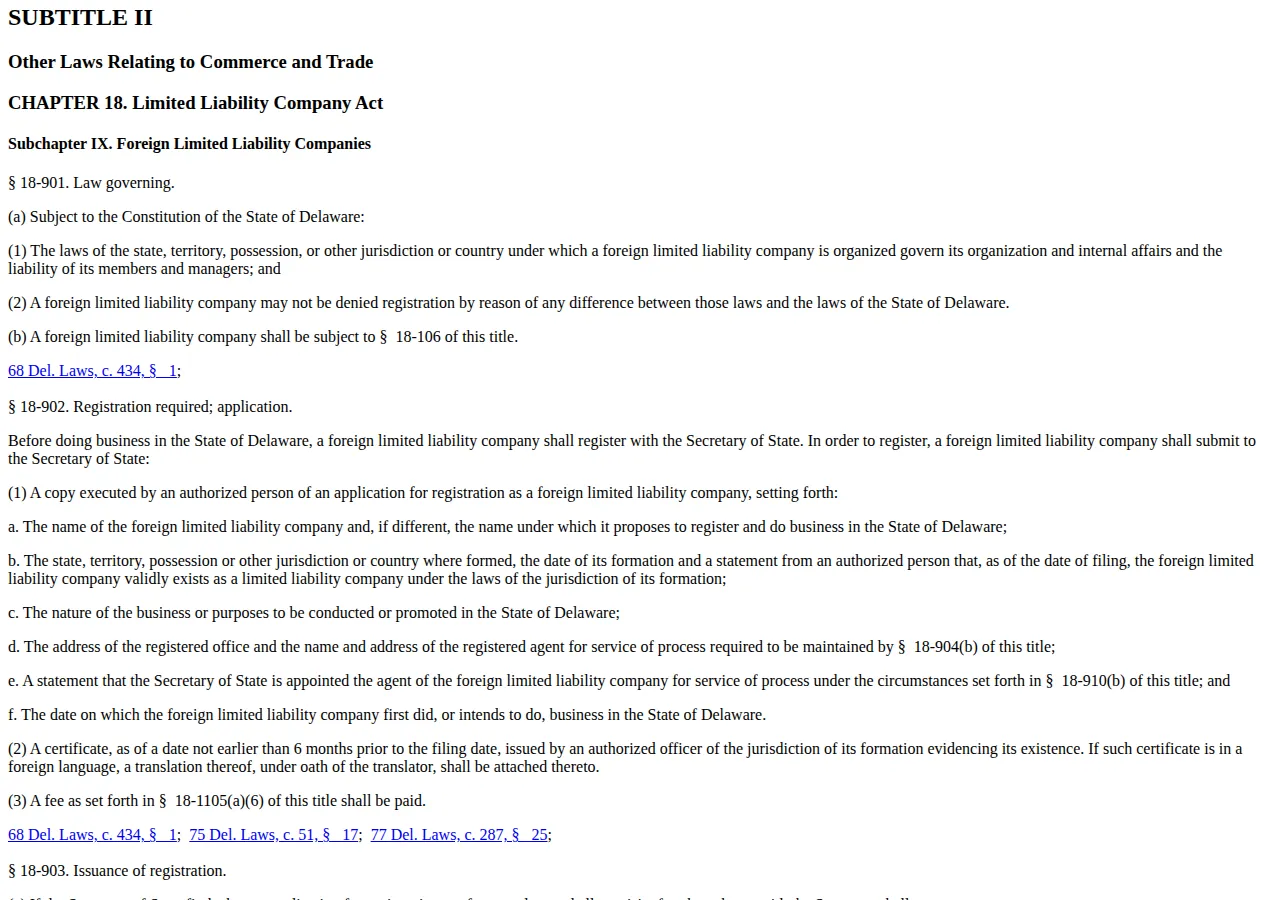
Every state uses the same shape of rule. Delaware section 18-902: "Before doing business in the State of Delaware, a foreign limited liability company shall register with the Secretary of State." Florida section 605.0902: "A foreign limited liability company may not transact business in this state until it obtains a certificate of authority from the department." New York requires an Application for Authority under section 802, and California requires registration under section 17708.02, before doing business there.
The test is activity, not intent. An office, an employee who works in the state, a warehouse, or contracts performed in the state all count, because the state looks at what the company does inside its borders, not where the customers sit. One employee working from a California apartment makes the Delaware LLC a California business, even if every invoice goes elsewhere.
Florida writes the exempt list into the statute. Section 605.0905 says the following do not constitute transacting business: maintaining or defending a proceeding, holding meetings of managers or members, maintaining bank accounts, selling through independent contractors, soliciting orders that need acceptance outside the state, and creating or collecting debts. If everything the company does in the state sits on that list, no filing is owed.
The filing in four states
The four filings differ by more than ten times, and the cheapest carries the most expensive annual bill. California takes Form LLC-5, the Application to Register a Foreign Limited Liability Company, for $70, then requires a Statement of Information within 90 days and every two years after that. The Franchise Tax Board charges every LLC doing business in California an $800 annual tax, due by the 15th day of the 4th month of the tax year — but not in the first tax year, because LLCs that organize, register, or file with the Secretary of State are exempt for that first year.
Texas takes Form 301, the Application for Registration of a Foreign Limited Liability Company, for $750. The form requires the registered agent's name and address and an affirmation that the agent consented to the appointment. Texas charges no franchise tax until revenue crosses the no-tax-due threshold of $2,650,000 for report years 2026 and 2027, and the Public Information Report is filed each year with the franchise tax report.
Florida takes the Application by Foreign Limited Liability Company for Authorization to Transact Business in Florida, form CR2E027, for $125 — a $100 application fee under section 605.0213(3) plus a $25 registered-agent designation fee under section 605.0213(7). The application must include the initial registered agent's name and Florida street address, with the agent's written acceptance, and a certificate of existence dated no more than 90 days before delivery. The annual report is due between January 1 and May 1 each year, starting the year after registration, and costs $138.75: a $50 filing fee under section 605.0213(5) plus an $88.75 supplemental fee under section 607.193. Filing after May 1 adds a $400 late fee under section 607.193(2)(b), bringing the total to $538.75.
New York takes the Application for Authority, form DOS-1361-f-a, under section 802 of the Limited Liability Company Law, for $250. Within 120 days of filing, the company must publish a notice once a week for six consecutive weeks in two newspapers in the county where its office sits — one daily and one weekly, designated by the county clerk — then file a Certificate of Publication for $50. Failure to publish suspends the company's authority in New York, and a Biennial Statement is due every two years. Our Texas vs Florida LLC formation playbook covers the formation side of the same two states.
| State | Form | Filing fee | Recurring cost | Authority |
|---|---|---|---|---|
| California | Form LLC-5 | $70 | $800 tax + $125 agent; SOI $20 biennial | CA SOS; FTB |
| Texas | Form 301 | $750 | $125 agent; $0 tax below $2,650,000 revenue | TX SOS; TX Comptroller |
| Florida | Form CR2E027 | $125 | $138.75 annual report + $125 agent | FL DOS; Fla. Stat. ch. 605 |
| New York | Form DOS-1361-f-a | $250 | $125 agent; $50 certificate; publication county-priced | NY DOS; NY LLC Law § 802 |
Worked example 1: the first year in California, Texas, or Florida
Take a Delaware LLC that qualifies in one new state in 2026. The agent is $125 per state per year, the published price of Northwest Registered Agent, held for 20 years. The $400-a-year Delaware home-state tax is common to every column, so it is added at the end.
California looks cheap and then is not: $70 for Form LLC-5, $20 for the Statement of Information, and $125 for the agent in year one — $215, because the $800 tax is exempt in year one; $925 in year two; $945 in year three.
Texas looks expensive and then is not: $875 in year one ($750 Form 301 plus $125 agent), $0 franchise tax below the $2,650,000 threshold, then $125 a year. Florida is the cheapest: $250 in year one, then $263.75 a year, because the first annual report falls in year two.
Add the $400-a-year Delaware home-state tax for 2026 through 2028, or $1,200, to every column: $3,285 for California, $2,325 for Texas, and $1,977.50 for Florida. The ranking does not change, because the home-state tax is the same everywhere. Run the three-year totals against the margin on the new state's revenue with our profit calculator before signing the lease.
Worked example 2: two years unregistered in Florida
The same Delaware LLC operates in Florida for two years without a certificate, then files. Section 605.0904(7) makes it pay all fees and penalties that would have been imposed had it applied on time, plus a civil penalty of $500 to $1,000 for each year it transacted business without a certificate.
The back fees are the $125 registration plus two annual reports at $138.75, or $402.50, and the civil penalty runs $1,000 to $2,000 for the two years — so the total to get compliant is $1,402.50 at the low end and $2,402.50 at the high end.
Doing it on time would have cost $250 in year one and $263.75 in year two, or $513.75 — the late bill is 2.7 times that at the low end and 4.7 times at the high end.
Worked example 3: three years unregistered in Delaware
Delaware fines an unregistered foreign LLC $200 for each year or part of a year it failed to register, under section 18-907(d), and section 18-907(a) bars the company from maintaining any action in Delaware until it has registered and paid all fees and penalties. Take a foreign LLC that did business in Delaware for tax years 2024, 2025, and 2026 without registering. The fines are $200 times three years, or $600. The back annual tax is $300 for 2024, $300 for 2025, and $400 for 2026, or $1,000 — a $1,600 total before the registration fee itself.
Registering on time would have cost the $1,000 of tax alone; the fines add $600, or 60 percent more — and the company could not have sued anyone in Delaware, because the court door stays shut until registration and payment are complete.
The registered agent: one per state, and it must be real
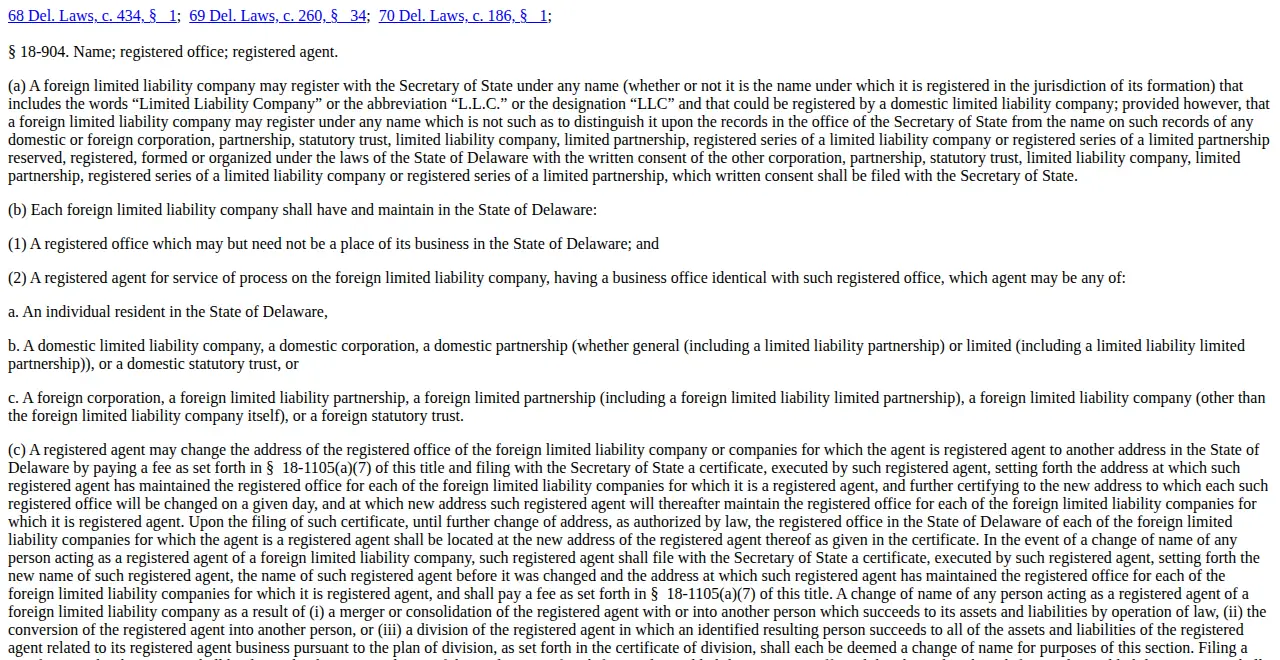
Every state here requires a registered agent with a street address in that state, because service of process has to land somewhere a court can reach. Delaware section 18-904(b) requires each foreign LLC to maintain a registered office and a registered agent with a business office identical to it, and section 18-104(a) imposes the same duty on a domestic LLC. Florida requires the agent's name, Florida street address, and written acceptance on the application, under section 605.0902(1)(d). Texas requires the agent's name and address on Form 301, with an affirmation of consent.
The agent cannot be a fiction. A Delaware registered agent may not perform its duties solely through a virtual office or a mail-forwarding service. The home-state agent does not cover the foreign state.
Northwest Registered Agent charges $125 per year per state and $100 per year per state for five or more states — five states cost $500 a year rather than $625. Our registered agent vs virtual office playbook explains why a virtual office is not a substitute.
Qualify or re-domesticate: the operator boundary
Qualify when the home state still holds real activity and the second state is an expansion; do not qualify when the home state holds nothing any more. An LLC that moved its office, employees, and customers out of Delaware and into California pays $400 a year in Delaware for a state it no longer uses, plus $800 a year in California — and the Delaware filing is the one to end, by converting into a California LLC and withdrawing the Delaware registration, not by quietly stopping payment. Stopping payment does not end the obligation: Delaware keeps charging the tax and adds a $200 late penalty plus 1.5 percent interest per month.
If everything the company does in the second state sits on Florida's section 605.0905 list, no filing is owed. If the company has an employee, an office, or contracts performed in the state, file. The middle case, a single remote employee, still counts: an employee working in the state is the company working in the state.
Founder & CEO Insight — Enow A. Jovial
The filing detail your CPA will ask about
Qualification creates no new entity, so the EIN stays with the domestic LLC and goes on the foreign-state returns. A disregarded single-member LLC reports on the owner's return under the owner's SSN or ITIN unless the LLC holds its own EIN for employment taxes — ask your CPA which number belongs on each state filing. A C-Corp qualifies on its own form and an S-Corp on its own, and the CPA who prepares the home-state return should prepare the foreign-state return too.
Execution checklist: qualify in one pass
- Step 1 — Name the trigger. Write down the state and the activity: office, employee, warehouse, or contracts performed there.
- Step 2 — Order the certificate. Get a certificate of good standing from the home state — Delaware wants it within 6 months of filing, Florida within 90 days.
- Step 3 — Appoint the agent. Name a registered agent with a street address in the foreign state and get the written acceptance.
- Step 4 — File and pay. File Form LLC-5 in California ($70), Form 301 in Texas ($750), form CR2E027 in Florida ($125), or the Application for Authority in New York ($250).
- Step 5 — Diary the recurring items. California: $800 a year plus the Statement of Information every two years. Florida: annual report January 1 to May 1. Texas: Public Information Report with the franchise tax report. New York: publish within 120 days, then the Biennial Statement.
- Step 6 — Tell the CPA before year-end. Both states' returns are filed separately from the federal return.
A second state is a second compliance calendar, not a second filing fee. Price the three years, file the week the trigger appears, and the expansion stays an expansion.