IRS Form 2210: The Underpayment Penalty Playbook
What Form 2210 actually decides
Form 2210 answers one question: did you pay enough income tax, early enough, to avoid the § 6654 addition? The charge runs by the day at a quarterly-reset rate, from the due date until the earlier of the following April 15 or payment.
The 2026 edition had not been published when this guide was researched on November 8, 2026: the form fetched from IRS.gov that day is the 2025 edition. Every line number and worksheet figure below comes from it; the 2026 rates come from the IRS quarterly interest rates page.
Part I: the required annual payment
Part I, lines 1 through 9, computes the required annual payment. Line 1 is tax after credits (Form 1040, line 22); line 2 adds other taxes, including self-employment tax, Additional Medicare Tax, and Net Investment Income Tax; line 3 subtracts other payments and refundable credits. Line 4 is current-year tax; under $1,000, stop — no penalty, no filing — the first exit, under § 6654(e)(1).
Line 5 is 90 percent of line 4. Line 6 is withholding taxes — estimated tax payments do not belong here. Line 7 subtracts line 6 from line 4; under $1,000, stop again — the second exit, the one that saves most wage earners with side income. Line 8 is the maximum required annual payment; line 9 takes the smaller of lines 5 and 8 — under § 6654(d)(1)(B), the lesser of 90 percent of this year's tax or 100 percent of last year's tax.
The prior-year leg has two conditions and one trap: it does not apply if the preceding year was not a 12-month year or if you filed no return for it, and under § 6654(d)(1)(C), if your prior-year adjusted gross income exceeded $150,000 ($75,000 married filing separately), the leg rises from 100 to 110 percent of the prior year's tax.
Founder & CEO Insight — Enow A. Jovial
The exits: when no penalty applies
| Exit | Test | Authority |
|---|---|---|
| Current-year tax under $1,000 | Line 4 < $1,000 | 26 U.S.C. § 6654(e)(1) |
| Tax minus withholding under $1,000 | Line 7 < $1,000 | 26 U.S.C. § 6654(e)(1) |
| Withholding covers the required payment | Line 6 ≥ line 9 | Form 2210, Part I |
| No prior-year tax liability | 12-month prior year, no liability, U.S. citizen/resident | 26 U.S.C. § 6654(e)(2) |
| Return filed and paid by January 31 | File and pay by January 31 | 26 U.S.C. § 6654(h) |
| Farmer or fisherman files by March 1 | One installment; file and pay by March 1 | 26 U.S.C. § 6654(i)(1)(D) |
One calendar note: for the 2026 tax year, January 31, 2027 falls on a Sunday, so under 26 U.S.C. § 7503 the act is timely the next business day — Monday, February 1, 2027. Filing by that date and paying in full bars any penalty on the fourth installment only. You may also skip the January 15 payment by filing by February 1, 2027 and paying the full balance with the return. Voucher mechanics are worked in our IRS Form 1040-ES estimated tax voucher playbook; the general calendar is in our quarterly estimated tax payments guide.
Part II: the five boxes that decide whether you file
Part II is the filing gate: no box applies, do not file — the IRS figures the penalty and sends a bill.
- Box A — full waiver requested. File page 1 only; no penalty calculation required.
- Box B — partial waiver requested. Figure the penalty and waiver amount; file the full form.
- Box C — income varied during the year. Penalty reduced or eliminated by the annualized income installment method; figure it on Schedule AI.
- Box D — withholding actually withheld on different dates. Penalty lower when withholding counts on the dates actually withheld; figure the penalty and file Form 2210.
- Box E — joint-return mismatch. Joint return for either the current or prior year, but not both, with line 8 smaller than line 5. File page 1 only, unless box B, C, or D also applies.
Part III, Section A: the underpayment grid
Section A is a four-column grid, one column per due date: April 15, June 15, September 15, January 15. Line 10 is the required installment, 25 percent of line 9 — unless box C applies, in which case the amounts come from Schedule AI, line 27. Line 11 is estimated tax paid plus withholding. Work lines 12 through 18 one column at a time: overpayments flow forward through line 12, underpayments net against later payments through line 14. Line 17 is the column's underpayment; line 18 is the overpayment. A late payment lands in the next column and reduces that underpayment through line 14, shortening the penalty period without erasing the days already run.
Worked example 1: a missed September installment
A single filer, 2025: current-year tax $24,000, prior-year tax $19,000. Her required annual payment is the lesser of 90 percent of $24,000 ($21,600) and 100 percent of $19,000 — $19,000, so each installment is $4,750. Her employer withheld $8,000, deemed $2,000 per due date under § 6654(g)(1). She paid $2,750 on April 15 and June 15, nothing on September 15, $5,500 on January 15.
Columns (a) and (b) are clean: $2,000 withholding plus $2,750 estimated tax equals $4,750. Column (c) is short by $2,750. Column (d) shows $2,000 plus $5,500, but line 14 pulls the column (c) shortfall forward, leaving $4,750 against $4,750 required — so the penalty runs only on the $2,750, September 15 to January 15.
The 2025 worksheet splits the underpayment period at each quarterly rate change. All four 2025 rate periods carry 7 percent, so the split is bookkeeping — the day count is the substance: 15 days (September 15–30), 92 days (September 30–December 31), 15 days (December 31–January 15):
Slice by slice: $7.91 + $48.52 + $7.91 = $64.34 — the same as the single-line figure, the amount to enter. A $2,750 miss for four months costs about sixty-four dollars, roughly 2.3 percent of the missed amount — which is why the rational response to a discovered shortfall is to pay immediately.
Part III, Section B: the worksheet, the rate, and the day count
Section B is the worksheet in the instructions, not lines on the form. For each column's underpayment, list its payments with their dates, then run it through up to four rate periods: underpayment × days ÷ 365 × rate. The period runs from the due date to the earlier of the following April 15 or payment, under § 6654(b)(2). Under § 6654(b)(3), a payment credits the earliest unpaid installment first. The rate is the § 6621 underpayment rate — the federal short-term rate plus three points, reset quarterly.
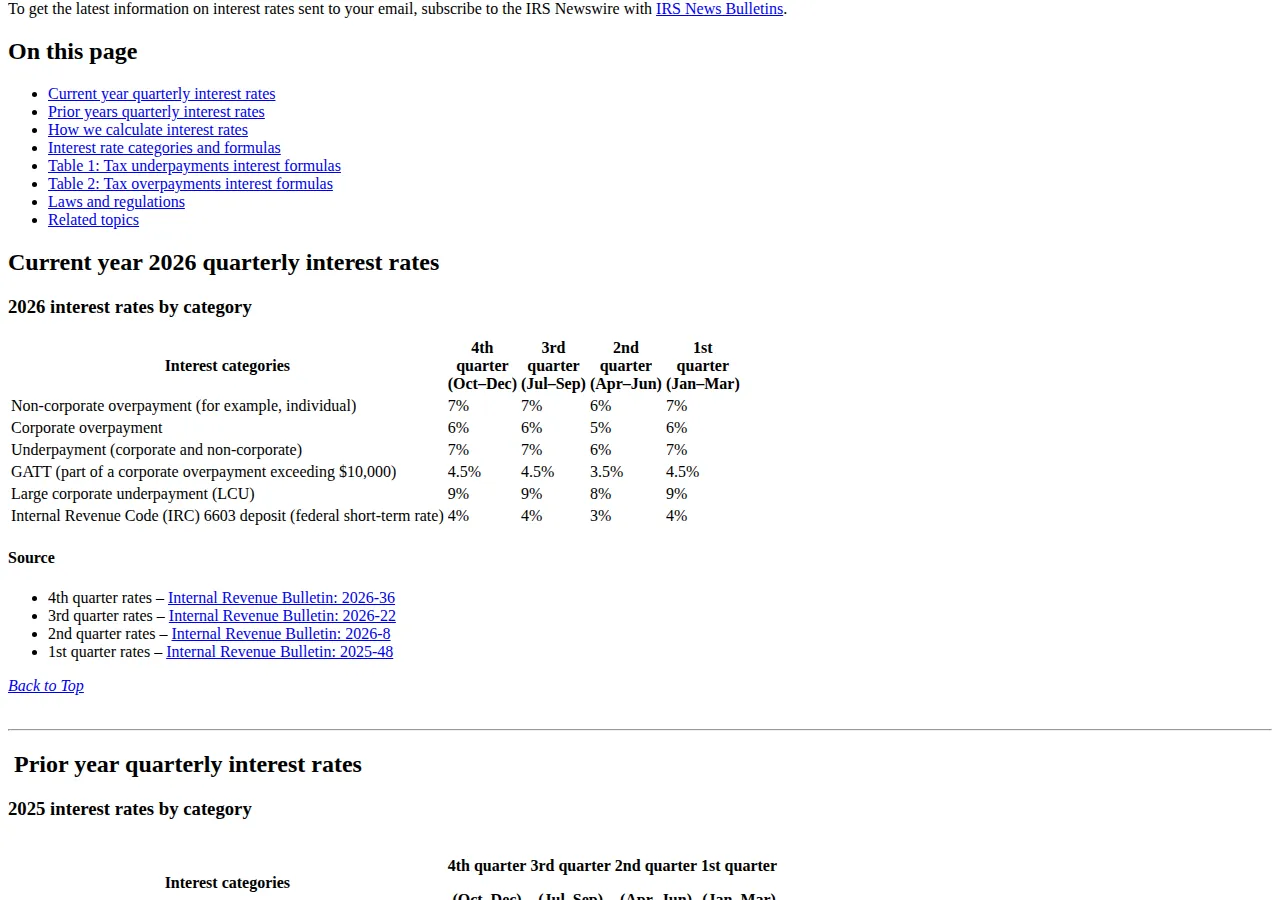
The 2026 quarterly underpayment rates are 7, 6, 7, and 7 percent, verified on the IRS quarterly interest rates page this cycle, sourced to Internal Revenue Bulletins 2026-8, 2026-22, and 2026-36. The 2026 Form 2210 worksheet had not been published when this guide was researched, so a 2026 penalty cannot yet be figured from a published worksheet — use the statute and the quarterly rates, and check for the 2026 form before filing.
Schedule AI: the annualized income installment method
Schedule AI is for income that does not arrive evenly. Under § 6654(d)(2), if the annualized income installment for a period is less than the flat 25-percent installment, the required installment is the annualized amount — any reduction recaptured by increasing the next installment. The factors, in § 6654(d)(2)(C)(ii), are 22.5, 45, 67.5, and 90 percent. Schedule AI, line 2, annualizes income with multipliers 4, 2.4, 1.5, and 1 for the periods ending March 31, May 31, August 31, and December 31 (estates and trusts: February 28, April 30, July 31, November 30).
Complete Schedule AI for all four periods, figure the tax on the annualized income, add annualized self-employment tax from Part II, and apply the percentage. File Form 2210 with Schedule AI even if no penalty is owed; if the IRS disagrees, the flat installments apply.
Worked example 2: income that lands in December
A consultant's full-year tax is $18,000 and her prior-year tax is $20,000, so her required annual payment is 90 percent of $18,000 — $16,200 — and the flat installments would be $4,050 each. Her income arrives late: the tax on her income earned to each cut-off date, annualized through Schedule AI, Part I, is $2,400 (March 31), $6,300 (May 31), $9,900 (August 31), and $18,000 (full year). Applying the percentages on Schedule AI, line 20:
Line 23 subtracts the installments already figured; line 24 caps each column at 25 percent of the $16,200 required annual payment ($4,050); lines 25 and 26 recapture earlier reductions. The line 27 installments are $540, $2,295, $3,847.50, and $9,517.50 — the same $16,200 total, timed to when the money exists. She pays $540 in April instead of $4,050; total tax is unchanged. Schedule AI never reduces the year's tax — it only reschedules the installments.
The withholding trap: § 6654(g) and box D
Under § 6654(g)(1), the year's withholding credit is deemed paid in four equal parts on the four due dates, unless the taxpayer establishes the actual dates — then the amounts are deemed paid on those dates. The default helps evenly spread withholding and hurts back-loaded withholding: a large December bonus still counts as one-quarter paid in April, June, and September, manufacturing underpayments that never happened in cash terms. Box D exists for that filer: check it, establish the actual dates from pay statements, and figure the penalty with withholding credited when it was actually withheld. A pay statement per pay period is enough; a year-end W-2 is not.
Part IV: waiver — narrow, documented, decided by the IRS
Part IV is a statement, not a calculation. Under § 6654(e)(3), the penalty is waived in two situations: casualty, disaster, or other unusual circumstances where imposing it would be against equity and good conscience; and retirement after age 62 or disability, in the tax year or the preceding tax year, where the underpayment was due to reasonable cause and not willful neglect. To request one, check box A (entire penalty) or box B (part of it), attach a statement explaining the circumstances and period covered, with documentation — a retirement date and your age then, or the date you became disabled. Box A: complete only page 1; you need not figure the penalty. Box B: figure the penalty through line 18 without regard to the waiver, enter the waived amount in parentheses next to line 19, subtract, and enter the result on line 19.
Two further reliefs sit outside Part IV: federally declared disasters can postpone estimated-tax deadlines outright, and Notice 2026-3 (2026-02 I.R.B. 307) provides limited relief from part of the § 6654 addition for a qualified farmland sale with a § 1062(a) election.
Farmers and fishermen: Form 2210-F
Under § 6654(i), a qualified farmer or fisherman — at least two-thirds of gross income from farming or fishing — has one required installment, due January 15 of the following year, equal to 66⅔ percent of the current-year tax (the prior-year leg does not apply), and the January 31 exit applies with March 1 substituted. File and pay in full by March 1 and no penalty applies; otherwise the penalty is figured on Form 2210-F (2025 edition). Run the numbers first through the tax estimator.
Execution checklist: from shortfall to filed form
- Run Part I from the finished return: if line 4 or line 7 is under $1,000, or withholding covers line 9, stop — no penalty, no filing (unless box E applies).
- If a penalty may apply, check Part II; no box applies, do not file — the IRS figures the penalty and bills you.
- Box C: complete Schedule AI for all four periods before Part III — the line 27 amounts replace the flat 25-percent installments. Box D: gather pay statements showing actual withholding dates.
- Complete Part III, Section A column by column — overpayments forward on line 12, shortfalls on line 14; do not skip the carryover lines — then run the Section B worksheet period by period, splitting at each quarterly rate change (7 percent throughout 2025; 7, 6, 7, and 7 percent by quarter for 2026).
- Enter the total on Form 1040, line 38, or Form 1041, line 27 — box A: file page 1 only with the waiver statement; box B: enter the waived amount in parentheses by line 19. If the shortfall is still open, pay it now; the penalty stops the day the money lands.
Form 2210 rewards the filer who treats estimated tax as four dated obligations: claim the safe harbors, the annualized method, the withholding election, and the waiver, with the right box checked, before the IRS figures the penalty without them.