A nondeductible IRA contribution is retirement money you put in after tax, grow tax-deferred, and then get taxed on again if you cannot prove what you already paid tax on. Form 8606 is the proof: the one-page form that tracks your basis — the after-tax dollars inside your traditional IRAs — and decides how much of every distribution and every Roth conversion is taxable. File it wrong, or skip it, and the IRS taxes the same dollars twice. This guide walks Form 8606 line by line for 2026, with the dollar figures from IRS Notice 2025-67 and the form itself, under 26 U.S.C. §§ 408 and 408A.
For 2026, the IRA contribution limit is $7,500 under 50 and $8,600 at 50 or older, with a $1,100 catch-up; for 2025, the limits are $7,000 and $8,000, with a $1,000 catch-up. The limit covers all traditional and Roth IRAs combined, and the 2026 contribution can be made through April 15, 2027. Using the wrong year's number turns a clean filing into a 6% excise tax.
Who must file: three triggers and one trap
You must file Form 8606 if any one of three things is true: you made nondeductible contributions to a traditional IRA; you took distributions from a traditional IRA and you have basis from this year or any earlier year; or you converted part, but not all, of your traditional IRAs to a Roth IRA and you have basis. A married couple files a separate form for each spouse who must file one.
The trap is the second trigger. Basis does not expire: a $5,000 nondeductible contribution made in 2019 sits in your basis until a distribution or conversion draws it down, and the year you take your first distribution — ten years later, at 72, with no contribution that year — the form is still required..
Who does not file matters too. If every contribution you ever made was deductible, you have no basis and a distribution needs no Form 8606 — the whole distribution is taxable and goes straight to Form 1040, line 4b. If you converted all of your traditional IRAs with no basis, Part II still applies but Part I does not.
The 2026 limits: who can deduct, who must go nondeductible
Whether a contribution is deductible depends on two facts: whether you or your spouse is an active participant in a workplace plan, and your modified adjusted gross income. If neither spouse is covered, it is fully deductible at any income. If either is covered, it phases out across the ranges below, set by IRS Notice 2025-67 under 26 U.S.C. § 219(g).
| Deduction phase-out, 2026 | Range |
|---|---|
| Single / head of household, active | $81,000–$91,000 |
| Married filing jointly, spouse active | $129,000–$149,000 |
| Not active, spouse is | $242,000–$252,000 |
| Married filing separately, active | $0–$10,000 |
The Roth IRA has its own phase-out under 26 U.S.C. § 408A(c)(3): single and head of household, $153,000–$168,000; married filing jointly, $242,000–$252,000. A single filer with modified AGI of $170,000 cannot contribute to a Roth IRA at all, and cannot deduct a traditional contribution if covered at work.
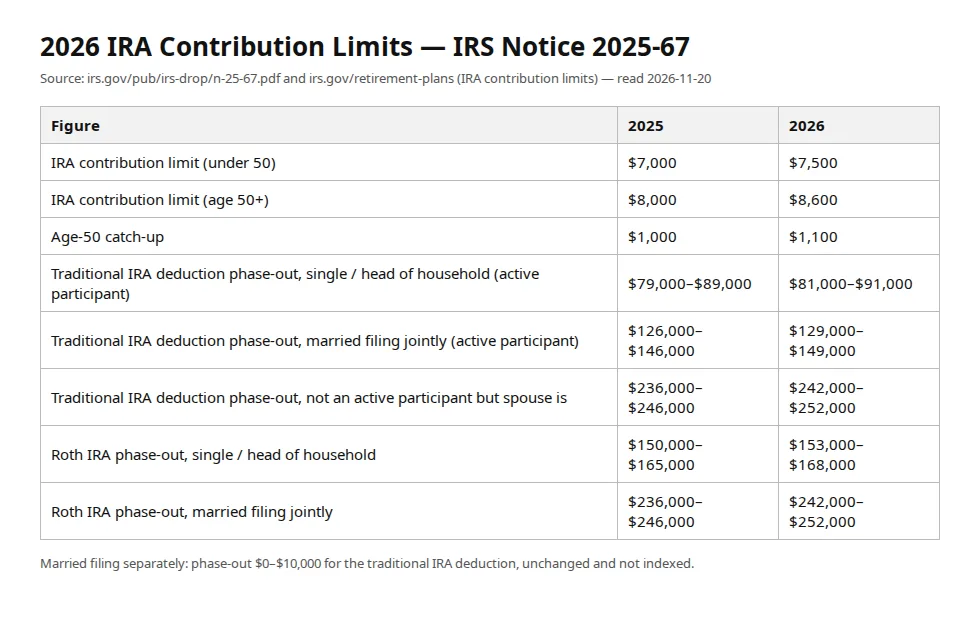
The phase-out is a slope, not a cliff: a single filer at $86,000 — the midpoint of the $81,000–$91,000 range — can deduct half of a $7,500 contribution, and the other $3,750 is nondeductible basis. File Form 8606 for that $3,750 or it is lost and taxed again on withdrawal.
Part I line by line: the pro-rata formula
Part I is the heart of the form. Lines 1 through 3 build the basis: line 1 is the nondeductible contribution for 2026, including contributions made from January 1 through April 15, 2027; line 2 is the total basis from all earlier years, carried forward from last year's Form 8606, line 14; line 3 adds them.
Lines 5 through 10 are the pro-rata formula. Line 5 is line 3 minus contributions made in the January-to-April window of the following year. Line 6 is the value of all traditional IRAs as of December 31, 2026, plus outstanding rollovers. Line 7 is the distributions taken in 2026, line 8 the net amount converted, and line 9 the sum of lines 6, 7, and 8. Line 10 divides line 5 by line 9, as a decimal rounded to at least three places, capped at 1.000 — the nontaxable fraction of everything you took out or converted.
Work it with real numbers. A filer has $12,000 of basis from earlier years (line 2) and makes a $7,500 nondeductible contribution for 2026 (line 1), so lines 3 and 5 are $19,500. The traditional IRAs are worth $80,500 on December 31, 2026 (line 6), no distributions are taken (line 7 is $0), and $20,000 is converted to a Roth IRA (line 8). Line 9 is $100,500, so line 10 is $19,500 divided by $100,500, or 0.194. Line 11 multiplies the $20,000 conversion by 0.194, giving a $3,880 nontaxable portion. Line 18, the taxable amount, is $16,120, and it goes to Form 1040, line 4b. Line 14, the remaining basis, is $15,620 — next year's line 2.
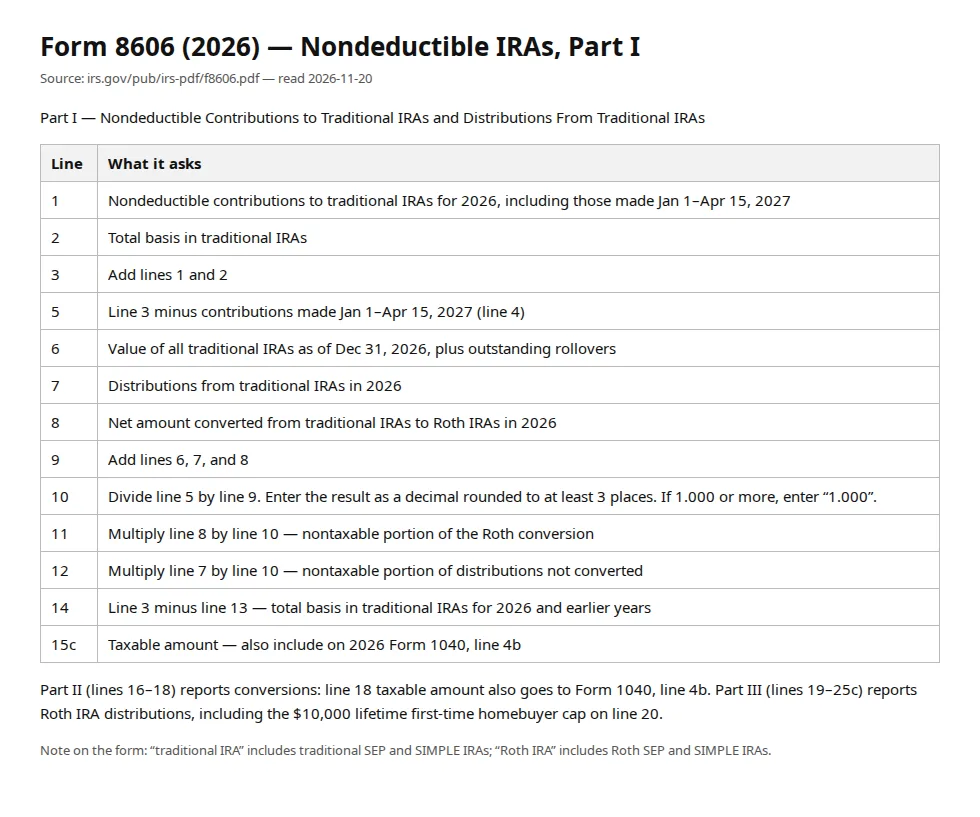
The same formula governs a straight distribution: line 12 multiplies the distribution by the line 10 ratio for the nontaxable portion, and line 15c — the taxable amount — goes to Form 1040, line 4b. Under age 59½, the taxable amount may also draw the 10% additional tax on early distributions.
The aggregation rule: why the backdoor Roth leaks
The backdoor Roth is the strategy the phase-out table pushes high earners toward: make a nondeductible contribution, then convert it to a Roth IRA, where it grows tax-free. It works cleanly only when the denominator is empty — the moment a pre-tax balance exists anywhere in your traditional IRAs, the pro-rata formula taxes part of the conversion.
Run the numbers. A single filer with modified AGI of $170,000 makes a $7,500 nondeductible contribution for 2026 and converts $7,500 to a Roth IRA. She also holds a $100,000 rollover IRA from a former employer's 401(k), all pre-tax. Line 5 is $7,500, line 6 is $100,000, line 8 is $7,500, and line 9 is $107,500, so line 10 is 0.070. The nontaxable portion is $525. The taxable amount is $6,975 — 93% of the conversion is taxed, even though every dollar she contributed that year was after tax. The rollover did the damage silently, because nothing on the contribution paperwork warned her.
The escape is the rollover. A pre-tax IRA balance can be rolled into an employer 401(k), which the aggregation rule does not count — 26 U.S.C. § 408(d)(3) permits rollovers from an IRA to a qualified plan, so the 401(k) balance never enters line 6. Empty the pre-tax bucket first, then run the backdoor on a zero balance: line 9 becomes $7,500, line 10 becomes 1.000, and the whole conversion is nontaxable. Roll first, contribute second, convert third — and the rollover must land before December 31 of the conversion year, because line 6 is measured on that date. For the contribution-side comparison, see our Roth IRA vs traditional IRA contribution limits playbook.
Founder & CEO Insight — Enow A. Jovial
Part II: conversions, line 16 to line 18
Part II is short because Part I did the work. Complete it if you converted part or all of your traditional IRAs to a Roth IRA in 2026. Line 16 is the net amount converted, line 17 the basis in that amount — the line 8 and line 11 amounts if you completed Part I. Line 18 subtracts line 17 from line 16, and the result, if more than zero, goes to Form 1040, line 4b.
A conversion of all of your traditional IRAs with no basis is still reported here — the taxable amount is the full conversion. A recharacterization is not a conversion and is not reported as one.
Part III: Roth IRA distributions and the ordering rules
Part III applies only if you took a distribution from a Roth IRA in 2026. The ordering rules in 26 U.S.C. § 408A(d)(4)(B) decide what comes out first: contributions, then conversions in the order made, and only last from earnings. Contributions come out tax-free and penalty-free at any age, because the tax was already paid. Conversions come out next, oldest first, subject to the five-year rule. Earnings come out last, and they are the only taxable piece.
The five-year rule has two clocks. The first starts on January 1 of the year of your first Roth IRA contribution or conversion: a distribution is qualified — tax-free and penalty-free — only after five tax years and age 59½, disability, the first-time homebuyer exception, or death. The second applies to each conversion: converting at 58 and withdrawing at 59 can still draw the 10% additional tax.
Line 19 is the total nonqualified distributions from Roth IRAs in 2026. Line 20 is qualified first-time homebuyer expenses, capped at $10,000 over a lifetime. Line 22 is the basis in contributions, line 24 the basis in conversions, and line 25c the taxable amount, which goes to Form 1040, line 4b.
Decision table: deductible, nondeductible, or Roth
| Situation, 2026 | Right move | Authority |
|---|---|---|
| Not covered at work, any income | Deductible traditional IRA up to $7,500 | 26 U.S.C. § 219(a) |
| Covered, single, MAGI under $81,000 | Deductible traditional IRA up to $7,500 | § 219(g); Notice 2025-67 |
| Covered, single, MAGI $81,000–$91,000 | Part deductible, part nondeductible — file Form 8606 for the basis | § 219(g); Notice 2025-67 |
| Covered, single, MAGI over $91,000, under $153,000 | Roth IRA contribution up to $7,500 | § 408A(c)(3); Notice 2025-67 |
| Single, MAGI over $168,000 | Nondeductible traditional IRA + conversion — the backdoor, after emptying pre-tax IRAs | §§ 408, 408A; Notice 2025-67 |
A self-employed filer with no workplace plan can deduct the full $7,500 at any income — see our Solo 401(k) vs SEP IRA self-employed retirement playbook. A filer with an HSA faces a parallel filing form — our IRS Form 8889 HSA health savings account playbook walks it line by line.
Entity type changes the answer a CPA gives first. An LLC taxed as a sole proprietorship reports income on Schedule C, and the owner pays SECA tax on net earnings — the IRA deduction cuts income tax, not SECA tax. An S-Corp owner-employee pays FICA on salary, not distributions, and the salary sets the 401(k) limit. A C-Corp shareholder-employee faces the same § 219(g) coverage test through the corporate plan, and the EIN on the plan documents is what the rollover check is written against. The QBI deduction under § 199A is computed on taxable income, so a deductible contribution can also move the QBI threshold.
The penalty stack: what a missed form costs
Four penalties sit behind Form 8606, and they stack. Failure to file is $50, unless you show reasonable cause. Overstating nondeductible contributions is $100. The excess-contribution excise is 6% of the excess, charged every year it stays in the account, figured on Form 5329 — a $500 excess costs $30 a year until withdrawn with its earnings by the return's due date, including extensions. The early-distribution additional tax is 10% of the taxable amount under age 59½, on top of ordinary income tax.
The cheapest buys the most protection: filing every year a nondeductible contribution is made keeps the basis on record. A basis the IRS has never seen is one you will have to prove from brokerage statements a decade later, when the custodian has merged and the distribution is already on the 1099-R as fully taxable.
Execution checklist
- [x] Step 1: Pull last year's Form 8606 — copy line 14 to this year's line 2; if no prior form exists, reconstruct basis from contribution records.
- [x] Step 2: Confirm the 2026 limit — $7,500 under 50, $8,600 at 50 or older; contributions accepted through April 15, 2027.
- [x] Step 3: Test the deduction — check the § 219(g) phase-out for your status and coverage; split the contribution at the midpoint.
- [x] Step 4: Work Part I — lines 1–3 for basis, lines 6–9 for the denominator, line 10 to three decimals, lines 11–12 for the nontaxable portions, line 14 for the basis carried forward.
- [x] Step 5: Clear the pre-tax bucket before a backdoor conversion — roll pre-tax IRA balances into an employer 401(k) before December 31.
- [x] Step 6: Report the taxable amounts — lines 15c, 18, and 25c each flow to Form 1040, line 4b; check the 1099-R.
- [x] Step 7: File Form 5329 if needed — 6% excise on excess contributions, 10% additional tax under 59½.
- [x] Step 8: Archive the form — keep it with the return; next year's line 2 depends on it.
Run the conversion's numbers through the ROI calculator before you decide — it turns the taxable amount into a payback period against the tax-free growth that follows.