A health savings account is the only triple-tax-advantaged account in the tax code: deductible contributions, tax-free growth, and tax-free withdrawals for qualified medical expenses. Form 8889 is the form that proves all three. It is also the form that catches the three mistakes that cost HSA owners real money — contributing more than the limit, claiming the full limit for a partial year, and spending the money on the wrong things. This guide walks Form 8889 line by line for the 2026 tax year, with the dollar figures from IRS Publication 969 and Revenue Procedure 2025-19, under 26 U.S.C. § 223.
For 2026, the contribution limit is $4,400 for self-only HDHP coverage and $8,750 for family coverage. For 2025, the limits are $4,300 and $8,550. The catch-up contribution for an account holder age 55 or older is $1,000 in both years. Using the wrong year's number is the most common error in the stack.
Who qualifies: the HDHP test
An HSA contribution is only deductible if the account holder was an eligible individual — covered by a high deductible health plan on the first day of the month, with no disqualifying coverage, and not enrolled in Medicare. The plan must meet a minimum annual deductible and a maximum annual out-of-pocket.
| HDHP requirement | 2025 | 2026 |
|---|---|---|
| Minimum annual deductible — self-only | $1,650 | $1,700 |
| Minimum annual deductible — family | $3,300 | $3,400 |
| Maximum out-of-pocket — self-only | $8,300 | $8,500 |
| Maximum out-of-pocket — family | $16,600 | $17,000 |
| Contribution limit — self-only | $4,300 | $4,400 |
| Contribution limit — family | $8,550 | $8,750 |
| Catch-up contribution (age 55+) | $1,000 | $1,000 |
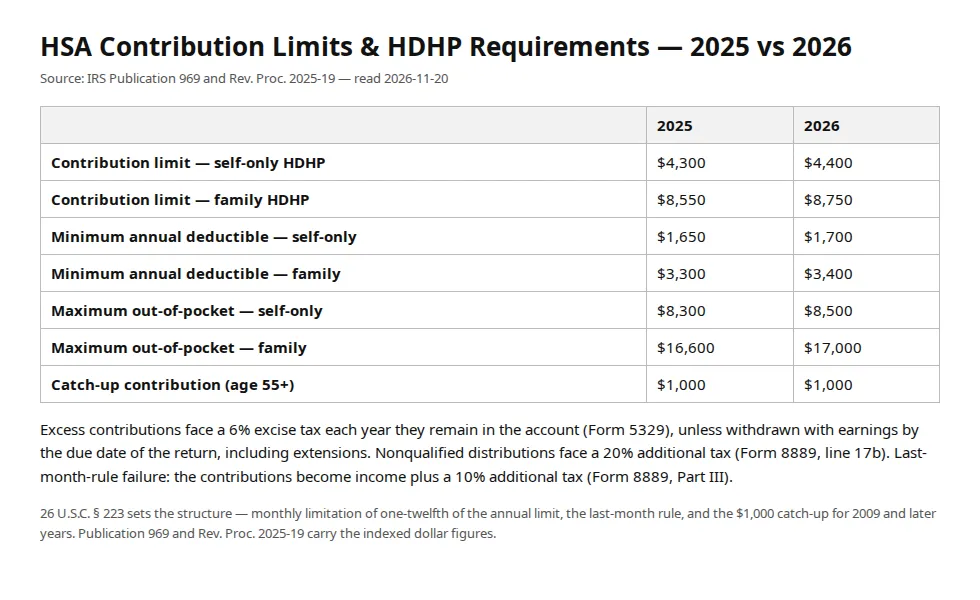
The deductible test is a cliff, not a slope. A 2026 plan with a $1,500 self-only deductible is not an HDHP, and its holder cannot contribute a dollar. Preventive care does not break eligibility, and neither does coverage for accidents, disability, dental care, vision care, or long-term care. What disqualifies is general coverage below the deductible — a copay plan, a spouse's non-HDHP family coverage, or enrollment in Medicare. Medicare enrollment ends eligibility the month it begins, and the contribution limit is prorated from that month.
The limit math: one-twelfth at a time
Section 223(b)(2) sets the annual limitation as a monthly limitation: one-twelfth of the annual limit for each month the individual is eligible. Seven months of self-only eligibility in 2026:
The Line 3 Limitation Worksheet rounds that to $2,567.
The last-month rule is the exception that makes the proration dangerous. If you are an eligible individual on December 1 of the tax year, § 223(b)(2)(B) treats you as eligible for every month of that year, and you may contribute the full annual limit. The price is the testing period: you must remain an eligible individual through December 31 of the following year. Fail the testing period and Part III takes the money back — the contributions for the months you were not actually eligible become income, plus 10% tax. Worked through: enroll December 1, 2026, contribute the full $4,400, then lose HDHP coverage June 30, 2027. You were actually eligible for one month, so the real limit was $366.67 and the excess is $4,033.33 of income, taxed at 10%:
The last-month rule is worth using only when the testing period is a near-certainty — same employer, same plan, no Medicare enrollment coming.
Married couples share one family limit. If both spouses have family HDHP coverage, the 2026 family limit is $8,750 between the two of them, split equally unless they agree on a different division. Each spouse age 55 or older adds $1,000 to their own HSA, and each files a separate Form 8889.
Part I, line by line: the deduction
Part I is where the deduction is proved. The 2026 form reads:
- Line 1: Check self-only or family coverage under an HDHP during 2026.
- Line 2: Your own HSA contributions for 2026, including contributions made by the unextended due date of the return. Do not include employer contributions, cafeteria-plan contributions, or rollovers.
- Line 3: The limit — $4,400 self-only or $8,750 family if you were under 55 and eligible with the same coverage all year; otherwise the Line 3 Limitation Worksheet amount.
- Line 4–5: Archer MSA contributions, if any, subtracted from line 3.
- Line 7–8: The age-55+ additional contribution amount, added to line 6 for the total limit.
- Line 9: Employer contributions made to your HSAs for 2026.
- Line 11: Lines 9 plus 10 (qualified HSA funding distributions).
- Line 12: Line 8 minus line 11 — the room left for your own deduction.
- Line 13: The HSA deduction — the smaller of line 2 or line 12. It goes to Schedule 1 (Form 1040), line 13.
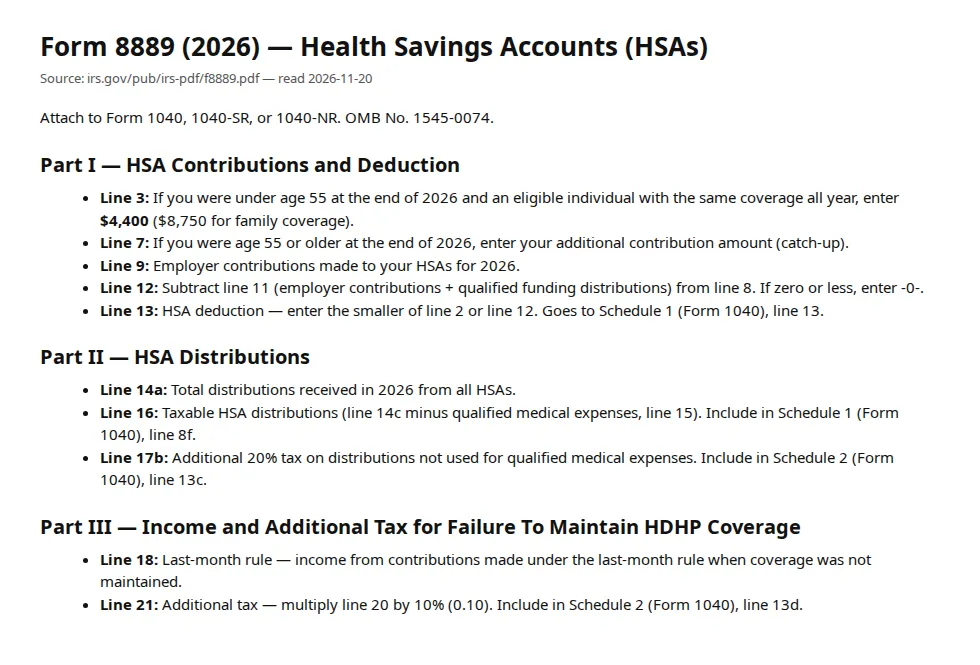
The worked example that ties the lines together: a self-only filer, age 40, eligible all of 2026, whose employer contributed $1,200 through payroll. Line 3 is $4,400. Line 8 is $4,400. Line 9 is $1,200, line 11 is $1,200, line 12 is $4,400 − $1,200 = $3,200. If the filer contributed $3,200 of their own money, line 13 is $3,200. If the filer contributed $4,400 on top of the employer's $1,200, line 13 is still $3,200, and the extra $1,200 is an excess contribution. The employer money counts against the limit first, and the form enforces it on line 12 before the deduction is ever figured.
Founder & CEO Insight — Enow A. Jovial
The triple tax advantage, priced
The deduction is only the first of the three advantages. Contributions made through a cafeteria plan at work also escape FICA tax — 7.65% for Social Security and Medicare — which a direct contribution from a bank account does not. At a 22% federal income tax bracket, the saving on a full 2026 self-only contribution:
The same math at the family limit: $8,750 × 0.22 = $1,925 of income tax, plus $8,750 × 0.0765 = $669.38 of FICA, for $2,594.38 in total. At the 24% bracket the family saving is $2,100 of income tax plus $669.38 of FICA, or $2,769.38. The second and third advantages — tax-free growth and tax-free withdrawals — are worth more over time than the deduction itself, because the account has no required minimum distribution and no use-it-or-lose-it rule.
Self-employed owners get a smaller version of the deal. A single-member LLC owner or an S-Corp owner-employee who contributes from a bank account gets the income-tax deduction but no SECA saving, because the HSA deduction does not reduce self-employment tax the way a payroll contribution reduces FICA. On a $4,400 contribution at the 22% bracket that is $968 saved and $336.60 left on the table — run the contribution through payroll where the business allows it, and confirm the treatment with a CPA. The comparison with the other health accounts is in our HSA vs FSA vs HRA health account playbook, and the distributions side is in our Form 1099-SA HSA distributions playbook.
Part II: distributions and the 20% tax
Part II taxes the money coming out. Line 14a is total distributions received in 2026 from all HSAs; line 14b subtracts rollovers and excess contributions withdrawn by the due date. Line 15 is qualified medical expenses paid with HSA distributions. Line 16 is the taxable remainder, and it goes to Schedule 1 (Form 1040), line 8f as other income. Line 17b is the additional 20% tax on the distributions not used for qualified medical expenses, and it goes to Schedule 2 (Form 1040), line 13c.
The worked example: $5,000 distributed in 2026, $3,000 spent on qualified medical expenses. Line 16 is $2,000 of taxable distributions. Line 17b is 20% of $2,000, or $400. Income tax on the $2,000 at the 22% bracket is $440. The total cost of the $2,000 nonqualified slice is $840 — 42% of the distribution. The 20% additional tax has three exceptions, checked on line 17a: the account holder is age 65 or older, disabled, or deceased. There is no hardship, first-home, or education exception. The only penalty-free exit before 65 is a medical expense.
Qualified medical expenses follow § 213(d) — the same definition as the itemized medical deduction — and include health insurance premiums only in narrow cases: COBRA continuation, qualified long-term care insurance, coverage while receiving unemployment compensation, and Medicare premiums (other than a supplemental policy) once the holder is 65 or older. Ordinary health insurance premiums while employed are not qualified expenses.
Part III: the last-month rule, collected
Part III exists for one situation: you used the last-month rule or a qualified HSA funding distribution and then failed the testing period. Line 18 is the last-month-rule income, line 19 the funding-distribution income, line 20 the total on Schedule 1 (Form 1040), line 8f, and line 21 the 10% additional tax on Schedule 2 (Form 1040), line 13d.
A qualified HSA funding distribution is a once-in-a-lifetime transfer from an IRA to an HSA, limited to the annual contribution limit, and it carries its own testing period. Lose HDHP coverage inside the testing period, and the transferred amount becomes income plus the 10% tax on Part III.
Excess contributions: the 6% leak
Contribute more than the limit and the excess faces a 6% excise tax for every year it stays in the account, figured on Form 5329. A $500 excess costs $30 a year until it is removed. The cure is in Publication 969: withdraw the excess contributions, plus the income earned on them, by the due date of the return including extensions, include the earnings in other income, and no excise tax is due on the amount withdrawn. The deadline is the return's due date with extensions, and the earnings must come out with the excess.
The excess usually comes from one of four mistakes: the employer contribution was not subtracted on line 12, the wrong year's limit was used, the partial-year proration was skipped, or both spouses contributed the full family limit to separate HSAs. All four are visible on the face of Part I before the return is filed.
Who should not use the HSA
| Situation | Do not do this | Because | Authority |
|---|---|---|---|
| Plan deductible below the HDHP minimum | Contribute at all | Not an eligible individual; the whole contribution is excess | 26 U.S.C. § 223(c)(1); Pub. 969 |
| Enrolled in Medicare | Keep contributing | Eligibility ends the month Medicare begins | Pub. 969 |
| Using the last-month rule with a job change coming | Contribute the full limit | Testing-period failure recaptures the deduction plus 10% | Form 8889, Part III |
| Paying ordinary health premiums from the HSA | Treat the distribution as qualified | Premiums are not qualified expenses while employed; 20% tax applies | Form 8889, line 17b |
| Both spouses at the family limit | Each contribute $8,750 | The family limit is shared, not per person | Pub. 969, married rules |
| Excess left in the account | Ignore it | 6% excise every year until removed | Form 5329; Pub. 969 |
File it in five steps
- Confirm the HDHP. Check the plan's deductible and out-of-pocket maximum against the table for the tax year.
- Figure the limit on the worksheet. Use the Line 3 Limitation Worksheet for a partial year, the last-month rule, or a coverage change.
- Subtract the employer money first. Enter employer contributions on line 9 and let line 12 set the room for your own deduction. Contribute only up to line 12.
- Reconcile the distributions. Match every 1099-SA distribution to a qualified medical expense receipt before completing Part II. An unmatched dollar is a taxable dollar plus 20%.
- Check the testing period. If you used the last-month rule or a qualified funding distribution, confirm HDHP coverage through December 31 of the following year.
- [x] HDHP deductible and out-of-pocket verified — against the right year's table.
- [x] Limit figured on the worksheet — partial year, last-month rule, or coverage change included.
- [x] Employer contributions subtracted on line 12 — before the personal contribution.
- [x] Distributions matched to receipts — every 1099-SA dollar accounted for.
- [x] Testing period confirmed — or Part III completed and the 10% paid.
Form 8889 is a short form with a long memory. The deduction it proves is worth $1,304.60 a year at the 22% bracket on a self-only contribution, and $2,594.38 on a family one — before a dollar of tax-free growth. The penalties are 6% a year on an excess, 20% on a nonqualified distribution, and 10% plus recapture on a failed testing period. Read line 12 before you contribute, match every distribution to a receipt, and confirm the testing period — then check the Solo 401(k) vs SEP IRA self-employed retirement playbook for the other self-employed tax-advantaged account, and run the bracket math in our tax estimator before the filing deadline.