The buyer is the withholding agent
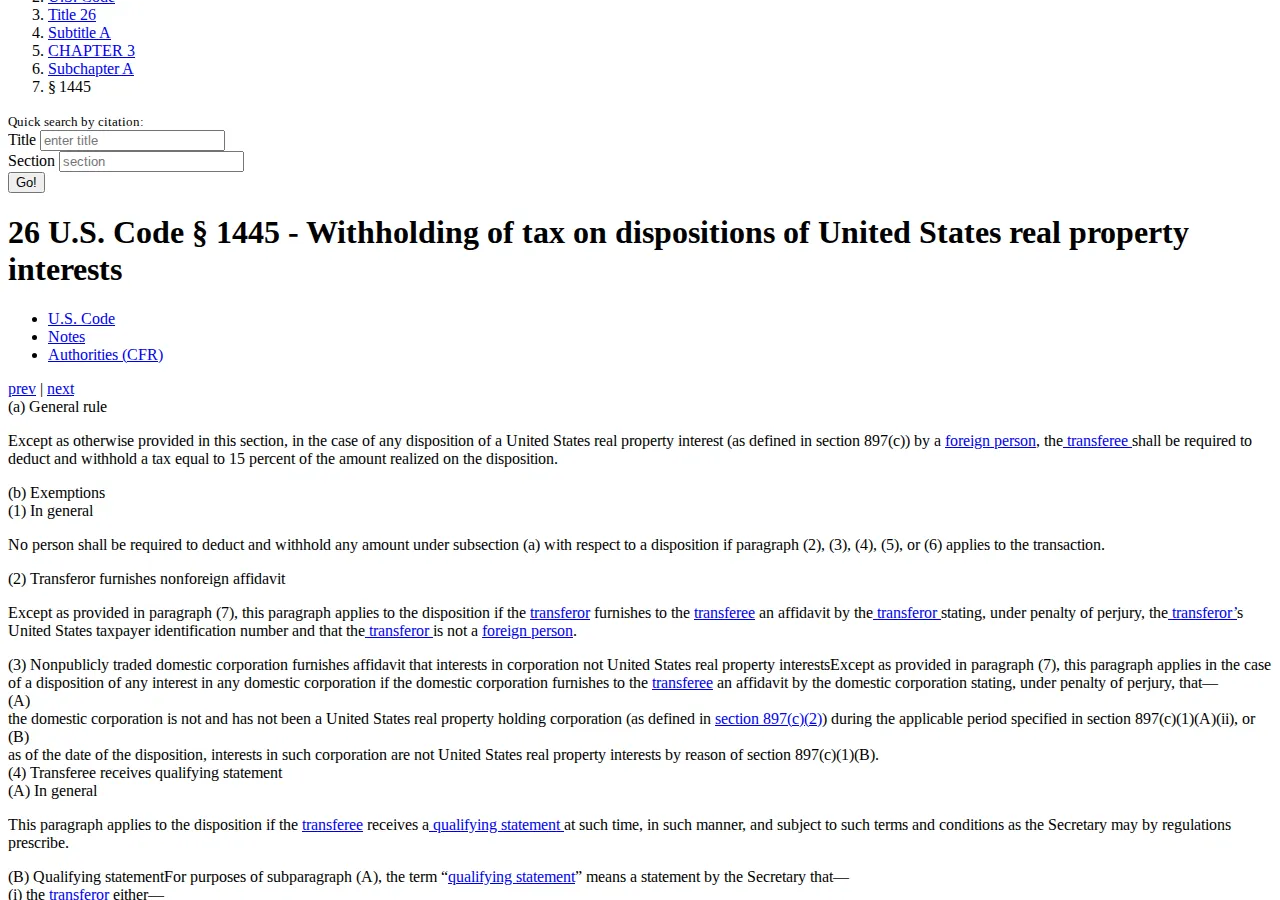
When a foreign person sells United States real property, the buyer does the withholding. Section 1445(a) puts the obligation on the transferee: the person acquiring the United States real property interest must deduct and withhold a tax equal to 15 percent of the amount realized. The seller is foreign, the property is American, and the buyer is the one the IRS holds responsible for collecting the tax at closing. This playbook covers the filing operation that follows: Form 8288, the withholding tax return that reports the amount withheld and transmits it to the IRS, with Form 8288-A for each foreign person subject to withholding.
This guide is for the buyer, the closing agent, and the settlement attorney when the seller is a foreign person. The seller's ultimate liability is computed on the gain under section 897, and it is usually far smaller. The withholding is a collection device, and Form 8288 is the paper that moves the money from the closing table to the IRS.
The 15 percent rule, in numbers
The withholding equals 15 percent of the amount realized, and the amount realized is generally the sales or contract price: cash paid or to be paid, plus the fair market value of other property transferred, plus liabilities assumed by the buyer. The Instructions for Form 8288, revised January 2026, state the rule in one line: generally, you must withhold 15 percent of the amount realized on the disposition by the transferor.
Take a closing at 485,000 dollars. The seller is a nonresident alien individual selling a Miami condominium. The amount realized is the contract price of 485,000 dollars, and the withholding is 485,000 dollars times 0.15, which equals 72,750 dollars. The buyer withholds that amount and transmits it to the IRS with Form 8288. The seller receives 412,250 dollars at closing.
The withheld amount is not the tax. The seller's actual tax is computed on the gain: amount realized minus basis, taxed at the applicable rate. If the seller bought the condominium for 285,000 dollars, the gain is 200,000 dollars, and at 20 percent the maximum liability is 40,000 dollars. The withholding of 72,750 dollars exceeds the liability by 32,750 dollars, and the seller recovers the excess by filing a United States return with the stamped copy of Form 8288-A attached, or by applying for an early refund. That gap is the reason the withholding certificate exists.
The rate ladder: 15, 10, zero, and 21 percent
The 15 percent rate is the default, not the only rate. Four rates apply, and the closing agent must pick the right one before the money moves.
| Situation | Withholding rate | Authority |
|---|---|---|
| General disposition of a United States real property interest by a foreign person | 15 percent of amount realized | 26 U.S.C. 1445(a) |
| Residence acquired for the buyer's own use, amount realized 1 million dollars or less | 10 percent of amount realized | 26 U.S.C. 1445(c)(4) |
| Residence acquired for the buyer's own use, amount realized 300,000 dollars or less | Zero; no withholding required | 26 U.S.C. 1445(b)(5) |
| Distribution by a domestic trust, estate, corporation, or qualified investment entity under section 1445(e) | 21 percent of the amount distributed, or of the gain recognized for a distributing corporation (35 percent for distributions before January 1, 2018) | 26 U.S.C. 1445(e) |
The residence rates turn on two conditions: the property is acquired for use as a residence, and the amount realized falls under the threshold. A residence purchase at 950,000 dollars withholds at 10 percent: 95,000 dollars instead of 142,500 dollars, a saving of 47,500 dollars. A residence purchase at 280,000 dollars withholds nothing. The test is strict: the buyer or a family member must have definite plans to reside there for at least 50 percent of the days it is used during each of the first two 12-month periods, and vacant days do not count. No form is required, but if the buyer does not in fact use the property as a residence, the tax may be collected from the buyer. The exception fails when the actual buyer is not an individual.
The 10 percent rate that applied before February 17, 2016 is history: the 2015 amendments raised the general rate from 10 percent to 15 percent for dispositions after February 16, 2016.
The exceptions that remove withholding entirely
Several exceptions remove the withholding obligation, and the closing agent must test each one before withholding. The most common is the certification of nonforeign status: the transferor furnishes a statement, signed under penalties of perjury, that the transferor is not a foreign person, with name, address, and taxpayer identification number. A valid Form W-9 is such a certification. The buyer may rely on it unless the buyer knew it was false or received notice that it was false. Keep any certification received for 5 years after the year of transfer.
The other exceptions are narrower. No withholding is required when the property is not a United States real property interest, or when a corporation furnishes a statement, dated not more than 30 days before transfer, that the interest is not one. No withholding is required on a nonrecognition or treaty provision, on notice signed under penalties of perjury, except that the section 121 exclusion, partially qualifying like-kind exchanges, and incomplete deferred exchanges need a certificate instead. No withholding is required when the amount realized is zero, or on the grant or lapse of an option, or when the property is acquired by a governmental unit.
The 20-day clock and the withholding certificate
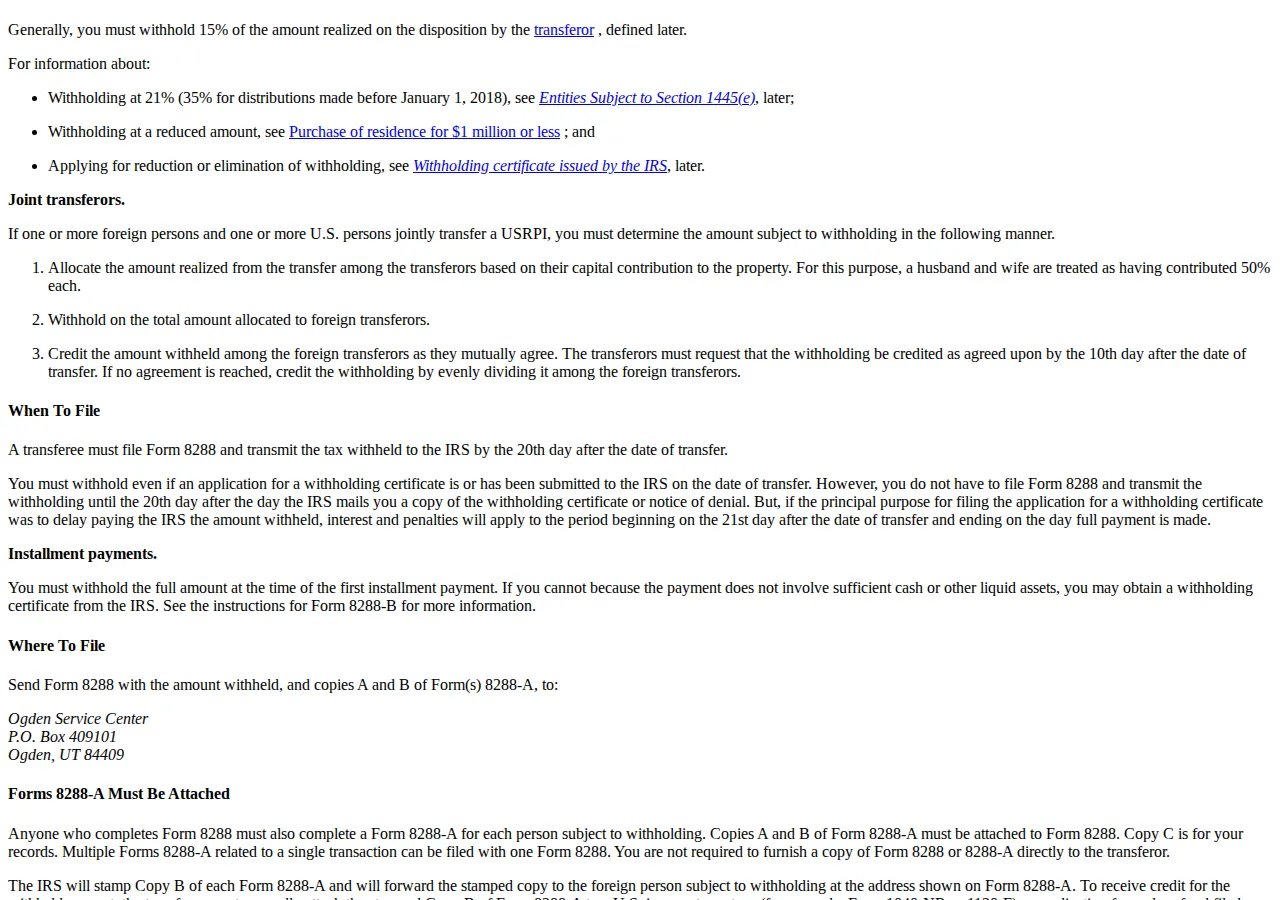
The filing deadline is short and absolute. A transferee must file Form 8288 and transmit the tax withheld to the IRS by the 20th day after the date of transfer. The date of transfer is the first date on which consideration is paid or a liability is assumed; earnest money does not count. For a closing on November 10, 2026, the 20th day is November 30, 2026. File at the Ogden Service Center, P.O. Box 409101, Ogden, UT 84409.
The withholding certificate on Form 8288-B is the pressure valve. Either party may apply to reduce or eliminate withholding when the 15 percent amount exceeds the transferor's maximum tax liability, when the transferor is exempt from United States tax, when nonrecognition provisions apply, or when the parties enter into a payment agreement with the IRS. The application must comply with Treasury Regulation sections 1.1445-3 and 1.1445-6 and Revenue Procedure 2000-35, and the IRS will normally act on a complete application by the 90th day after it is received. Return to the worked example: withholding of 72,750 dollars against a maximum liability of 40,000 dollars is a 32,750 dollar over-withholding, and a certificate reducing the withholding to 40,000 dollars is the correct application.
The certificate application does not stop the clock. The buyer must withhold even if an application is pending on the date of transfer, but does not have to file Form 8288 until the 20th day after the IRS mails the certificate or notice of denial. If the purpose was to delay paying the IRS, interest and penalties apply from the 21st day after transfer until full payment is made. A certificate that excuses withholding entirely removes the filing obligation; one that only reduces it still requires Form 8288.
Form 8288 and Form 8288-A, line by line
Form 8288 has two parts: Part I for a buyer or other transferee of a United States real property interest, and Part II for a corporation, qualified investment entity, or fiduciary withholding under section 1445(e). If two or more persons are joint transferees, each is obligated to withhold, but the obligation of each is met if one of them withholds and transmits the required amount.
Anyone who completes Form 8288 must also complete a Form 8288-A for each person subject to withholding. Copies A and B must be attached to Form 8288; Copy C is for the filer's records. The IRS stamps Copy B and forwards it to the foreign person at the address shown. To receive credit, the transferor must generally attach the stamped Copy B to a United States income tax return, for example Form 1040-NR or Form 1120-F, or to an application for early refund.
The taxpayer identification number is the most common point of failure. If the filer does not have the transferor's number, the filer must still file Forms 8288 and 8288-A, but no stamped Copy B will be provided until the number is supplied. The seller's number is a Social Security Number (SSN) for an individual, an Employer Identification Number (EIN) for an entity, or an Individual Taxpayer Identification Number (ITIN) where neither applies. A disregarded entity cannot be the transferor: the person treated as owning its assets is the transferor.
ECI, FDAP, and the boundary with section 1446
The FIRPTA gain is effectively connected income: section 897 treats it as ECI, so the seller files Form 1040-NR, not as FDAP income subject to the flat 30 percent withholding under section 1441, which is reported on Forms 1042 and 1042-S. Form 8288 also carries section 1446(f) withholding on transfers of partnership interests by foreign persons, for transfers on or after January 1, 2023, while the annual partnership withholding under section 1446(a) is a different return, Form 8804 with Form 8805 for each foreign partner. Distributions by a publicly traded partnership, dividend distributions by a qualified investment entity, and distributions from a regularly traded trust are not reported on Form 8288 at all; they go on Forms 1042 and 1042-S.
The seller's entity form decides the return and the number. An individual seller files Form 1040-NR; a C-Corp seller files Form 1120-F; a seller that is an LLC files as its owner when the LLC is disregarded, or as a partnership when it is not, and the CPA preparing the return must get the classification right before the stamped Copy B can be used. FICA and SECA taxes do not apply to the FIRPTA gain, because it is not wages or self-employment income, but the withholding is still 15 percent of the amount realized.
Four closings, four outcomes
Scenario one is the standard closing. A nonresident alien sells a Miami rental condominium for 485,000 dollars, basis 285,000 dollars, gain 200,000 dollars. The buyer withholds 72,750 dollars, files Form 8288 with one Form 8288-A by the 20th day after transfer, and sends the money to Ogden. The seller files Form 1040-NR with the stamped Copy B and claims a credit of 72,750 dollars against a liability of 40,000 dollars.
Scenario two is the residence purchase: a couple buys a house from a nonresident alien for 950,000 dollars and will live in it, so the withholding is 10 percent, or 95,000 dollars, a saving of 47,500 dollars. The couple must in fact use it as a residence for at least 50 percent of the days it is used during each of the first two 12-month periods, or the IRS may collect the balance.
A residence purchase at 280,000 dollars withholds nothing and needs no form, though the buyer should keep the contract and the residence evidence in the file. A foreign corporation selling commercial property for 2,400,000 dollars, with a gain of 600,000 dollars and a maximum liability of 126,000 dollars, would face 360,000 dollars of withholding without a certificate, so the certificate is the filing that saves the 234,000 dollar difference.
Founder & CEO Insight — Enow A. Jovial
Execution checklist
- [x] Confirm the seller is a foreign person: no certification of nonforeign status, no Form W-9, no section 897(i) election acknowledgment.
- [x] Test the residence rates first: 300,000 dollars or less means zero withholding; 1 million dollars or less means 10 percent.
- [x] Compute the withholding: amount realized times 0.15, or times 0.10 for a qualifying residence, or 0.21 for a section 1445(e) distribution.
- [x] Consider the withholding certificate: if 15 percent exceeds the seller's maximum liability, apply on Form 8288-B under Revenue Procedure 2000-35; the IRS normally acts by the 90th day.
- [x] Complete Form 8288 and one Form 8288-A per foreign person: Part I for a buyer, Part II for a section 1445(e) agent; attach Copies A and B, keep Copy C.
- [x] File and transmit by the 20th day after transfer: Ogden Service Center, P.O. Box 409101, Ogden, UT 84409; if a certificate is pending, file by the 20th day after the IRS mails it.
The FIRPTA withholding regime is the context: our FIRPTA withholding playbook covers the 15 percent rule, the buyer liability, and the exceptions. The settlement reporting at the same closing is covered in our Form 1099-S real estate closing playbook, and the partnership-side withholding that shares Form 8288 is covered in our section 1446 foreign partner withholding playbook. Before you close, run the numbers through our tax estimator.