A U.S. partnership with a foreign partner owes the IRS money before the partner files anything. Section 1446 of the Internal Revenue Code makes the partnership itself the withholding agent: when effectively connected taxable income — ECTI — is allocable to a foreign partner, the partnership must pay a withholding tax on that share at the highest applicable rate, in four installments during the year, and report it on Form 8804. The foreign partner then claims the withheld amount as a credit under section 33.
This is the partnership-side withholding regime. Section 1445 — FIRPTA withholding — applies when a foreign person sells U.S. real property; section 1446 applies every year a U.S. partnership earns effectively connected income allocable to a foreign partner. The FIRPTA withholding playbook covers the real-property side — this guide covers the annual partnership side.
Who this guide is for, and who should stop here
This guide is for a U.S. partnership — LLC taxed as a partnership, limited partnership, or general partnership — with at least one foreign partner, and for the CPA who signs its Form 8804. It gives the rates, the installment calendar, the filing chain, and the worked math, with the statute text behind every number.
No foreign partner, no section 1446, no Form 8804. Stop here if the only foreign persons involved are lenders or service providers — a foreign lender's interest is FDAP income under section 871, not a partner's share of ECTI. Stop here if the income is not effectively connected: portfolio dividends and interest are not ECTI. If the entity is a corporation, see the Form 5471 playbook and the Form 5472 guide.
The statute in one page
| Subsection | Rule |
|---|---|
| § 1446(a) | The partnership pays a withholding tax on ECTI allocable under § 704 to a foreign partner |
| § 1446(b) | The tax equals the applicable percentage of that allocable ECTI: highest § 1 rate (non-corporate) or highest § 11(b) rate (corporate) |
| § 1446(c) | ECTI is the partnership's taxable income effectively connected with a U.S. trade or business, with the § 1446(c) adjustments |
| § 1446(d) | Each foreign partner gets a § 33 credit for its share, treated as distributed when paid or at year-end, whichever is earlier |
| § 1446(f) | A transferee buying a partnership interest withholds 10 percent of the amount realized when the gain would be ECI under § 864(c)(8) |
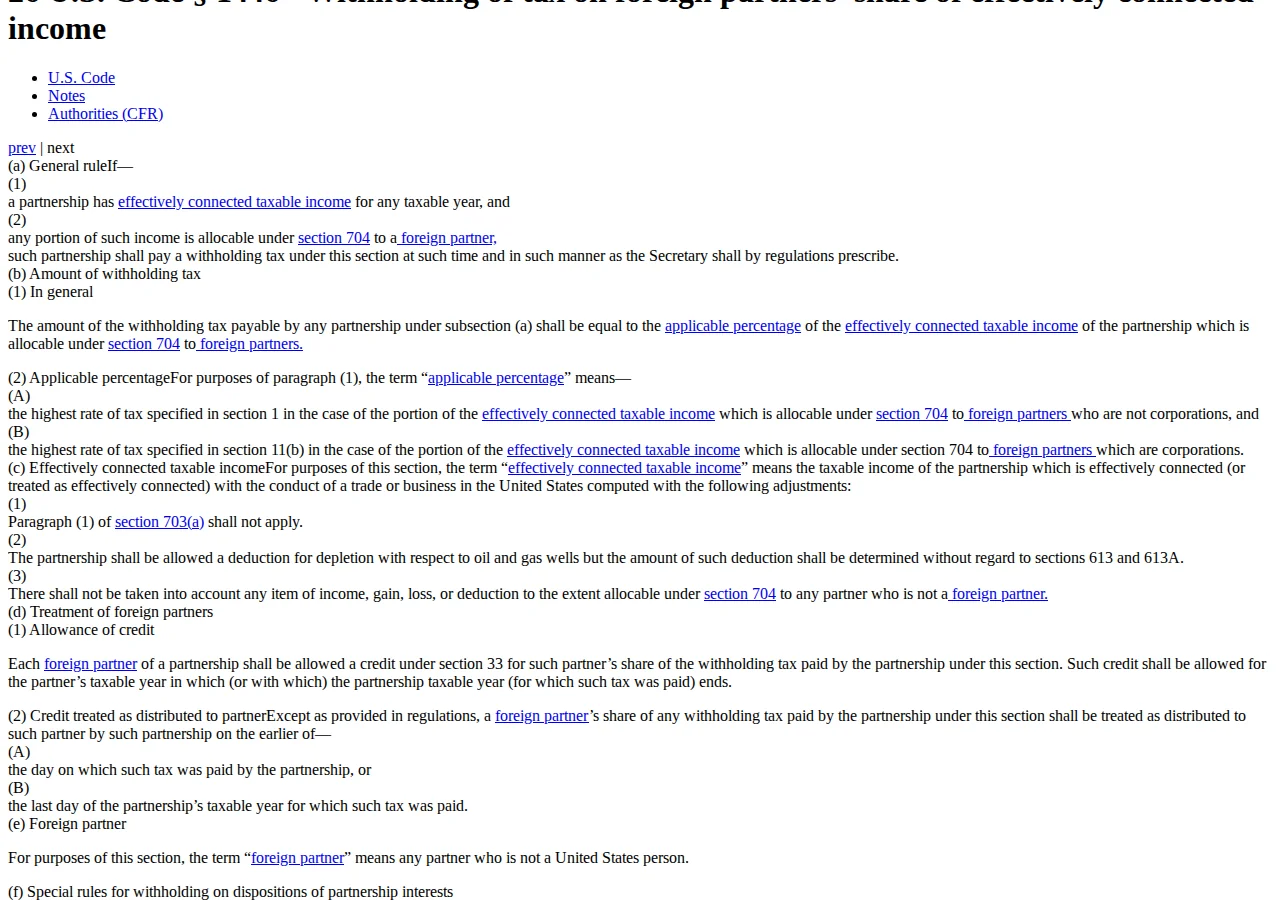
26 U.S.C. § 1446(b) — the applicable percentage.
Identification comes first. A foreign partner is any partner who is not a United States person under section 7701(a)(30) — a nonresident alien, a foreign corporation, partnership, trust, or estate. The partnership determines status from the certificate the partner furnishes: Form W-9 for a U.S. person, Form W-8BEN or W-8BEN-E for a foreign person, Form W-8IMY for a flow-through. A certificate the partnership knows or has reason to know is invalid does not protect it — the partnership stays liable from the installment period in which it learned the certificate was bad.
The ECTI base comes second. ECTI is the partnership's taxable income effectively connected — or treated as effectively connected — with a U.S. trade or business, with the section 1446(c) adjustments. In practice, start from Form 1065 income, strip non-ECI items such as portfolio interest and dividends, then apply the section 704 percentages. A partner can certify deductions and losses under Regulation § 1.1446-6, cutting the base by the certified amounts. Without it, the partnership withholds on the gross share; with it, on the net share.
Worked example: $2,400,000 of ECTI, two foreign partners
Example: a Delaware LLC taxed as a partnership runs a U.S. logistics business with 2026 ECTI of $2,400,000. Two partners are foreign: a nonresident alien individual in Dubai with 40 percent, and a German GmbH with 25 percent. The other two are U.S. persons, so no tax attaches to their shares.
The individual's share is 40 percent of $2,400,000 — $960,000 — at 37 percent:
The GmbH's share is 25 percent — $600,000 — at 21 percent:
The partnership's total section 1446 tax is $481,200, due in four installments of $120,300 each.
| Partner | Share of ECTI | Rate | Withholding |
|---|---|---|---|
| Nonresident alien, 40% | $960,000 | 37% | $355,200 |
| German GmbH, 25% | $600,000 | 21% | $126,000 |
| U.S. partners, 35% | $840,000 | — | $0 |
| Partnership total | $2,400,000 | — | $481,200 |
The preferential-rate cut: when 37 percent is not the rate
The Form 8804 instructions carry a qualification that saves real money: for a non-corporate foreign partner, the partnership can use the highest rate applicable to a particular type of income if the partner would be entitled to a preferential rate. The classic case is long-term capital gain, taxable at a 20 percent maximum rather than 37 percent.
Example: suppose $400,000 of the individual's $960,000 share is long-term capital gain. At 37 percent that slice costs $148,000; at 20 percent, $80,000 — a $68,000 saving:
Actual liability on the $960,000 share: $80,000 on the gain slice plus 37 percent on the remaining $560,000 — $207,200 — for $287,200 total, against $355,200 withheld. The $68,000 is an over-withholding the partner recovers as a credit on Form 1040-NR, but the cash sits with the IRS until the return is filed. The facts the partnership knows decide whether the preferential rate applies — document the income's character in the workpapers. Publicly traded partnerships do not get this cut: a PTP must withhold at 37 and 21 percent and cannot consider preferential rates.
The payment calendar: four installments and the annual return
The calendar is the part partnerships miss. The partnership must make four installment payments during the tax year, using Form 8813. The installments fall due on or before the 15th day of the 4th, 6th, 9th, and 12th months of the partnership's tax year — April 15, June 15, September 15, and December 15 for a calendar-year partnership. Each installment is computed under section 6655 principles and Regulation section 1.1446-3, using Form 8804-W — four installments of $120,300 each in the worked example.
| Filing | Form | Due |
|---|---|---|
| Installment 1 | Form 8813 | 15th day of the 4th month of the tax year |
| Installment 2 | Form 8813 | 15th day of the 6th month of the tax year |
| Installment 3 | Form 8813 | 15th day of the 9th month of the tax year |
| Installment 4 | Form 8813 | 15th day of the 12th month of the tax year |
| Annual return + statements | Form 8804 + Form 8805 per foreign partner | 15th day of the 3rd month after year-end (6th month if books are outside the U.S. and Puerto Rico) |
| Extension of time to file | Form 7004 | Extends filing, never payment |
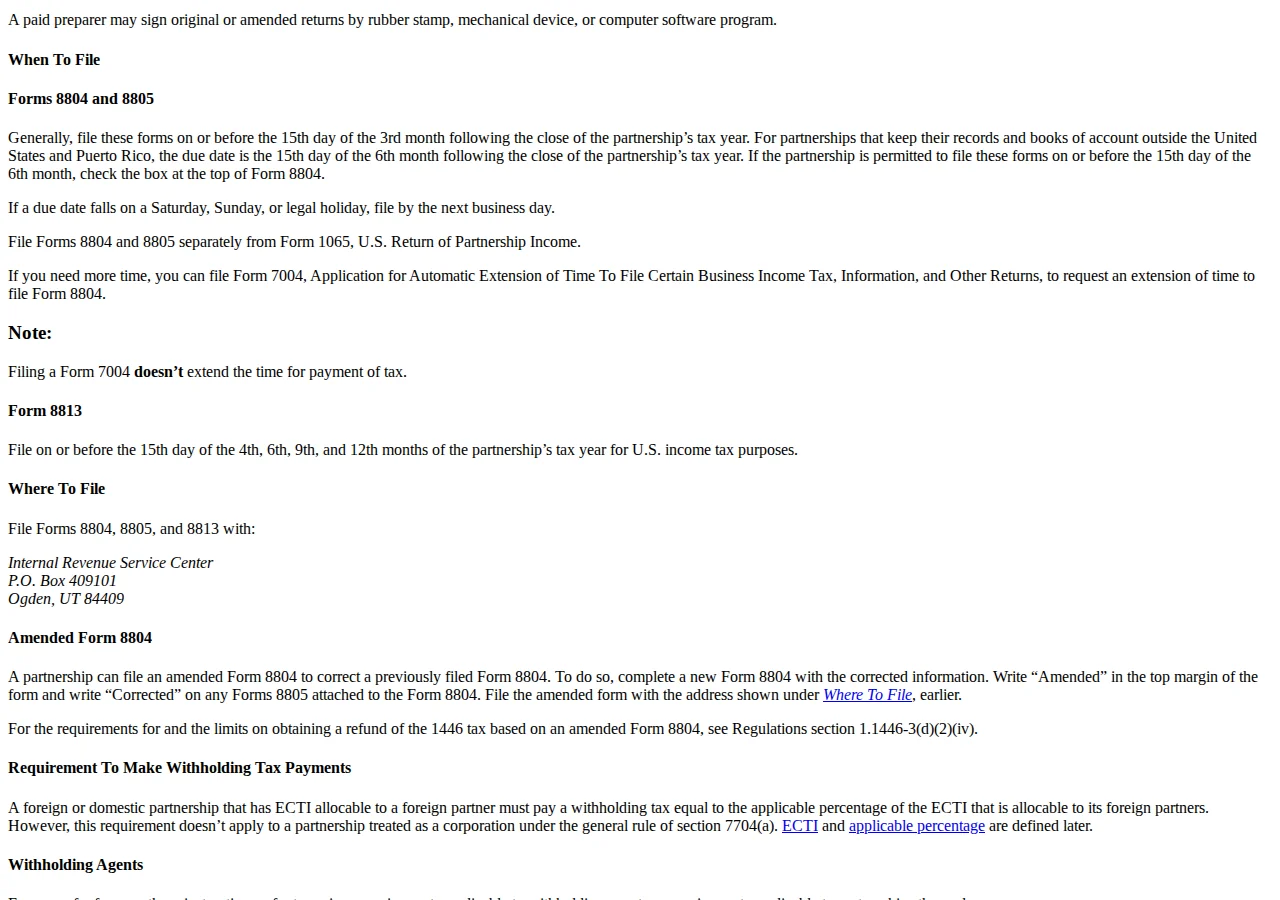
IRS Instructions for Forms 8804, 8805, and 8813 (revised January 2026).
Form 8804 and Form 8805 are due by the 15th day of the 3rd month after year-end — March 15 for a calendar-year partnership. Form 7004 buys filing time, not payment time: pay any estimated balance with it. File Forms 8804 and 8805 separately from Form 1065 — attaching them to the 1065 starts the penalty clock. Notify each foreign partner of its share at each installment and furnish a correct Form 8805. Pay installments through EFTPS.
A publicly traded partnership reports on Form 1042 and Form 1042-S rather than on Forms 8804 and 8805. Tiered partnerships add a second layer: a partnership that is itself a partner in another partnership must track the section 1446 tax paid at the lower tier and the credit it carries upward. A foreign partner in both a PTP and an ordinary partnership should expect two different statements for the same economic event.
Section 1446(f): the 10 percent on selling the interest
Section 1446(a) withholds on annual income; section 1446(f) withholds on the exit. When a foreign partner sells an interest in a partnership engaged in a U.S. trade or business, and any portion of the gain would be treated under section 864(c)(8) as effectively connected, the buyer must withhold 10 percent of the amount realized.
Example: a foreign partner sells its interest for $1,500,000; the buyer withholds $150,000, even though the seller's actual gain may be far smaller. The 10 percent applies to the amount realized, not to the gain, which is why the withholding so often exceeds the tax. Three relief valves exist. First, no withholding if the transferor furnishes a nonforeign affidavit — a statement under penalty of perjury giving its U.S. taxpayer identification number and stating it is not a foreign person — unless the transferee knows it is false or receives notice that it is. Second, the Secretary may prescribe a reduced amount on request if collection is not jeopardized. Third, if the transferee fails to withhold, the partnership must deduct the shortfall, plus interest, from distributions to the transferee. Treasury Decision 9919 carries the detail, including the credit a foreign partnership claims on Form 8804, lines 6f or 6g, for section 1446(f) tax withheld on its own transfer. Since January 1, 2018, a foreign partnership faces section 1446(f)(1) withholding on transferring an interest in another partnership engaged in a U.S. trade or business, unless publicly traded.
The FIRPTA boundary matters here. Section 1445 withholds on the disposition of a U.S. real property interest; section 1446(f) withholds on the disposition of a partnership interest whose gain is effectively connected under section 864(c)(8). A partnership owning U.S. real estate can trigger both regimes on one transaction; the Form 8804 instructions' coordination rules decide which withholding applies to which slice.
What goes wrong: late payment, failure to withhold, over-withholding
Three failure modes dominate, each with a different price. Late payment costs 0.5 percent a month, capped at 25 percent. One missed $120,300 installment paid three months late costs $120,300 × 0.5% × 3 = $1,804.50, plus interest. Reasonable cause can defeat it; the explanation goes in response to the IRS notice, not attached to Form 8804. Failure to withhold is worse: the civil penalty under section 6672 equals the amount that should have been withheld and paid over. A partnership that withholds nothing on the worked example owes a $481,200 penalty on top of the $481,200 tax. Negligence, substantial understatement, valuation misstatement, or fraud can add sections 6662 and 6663 penalties, absent reasonable cause and good faith.
Over-withholding is the quiet failure, and it costs the partner, not the partnership. A partnership that withholds at 37 percent on known preferential-rate gain, or on a gross share when the partner certified deductions and losses, hands the IRS cash the partner will not see until its return is processed. The remedy is the section 33 credit on Form 1040-NR or Form 1120-F, with Form 8805 as proof. Run the tax estimator on the partner's actual liability — a figure that matches the statute is not the same as a figure that matches the partner.
Execution checklist
- [x] Step 1: Identify every foreign partner. Collect W-8BEN, W-8BEN-E, or W-8IMY per foreign partner, W-9 per U.S. partner; record every EIN, SSN, or ITIN.
- [x] Step 2: Compute ECTI and allocate it under section 704. Start from Form 1065 income, strip non-ECI items, apply § 1446(c), allocate by agreement percentages.
- [x] Step 3: Request deduction and loss certifications. Get a Regulation § 1.1446-6 certificate from each foreign partner before the first installment; reduce the base by the certified amounts.
- [x] Step 4: Apply the preferential rate where the income earns it. Test each income slice for a lower rate — long-term capital gain at 20 percent for a non-corporate partner — and document the character.
- [x] Step 5: Pay four installments on Form 8813. Calendar the 15th day of the 4th, 6th, 9th, and 12th months; compute on Form 8804-W; pay through EFTPS.
- [x] Step 6: File Form 8804 and furnish Form 8805. File by the 15th day of the 3rd month after year-end, separately from Form 1065; furnish Form 8805 to each partner.
- [x] Step 7: Police the exit. On any transfer, test § 1446(f): 10 percent of the amount realized, unless a valid nonforeign affidavit or reduced-amount certificate applies.
Founder & CEO Insight — Enow A. Jovial
The withholding is the partnership's duty and the partner's credit. Identify right, pay the four installments, file Form 8804 apart from Form 1065, and test every exit for § 1446(f) before the money moves.