Every reportable real estate sale leaves a paper trail, and Form 1099-S is it. The settlement agent files it, the seller receives a copy, and the IRS receives the gross proceeds — the contract price, unreduced by commissions or closing costs. The form is not a tax bill: it is how the IRS learns a sale happened. Figures as read on November 16, 2026.
The statute: section 6045(e) and the reporting-person ladder
IRC § 6045(e)(1) states the duty in one sentence: in a real estate transaction, the real estate reporting person shall file a return and furnish a statement. Section 6045(e)(2) then ranks the candidates — the first person on the ladder who is involved carries the duty, and everyone below is off the hook.
| Priority | Real estate reporting person | When it applies |
|---|---|---|
| 1 | Person responsible for closing | Settlement agent on the Closing Disclosure |
| 2 | Mortgage lender | No one is responsible for closing |
| 3 | Seller's broker | No closing person and no lender |
| 4 | Buyer's broker | No closing person, lender, or seller's broker |
| 5 | Person designated in regulations | None of the above |
The December 2026 instructions fill in the detail the statute leaves out. If a Closing Disclosure names a settlement agent, that person is responsible for closing. If none is used, the ladder runs through the transferee's attorney, then the transferor's attorney, then the disbursing title or escrow company. The parties may also short-circuit the ladder with a written designation agreement, signed at or before closing; every signer keeps it for four years.
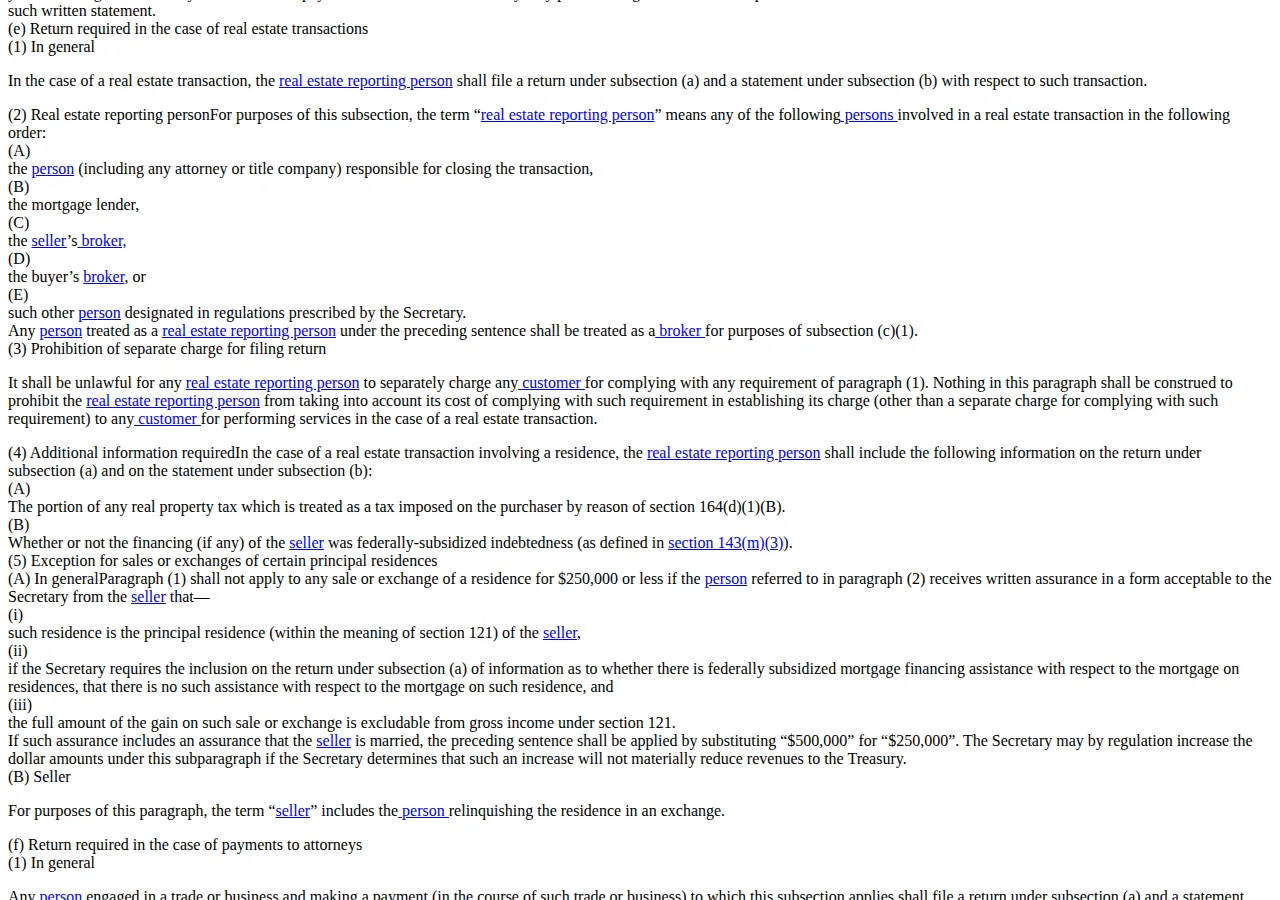
Section 6045(e), above: the ladder and the paragraph (3) ban on a separate filing charge. One Form 1099-S per transferor — a title company adding a "$75 1099-S filing fee" to the settlement statement is breaking the statute it is complying with.
The $250,000 and $500,000 certification that removes the form
The most valuable paragraph in the instructions is the first exception. A sale of a residence for $250,000 or less is not reportable if the reporting person obtains a written certification: the residence is the seller's principal residence under section 121, and the full gain is excludable under section 121. If the certification states the seller is married, substitute $500,000 for $250,000. Joint sellers must each certify, or a form is filed for any seller who does not.
The certification must also state there has been no period of nonqualified use after December 31, 2008, and must be signed under penalties of perjury. A sample format sits in Revenue Procedure 2007-12, but it predates the nonqualified-use assurance — the seller must add it. It may be obtained any time on or before January 31 of the year after the sale and must be kept for four years. Without one, the form must be filed even when the gain is fully excludable.
Work the numbers on our example closing. A single seller bought for $310,000, sells for $485,000, and pays $29,100 in commission (6 percent) plus $2,400 in other costs:
The gain is $143,500, below the $250,000 single cap, so it is fully excludable under section 121 — and with the certification in hand, no Form 1099-S is filed at all. Without it, the same sale produces a filed return with $485,000 in box 2a. Our section 121 playbook works the exclusion itself — the two-year test, the partial exclusion, and the recapture.
The $600 de minimis and the other exceptions
Not every transfer of real estate is reportable. The $600 de minimis rule is the one most often misread: a transfer is de minimis if the total money, services, and property received or to be received is certainly less than $600, measured on the closing date — and the test applies to the transaction as a whole, not per transferor.
| Exception | Rule | Trap |
|---|---|---|
| Principal residence with certification | ≤ $250,000 single / $500,000 married, signed certification | No certification, no exception |
| Transferor is a corporation | C-Corp, S-Corp, association, publicly traded partnership | An LLC taxed as a corporation counts; a disregarded LLC does not |
| Governmental unit or exempt volume transferor | Government, or 25+ sales to 25+ transferees in the year or either prior year | Needs a certification under penalties of perjury |
| Not a sale or exchange | Gift, bequest, § 1041 transfer, financing unrelated to acquisition | A land contract IS reportable in the year it is entered into |
| De minimis | Total consideration less than $600, measured at closing | "$1.00 plus other valuable consideration" is not de minimis unless the rest is provably under $599 |
Reportable property is broad: improved or unimproved land including air space, inherently permanent structures, a condominium unit with its fixtures and common elements, stock in a cooperative housing corporation, and any non-contingent interest in standing timber. An ownership interest includes fee simple, life estates, reversions, remainders, perpetual easements — and a leasehold, easement, or timeshare with at least 30 years remaining.
Reading the boxes: what each number is
Box 2a is the number the IRS matches against the seller's return, so it must be built exactly as the instructions define it: total gross proceeds, generally the contract sales price, equal to box 2b plus box 2c. Box 2b cash includes cash, notes, a mortgage assumed by the buyer, and a note or mortgage paid off at settlement. Digital asset proceeds go in box 2c, new in the December 2026 form. Property other than cash, consideration treated as cash, and digital assets is excluded from gross proceeds — which is why box 6 exists.
| Box | Contents | Our $485,000 closing |
|---|---|---|
| 1 | Date of closing | Closing Disclosure date |
| 2a | Total gross proceeds | $485,000 |
| 2b | Total cash gross proceeds | $485,000 |
| 2c | Digital asset gross proceeds | $0 |
| 3 | Address or legal description | Street address; add lot and block if needed |
| 4 | Buyer's part of real estate tax (residence only) | See below |
| 6 | Services or property received (not cash, notes, or digital assets) | Blank on a clean cash sale; X on a like-kind exchange with -0- in 2a |
| 7 | Foreign transferor | X for a foreign seller — read the FIRPTA section next |
Box 4 is the one box that requires arithmetic rather than transcription. For a residence, enter the real estate tax paid in advance allocable to the buyer. On our closing, the seller prepaid $4,800 of annual tax and the buyer takes ownership for the final 73 days:
The seller's return then treats the $960 as tax imposed on the buyer — which is why section 6045(e)(4) requires it.
The foreign seller: FIRPTA withholding at 15 percent
Sales involving foreign transferors are reportable on Form 1099-S — the form is filed, box 7 is checked, and the TIN is requested on the appropriate Form W-8 (SSN, ITIN, or EIN on Form W-9 for U.S. persons). But the form is the smaller half of the problem. Under IRC § 1445(a), when a foreign person disposes of a U.S. real property interest, the transferee must deduct and withhold 15 percent of the amount realized — the buyer's duty, at closing, not at filing time.
The only rate reduction is section 1445(b)(5): 10 percent instead of 15 percent where the transferee buys the property for use as a residence and the amount realized does not exceed $300,000. On a $620,000 sale the buyer withholds $93,000; on a $280,000 residence purchase, $28,000. The buyer that forgets cannot blame the seller — the liability sits with the transferee, and Publication 515 is the document to read before the closing table, not after it.
Multiple transferors and the allocation
One property, several sellers, one form each. For multiple transferors, the reporting person must file a separate Form 1099-S for each and request an allocation of the gross proceeds at or before closing. The request need not be in writing, and the reporting person may rely on an unchallenged response — once a complete allocation covering 100 percent is received, no further contacts are required. If no allocation arrives, or the allocations conflict, every form reports the total unallocated gross proceeds.
Spouses are the exception that simplifies the file: spouses who held the property as joint tenants, tenants by the entirety, tenants in common, or community property are treated as a single transferor, and one form showing either spouse is enough — unless an uncontested allocation is received, in which case a form is filed for each spouse. A partnership is one transferor too: one form for the partnership, never one per partner. Request the TIN no later than closing and keep the W-9 or W-8 for four years. The TIN may be truncated on the payee statement under Regulation § 301.6109-4 — never on the copy filed with the IRS. Copy B is a fillable PDF on IRS.gov.
Founder & CEO Insight — Enow A. Jovial
Deadlines, TINs, and the penalty ladder
Furnish the statement to each transferor by January 31 after closing. File by February 28 on paper, or March 31 if e-filed — the 10-return threshold means a busy title company is e-filing, not mailing. The penalty ladder under sections 6721 and 6722 prices delay by the day:
$60 per return corrected within 30 days of the due date, $130 corrected more than 30 days after but by August 1, $340 after August 1 or not filed, and at least $680 per return for intentional disregard, with no maximum. On forty closings, filing in September instead of February costs $13,600. A missing or wrong TIN runs through backup withholding at 24 percent — a TIN requested late is a TIN that costs money. Depreciated property runs through section 1245 and 1250 recapture, which the section 121 exclusion cannot shelter. Have a CPA spot-check the first run.
Who should not use this playbook
A closer whose transactions are all gifts, bequests, or refinancings unrelated to acquisition should not file Form 1099-S at all. A seller who is a corporation, a governmental unit, or a certified exempt volume transferor is outside the form's reach. And a buyer acquiring from a foreign seller should not treat this playbook as the FIRPTA guide — the withholding duty is the buyer's, priced at closing, and it needs Publication 515, not just a checked box 7.
The execution checklist
- [x] Step 1: At the closing table, identify the reporting person — normally the settlement agent — and confirm no designation agreement names someone else.
- [x] Step 2: Request the transferor's TIN at closing (W-9 for U.S. persons, W-8 for foreign persons) and keep it for four years.
- [x] Step 3: Collect the section 121 certification at the table for every principal-residence sale at or under $250,000 single or $500,000 married — signed under penalties of perjury.
- [x] Step 4: Build box 2a as cash plus digital assets, never net of commissions; compute box 4 from the prepaid tax and the buyer's days.
- [x] Step 5: For a foreign seller, check box 7 and price FIRPTA withholding before the funds move — 15 percent, or 10 percent on a residence at $300,000 or less.
- [x] Step 6: For multiple transferors, request the allocation at or before closing and file one form per transferor.
- [x] Step 7: Furnish by January 31, file by February 28 on paper or March 31 e-filed. Run the gain and penalty math through the tax estimator.
Form 1099-S is a closing document filed with the IRS. The filer is decided by a ladder, the proceeds are the contract price, the escape is a certification collected at the table, and the expensive mistakes — a netted commission, a missed FIRPTA withholding, a late filing — are made before the form is printed.