A founder takes a return position that a reasonable CPA would call aggressive but defensible. The IRS disagrees, disallows $60,000 of tax, and the question is no longer whether the tax is owed — it is — but whether another $12,000 rides on top of it. That second number is the accuracy-related penalty, and Form 8275 decides whether it applies.
The penalty machine: IRC § 6662
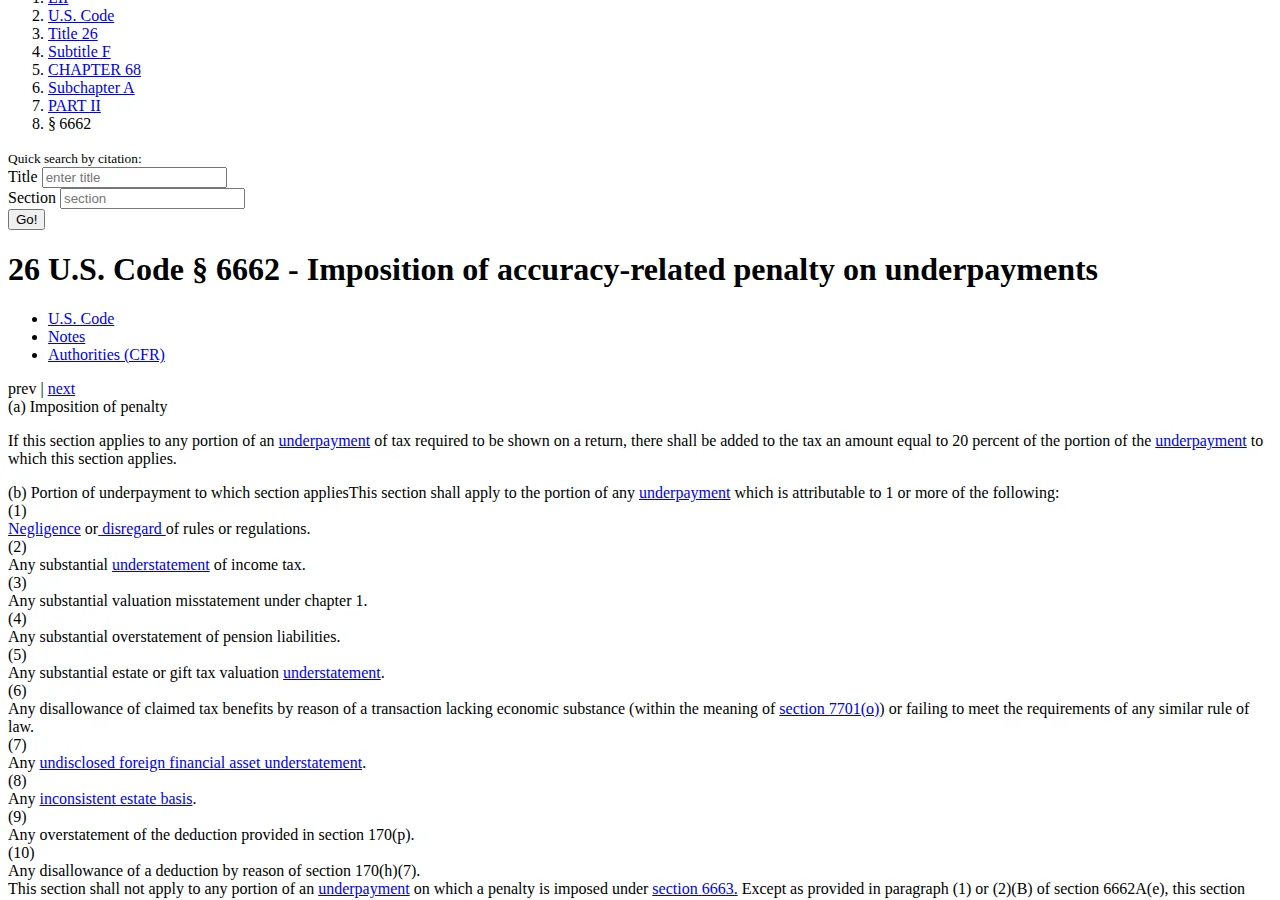
Section 6662(a) is one sentence and it is the whole machine: "If this section applies to any portion of an underpayment of tax required to be shown on a return, there shall be added to the tax an amount equal to 20 percent of the portion of the underpayment to which this section applies."
Section 6662(b) lists ten triggers: negligence or disregard of rules or regulations; substantial understatement of income tax; substantial valuation misstatement under chapter 1; substantial overstatement of pension liabilities; substantial estate or gift tax valuation understatement; disallowance of tax benefits from a transaction lacking economic substance under § 7701(o); undisclosed foreign financial asset understatement; inconsistent estate basis; overstatement of the § 170(p) deduction; and disallowance of a deduction under § 170(h)(7). The section does not apply to any portion penalised under § 6663, the civil fraud penalty, or to a reportable transaction understatement penalised under § 6662A.
Three escalations sit on top of the 20 percent base rate: 40 percent for a gross valuation misstatement under § 6662(h), 40 percent for a nondisclosed noneconomic substance transaction under § 6662(i) — the word "nondisclosed" is doing the work — 40 percent for an undisclosed foreign financial asset understatement under § 6662(j), and 50 percent for an overstatement of the § 170(p) deduction under § 6662(l).
Negligence, under § 6662(c), "includes any failure to make a reasonable attempt to comply with the provisions of this title," and "disregard" includes "any careless, reckless, or intentional disregard." A return position with a reasonable basis "is not attributable to negligence" under Treas. Reg. § 1.6662-3(b)(1).
The substantial understatement threshold
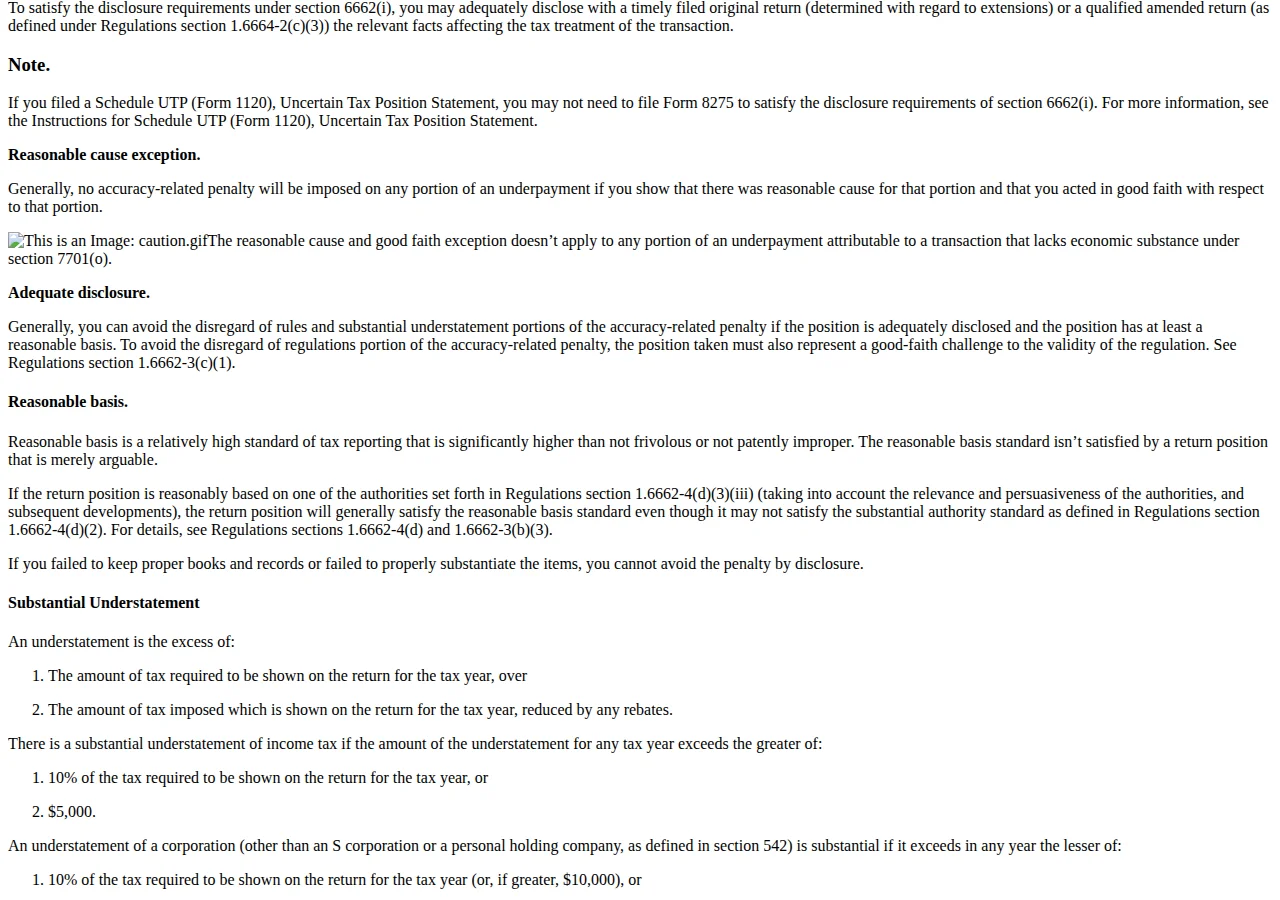
The understatement, under § 6662(d)(2)(A), is the excess of the tax required to be shown over the tax shown, reduced by any rebate. For an individual, § 6662(d)(1)(A) sets the test at the greater of 10 percent of the tax required or $5,000:
For a corporation other than an S-Corp or a personal holding company, § 6662(d)(1)(B) sets it at the lesser of 10 percent of the tax required (or, if greater, $10,000) or $10,000,000:
Section 6662(d)(1)(C) tightens the individual test for any taxpayer claiming a § 199A deduction: 10 percent becomes 5 percent, so a QBI claimant trips the line at half the understatement. And § 6662(m), added in 2025 by Pub. L. 119–21, substitutes 1 percent for 10 percent for understatements due to the disallowance of an applicable energy credit.
The worked example is the whole playbook in miniature: an individual founder files showing $180,000 of tax against a correct $240,000. The understatement is $60,000, and the threshold is the greater of 10 percent of $240,000 ($24,000) or $5,000 — $24,000. The understatement is substantial, and the penalty on the full portion is:
Now suppose $40,000 of that $60,000 is attributable to a position adequately disclosed on Form 8275 with a reasonable basis. Section 6662(d)(2)(B)(ii) reduces the understatement by that $40,000, leaving $20,000 — below the $24,000 threshold. There is no substantial understatement at all, and the substantial-understatement penalty is zero. The $60,000 of tax is still owed, but the $12,000 penalty is gone. Run your own numbers through our tax estimator before the return is filed, not after the notice arrives.
The three defences, in order of strength
First and strongest is substantial authority: under § 6662(d)(2)(B)(i), the understatement is reduced by the portion attributable to any item with substantial authority. Treas. Reg. § 1.6662-4(d)(2) defines it as an objective standard, "less stringent than the more likely than not standard," but "more stringent than the reasonable basis standard." The possibility that the return will not be audited is not relevant. Substantial authority needs no disclosure at all.
Second is adequate disclosure plus a reasonable basis, under § 6662(d)(2)(B)(ii): the item is reduced if "the relevant facts affecting the item's tax treatment are adequately disclosed" and "there is a reasonable basis for the tax treatment of such item." Treas. Reg. § 1.6662-4(e)(1): items adequately disclosed "are treated as if such items were shown properly on the return."
Third is the reasonable cause and good faith exception under § 6664(c), which generally prevents any accuracy-related penalty "if you show that there was reasonable cause for that portion and that you acted in good faith." It is the only exception available for corporate tax shelter items, and it does not apply to any portion attributable to a transaction lacking economic substance under § 7701(o).
Reasonable basis itself is defined in Treas. Reg. § 1.6662-3(b)(3): "Reasonable basis is a relatively high standard of tax reporting, that is, significantly higher than not frivolous or not patently improper. The reasonable basis standard is not satisfied by a return position that is merely arguable or that is merely a colorable claim." A position reasonably based on an authority in Treas. Reg. § 1.6662-4(d)(3)(iii) will generally satisfy the standard; conclusions in treatises and tax professionals' opinions are not authority. A position with only a well-reasoned construction of the statute can still clear reasonable basis; a position with nothing but an argument cannot.
Form 8275 vs Form 8275-R: the decision table
The choice turns on one question: is the position contrary to a regulation? The instructions are blunt — "If you are disclosing a position taken contrary to a regulation, use Form 8275-R, Regulation Disclosure Statement, instead of Form 8275."
| Situation | Form | What it protects | Authority |
|---|---|---|---|
| Position not contrary to a regulation, not otherwise disclosed | Form 8275 | Disregard of rules + substantial understatement portions, if reasonable basis | IRC § 6662(d)(2)(B)(ii); Treas. Reg. § 1.6662-4(e), (f) |
| Position contrary to a regulation | Form 8275-R | Disregard of regulations portion, if reasonable basis + good-faith challenge to the regulation's validity | Treas. Reg. § 1.6662-3(c)(1) |
| Tax shelter item | Neither helps | Only reasonable cause and good faith under § 6664(c) | IRC § 6662(d)(2)(C) |
| Reportable transaction | Form 8886 as well | § 6662A regime; § 6662 does not apply to that portion | IRC § 6662(b) flush language; Form 8275 instructions |
The 8275-R line matters because a regulation-contrary position needs one extra element: a good-faith challenge to the validity of the regulation under Treas. Reg. § 1.6662-3(c)(1). Disagreeing with a regulation because it costs money is not a good-faith challenge; arguing, with authority, that it exceeds the statute is. The disclosure exception never applies to a position without a reasonable basis, or where the taxpayer failed to keep adequate books and records.
What disclosure cannot save
Form 8275 buys nothing in eleven categories: negligence; disregard of regulations; any substantial understatement on a tax shelter item; any substantial or gross valuation misstatement; any substantial overstatement of pension liabilities; any substantial estate or gift tax valuation understatement; any claim of tax benefits from a transaction lacking economic substance (§ 7701(o)); any undisclosed foreign financial asset understatement; any inconsistent estate basis; any overstatement of the § 170(p) deduction; or any disallowance under § 170(h)(7).
The valuation entries deserve a worked check: the thresholds are ratios, not dollars. A substantial valuation misstatement under § 6662(e)(1)(A) exists where the value claimed is 150 percent or more of the correct value, and no penalty is imposed unless the portion of the underpayment exceeds $5,000 ($10,000 for a corporation other than an S-Corp or personal holding company). Claim a business interest at $300,000 when the correct value is $180,000:
ext{Claimed / correct} =
rac{$300{,}000}{$180{,}000} = 166.7% geq 150% ext{ — substantial valuation misstatement}
No Form 8275 can be filed against a valuation number, because the statute excludes valuation misstatements from disclosure protection entirely.
The regulation's own worked examples
Treas. Reg. § 1.6662-4(b) works the threshold math twice. In Example 1, Individual A files a 1989 return showing tax of $2,734; audit adjustments raise it to $12,339. One item, producing a $5,300 taxable-income adjustment, had substantial authority, so the tax treated as shown becomes $4,176. The understatement is $12,339 minus $4,176, or $8,163, and the threshold is the greater of 10 percent of $12,339 ($1,234) or $5,000 — $5,000. The penalty is:
In Example 3, Individual P files a 1990 return reporting $1,504 of tax, then fails to report $25,000 of income with neither substantial authority nor adequate disclosure. The correct tax is $7,279, the understatement is $7,279 minus $1,504, or $5,775, and the threshold is the greater of 10 percent of $7,279 ($728) or $5,000 — $5,000. Substantial by $775. The penalty is:
Example 3 carries a second lesson: a later NOL carryback to 1990 does not reduce the understatement.
How to file: Parts I, II, and III
Form 8275 is filed with the original return, and it may be filed with an amended return (Treas. Reg. §§ 1.6662-4(f)(1), 1.6664-2(c)(3)). Keep a copy. All requested information must be provided in detail. Attaching the underlying documents instead does not work. The form is the disclosure; the letter is not.
Part I is the identification grid: column (a) identifies the rule, (b) names the item, (c) gives a complete description — the instructions' example is entertainment expenses, where column (c) must list "theater tickets, catering expenses, and banquet hall rentals" — and (d) through (f) give the form, line, and amount. Part II is the narrative: the relevant facts affecting the tax treatment. Part III covers pass-through items: the entity's name, EIN, and filing location.
First, pass-through items are disclosed on the entity's return; if the entity does not disclose, a partner or shareholder may disclose by filing Form 8275 in duplicate, with a separate form for each entity, whether an LLC, partnership, or S-Corp. Second, carryover and carryback items are disclosed in the year they originated; recurring items such as depreciation must be disclosed in each year they occur. Third, some items need no form at all: an annual revenue procedure lists circumstances where the return itself is adequate disclosure.
Founder & CEO Insight — Enow A. Jovial
Who should NOT use this
A taxpayer whose position has no authority behind it should not file Form 8275 — disclosure without a reasonable basis protects nothing. A taxpayer with a tax shelter item should not expect the form to help: § 6662(d)(2)(C) removes shelter items from the reduction entirely. A taxpayer who has not kept books and records should fix the records first, and a taxpayer whose item is a valuation should not file for that item. And a taxpayer who has already received an IRS notice should not file the form as a late fix without checking the amended-return rules in Treas. Reg. § 1.6664-2(c)(3). When the IRS sends a CP2000 underreporter notice, the response clock is already running — our IRS Notice CP2000 underreporter response playbook covers that sequence, and our Form 2210 underpayment penalty playbook covers the estimated-tax penalty.
Execution checklist
- [x] Step 1: Price the exposure: compute the understatement, the threshold, and the 20 percent penalty on the undisclosed portion.
- [x] Step 2: Grade the position: substantial authority, reasonable basis, or neither. Gather the authorities from the Treas. Reg. § 1.6662-4(d)(3)(iii) list. If the grade is "neither," do not take the position.
- [x] Step 3: Choose the form: Form 8275 unless the position is contrary to a regulation — then Form 8275-R with a good-faith challenge to the regulation's validity. If the position also relates to a reportable transaction, add Form 8886.
- [x] Step 4: Complete Parts I, II, and III in detail: rule in column (a), item name in (b), complete description in (c), form, line, and amount in (d) through (f), the facts in Part II, and pass-through information in Part III. No attached letter substitutes for the form.
- [x] Step 5: File with the original return and keep a copy: separate form per entity; disclose carryovers in the year of origin; re-disclose recurring items each year they occur.