A founder claims a $400,000 tax benefit from a structured transaction, files the return, and never mentions the transaction anywhere else. Two years later the IRS identifies the structure as a listed transaction. The founder now owes the tax, a 30 percent accuracy penalty, and a Section 6707A penalty of up to $200,000 — and the assessment period is still open, because it never closes on an undisclosed listed transaction. One form, filed twice, would have changed every number in that sentence.
Who must file
Any taxpayer — individual, trust, estate, partnership, S corporation, or C corporation — that participates in a reportable transaction and must file a federal return or information return must file a disclosure statement. Your counterparty disclosing does not disclose for you.
Participation is broad. A reporting shareholder of a foreign corporation participates if the corporation would be considered to participate were it domestic — except for transactions of interest, where the guidance must name the shareholder. A 10 percent shareholder by vote or value of a qualified electing fund is in the same position.
A foreign corporation filer should already be running the Form 5471 playbook, and a partnership filer the Form 8865 playbook — Form 8886 is the layer on top, filed in addition to them, never instead of them.
The five categories
A reportable transaction falls into one or more of the five categories in Regulation Section 1.6011-4. One category is enough, and there is no de minimis exception for small transactions inside a category.
| Category | Trigger | Authority |
|---|---|---|
| Listed transaction | The same as, or substantially similar to, a transaction the IRS has identified as a tax avoidance transaction in published guidance | Reg. § 1.6011-4(b)(2); § 6707A(c)(2) |
| Confidential transaction | Offered under conditions of confidentiality, with a minimum fee — $250,000 for corporations, $50,000 for all others | Reg. § 1.6011-4(b)(3) |
| Transaction with contractual protection | The taxpayer has the right to a refund of fees if the intended tax consequences are not sustained | Reg. § 1.6011-4(b)(4) |
| Loss transaction | A Section 165 loss of at least $10 million in one year ($20 million combined) for corporations, $2 million ($4 million combined) for individuals, $50,000 for Section 988 currency losses | Reg. § 1.6011-4(b)(5) |
| Transaction of interest | The same as, or substantially similar to, a transaction the IRS has identified as a transaction of interest in published guidance | Reg. § 1.6011-4(b)(6) |
Two of these categories trap the unwary. "Substantially similar" in the listed-transaction definition means a transaction does not have to match the published description line for line — the same tax benefit, reached by the same structure, is enough. The loss thresholds are measured on the loss claimed, not on business size: a $2.4 million Section 165 loss by an individual in one year is reportable.
The penalty machine: Section 6707A
Section 6707A is the reason Form 8886 exists. Any person who fails to include, on any return or statement, information about a reportable transaction that Section 6011 requires to be included pays a penalty in the amount determined under subsection (b). Each failure counts separately: a missing return attachment, a missing OTSA copy, or a form that omits required information or includes incorrect information.
The statute then floors and caps that figure. The minimum is $10,000, or $5,000 for a natural person. The maximum for a listed transaction is $200,000, or $100,000 for a natural person. The maximum for any other reportable transaction is $50,000, or $10,000 for a natural person. The penalty is in addition to any other penalty imposed by the Code — it stacks on top of the accuracy penalty, it does not replace it.
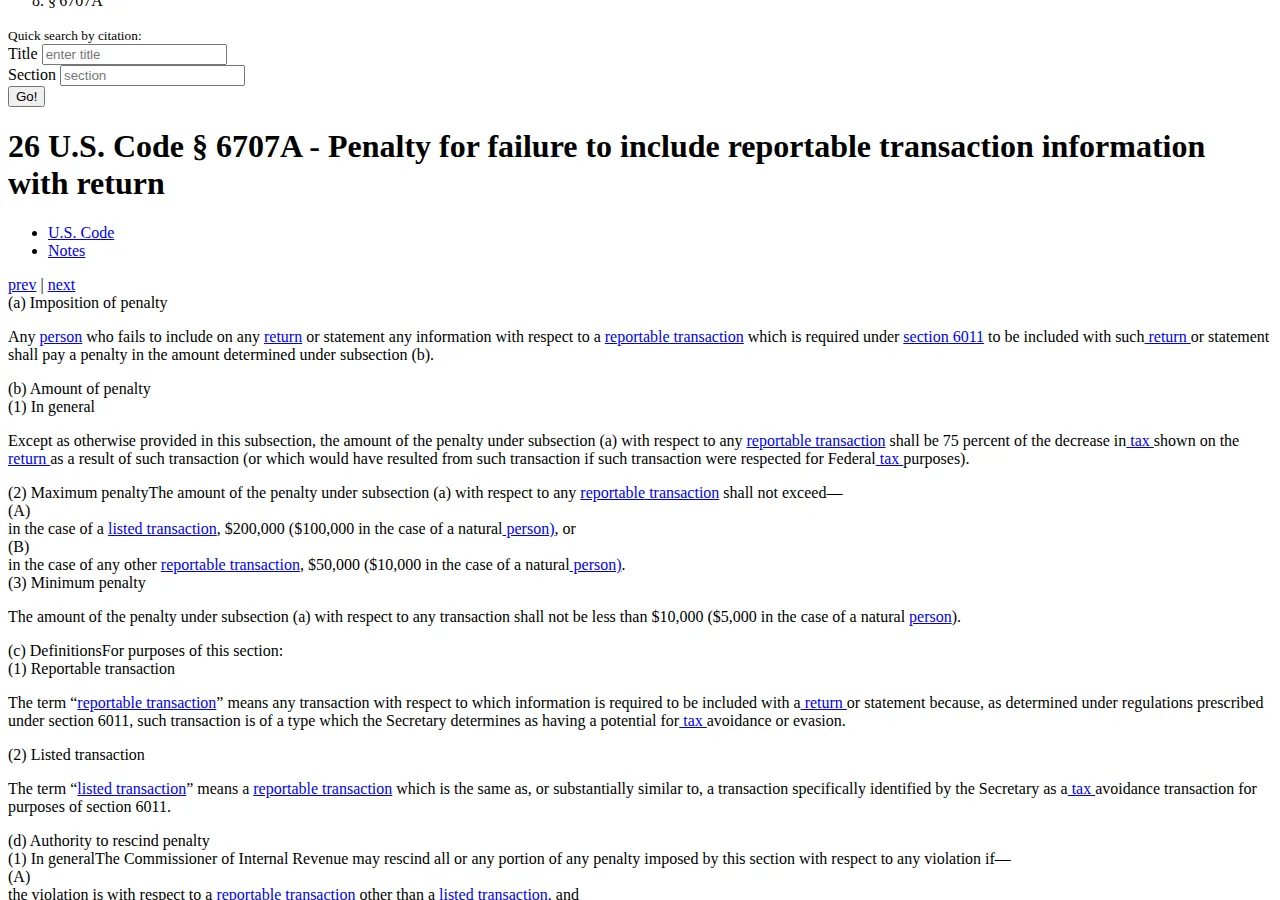
Example A — listed transaction, C corporation. A C-Corp claims a $400,000 tax decrease from a listed transaction and files no Form 8886. The raw penalty is 75 percent of $400,000, which is $300,000. The listed-transaction maximum for a corporation is $200,000, so the penalty is $200,000. The cap, not the percentage, decides the bill.
Example B — non-listed reportable transaction, individual. An individual claims a $40,000 tax decrease from a transaction of interest and files no Form 8886. The raw penalty is 75 percent of $40,000, which is $30,000. The maximum for a non-listed transaction for a natural person is $10,000, so the penalty is $10,000.
Example C — the floor binds. An individual claims a $4,000 tax decrease from a reportable transaction and files no Form 8886. The raw penalty is 75 percent of $4,000, which is $3,000. The minimum for a natural person is $5,000, so the penalty is $5,000.
There is one escape valve and it is narrow. The Commissioner may rescind all or part of a Section 6707A penalty if the violation is with respect to a reportable transaction other than a listed transaction and rescinding would promote compliance and effective tax administration. Rescission is unavailable for listed transactions, and the Commissioner's determination cannot be reviewed in court. Do not plan around rescission; plan around filing.
The second penalty: Section 6662A
Disclosure changes the accuracy penalty too. Section 6662A imposes an accuracy-related penalty on a reportable transaction understatement: 20 percent of the understatement when the transaction was properly disclosed, 30 percent when it was not. The IRS Q&A states it plainly: an undisclosed reportable transaction draws the 30 percent rate, not the 20 percent rate.
Example D — the disclosure discount. A $100,000 reportable transaction understatement, properly disclosed, carries a $20,000 Section 6662A penalty. The same understatement, undisclosed, carries $30,000 — and the undisclosed filer also faces the Section 6707A penalty on top. Disclosure does not concede the position or admit abuse. It buys the lower rate and removes the Section 6707A penalty — usually the cheapest decision in the whole matter.
The filing operation: twice, every year
Attach Form 8886 to the return, including amended returns, for each tax year of participation. If the transaction produces a loss or credit carried back, attach it to the application for tentative refund (Form 1045 or Form 1139) or the amended return for the carryback years. A multi-year transaction generates a filing duty in every year it touches.
The second filing is the one operators miss. An exact copy of an initial Form 8886 must be filed with the Office of Tax Shelter Analysis (OTSA), by mail or by fax. The instructions give the address and the fax number:
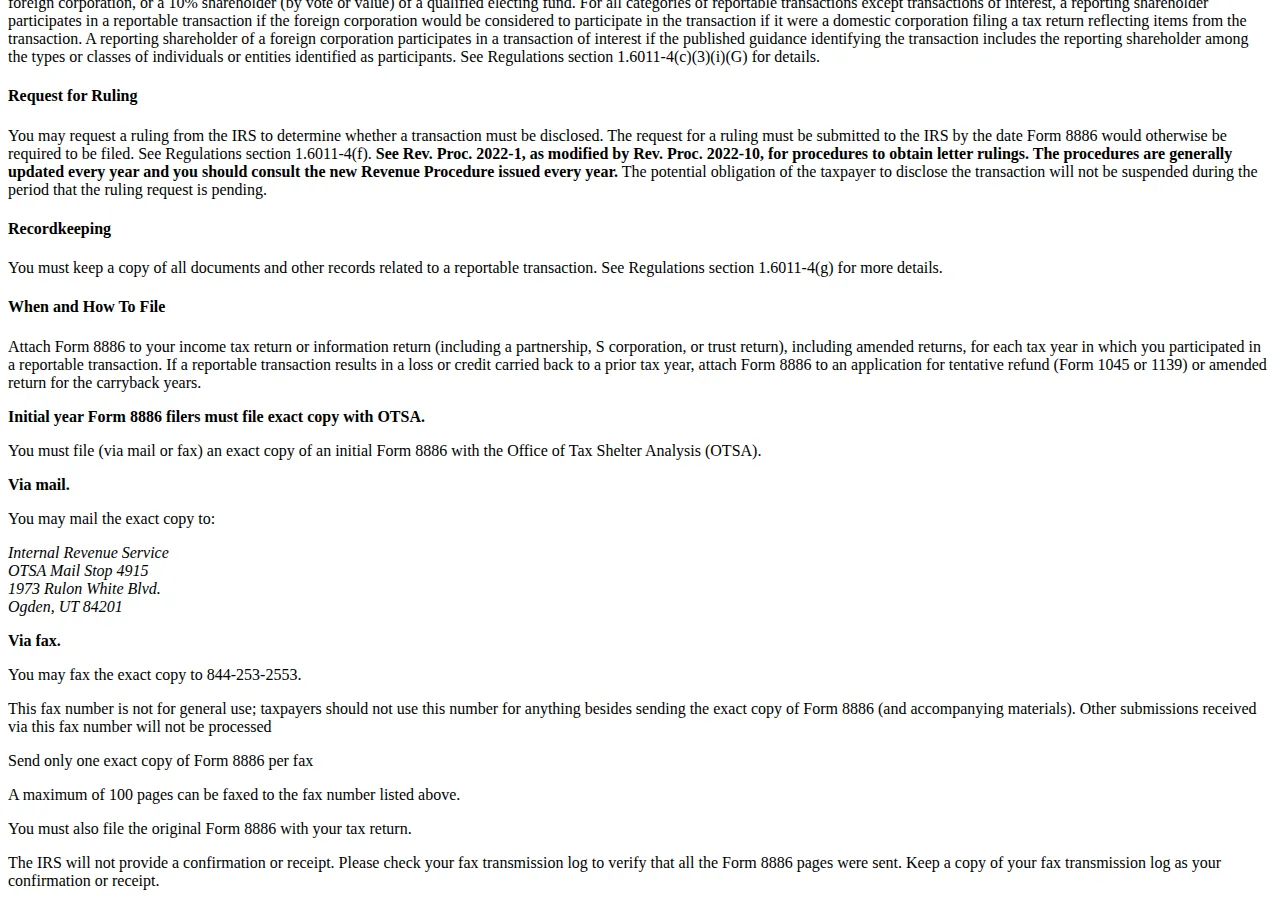
Mail the copy to Internal Revenue Service, OTSA Mail Stop 4915, 1973 Rulon White Blvd., Ogden, UT 84201, or fax it to 844-253-2553 — one exact copy per fax, a maximum of 100 pages, and the number is not for general use. The IRS gives no confirmation or receipt, so the fax transmission log is the proof of filing; keep it with the return workpapers in PDF. A CPA preparing the return will ask for the EIN, the LLC operating agreement or the S-Corp election, and the transaction documents before drafting — the form requires the facts, the tax benefits by year, and the published guidance the transaction resembles. There is no API or e-file path for the OTSA copy — mail or fax is the only route.
The timing rule for transactions that become listed after filing is precise. If the transaction was entered into after August 2, 2007 and later becomes a listed transaction or a transaction of interest, file Form 8886 with OTSA within 90 days after the date it became listed. Pre-August 3, 2007 transactions attach to the next return filed after designation; transactions of interest entered into after November 1, 2006 follow the same 90-day rule. Calendar from the designation date, not from when the notice arrives.
If the analysis is genuinely uncertain, request a ruling under Revenue Procedure 2022-1 as modified by Revenue Procedure 2022-10, submitted by the date Form 8886 would otherwise be due. The disclosure obligation is not suspended while the ruling request is pending, so the ruling route protects the analysis, not the deadline.
Material advisors: Form 8918 and Section 6707
Under Section 6111, each material advisor must file Form 8918, the Material Advisor Disclosure Statement, identifying and describing the transaction and the expected tax benefits. Section 6112 separately requires the advisor to maintain a list of persons offered the transaction, available to the IRS on request.
The advisor penalty is in Section 6707. The penalty for failing to file the Form 8918 return is $50,000, except for a listed transaction, where it is the greater of $200,000 or 50 percent of the gross income derived by the advisor from the transaction. An advisor who earned $600,000 of fees on a listed transaction and never filed faces a penalty of $300,000 — 50 percent of gross income — not the $200,000 floor. Before engaging, ask whether the advisor has filed Form 8918 for the structure being sold. An advisor who will not answer is itself a data point.
Disclose or not: the decision table
| Choice | Cost if the transaction is reportable | Cost if it is not | Authority |
|---|---|---|---|
| Disclose (file Form 8886) | Preparation time; Section 6662A at 20% if the position fails | Preparation time; no penalty exposure | § 6011; Reg. § 1.6011-4 |
| Do not disclose | § 6707A penalty up to $200,000; § 6662A at 30%; assessment period open indefinitely | Nothing — if the analysis was right | § 6707A; § 6662A; § 6501(c)(10) |
| Request a ruling first | Analysis protected; filing still due on time | Analysis protected; filing still due on time | Rev. Proc. 2022-1; Reg. § 1.6011-4(f) |
The table is asymmetric on purpose: disclosure costs preparation time in both columns, while nondisclosure costs nothing in one column and up to $200,000 plus a 30 percent accuracy penalty plus an open assessment period in the other. For any transaction even arguably inside a category, file or get the ruling — and document the analysis either way, because Regulation Section 1.6011-4(g) requires the taxpayer to keep all documents and records related to a reportable transaction.
Founder & CEO Insight — Enow A. Jovial
Who should not file — and what to do instead
Not every aggressive position is a reportable transaction: an ordinary business acquisition, a standard entity election, or a routine loss inside a real operating business is not reportable because it is large or because it reduces tax. The categories are the test, and a transaction that fails all five is not disclosable. When the analysis is close, document the category-by-category reasoning and the published guidance considered, kept with the workpapers under Regulation Section 1.6011-4(g). If the conclusion is uncertain, request the ruling before the due date. What the record must never show is a transaction that was never analysed at all.
Filing checklist
- [x] Step 1 — Category screen: Test the transaction against all five Regulation Section 1.6011-4 categories, including the "substantially similar" test and the Section 165 loss thresholds. Record the analysis.
- [x] Step 2 — Draft Form 8886: Complete it in its entirety with all required attachments. A form that omits required information is a failure, not a filing.
- [x] Step 3 — Attach to the return: Attach Form 8886 to the return for each year of participation, including amended returns and carryback applications.
- [x] Step 4 — File the OTSA copy: Mail or fax an exact copy of the initial Form 8886 to OTSA the same day. Keep the fax log or mail receipt in PDF with the workpapers.
- [x] Step 5 — Calendar the 90 days: If the transaction later becomes listed or a transaction of interest, file with OTSA within 90 days of designation, or attach to the next return for pre-August 3, 2007 transactions.
- [x] Step 6 — Confirm the advisor filed: Ask the material advisor for confirmation that Form 8918 was filed under Section 6111, and keep it.
- [x] Step 7 — Close the loop: A disclosed listed transaction closes on the normal limitations clock; an undisclosed one stays open under Section 6501(c)(10) until disclosure is made.
The penalty math is mechanical, the categories are published, and the filing is two copies of one form. Run the exposure through the tax estimator before the return is filed. The E&P ledger inside the Form 5471 Schedule J playbook is the same discipline on a different schedule: the return is only as good as the disclosures attached to it.