A calendar-year C corporation owes $120,000 on its 2026 return, its books are not closed on April 15, and the return cannot be filed. Two filings are available that day: Form 7004, or nothing. With Form 7004 filed properly and $108,000 paid, the corporation files on October 15 owing only interest on the $12,000 balance. With nothing filed, the failure-to-file penalty alone reaches $18,000 by July 15, plus failure-to-pay and interest.
What Form 7004 buys
Form 7004 is the Application for Automatic Extension of Time To File Certain Business Income Tax, Information, and Other Returns. The December 2025 instructions state the IRS no longer sends an approval notification; it notifies the filer only if the request is disallowed.
Three conditions do the quiet work. The form must be filed on or before the return's due date — filed April 16 for an April 15 return, it is not late, it is void. The name and EIN must match the IRS database exactly; a mismatch means no valid extension. One Form 7004 covers one return only: a group with C corporation, partnership, and trust returns files three separate forms.
The statute: Section 6081
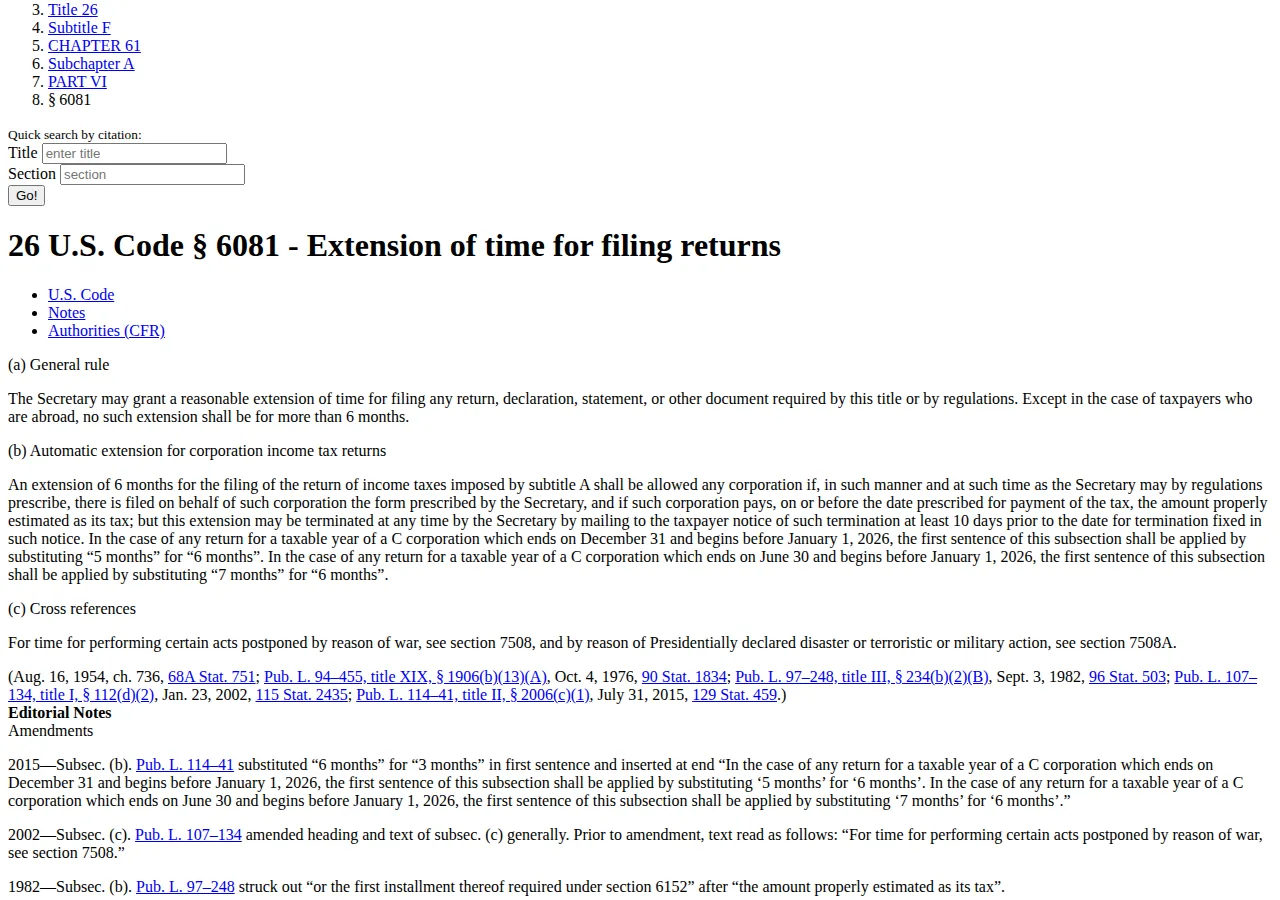
The authority is 26 U.S.C. § 6081. Subsection (a) lets the Secretary grant a reasonable extension for filing any return or document, capped at six months except for taxpayers abroad. Subsection (b) makes the corporation extension automatic: six months if the prescribed form is filed and the corporation pays, by the date prescribed for payment, the amount properly estimated as its tax.
Two exceptions still apply to tax years beginning before January 1, 2026: a C corporation whose tax year ends December 31 gets five months instead of six, and one ending June 30 gets seven. For tax years beginning in 2026, both exceptions expire, so a calendar-year C corporation filing for 2025 extends to September 15, not October 15. The Secretary may terminate the extension at any time by mailing notice at least ten days before the termination date.
Which returns it covers
Form 7004 covers business income tax, information, and other returns — a defined list, not every business form. The instructions list more, including 706-GS(D), 708, 8612, 8725, 8876, 8924, and 1120-SF.
| Return | Who files it | Extension | Authority |
|---|---|---|---|
| Form 1120 | C corporation | 6 months; 5 months for Dec 31 year-end before 2026 | § 6081(b); i7004 |
| Form 1120-S | S corporation | 6 months | § 6081(a); i7004 |
| Form 1065 | Partnership | 6 months | § 6081(a); i7004 |
| Form 1041 | Estate or trust | 5½ months | i7004 |
| Form 1120-F | Foreign corporation | 6 months | § 6081(a); i7004 |
Which entity files matters. A single-member LLC with no election is disregarded: its owner extends with Form 4868, not Form 7004. An LLC that elected C-Corp treatment, an S-Corp, or a C-Corp files Form 7004 under its own EIN. A CPA usually prepares the line 6 estimate from GAAP books and the year's FICA payroll records, because the 90 percent safe harbor turns on that estimate alone.
The 990 and 5500 correction
Form 990 and Form 5500 are not covered by Form 7004 — neither number appears anywhere in its instructions, and filing Form 7004 for either return extends nothing. An exempt organization extends Form 990 with Form 8868; a benefit plan extends Form 5500 with Form 5558. The IRS assigns each return its own extension vehicle; using the wrong one is the same as filing no extension at all. The individual extension playbook covers the personal side of the same mistake: Form 4868 extends individuals, Form 7004 extends businesses, neither extends the other.
The extension calendar
Original due dates come from 26 U.S.C. § 6072: calendar-year returns due April 15, partnership and S corporation returns March 15. For 2025:
| Return | Original due | Extension | Extended due |
|---|---|---|---|
| Form 1120, 2025 | April 15 | 5 months | September 15 |
| Form 1120, 2026 | April 15 | 6 months | October 15 |
| Form 1120-S | March 15 | 6 months | September 15 |
| Form 1065 | March 15 | 6 months | September 15 |
| Form 1041 | April 15 | 5½ months | September 30 |
A June 30 C corporation is due October 15, and its seven-month extension carries it to May 15; a short year ending in June counts as June 30.
The penalty machine: Section 6651
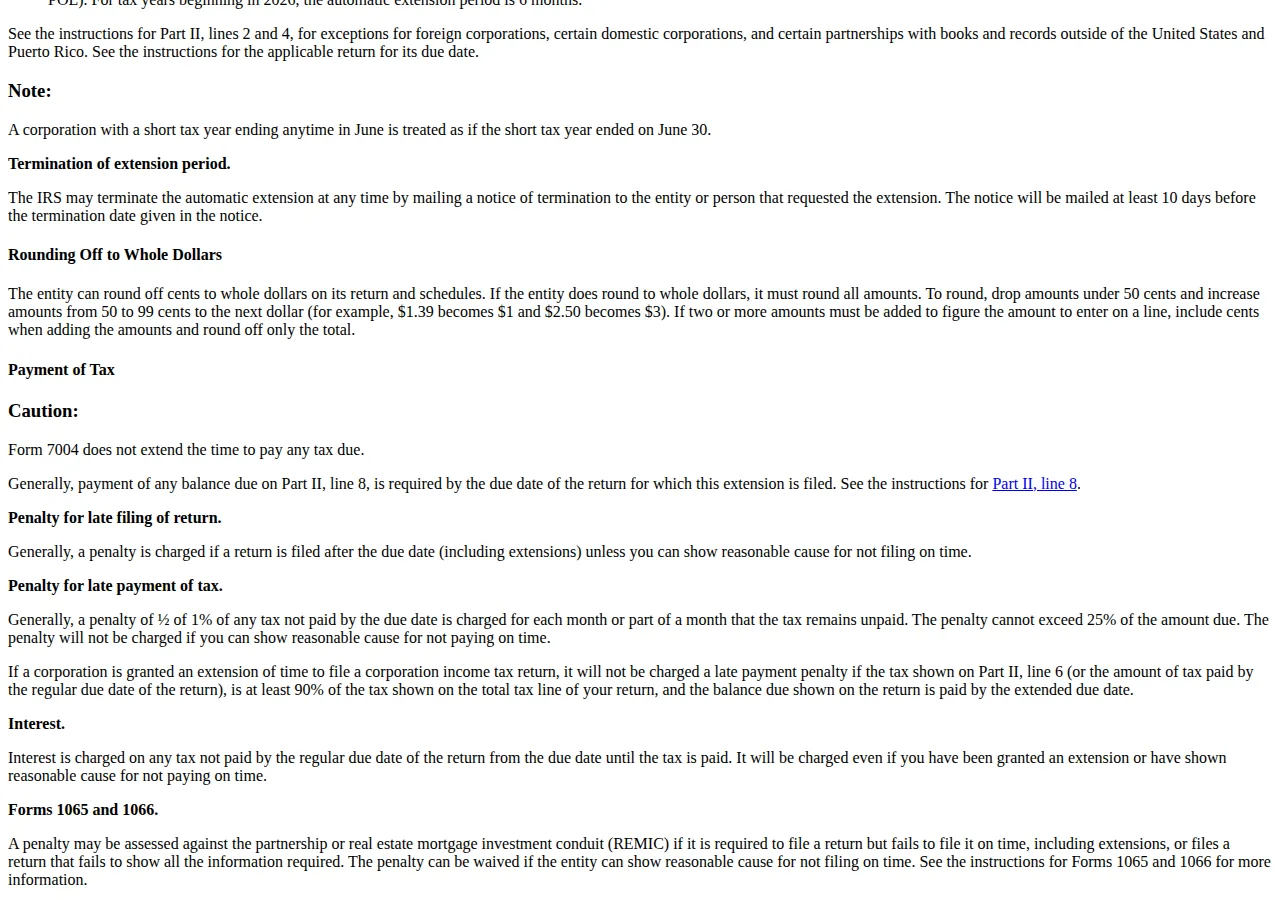
Section 6651(a)(1) adds 5 percent of the tax shown for each month or part of a month the return is late, capped at 25 percent; (a)(2) adds 0.5 percent of the tax shown for each month the tax goes unpaid, capped at 25 percent. Section 6651(c)(1) merges them: when both apply in the same month, the failure-to-file addition is cut by the failure-to-pay addition, so the combined rate is 5 percent, not 5.5 percent. A chapter 1 return filed more than 60 days late carries a failure-to-file addition of at least the lesser of $435 — before the § 6651 inflation adjustment — and the tax shown.
Take the $120,000 corporation, three months late, no extension, nothing paid: failure-to-file is 15 percent, $18,000; failure-to-pay is 1.5 percent, $1,800. The combined cap makes the total $18,000, not $19,800 — the $1,800 sits inside the $18,000.
The same corporation with a valid Form 7004, filed inside the extension, nothing paid by April 15, owes no failure-to-file penalty — the extension moved the due date. Failure-to-pay runs on the full $120,000 for six months: 3 percent, $3,600. The extension saved $18,000 and left $3,600 plus interest.
The 90 percent safe harbor
Corporations get one more protection: if the tax on Part II, line 6 — or the amount paid by the regular due date — is at least 90 percent of the total tax, and the balance is paid by the extended due date, no late-payment penalty applies.
Pay $108,000 by April 15 and the remaining $12,000 by October 15: the late-payment penalty is zero. Pay $60,000 instead and the penalty runs on the $60,000 unpaid for six months: 0.5 percent times six, $1,800. The safe harbor is a cliff — 89 percent buys nothing, 90 percent buys everything — so the line 6 estimate deserves the same care as the return. Interest is not covered: it runs on any tax unpaid by the regular due date until paid.
A trust filing Form 1041 or a REMIC filing Form 1066 gets the extension even if it cannot pay the full line 8 amount — but it should pay as much as it can: every unpaid dollar accrues penalty and interest. A partnership or REMIC that files late, past the extension, or files an incomplete return faces its own penalty, waivable only on reasonable cause.
How to file: e-file rules and the paper trap
Form 7004 can be filed electronically for most returns — the instructions point filers to IRS.gov/Efile7004 — but six forms cannot be e-filed: 8612, 8613, 8725, 8831, 8876, and 706-GS(D). For tax year 2025, Forms 708, 8924, and 8928 also require paper; electronic filing starts in tax year 2026. Paper filers use the instructions' Where To File table — Kansas City for most eastern and central states, Ogden for the west and foreign addresses.
One trap is specific to mixed filing: if Form 7004 goes on paper and the return electronically, the return may be processed before the extension is granted, producing a penalty notice. File the extension electronically when the return will be e-filed, or file both on paper. The IRS burden estimate is about seven hours: 3 hours 35 minutes recordkeeping, 1 hour 3 minutes learning, 2 hours 6 minutes preparing, 16 minutes copying.
The foreign-books exception
Some entities never file Form 7004 at all. Under Regulations section 1.6081-5, partnerships keeping books outside the United States and Puerto Rico, foreign corporations maintaining a US office, domestic corporations transacting business and keeping books there, and domestic corporations whose principal income comes from US territories already have an automatic extension to file and pay. They must file — or request a further extension — and pay any balance by the 15th day of the sixth month after the tax year closes, attaching a statement of qualification.
If it still cannot file by that date, it checks Form 7004, line 4, for an additional extension to file — not to pay: three months for partnerships and S corporations, four months for C corporations and Form 1120-POL filers. Foreign corporations with no US office have their own line 2 rule: file Form 7004 by the return's due date, the 15th day of the sixth month after the tax year closes. The Form 5471 playbook covers the reporting those foreign corporations owe on top of the return, and the Form 1042 playbook covers the withholding returns on the same June 15 calendar.
Founder & CEO Insight — Enow A. Jovial
State extensions do not follow federal
A federal extension extends nothing at the state level unless the state says so. California grants it automatically under FTB Publication 1060 — no form, no application — for tax years beginning on or after January 1, 2019, but only to corporations in good standing with the FTB and the Secretary of State; a suspended or forfeited corporation loses it. New York is the opposite: Form CT-5 must be filed and the properly estimated franchise tax and MTA surcharge paid by the original due date. Combined filers use Form CT-5.3; extensions beyond six months need Form CT-5.1.
| State | Mechanism | Period | Payment rule |
|---|---|---|---|
| California | Automatic, no form, if in good standing | 7 months for Form 100; 6 months for Form 100S | Tax due on original due date; pay with FTB 3539 |
| New York | File Form CT-5 (C corps) or CT-5.4 (S corps) | 6 months | Estimate equals prior-year tax or 90% of current-year tax, paid by original due date |
Federal first, then each state on its own form and deadline; in every state the extension covers filing only.
Who should not rely on it
Form 7004 is the wrong instrument in four situations. First, a filer who cannot pay: the extension does not stop the payment penalty or interest, so a business with no cash should pay what it can, file the extension to kill the filing penalty, and treat the payment penalty as the smaller fire. Second, a filer who needs more than six months: there is no second Form 7004 for the same return, except the narrow line 4 extension for foreign-books entities. Third, a filer whose return is already late: Form 7004 cannot be filed after the due date; the only remaining defense is reasonable cause. Fourth, an individual, an exempt organization filing Form 990, or a plan filing Form 5500: each has its own extension form. Run the exposure through the tax estimator before the return is due: the estimator turns the corporation's own numbers into the amount at stake.
Execution checklist
- [x] Step 1 — Confirm the return is on the list: Match the return to Part I; Form 990 and Form 5500 are not on it — use Form 8868 and Form 5558.
- [x] Step 2 — Estimate the tax on line 6: Total tax including nonrefundable credits; target at least 90 percent of the final total for the safe harbor.
- [x] Step 3 — Pay line 8 by the original due date: Pay by EFTPS, or by Electronic Funds Withdrawal when e-filing; the extension never moves this date.
- [x] Step 4 — File Form 7004 by the original due date: Electronically for most returns; on paper for Forms 8612, 8613, 8725, 8831, 8876, and 706-GS(D).
- [x] Step 5 — Verify the name and EIN: A mismatch voids the extension silently; re-check both against the prior year's return.
- [x] Step 6 — File each state extension separately: California is automatic if in good standing; New York needs Form CT-5 or CT-5.4 with payment by the original due date.
- [x] Step 7 — Diary the extended due date and the balance: The balance is due on the extended date to keep the safe harbor; interest runs from the original date.
- [x] Step 8 — File the return, then keep the proof: No approval notice arrives; keep the e-file acceptance or certified mail receipt — the only evidence the extension was filed on time.