Both federal home energy credits are dead for new work, and both are still worth money on the 2025 return. The Energy Efficient Home Improvement Credit under IRC § 25C pays 30 percent of qualifying improvements, capped at $1,200 a year for most work and $2,000 a year for heat pumps and biomass stoves — a $3,200 annual maximum. The Residential Clean Energy Credit under IRC § 25D pays 30 percent of solar, battery storage, geothermal, small wind, and fuel cell property, with no annual cap except the fuel cell limit. The One Big Beautiful Bill Act ended both credits for property placed in service after December 31, 2025, so a 2025 installation is claimed on the 2025 return filed in 2026, and a 2026 installation gets nothing. Both credits are claimed on IRS Form 5695: Part I for § 25D, Part II for § 25C. Both are nonrefundable, so the credit cannot exceed the tax you owe — but only § 25D lets the unused part carry forward.
The two credits, side by side
The credits share a form and a 30 percent rate, and almost nothing else. § 25C is a capped annual credit for efficiency improvements to a principal residence. § 25D is an uncapped percentage credit for clean energy generation at a home you live in, including a second home you do not rent out. The table is the whole decision:
| Attribute | § 25C Home Improvement | § 25D Clean Energy | Authority |
|---|---|---|---|
| Rate | 30% of qualifying cost | 30% of qualifying cost | 26 U.S.C. §§ 25C(a), 25D(a) |
| Annual cap | $1,200 general; $2,000 heat pump/biomass | None, except fuel cells | 26 U.S.C. §§ 25C(b), 25D(b)(1) |
| Per-item caps | $600 per energy property item; $600 windows; $250 per door, $500 doors total; $150 audit | $500 per half kW of fuel cell capacity | 26 U.S.C. §§ 25C(b)(2)–(6), 25D(b)(1) |
| Residence test | Principal residence only | Home you live in, including a second home not rented out; fuel cells excluded for a second home | 26 U.S.C. § 25C(c)(1); IRS Residential Clean Energy Credit page |
| Carryforward of unused credit | No — excess is lost | Yes — unused § 25D carries to the next year | IRS Instructions for Form 5695 (2025), Part I |
| Last year | Property placed in service by Dec 31, 2025 | Expenditures made by Dec 31, 2025 | OBBBA §§ 70506, 70505; IRS Form 5695 instructions |
The residence test is the first place claims fail. § 25C requires the dwelling to be owned and used by the taxpayer as a principal residence, the original use of the component must commence with the taxpayer, and the component must reasonably be expected to remain in use for at least five years — 26 U.S.C. § 25C(c)(1). A rental property does not qualify under either credit, and a landlord who improves a rental and claims § 25C has claimed a credit the statute does not offer. § 25D is the more forgiving of the two: the IRS states that a second home you live in part-time and do not rent to others qualifies, with one exception — fuel cell property cannot be claimed for a second home. A home outside the United States qualifies for neither credit. And the credits belong to the individual homeowner, not to an entity: a C-Corp, an S-Corp, and an LLC do not file Form 5695 for the business, and a rental held inside an LLC gets no credit for the same reason a rental held personally gets none. If the property sits in an entity, the question is whether the individual who lives there can claim it — and a CPA should confirm the answer before the return is filed, because the entity changes the paperwork even when it does not change the house.
§ 25C: the cap stack, worked in full — Example 1
§ 25C is not one cap but a stack of them, and the order matters. The general annual limit is $1,200 under § 25C(b)(1). Inside that limit sit sub-caps: $600 for any single item of qualified energy property under § 25C(b)(2), $600 in aggregate for all exterior windows and skylights under § 25C(b)(3), $250 per exterior door and $500 for all exterior doors under § 25C(b)(4), and $150 for a home energy audit under § 25C(b)(6). The heat pump and biomass bucket is separate: § 25C(b)(5) allows up to $2,000 a year for heat pumps, heat pump water heaters, and biomass stoves and boilers, notwithstanding the $1,200 limit. The maximum any taxpayer claims in one year is therefore $3,200 — $1,200 plus $2,000 — and the audit credit sits inside the $1,200 bucket, not on top of it.
Take a homeowner who in 2025 spent $2,500 on insulation, $4,000 on windows, $1,200 on two exterior doors, $9,000 on a heat pump, and $500 on a home energy audit. The credit computes as:
The audit line is the trap most filers miss. The $150 audit credit is real, but it draws from the same $1,200 bucket as the insulation, windows, and doors — so a homeowner whose general bucket is already full gains nothing from the audit, while a homeowner who spent only $800 on insulation gains the full $150. The second trap is the tax-liability ceiling. Both credits are nonrefundable: the credit cannot exceed the tax owed. Our homeowner's § 25C credit is $3,200, but if her 2025 federal tax liability is $2,800, the credit is $2,800 and the remaining $400 is lost — § 25C has no carryforward. Spending decisions made in December 2025 on the assumption of a $3,200 refund were spending decisions made against a liability the filer had not checked.
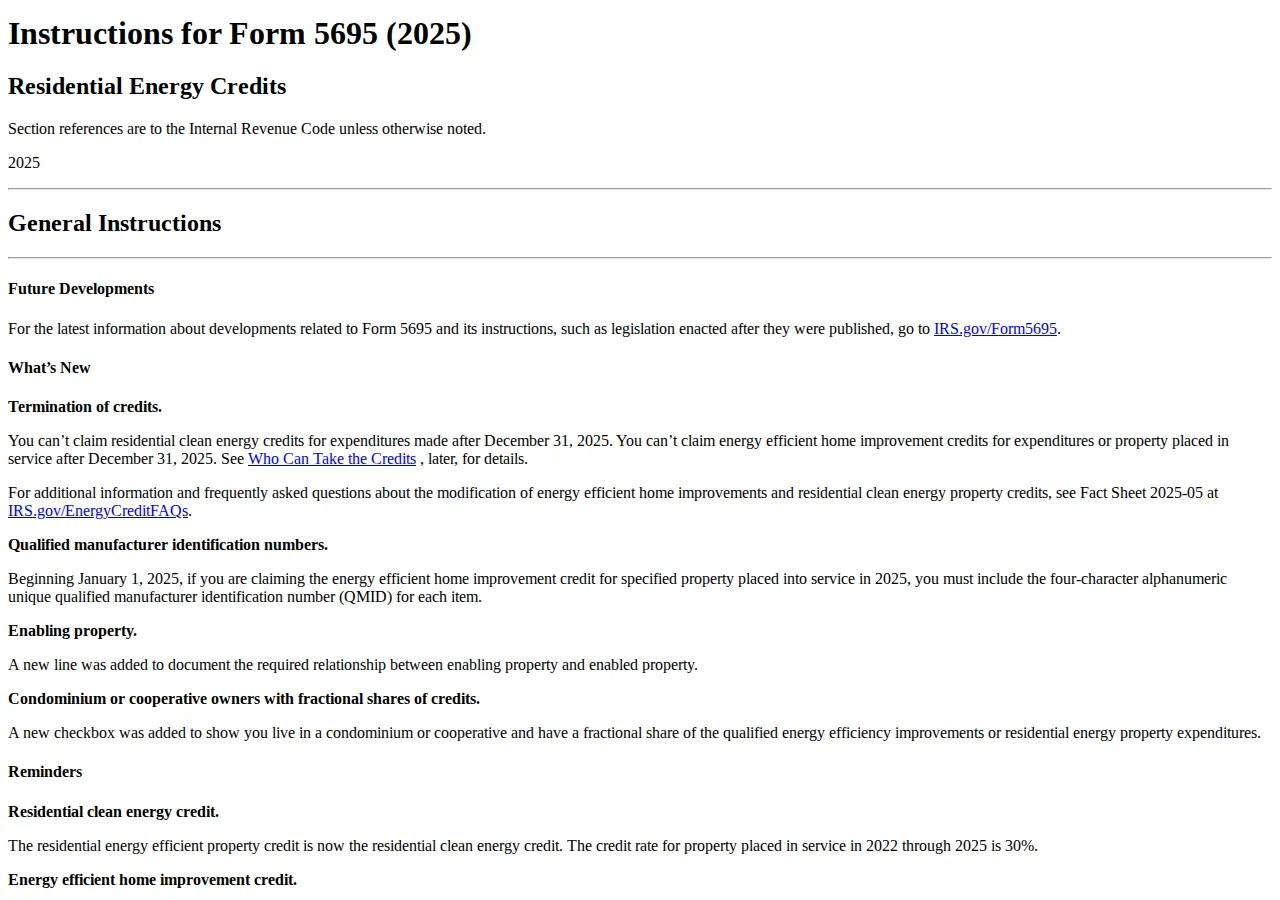
The QMID rule is new and strict. The 2025 Instructions for Form 5695 state that, beginning January 1, 2025, a taxpayer claiming the energy efficient home improvement credit for specified property placed in service in 2025 must include the four-character alphanumeric QMID for each item, and the Part II caution is blunt: to qualify for the credit for specified property, you must provide a valid QMID for each item. The number comes from the manufacturer, not the installer, and it must be on the return. A home energy audit has its own substantiation rule: the written report must include the auditor's name and employer identification number (EIN) or other taxpayer identifying number (TIN) — for an individual auditor, that TIN is an SSN or ITIN — an attestation that the auditor is certified by a qualified certification program, and the name of that program. An audit receipt without those three elements supports no credit.
§ 25D: 30 percent, no cap, and the carryforward that saves it — Example 2
§ 25D is the simpler credit and the larger one. It pays 30 percent of qualified solar electric property, solar water heating property, fuel cell property, small wind energy property, geothermal heat pump property, and battery storage technology expenditures under 26 U.S.C. § 25D(a) — for property installed from 2022 through December 31, 2025, per the IRS Residential Clean Energy Credit page. There is no annual cap. The only limit is the fuel cell rule: § 25D(b)(1) caps the fuel cell credit at $500 for each half kilowatt of capacity. Battery storage must have a capacity of at least 3 kilowatt hours. The credit is claimed in the tax year the property is installed, not merely purchased — a deposit paid in 2025 for a system installed in 2026 is a 2026 expenditure, and there is no § 25D credit for 2026 expenditures.
Take a homeowner who installed a $28,000 solar array and a $12,000 battery in 2025:
The $3,000 carryforward is the difference between the two credits. It is claimed on Form 5695 — the 2025 instructions direct taxpayers to use the form both to take a residential clean energy credit carryforward from 2024 and to carry the unused portion of the credit to 2026, on line 16 of Part I. The fuel cell cap works the same way in miniature: a $20,000 fuel cell system with 2 kilowatts of capacity computes to 30 percent, or $6,000, but § 25D(b)(1) caps it at $500 per half kilowatt — four half kilowatts, $2,000. The $4,000 difference is not a planning failure; it is the statute working as written, and the installer who quoted the credit at 30 percent of the system price quoted it wrong.
Founder & CEO Insight — Enow A. Jovial
The termination: two tests, one deadline, one trap
The One Big Beautiful Bill Act, signed July 4, 2025, terminated both credits — but the two terminations use different tests, and the difference decides one real edge case. § 25C, under OBBBA § 70506, does not apply to property placed in service after December 31, 2025. § 25D, under OBBBA § 70505, does not apply to expenditures made after December 31, 2025. The 2025 Instructions for Form 5695 state both plainly: you cannot claim residential clean energy credits for expenditures made after December 31, 2025, and you cannot claim energy efficient home improvement credits for expenditures or property placed in service after December 31, 2025. The IRS Residential Clean Energy Credit page adds that the credit is not available for any property placed in service after December 31, 2025.
The trap is the system paid for in December 2025 and installed in January 2026. Under the § 25D expenditures-made test, the payment date helps; under the placed-in-service formulation the IRS page states, it does not. Do not rely on the payment date alone — confirm the position with a CPA before filing, and do not let an installer promise a credit for a 2026 installation on the strength of a 2025 invoice. Before OBBBA, § 25C ran through 2032 and § 25D through 2034 with a rate step-down; the Act pulled both endings forward to the same date. The same Act ended the clean vehicle credit under § 30D — the IRS Form 8936 clean vehicle credit playbook covers that sibling termination — and the bonus depreciation playbook and the § 174 software capitalization guide cover the OBBBA business changes that did survive.
The claim, in five steps:
- Confirm the 2025 placed-in-service date. Invoices and the installer's completion certificate are the evidence.
- Collect the QMID and manufacturer certification for every § 25C item. No valid QMID, no credit for that item.
- Compute the § 25C cap stack: $1,200 general bucket, $2,000 heat pump bucket, audit inside the general bucket.
- Complete Form 5695: Part I for § 25D with the line 16 carryforward, Part II for § 25C with none.
- Check the credit against your 2025 liability. § 25C excess is lost; § 25D excess carries to 2026.
File it in this order
- [x] Confirm the placed-in-service date is in 2025. Invoices, the installer's completion certificate, and the inspection sign-off are the evidence. A 2026 date means no credit under either section.
- [x] Collect the manufacturer's certification and the QMID for every § 25C item. Specified property without a valid QMID gets no credit.
- [x] Compute the § 25C cap stack before the liability check. General bucket $1,200, heat pump bucket $2,000, sub-caps inside the general bucket. Do not add the audit $150 on top of a full bucket.
- [x] Complete Form 5695, Part I for § 25D and Part II for § 25C. Part I line 16 carries any unused § 25D credit to 2026. Part II has no carryforward line.
- [x] Check the credit against your 2025 tax liability. § 25C excess is lost; § 25D excess carries forward.
- [x] Keep the audit substantiation. Auditor name and EIN or TIN, the certification-program attestation, and the program name — all three, or the audit credit fails.