The clean vehicle credits are over as a buying incentive, and the filing work is not. The One Big Beautiful Bill Act (Public Law 119-21) terminated them for vehicles acquired after September 30, 2025 — §30D, §25E, and §45W share that date. But a termination date is not a filing deadline: vehicles acquired on or before September 30, 2025 still claim, and dealer transfers from those sales still have to be reconciled on Form 8936. Every figure below is read from the IRS credit pages, the 2025 instructions, or the statute text on November 16, 2026.
The three credits, one termination date
Form 8936 covers three different credits, and the first mistake is treating them as one: §30D pays up to $7,500 to an individual buyer, §25E up to $4,000 to an individual buying a used EV or fuel cell vehicle from a licensed dealer, and §45W up to $40,000 to a business or tax-exempt organization. All three share the September 30, 2025 termination date, but the tests differ — the MSRP caps only to §30D, the $25,000 price ceiling only to §25E, the weight-based maximum only to §45W.
| Attribute | §30D new clean vehicle | §25E previously owned | §45W commercial | Authority |
|---|---|---|---|---|
| Maximum credit | $7,500 | $4,000 | $40,000 | 26 U.S.C. §§ 30D, 25E; IRS §45W page |
| Formula | $3,750 + $3,750 (two halves) | Lesser of $4,000 or 30% of price | Lesser of max, % of basis, incremental cost | 26 U.S.C. §§ 30D(b), 25E(a), 45W |
| Price ceiling | MSRP $80,000 vans/SUVs/pickups; $55,000 other | Sale price $25,000 or less | None — weight-based maximum instead | IRS new/used/commercial pages |
| Income cap (MFJ) | Modified AGI $300,000 | Modified AGI $150,000 | None | 26 U.S.C. §§ 30D(f), 25E(b) |
The §30D math: two $3,750 halves
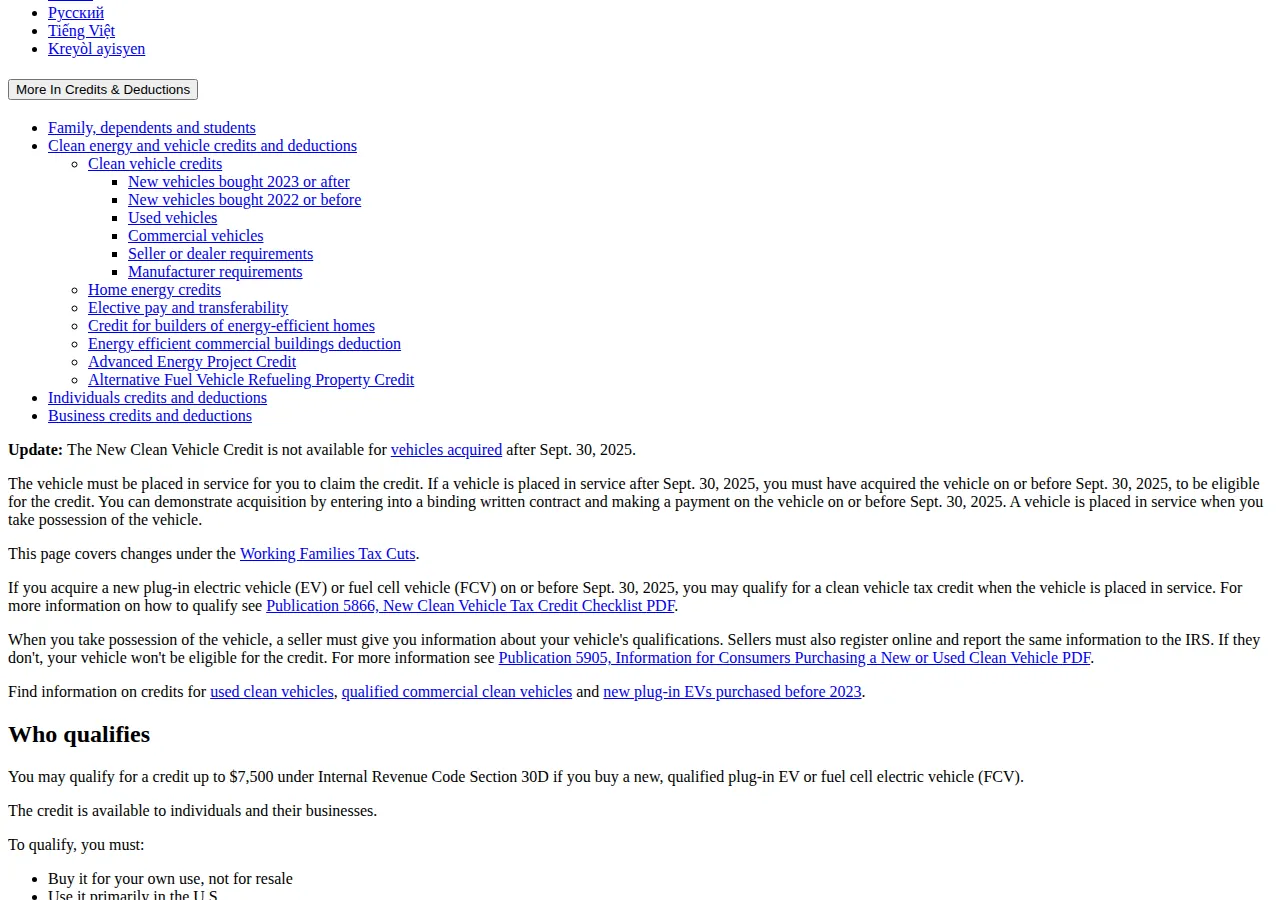
Under 26 U.S.C. §30D(b), the credit is the sum of two amounts: $3,750 if the vehicle meets the critical minerals requirement and $3,750 if it meets the battery components requirement. One met earns $3,750; neither earns nothing.
The percentages behind each half rose every year the credit was live: the critical-mineral requirement was 40% for 2023, 50% for 2024, and 60% for 2025, on the value of the battery's critical minerals extracted or processed in the United States or a free-trade partner; the battery-component requirement was 50%, 60%, and 70% for the same years, on components manufactured or assembled in North America. The statute carried higher rungs for 2026 and later, but the Act struck them.
Four gates stand before either half is payable: a battery of at least 7 kilowatt hours, a gross vehicle weight rating under 14,000 pounds, a qualified manufacturer, final assembly in North America. The buyer must buy for personal use, not resale, primarily in the United States. MSRP may not exceed $80,000 for vans, SUVs, and pickups, or $55,000 for other vehicles, excluding destination fees. The seller must report to the buyer and the IRS; without it, the vehicle is not eligible at all.
Worked example — new SUV, both halves met. A married couple filing jointly buys a new SUV: MSRP $72,000, North American assembly, 75 kWh battery, both requirements met — credit $3,750 + $3,750 = $7,500. Their modified AGI is $280,000, under the $300,000 joint cap, tested on the lower of the delivery year or the prior year. At $305,000 in both years the credit would be zero, not reduced: the income test is a cliff, not a phaseout.
The §25E math: the lesser of $4,000 or 30%
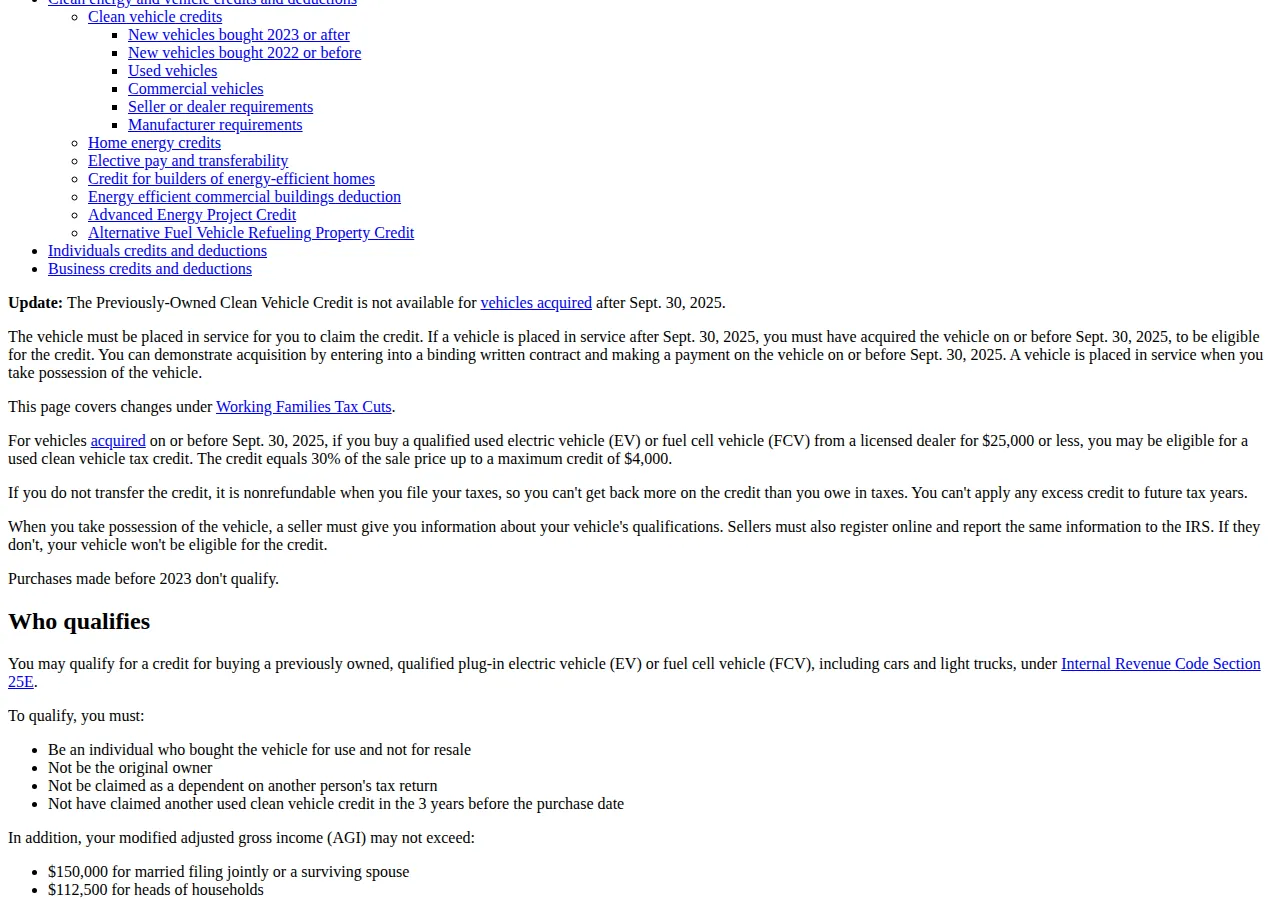
Under 26 U.S.C. §25E(a), the credit is the lesser of $4,000 or 30% of the sale price, and the sale price itself may not exceed $25,000. Four conditions attach: a licensed dealer must make the sale, it must be the first transfer since enactment to a qualified buyer other than the original user, the model year must be at least two years earlier than the purchase year, and the buyer must not have claimed another used clean vehicle credit in the three years before the purchase date.
Worked example — used EV at $18,000. Thirty percent of $18,000 is $5,400, so the cap binds: the credit is $4,000. At $12,000, 30% is $3,600 and the percentage binds instead. The break-even price is $13,333: below it the percentage governs, above it the cap. The income caps are half the new-vehicle figures — $150,000 married filing jointly, $112,500 head of household, $75,000 for other filers — again tested on the lower of the two years. A buyer who claimed one in 2023 and buys again in 2025 is barred — the lookback runs from the purchase date.
The dealer transfer: cash now, reconciliation later
Since 2024, a buyer could transfer the credit to a registered dealer at the time of sale and take it as a price reduction instead of a credit on the return — the single most valuable election on the form, because the untransferred credit is nonrefundable: a $4,000 credit against a $2,300 tax liability wastes $1,700, with no carryforward. The transferred credit is worth the full $4,000 at the dealership, whatever the buyer's liability is.
The transfer is not free money. The dealer must be registered, must submit a time-of-sale report to IRS Energy Credits Online, and must give the buyer the accepted seller report within three calendar days of taking possession. The IRS dealer page states the portal closed to new submissions on September 30, 2025, and stays open only for previously registered users to file time-of-sale reports and updates. The buyer still files Form 8936 and Schedule A to reconcile the amount, and a buyer who no longer qualifies — the income test fails, or the vehicle is resold too soon — repays the transferred credit.
Founder & CEO Insight — Enow A. Jovial
Form 8936, line by line
The 2025 instructions organize the form into four parts, taken in order. Part I figures the modified AGI amount: lines 1a and 3a take the current-year and prior-year figures, and the lower one is tested against the caps. Part II figures the business or investment use part of a new clean vehicle, Part III the personal use part — the instructions add that a taxpayer claiming the personal-use part must fill out Part II even when no business-use amount is claimed — and Part IV the previously-owned credit. Schedule A carries the vehicle details, including the VIN on line 2, and reconciles the transferred amount.
- Confirm the acquisition date first. Acquired after September 30, 2025, there is no credit. Acquisition is the binding written contract plus a payment on or before September 30, 2025.
- Collect the seller report. Without the dealer's time-of-sale report the vehicle is not eligible — keep the accepted copy with the workpapers.
- Run the modified AGI test in Part I. Enter both years' figures on lines 1a and 3a and test the lower one against the caps — $300,000, $225,000, or $150,000 for a new vehicle; $150,000, $112,500, or $75,000 for a used one.
- Figure the credit amount. New: test the two $3,750 halves against the placed-in-service-year schedules. Used: the lesser of $4,000 or 30% of the price. Commercial: the lesser of the weight maximum, the basis percentage, and the incremental cost.
- Split business and personal use. Complete Part II even when the claim is entirely personal — the instructions require it — then take the personal portion in Part III.
- Route the credit to the right line. Personal use to Schedule 3 (Form 1040), line 6f for new and line 6m for previously owned. Business use to Form 3800, Part III — line 1y for new, line 1aa for commercial. A transferred credit is reconciled on Schedule A so it is not claimed twice.
The §45W commercial credit follows the same form but a different formula: the lesser of the weight-based maximum ($7,500 under 14,000 pounds GVWR, $40,000 at or over), the basis percentage (30% for a vehicle not powered by a gasoline or diesel engine, 15% for one powered even partially by gas or diesel, including plug-in hybrids), and the incremental cost — the excess of the purchase price over a comparable gas or diesel vehicle. A $60,000 electric delivery van under 14,000 pounds GVWR has a $7,500 maximum, an $18,000 basis figure, and an $8,000 incremental cost against a $52,000 comparable diesel van — so the $7,500 maximum is the credit. Businesses must complete the IRS pre-filing registration before electing payment.
The commercial credit is claimed by the business that places the vehicle in service — an LLC, an S-Corp, or a C-Corp — and the entity's EIN goes on the pre-filing registration. A CPA should confirm the incremental-cost computation before filing: the comparable-vehicle price is the number the IRS tests first, and a CPA review is cheaper than the adjustment that follows a thin one. The same question decides the personal-use split in Part II: an S-Corp owner-employee who takes the vehicle home has a business-use percentage to defend, backed by a mileage log.
The failure modes that cost the credit
Most lost clean vehicle credits are lost on the paperwork around them, not on the statute. First, the seller report: a dealer who never registered, or who filed the time-of-sale report late, leaves the buyer with a vehicle the IRS will not credit. Second, the income cliff: income over the cap in both the delivery year and the prior year means zero, not a reduced credit. Third, the three-year rule: a used-vehicle buyer who claimed the credit in 2023 and buys again in 2025 is barred — the dealer has no way to know; the buyer certifies it. Fourth, the MSRP test, which traps buyers who add the destination fee to the sticker and conclude they are over the cap when they are under it. Fifth, the transfer repayment: a buyer who takes the full $7,500 at the dealership and then fails the income test repays the whole amount as a tax liability, not a reduction.
Who should not file Form 8936
Do not file for a vehicle acquired after September 30, 2025 — there is no credit to claim. Do not file for a vehicle bought for resale, or for one used primarily outside the United States; both fail the §30D use tests. Do not file a §25E claim for a private-party sale — the credit requires a licensed dealer — or for a vehicle whose model year is less than two years older than the purchase year, or for a second used-vehicle credit inside the three-year window. Do not file the commercial credit without the pre-filing registration: the IRS made registration a precondition to electing payment. Run the numbers through the tax estimator first — a nonrefundable credit against a small liability is worth less than the same amount taken at the dealership.
Execution checklist
- [x] Step 1: Date the acquisition. The binding written contract and the payment record must both be on or before September 30, 2025.
- [x] Step 2: Get the seller report. Confirm the dealer filed the time-of-sale report and gave you the accepted copy within three days of possession.
- [x] Step 3: Test modified AGI on both years. Enter both years' figures in Part I and test the lower one.
- [x] Step 4: Compute the credit from the statute. New: two $3,750 halves against the placed-in-service-year percentages. Used: lesser of $4,000 or 30% of price. Commercial: lesser of the weight maximum, the basis percentage, and the incremental cost.
- [x] Step 5: Decide transfer or return claim. If your tax liability is smaller than the credit, the transfer is worth the full amount; if larger, the return claim is equivalent and simpler.
- [x] Step 6: File Form 8936 and Schedule A, then route the credit. Personal use to Schedule 3 lines 6f or 6m; business use to Form 3800 Part III lines 1y or 1aa; never claim a transferred amount twice.
- [x] Step 7: Keep the workpapers. The seller report, contract and payment proof, VIN, and modified AGI worksheets stay with the return for the audit window.
Our §45L and §179D termination playbook covers the other energy credits the same Act ended, with June 30, 2026 triggers that work differently. The §199A QBI playbook covers the same Act's $400 QBI floor and 2026 thresholds, and the SALT cap playbook prices the $40,000 deduction.