Bonus depreciation melted for three years — 80% in 2023, 60% in 2024, 40% in 2025, headed for 20% in 2026 and zero in 2027 — until the One Big Beautiful Bill Act (OBBBA), signed July 4, 2025, repealed the melt. Section 70301 of the enrolled bill strikes the words "the applicable percentage" from §168(k)(1)(A) and inserts "100 percent", deletes the phase-down paragraphs, and makes the restoration permanent — there is no sunset left in the statute. For property acquired after January 19, 2025, the full cost of qualifying equipment is deductible in the placed-in-service year, with no dollar cap and no income limit. The money is in four details: the acquisition date is fixed by the binding-contract date, not the delivery date; a 40% transitional election exists for the first year; used property qualifies only when it is genuinely new to you; and a separate 100% allowance now exists for factory buildings under new §168(n). This playbook prices each one, with every figure traceable to the enrolled text or the current §168(k).
What §70301 actually changed in the statute
The enrolled text of H.R. 1, §70301, is surgical: it amends §168(k)(2)(A) by striking clause (iii) — the sunset clause — and §168(k)(1)(A) by striking "the applicable percentage" and inserting "100 percent", and it strikes paragraphs (6) and (8), which carried the phase-down percentages. The applicable percentage is now a constant, not a schedule: 100% every year, with no 2027 cliff.
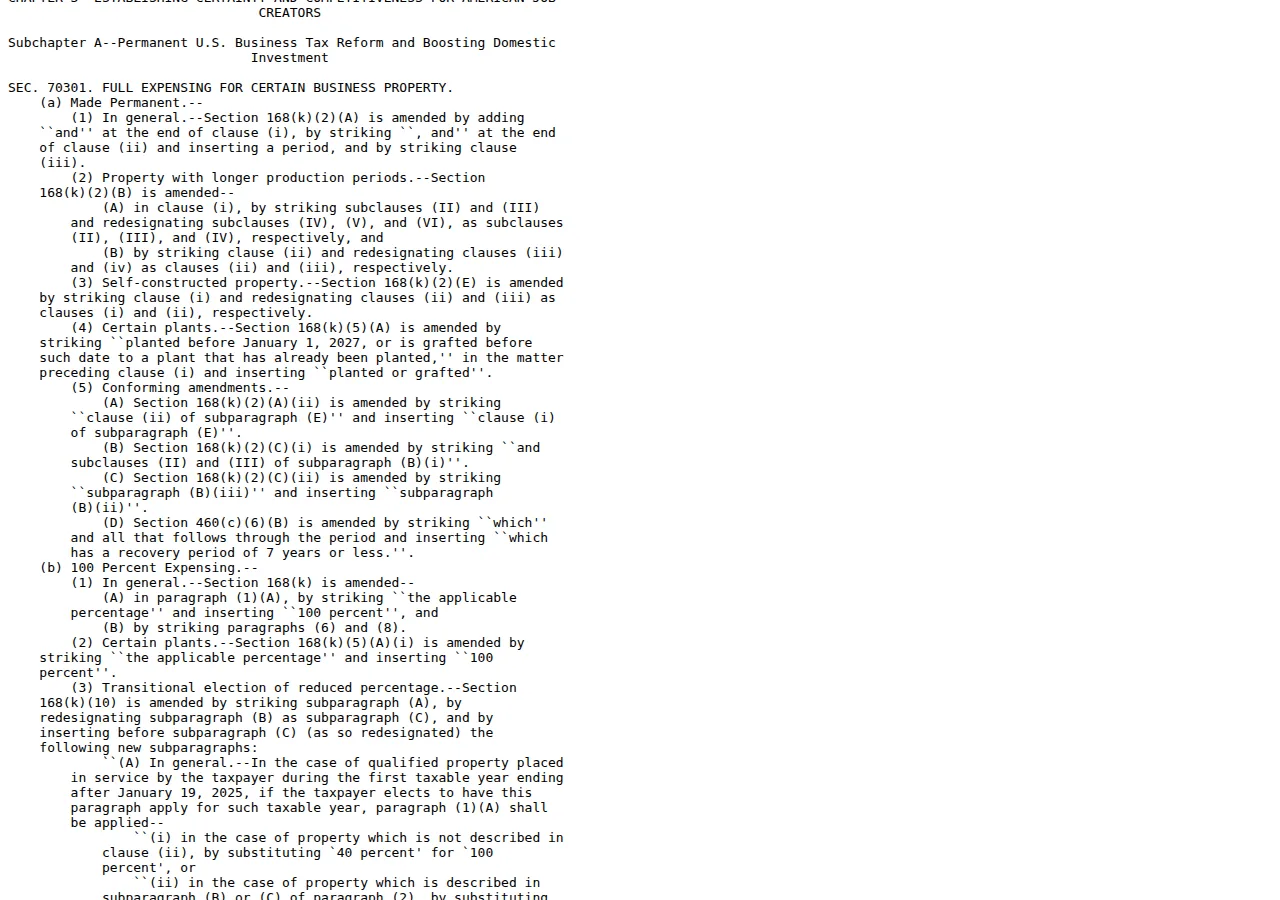
Above: the "Made Permanent" and "100 Percent Expensing" subsections, and the transitional 40% election for the first taxable year ending after January 19, 2025.
Cornell's current §168(k)(1) reads as amended: the placed-in-service-year deduction "shall include an allowance equal to 100 percent of the adjusted basis of the qualified property", and the adjusted basis is reduced by that amount. After year one, a fully bonused asset has zero basis — which is why the recapture rules on a later sale matter as much as the deduction.
The January 19, 2025 line — and the binding-contract trap
The effective date in §70301(c)(1) is "property acquired after January 19, 2025". First, "acquired" does not mean delivered: §70301(c)(4) provides that property "shall not be treated as acquired after the date on which a written binding contract is entered into for such acquisition". Sign a binding contract on January 10, 2025, take delivery in June, place the asset in service in July — the acquisition date is January 10, and the 100% rate does not apply. The property falls under the old phase-down: 40% in 2025, 20% in 2026, zero in 2027. Second, bonus is claimed in the year the property is placed in service, not the year it is bought: a machine delivered December 28, 2026 but not ready for its assigned function until January 2027 takes its deduction in 2027.
The $400,000 is the remaining basis after the 20% bonus.
The 40% transitional election: when less is more
Section 70301(b)(3) rewrites §168(k)(10) to add a transitional election. For qualified property placed in service during the first taxable year ending after January 19, 2025, a taxpayer may elect to apply 40% instead of 100% — or 60% for property described in §168(k)(2)(B) or (C), the longer-production-period property and certain aircraft. The election is made on a timely filed return, and the IRS's Notice 2026-11 (announced in IR-2026-06 on January 14, 2026) confirms the mechanics: the existing Reg. §1.168(k)-2 framework applies with date substitutions, and the election rides on the applicable Form 4562.
Who takes 40% when 100% is on the table? A business with an NOL it cannot use, where the extra deduction enlarges an NOL that sits unused; a business managing the §179 business-income limit, where expensing more than taxable income wastes §179 dollars; or a business smoothing income to stay in a lower bracket. The election is per taxable year, made on the return — with the year's numbers in front of you.
| Election | Rate applied | Who it serves | Authority |
|---|---|---|---|
| No election (default) | 100% | Profitable buyers who want the full year-one deduction | §168(k)(1)(A), as amended by OBBBA §70301(b)(1) |
| Transitional election | 40% (60% for longer-production-period property and aircraft) | NOL-heavy or income-smoothing taxpayers, first tax year ending after Jan 19, 2025 only | §168(k)(10), as amended by OBBBA §70301(b)(3) |
| Elect out by class | 0% bonus for that class | Taxpayers who want straight MACRS for a whole asset class | §168(k)(7), unchanged |
| §179 instead of bonus | Up to the §179 limit, then bonus on the remainder | Buyers under the §179 phaseout who want the income-limited expensing first | §179(b), as amended by OBBBA §70306 |
Our section 179 vs bonus depreciation guide runs the full comparison for startup equipment, including the business-income limit that bonus depreciation does not have. Our cost segregation study playbook covers the engineering study that reclassifies building components into 5-, 7-, and 15-year property — the components that then take 100% bonus in year one.
What qualifies: the 20-year rule, used property, and the new sound recordings
Section 168(k)(2)(A) defines qualified property. The core test is a recovery period of 20 years or less — machinery, equipment, vehicles, furniture, computers, and the 5-, 7-, and 15-year components a cost segregation study pulls out of a building. Computer software deductible under §167(a) qualifies, as does water utility property, qualified film or television productions, qualified live theatrical productions, and — the OBBBA addition — qualified sound recording productions, for productions produced and recorded in the United States commencing in a tax year ending after July 4, 2025. Property under the alternative depreciation system (ADS) does not qualify.
Used property qualifies, and this is where founders leave money on the table. Section 168(k)(2)(E)(i) allows an acquisition of used property when it was not used by the taxpayer at any time before the acquisition and the acquisition meets the §179(d)(2)(A), (2)(B), (2)(C), and (3) requirements — the related-party rules. The test is "new to you", not "new". A used CNC machine bought from an unrelated seller, never used by your business before, takes the full 100% in year one. The identical machine bought from your brother, from a partnership you control, or received as a gift or inheritance does not.
The $102,852 difference is the price of the seller's identity. Keep the purchase agreement, the seller's identity, and the placed-in-service date in the file — the three facts an examiner asks for first.
The §179 interplay: two expensing tools, one ordering rule
OBBBA §70306 raised the §179 limits alongside the bonus restoration: §179(b)(1) from $1,000,000 to $2,500,000, and the phaseout threshold in §179(b)(2) from $2,500,000 to $4,000,000, effective for tax years beginning after December 31, 2024. Rev. Proc. 2025-32 indexed those figures for 2026: limit $2,560,000, phaseout above $4,090,000, SUV cap $32,000. The ordering rule is fixed: §179 first, subject to its business-income limit, then bonus on the remaining basis.
| Year | §179 limit | Phaseout begins above | SUV cap | Authority |
|---|---|---|---|---|
| 2024 (pre-OBBBA) | $1,220,000 | $3,050,000 | $30,500 | Rev. Proc. 2023-34 |
| 2025 | $2,500,000 | $4,000,000 | $31,300 | OBBBA §70306; Rev. Proc. 2025-32 §2.10 |
| 2026 | $2,560,000 | $4,090,000 | $32,000 | Rev. Proc. 2025-32 §2.24 |
On a $3,000,000 equipment purchase in 2026 — under the $4,090,000 phaseout threshold, so the full §179 limit is available — §179 expenses $2,560,000 and 100% bonus takes the remaining $440,000:
The choice is not about the federal total. It is about the §179 business-income limit (bonus has none), state treatment (several states, including California, do not conform, so the state return may still use MACRS), and recapture: §179 recapture on a business-use drop below 50% is ordinary income, and bonus on property later converted to personal use is recaptured the same way. Run the numbers through the profit calculator before you sign the purchase order.
The factory-building allowance: new §168(n)
OBBBA §70307 added §168(n), the part of the restoration most buyers have not heard of: for qualified production property — the production portion of a new nonresidential real property — the placed-in-service-year deduction includes an allowance equal to 100 percent of the adjusted basis. The conditions are: original use must commence with the taxpayer; construction must begin after January 19, 2025 and before January 1, 2029; the property must be placed in service before January 1, 2031; and it must be used as an integral part of a qualified production activity — manufacturing, production, or refining of a qualified product, with a substantial transformation of the property. Office space, administrative services, lodging, parking, sales activities, research, and software development or engineering space are expressly excluded. The allowance is an election, made on the return, and the basis is reduced by the allowance before any further depreciation is computed.
A manufacturer that begins construction on a $2,000,000 production hall in June 2025 and places it in service in 2027 deducts the full $2,000,000 in 2027 — against 39 years of MACRS under the old rules; the excluded office portion inside the same building is depreciated normally. An acquired building can also qualify if it was not used in a qualified production activity by anyone from January 1, 2021 through May 12, 2025, was not used by you before acquisition, and the acquisition meets the §179(d) related-party rules. Our section 174 software capitalization guide covers the other OBBBA restoration — §174A domestic research expensing — in the same bill and the same planning conversation.
Founder & CEO Insight — Enow A. Jovial
Operator boundaries: who this helps, and who it hurts
The restoration is not a universal win. A business with an NOL carryforward it cannot absorb gains nothing from a larger deduction — it creates a bigger NOL, not cash. A business whose income is sheltered by the §199A qualified business income deduction should check the interaction: bonus depreciation reduces taxable income and can reduce QBI, which can reduce the §199A deduction itself. And a business in a non-conforming state pays state tax on MACRS while taking federal bonus, so the combined saving is smaller than the federal arithmetic suggests.
Bonus depreciation is recaptured as ordinary income to the extent of gain on a later sale. A $120,000 machine fully expensed in 2026 and sold for $60,000 in 2028 produces $60,000 of ordinary income in 2028 — the deduction is a timing benefit, not a permanent exclusion.
Execution checklist
- [x] Step 1: Confirm the acquisition date: find the binding-contract date in the purchase agreement; on or before January 19, 2025, the 100% rate does not apply.
- [x] Step 2: Confirm the placed-in-service date: the asset must be ready and available for its function; delivery alone is not placed in service.
- [x] Step 3: Classify the property: recovery period of 20 years or less, or software, water utility, film/TV, live theatre, or sound recordings; ADS property is excluded.
- [x] Check the used-property test: not used by you before, and the seller is not a related party under §179(d).
- [x] Step 4: Run §179 first, then bonus: the 2026 limit is $2,560,000 with phaseout above $4,090,000, then 100% bonus on the remaining basis.
- [x] Decide on the 40% election: for the first tax year ending after January 19, 2025, decide with the actual return numbers whether 40% serves you better.
- [x] Check state conformity: if your state does not follow federal bonus, budget the state MACRS liability separately.
- [x] Make the elections on the return: the 40% election and the §168(n) election are both made on a timely filed return, with Form 4562 carrying the detail.