IRS Form 5500: The Employee Benefit Plan Filing Playbook
Every private-sector retirement plan and most welfare benefit plans in the United States owe the government one annual report: Form 5500. The form is short; the rules are not.
Form 5500 is the annual return and report of an employee benefit plan under the Employee Retirement Income Security Act of 1974, known as ERISA. It goes to the Department of Labor and the IRS through one electronic filing. Section 103 of ERISA, 29 U.S.C. section 1023, says an annual report shall be published for every employee benefit plan to which the law applies, filed with the Secretary of Labor, and made available and furnished to participants. Whether the sponsor is an LLC, an S-Corp, or a C-Corp, the filing duty is the same; the return identifies the sponsor by EIN and the plan by its plan number.
Who must file
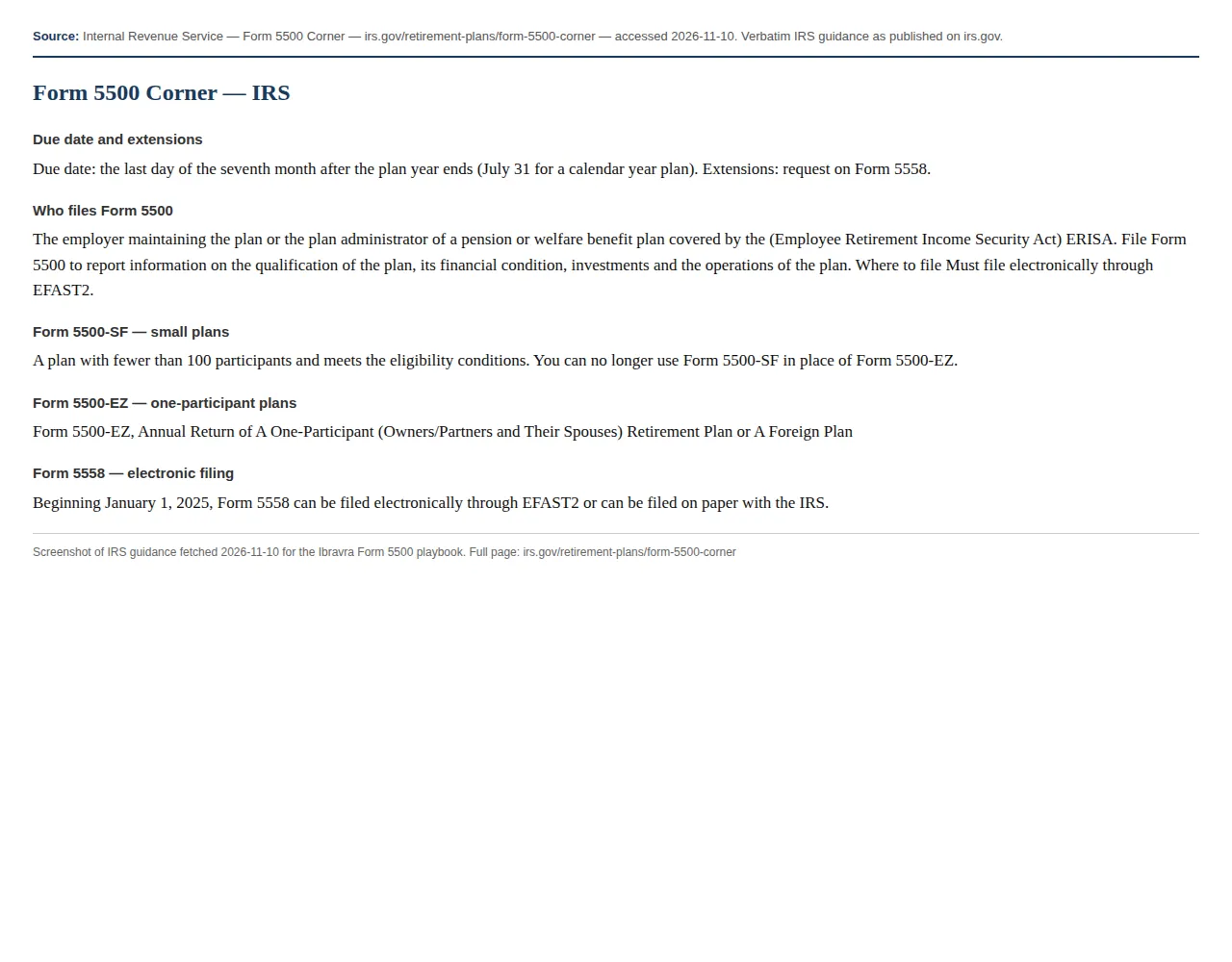
The filing duty falls on the plan administrator of a pension or welfare benefit plan covered by Title I of ERISA, usually the employer maintaining the plan. The IRS states it on its Form 5500 Corner: file Form 5500 to report information on the qualification of the plan, its financial condition, its investments, and the operations of the plan.
The size line is the participant count at the beginning of the plan year. A plan covering 100 or more participants at the start of the year is a large plan and files the full Form 5500 with Schedule H and an independent audit. A plan with fewer than 100 participants at the start of the year is a small plan and files the full Form 5500 with Schedule I, or the short form where it qualifies.
Two edges soften that line. First, the 80 to 120 rule: a plan with between 80 and 120 participants at the beginning of the plan year may elect to file in the same category it filed the year before (29 CFR 2520.103-1(d)). Second, a welfare plan with fewer than 100 participants at the beginning of the year that is unfunded, fully insured, or a combination of the two is generally exempt. A 401(k) plan has no such escape.
Plans in common or collective trusts, pooled separate accounts, master trusts, 103-12 investment entities, or group insurance arrangements file through direct filing entities, so the same investment detail is not reported twice.
Which return: 5500, 5500-SF, or 5500-EZ
Three forms cover the same duty at different depths. Picking the wrong one is the most common filing error in small plans: Form 5500-SF can no longer be used in place of Form 5500-EZ.
| Form | Who files it | What it is | Authority |
|---|---|---|---|
| Form 5500 | Large plans with 100 or more participants, and small plans that do not qualify for the short form | The full annual return with Schedules A, C, H or I, and R | 29 U.S.C. section 1023; IRS Form 5500 Corner |
| Form 5500-SF | A plan with fewer than 100 participants that meets the eligibility conditions | The short form annual return for small plans | IRS Form 5500 Corner; 29 CFR 2520.103-1 |
| Form 5500-EZ | A one-participant plan covering only owners or partners and their spouses, or a foreign plan | The annual return of a one-participant retirement plan | IRS Form 5500-EZ page; 26 U.S.C. section 6652 |
Form 5500-EZ is the return for a plan that covers nobody but the owner and the owner's spouse, the classic solo 401(k). Because a one-participant plan is not subject to Title I of ERISA, the EZ filer reports to the IRS only, and the Labor Department's relief programs do not apply to it. If you run a solo plan, read the comparison in solo 401(k) vs SEP IRA: the self-employed retirement playbook before you pick a plan design.
Form 5500-SF is the middle path. A small plan that meets the eligibility conditions files the short form instead of the full Form 5500 with Schedule I, and it skips the audit entirely. A plan with complex features, such as a defined benefit promise or a multiple-employer structure, usually cannot use it.
The schedules
The main form is a cover sheet. The substance lives in the schedules, and each schedule answers a different question the agencies ask about the plan.
| Schedule | What it reports | Who completes it | Authority |
|---|---|---|---|
| Schedule A | Insurance information, including contracts and commissions | Plans with insurance contracts | 29 CFR 2520.103-1 |
| Schedule C | Service provider information and direct and indirect compensation | Plans with reportable service providers | 29 CFR 2520.103-1 |
| Schedule H | Financial information for large plans, with the audit attached | Plans with 100 or more participants | 29 U.S.C. section 1023(a)(3) |
| Schedule I | Financial information for small plans | Plans with fewer than 100 participants | 29 CFR 2520.103-1 |
| Schedule R | Retirement plan information, including distributions and funding | Retirement plans | 29 CFR 2520.103-1 |
Schedule C is where fee disclosure lives: it requires reporting of compensation paid to service providers, including indirect compensation from sources other than the plan. Schedule H is the large-plan financial statement, and the independent audit attaches to it. Defined benefit plans add Schedules MB or SB; multiple-employer plans add Schedule MEP. A return missing a required schedule is incomplete and can be rejected, which the statute treats as not filed at all.
The deadline and the extension
Form 5500 is due on the last day of the seventh month after the plan year ends. For a calendar-year plan the plan year ends December 31 and the return is due July 31 of the following year. The screenshot below shows the IRS Form 5500 Corner page as fetched on November 10, 2026.
Form 5558, filed on or before the normal due date, moves the deadline by two and a half months, to the 15th day of the third month after the normal due date. For a calendar-year plan that means July 31 becomes October 15. The extension is automatic when the form is filed on time; no reason is required and no approval letter comes back.
The extension moves one clock and not the other. The IRS penalty count respects the extension, so a return filed on October 14 under a valid Form 5558 is on time for IRS purposes. The Labor Department's DFVC fee does not respect it: under the program notice, the fee runs from the original due date without regard to any extension.
The audit rule and the small-plan waiver
Section 103 of ERISA requires the plan administrator to engage an independent qualified public accountant, in practice a CPA firm, to examine the plan financial statements and offer an opinion on whether they are presented fairly under FASB standards (GAAP). For a large plan filing Schedule H, the audit is a fixed cost to plan months ahead.
Small plans can escape the audit under the waiver in 29 CFR 2520.104-46. The plan qualifies if at least 95 percent of its assets are qualifying plan assets, or if every person who handles the non-qualifying assets is bonded under ERISA section 412 in an amount at least equal to the value of those assets. Qualifying plan assets are, in substance, assets held by an FDIC-insured bank, insurance carrier, or registered broker-dealer, or in mutual funds whose values are independently reported.
What a late filing costs
A late Form 5500 draws two separate penalties from two separate agencies, and they stack. The Labor Department assesses under ERISA section 502(c)(2). The statute sets the maximum at 1,000 dollars a day, adjusted for inflation each year under 29 CFR 2575.3. The adjusted figure for 2025 was 2,739 dollars a day, set by the Department's January 10, 2025 notice at 90 FR 1854. For 2026 the Department published a notice of no adjustment, because the Bureau of Labor Statistics did not publish its October 2025 CPI-U data and the law allows no alternative calculation, so the 2025 amount continues to apply. The 2026 daily maximum is therefore 2,739 dollars, published at 91 FR 31358 on May 27, 2026. The IRS assesses under section 6652(e): 250 dollars a day, capped at 150,000 dollars per return.
The exposure math is simple, and the numbers get large fast:
Take a large plan that files 90 days late with no extension. The Labor Department exposure is 90 times 2,739 dollars, which is 246,510 dollars. The IRS exposure is 90 times 250 dollars, which is 22,500 dollars, well under the cap. The combined exposure is 269,010 dollars for a return that cost a few thousand dollars to prepare. These are maximums, and the Labor Department penalty is discretionary, so an assessed penalty may be lower. But the ceiling is the number a plan administrator must plan against.
The Labor Department counts from the original due date. The IRS counts from the due date as extended by a valid Form 5558. The extension saves the IRS count and nothing else.
DFVC: the way back
The Labor Department runs a program for plans that missed the deadline and want to come back in. The Delinquent Filer Voluntary Compliance Program, DFVC, lets a plan administrator file the overdue returns through EFAST2 and pay a reduced fee instead of facing the full section 502(c)(2) penalty. The fee is 10 dollars for each day the report is late, counted from the original due date without regard to any extension. The fee is capped at 750 dollars for a single late report from a small plan and 2,000 dollars for a single late report from a large plan. Where one submission covers more than one delinquent report for the same plan, the per-plan caps are 1,500 dollars for a small plan and 4,000 dollars for a large plan. The fee schedule comes from the program notice at 78 FR 6135.
Run the same 90-day example through the program. The large plan's fee is 10 times 90, which is 900 dollars, under the 2,000 dollar cap. The small plan's fee is also 900 dollars of daily charges, but the 750 dollar cap binds, so the fee is 750 dollars. The program replaces the Labor Department penalty, and the IRS has agreed to waive its penalties for delinquent reports filed under the program.
The program is open to plan administrators with filing obligations under Title I of ERISA who have not been notified in writing by the Labor Department of a failure to file. Once the Department sends a notice of intent to assess a penalty, the door closes. File under DFVC the moment the miss is found, before any letter arrives.
The filing operation: EFAST2 and the 120-day rule
Form 5500, Form 5500-SF, and the schedules are filed electronically through EFAST2, the Labor Department's ERISA Filing Acceptance System. There is no paper filing for the main return; the return is filed as structured data through EFAST2, not as a scanned PDF. The filing requires electronic signatures from the plan administrator and, where applicable, the plan sponsor, and the EFAST2 credentials must work before the deadline week. Form 5500-EZ is the exception: it is filed with the IRS, on paper or electronically as the IRS directs for the year.
The statute builds in a timing rule that shapes the whole preparation calendar. Where an insurance carrier, bank, or plan sponsor holds the information the administrator needs, that holder must transmit and certify the accuracy of the information to the administrator within 120 days after the end of the plan year. For a calendar-year plan that date is April 30. Payroll and benefits administration sit next to this filing; the employer cost picture is covered in Gusto vs Rippling vs QuickBooks Payroll: the employer cost playbook, and the quarterly payroll return is covered in IRS Form 941: the quarterly payroll tax filing playbook.
Founder & CEO Insight — Enow A. Jovial
The execution checklist
Run the filing as a dated operation, not as a single deadline.
- Count participants on the first day of the plan year and record the number; that count decides the form and the audit.
- Decide by March whether the plan qualifies for Form 5500-SF and whether the small-plan audit waiver is available.
- Collect carrier, custodian, and service provider data by April 30, the 120-day certification date.
- Engage the auditor by May if the plan files Schedule H.
- File Form 5558 before the normal due date if the return will not be ready, and treat October 15 as the reserve date, not the target.
- File through EFAST2, keep the filing confirmation with the plan records, and send participants the summary annual report.
- If a return is missed, file under DFVC at once; run the exposure through the tax estimator to see what the daily penalties add up to.
The statute is short, the schedules are fixed, the deadline is arithmetic, and the penalty for missing it is priced by the day.