Form 1120-S is the return that makes an S corporation real to the IRS — and the only return where the filer usually owes nothing and the shareholders owe everything. The corporation reports income, deductions, and credits, then passes each item through on Schedule K-1, and the shareholders pay the tax on their own returns. That pass-through is the point of the election, and where the filing goes wrong: the return decides how much profit reaches each shareholder tax-free, how much arrives as a dividend, and how much the corporation itself owes under two corporate-level taxes most owners never budget. Figures are from the Instructions for Form 1120-S (2025) and the statute, as read November 16, 2026.
Who files it, and what the election requires
An S corporation is a domestic corporation that elects S treatment under § 1362(a) and meets every gate in § 1361(b)(1): no more than 100 shareholders; no shareholder who is not an individual, other than an estate, a § 1361(c)(2) trust, or a § 1361(c)(6) organization; no nonresident alien shareholder; and no more than one class of stock. Fail any gate and the election terminates — the corporation reverts to C treatment and files Form 1120. Our 1120s vs 1120 comparison runs the two returns side by side; the § 1361 eligibility playbook works each gate with the trust and estate exceptions.
The election is Form 2553, and timing is the trap: under § 1362(b), an election made after the 15th day of the 3rd month takes effect the following taxable year. The instructions describe a relief procedure for late elections — the Form 2553 deadline playbook runs it — but relief has its own conditions, not a right.
Founder & CEO Insight — Enow A. Jovial
The calendar: March 16, then September 15
A calendar-year S corporation files by the 15th day of the 3rd month after its tax year ends. For the 2025 return that is March 16, 2026 — March 15 falls on a Sunday, so the date moves to Monday. A dissolved corporation files by the 15th day of the 3rd month after dissolution. File Form 7004 by the regular due date and the automatic extension is generally six months, to September 15, 2026. The extension covers filing, not payment: any § 1374, § 1375, or recapture tax due is still due March 16, and interest runs from the original due date.
| Date | Event | Authority |
|---|---|---|
| March 16, 2026 | Form 1120-S due (calendar-year 2025 return; March 15 is a Sunday) | Instructions for Form 1120-S (2025), When To File |
| March 16, 2026 | Schedule K-1 furnished to each shareholder | Instructions for Form 1120-S (2025); §§ 6722/6724 |
| September 15, 2026 | Extended due date with Form 7004 filed on time | Instructions for Form 7004 (6-month automatic extension) |
| April 15 / June 15 / September 15 / December 15, 2026 | Estimated tax installments (calendar year) | Instructions for Form 1120-S (2025), Estimated Tax Payments |
Schedule K-1 is due the same day — the shareholder cannot file accurately without it, and a late K-1 carries its own penalty, covered below. Run the shareholder numbers through the tax estimator the week the K-1s go out.
What the return contains
Page 1 reports income, deductions, and the tax the corporation itself owes — usually zero, except built-in gains, excess net passive income, and investment credit recapture taxes. Schedule K aggregates the pass-through items: ordinary business income, rental income, interest, dividends, royalties, capital gains, § 179 expense, credits, and basis adjustments. Schedule K-1 allocates each item to each shareholder by ownership percentage and holding period. Schedule M-1 reconciles book income to tax income; Schedule M-2 tracks the AAA, other adjustments, and accumulated earnings and profits — the three balances that decide how every distribution is taxed.
The $500 rule governs estimated tax: if the § 1374, § 1375, and recapture taxes total $500 or more, the corporation pays estimated tax in four equal installments. Below $500, no estimated payments are required — but the tax is still due with the return.
The pass-through and the AAA ordering
Under § 1366, each shareholder takes a pro-rata share of the corporation's income, loss, deduction, and credit — the corporation is a conduit, not a taxpayer, for everything except the two corporate-level taxes. A shareholder's share increases stock basis; distributions decrease it. Form 7203 tracks that basis, and the Form 7203 basis playbook runs the full computation, including debt basis.
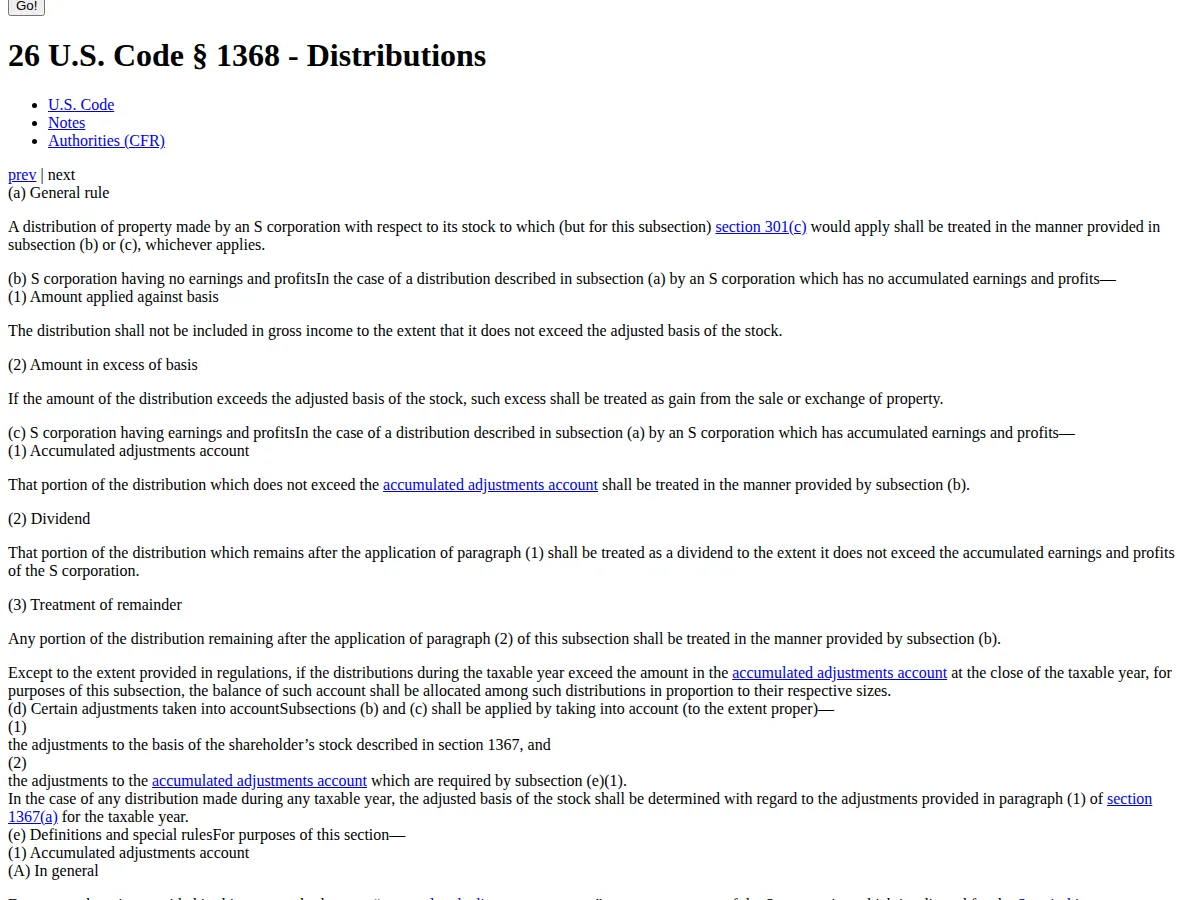
The distribution ordering is § 1368. For a corporation with accumulated earnings and profits from its C years: first, out of the AAA — tax-free, to the extent of basis; second, as a dividend, to the extent of E&P; third, as a tax-free return of basis; fourth, as gain from a sale or exchange. With no E&P, the ordering collapses: tax-free to basis, then gain.
Example: AAA of $60,000, E&P of $40,000, a shareholder with stock basis of $80,000, and a $120,000 distribution. The ordering runs:
The shareholder reports $40,000 of dividend income and receives $80,000 tax-free. The same $120,000 from a corporation with no AAA and no E&P would be $80,000 tax-free and $40,000 capital gain — a different return for the same cash. The AAA balance is the difference, and Schedule M-2 is where it lives.
The two corporate-level taxes
Most S corporations owe no entity-level tax. Two exceptions survive, both only for former C corporations.
Built-in gains, § 1374. If the corporation held an asset at conversion with fair market value above basis, and sells it during the 5-year recognition period beginning with the first S year, the net recognized built-in gain is taxed at the highest rate specified in § 11(b) — 21 percent. Example: an asset worth $700,000 with a $200,000 basis at conversion carries $500,000 of built-in gain; sell it in year 2 for $700,000 and the corporation owes:
The remaining gain still passes through. Hold the asset past year 5 and the tax disappears — mark the expiry on the filing calendar.
Excess net passive income, § 1375. If passive investment income — rents, royalties, dividends, interest, annuities — exceeds 25 percent of gross receipts, and the corporation still has accumulated earnings and profits at year-end, the excess net passive income is taxed at the same 21 percent rate. Example: gross receipts of $1,000,000, passive investment income of $300,000. The 25 percent line is $250,000, so the excess is $50,000, and:
Three consecutive years over the line terminates the S election — the tax is the warning, termination the consequence. A corporation drifting toward the line should distribute its E&P before year-end: with no E&P, § 1375 does not apply.
Reasonable compensation: the salary before the distribution
The S corporation's advantage is the 15.3 percent payroll tax that distributions escape — and the IRS polices exactly that boundary. Its published position: distributions to a corporate officer must be treated as wages to the extent of reasonable compensation, before any non-wage distribution. A shareholder-employee taking $0 salary and $180,000 of distributions has not avoided payroll tax; the IRS recharacterizes the salary portion as wages, with payroll tax, penalties, and interest.
Example: an owner-operator with a $120,000 market salary takes no salary and $180,000 in distributions. The recharacterized wage is $120,000, and the payroll tax on it is:
That $18,360 is the tax the $0-salary plan was trying to avoid, now due with penalties and interest — plus the employer half, which was never paid either. Our reasonable compensation guide works the market-salary factors the IRS weighs: duties, time, comparable pay, and dividend history.
The penalty ladder
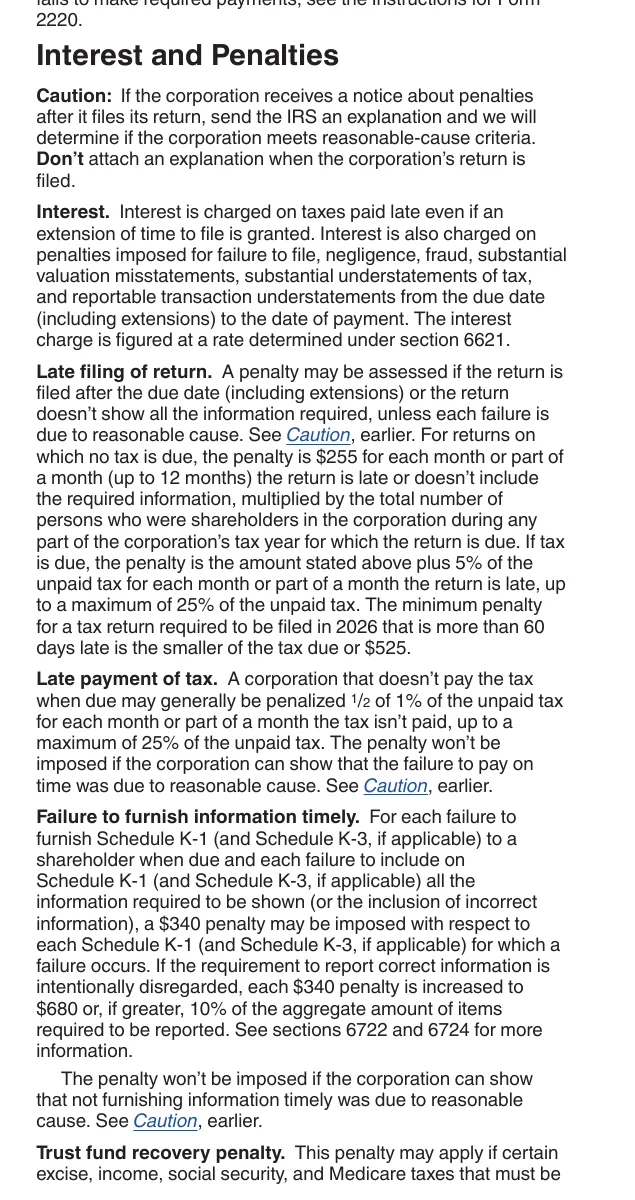
The late-filing penalty is what makes March 16 a hard date. For returns required to be filed in 2026 with no tax due: $255 for each month or part of a month the return is late or incomplete, up to 12 months, multiplied by the number of shareholders. If tax is due, add 5 percent of the unpaid tax per month, up to 25 percent. A return more than 60 days late carries a minimum penalty of the smaller of the tax due or $525.
Example: three shareholders, four months late, no tax due:
Example: the same three shareholders, four months late, with $10,000 of tax unpaid:
The 5 percent portion is capped at 25 percent of the unpaid tax — 20 percent here, so the full $2,000 applies. Late payment is separate: 1/2 of 1 percent of the unpaid tax per month, up to 25 percent. The K-1 penalty is per shareholder: $340 for each K-1 not furnished on time or furnished with incorrect information — $1,360 for four shareholders — rising to $680 per K-1, or 10 percent of the aggregate reportable items if greater, when intentional. Reasonable cause is the only escape, and it must be shown, not asserted.
| Failure | Penalty | Cap | Authority |
|---|---|---|---|
| Late filing, no tax due | $255 per shareholder per month | 12 months | Instructions for Form 1120-S (2025) |
| Late filing, tax due | $255 per shareholder per month + 5% of unpaid tax per month | 25% of unpaid tax | Instructions for Form 1120-S (2025) |
| Return more than 60 days late | Minimum penalty: smaller of tax due or $525 | — | Instructions for Form 1120-S (2025) |
| Late payment | 1/2 of 1% of unpaid tax per month | 25% of unpaid tax | Instructions for Form 1120-S (2025) |
| Late or incorrect K-1 | $340 per K-1; $680 or 10% if intentional | — | §§ 6722/6724 |
Who should not elect, and the filing checklist
The S election is wrong for a corporation that needs more than 100 shareholders, a nonresident alien shareholder, a corporate shareholder, or more than one class of stock — preferred shares with different distribution rights are a second class, and venture investors who want preferred stock should stay C. It is wrong for a business whose income is mostly passive with accumulated E&P: the § 1375 tax and the three-year termination clock will eat the benefit. And it is wrong for an owner who will not take a reasonable salary — the payroll-tax saving is the benefit, and a $0 salary converts it into an audit.
- [x] Confirm the gates: 100 or fewer shareholders, all eligible, one class of stock — before the year starts, not at filing.
- [x] File Form 2553 by the 15th day of the 3rd month of the year the election is to take effect.
- [x] Track AAA, E&P, and basis on Schedule M-2 and Form 7203 all year — the distribution ordering is decided by balances, not by intent.
- [x] Set and document the reasonable salary before the first distribution of the year.
- [x] Pay estimated tax in four installments if the § 1374, § 1375, and recapture taxes total $500 or more.
- [x] Furnish Schedule K-1 to every shareholder by March 16 — the shareholder's return depends on it.
- [x] File Form 7004 by March 16 if the return will not be ready; remember the extension is filing only.
- [x] Mark the 5-year recognition period expiry on the filing calendar the day the election takes effect.
The filing operation, end to end
Form 1120-S is a pass-through return with a corporate shadow: the corporation reports, the shareholders pay, and the ordering rules decide who pays what. The deadlines are unforgiving because the penalties multiply by headcount — $255 per shareholder per month is small for one shareholder and large for forty. Both corporate-level taxes are avoidable with a calendar: hold conversion assets past the 5-year recognition period, and clear E&P before passive income crosses 25 percent. The operation runs in five steps:
- Confirm the election and the gates before the year starts.
- Track AAA, E&P, and basis on Schedule M-2 and Form 7203 all year.
- Set the reasonable salary before the first distribution.
- Furnish every K-1 by March 16.
- File the return by March 16, or file Form 7004 for the six-month extension.