The return that taxes almost nothing
Form 1120-S is the annual return of an S corporation, and line 22 tells the story: ordinary business income flows straight to the shareholders. Section 1363(a) states the rule — "except as otherwise provided in this subchapter, an S corporation shall not be subject to the taxes imposed by this chapter." The corporation computes the income; the shareholders pay the tax — and the exceptions are the only entity-level taxes on the form, which is why the return is easy to file badly.
An S corporation elected under section 1362(a) and meets five tests: allowable shareholders only, no more than 100 shareholders, one class of stock. The return allocates income on Schedule K-1, tracks basis on Schedule M-2, and collects the entity-level taxes on lines 23a through 23c, under the corporation's EIN.
The election comes first: Form 2553
No Form 2553, no S corporation. The election is made on Form 2553, signed by all shareholders, and section 1362(b)(3) sets the deadline: an election made not later than 2 months and 15 days after the first day of the taxable year is treated as timely. A calendar-year corporation wanting S status for 2026 must file by March 15, 2026; miss it and the election takes effect the next year. Relief lives in Revenue Procedure 2013-30: file within 3 years and 75 days of the effective date, attach the required representations, and show reasonable cause — and the corporation must have acted as an S corporation since then.
The calendar: March 15, then September 15
The due date is the 15th day of the 3rd month after the tax year ends — March 15, or March 16, 2026 for the 2025 return, since March 15, 2026 falls on a Sunday.
Form 7004 buys time, not forgiveness: file it by the regular due date for an automatic extension of generally 6 months — September 15 for a calendar-year corporation. The extension covers filing only; any entity-level tax is due with the request, and estimated tax is required if the three taxes total 500 dollars or more. A corporation filing 10 or more returns of any type in a calendar year must e-file Form 1120-S (Regulation section 301.6037-2).
For returns required to be filed in 2026, the late-filing penalty is 255 dollars per month (up to 12) per shareholder; add 5 percent of unpaid tax per month, up to 25 percent, if tax is due, with a 525-dollar minimum when more than 60 days late.
The map of the return
Page 1 runs the operating result: gross receipts on line 1, cost of goods sold (COGS) on line 2, gross profit on line 3, deductions on lines 7 through 20, total deductions on line 21. Line 22 is ordinary business income or loss: line 6 minus line 21. Below it sit the taxes: line 23a takes the excess net passive income tax or LIFO recapture tax; line 23b takes the tax from Schedule D (Form 1120-S) — the built-in gains tax, figured on Schedule D, Part III, line 23; line 23c adds them, plus Form 4255 investment credit recapture.
Behind page 1 sit the schedules: Schedule K aggregates the pass-through items; Schedule K-1, one per shareholder, allocates them; Schedule D computes capital gains and the built-in gains tax; Schedule M-1 reconciles book income to tax income; Schedule M-2 tracks the AAA, the OAA, and AE&P. Schedule K-2 and K-3 report international items — our Form 1065 Schedules K-2 and K-3 playbook runs the same logic.
Pass-through: section 1366 and the K-1
Section 1366(a)(1) is the engine: each shareholder takes a pro rata share of the separately stated items — income, loss, deduction, or credit — plus the nonseparately computed income or loss. Section 1366(b) preserves character: a long-term capital gain stays one, as if the shareholder realized it directly. Schedule K splits the items; the K-1 delivers each share; the shareholder reports it on Form 1040, Schedule E.
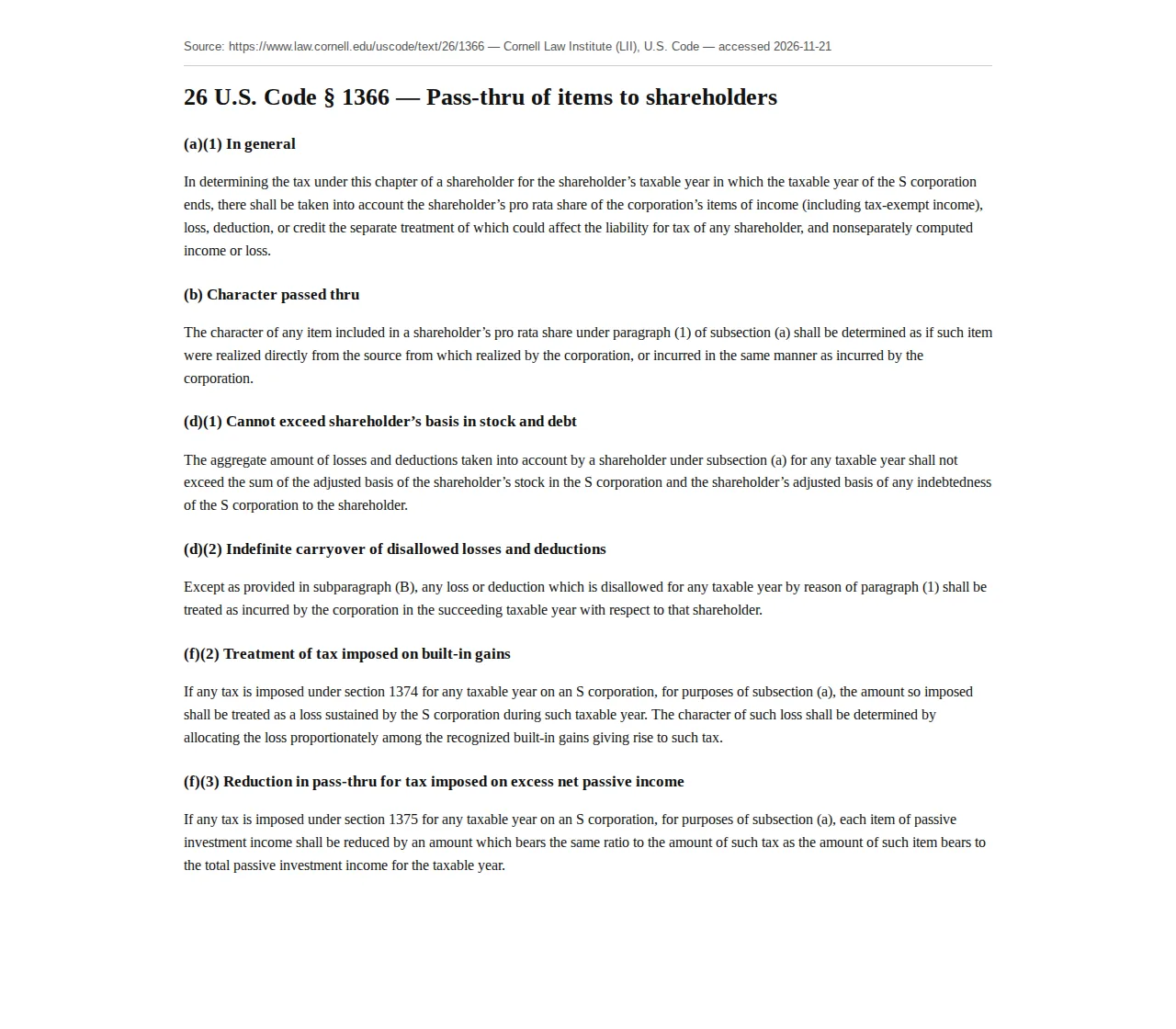
The pass-through is capped by basis: section 1366(d)(1) limits losses and deductions to the adjusted basis of the stock plus the adjusted basis of any debt the corporation owes the shareholder. A shareholder with 10,000 dollars of stock basis and no shareholder debt cannot deduct a 40,000-dollar loss share this year — 30,000 dollars waits. Section 1366(d)(2) makes the wait indefinite: the disallowed loss is treated as incurred in the succeeding year, and it revives when basis returns.
Schedule K-1 goes to each shareholder when the return is due; a failure to furnish one costs 340 dollars per K-1, rising to 680 dollars or 10 percent if intentionally disregarded. Our Form 1065 Schedule K-1 playbook works the allocation mechanics in partnership form.
Section 1374: the built-in gains tax
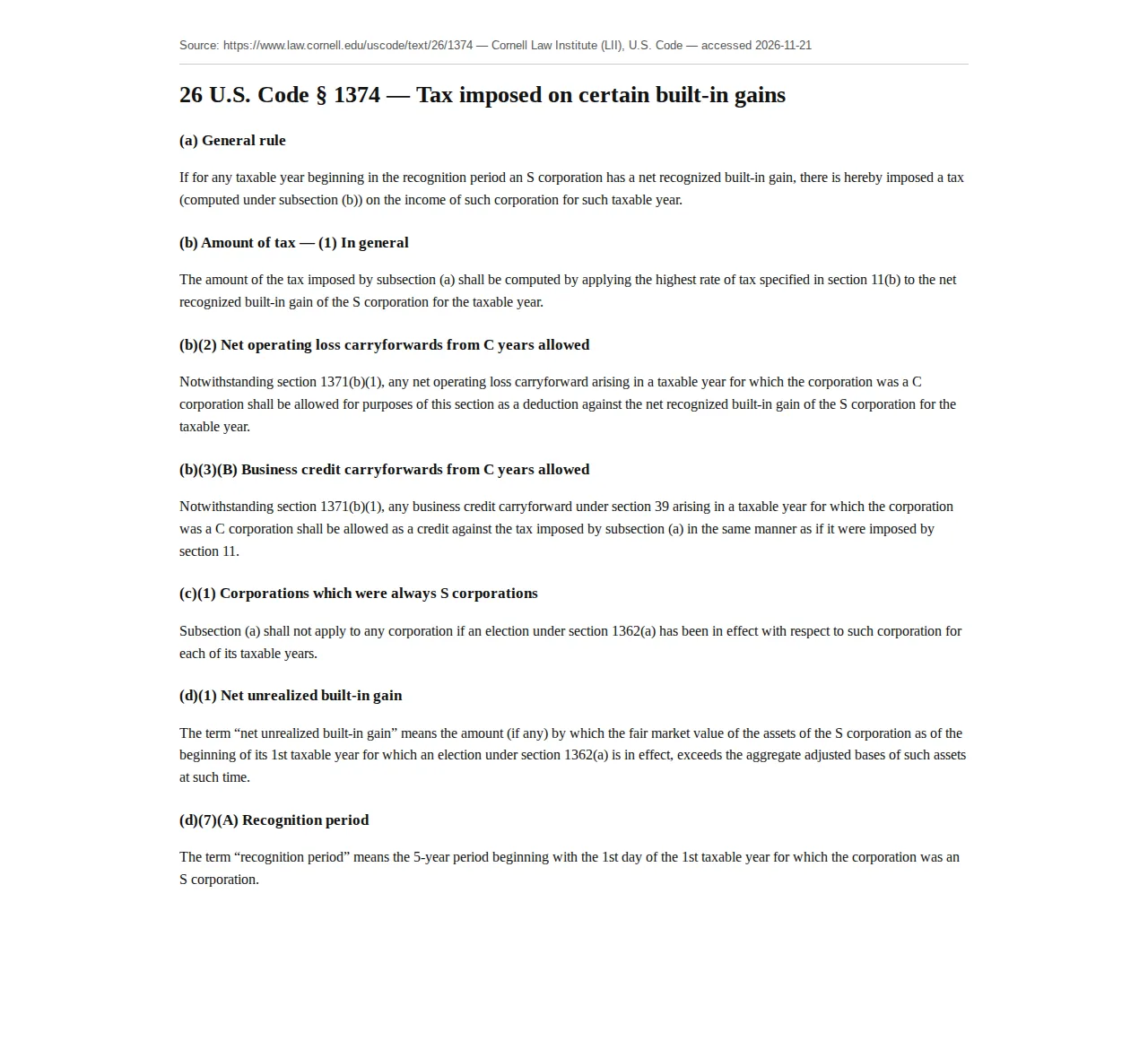
Section 1374 exists for one situation: a C corporation converts to S status holding appreciated assets. Section 1374(a) imposes the tax whenever an S corporation has net recognized built-in gain in a year beginning in the recognition period — the 5-year period defined in section 1374(d)(7)(A), beginning with the first day of the first S year.
The measurement starts at conversion: section 1374(d)(1) defines net unrealized built-in gain (NUBIG) as the amount by which the fair market value of the corporation's assets at the beginning of its first S year exceeds their aggregate adjusted bases — the ceiling for the whole five years, since section 1374(c)(2) caps the gain taken into account in any year at NUBIG minus prior years' recognized gains.
Section 1374(b)(1) sets the rate: the highest rate in section 11(b) — a flat 21 percent. Two C-year shelters survive conversion: under section 1374(b)(2), a net operating loss (NOL) carryforward from a C year is allowed as a deduction against net recognized built-in gain, and a capital loss carryforward likewise; under section 1374(b)(3)(B), a business credit carryforward under section 39 from a C year is allowed as a credit against the section 1374 tax.
Example A — the section 1374 tax. A C corporation converts to S status on January 1, 2026, with assets worth 3,000,000 dollars against bases of 1,000,000 dollars: NUBIG of 2,000,000 dollars. In 2026 it sells a warehouse held since the C years — value at conversion 500,000 dollars, basis 200,000 dollars — for 520,000 dollars:
It also sells equipment at a 50,000-dollar recognized built-in loss, so net recognized built-in gain is 250,000 dollars, against which a C-year NOL carryforward of 40,000 dollars is allowed:
The 44,100 dollars is figured on Schedule D, Part III, and lands on line 23b.
Section 1375: the excess net passive income tax
Section 1375 is the companion tax, and it only bites converted corporations: it applies when the S corporation has accumulated earnings and profits (AE&P) at year-end and more than 25 percent of its gross receipts are passive investment income — rents, royalties, dividends, interest, annuities. Section 1375(a) imposes the tax at 21 percent on excess net passive income.
Net passive income is passive investment income minus the deductions directly connected with producing it (section 1375(b)(2)), scaled by the share of passive income above the 25 percent line (section 1375(b)(1)(A)):
Section 1375(b)(1)(B) caps the result at the corporation's taxable income, computed without the section 172 NOL deduction. The tax is 21 percent of the cap-tested excess, on Form 1120-S, line 23a.
Example B — the section 1375 tax. A converted S corporation has AE&P of 300,000 dollars, gross receipts of 1,000,000 dollars, and passive investment income of 400,000 dollars — 40 percent. Deductions directly connected with the passive income are 60,000 dollars, so net passive income is 340,000 dollars:
Taxable income is 200,000 dollars, so the cap does not bind:
The 26,775 dollars goes on line 23a — and the same year is the first of three: three consecutive years over 25 percent with AE&P remaining terminates the election under section 1362(d)(3), effective the first day of the following year.
AAA, OAA, and PTI: the distribution ordering
Distributions either reward shareholders tax-free or hand them a surprise dividend; the ordering is fixed by section 1368 and tracked on Schedule M-2. The accumulated adjustments account (AAA) is the running balance of S-period income, increased by income other than tax-exempt income and decreased by losses and distributions. Three accounts matter: the AAA, the other adjustments account (OAA) for tax-exempt income, and previously taxed income (PTI), a pre-1983 legacy account.
For a corporation with AE&P, section 1368(c) sets the order: first, the portion up to the AAA is a return of basis, not included in gross income to the extent it does not exceed stock basis. Second, the remainder is a dividend to the extent of AE&P. Third, anything left is a return of basis again, with any excess over basis taxed as gain from a sale or exchange. The corporation may elect under section 1368(e)(3) to take the dividend first.
Example C — the distribution ordering. A shareholder holds stock with a basis of 150,000 dollars. The corporation's AAA stands at 200,000 dollars after earning 80,000 dollars of ordinary income, and AE&P stand at 300,000 dollars. The corporation distributes 230,000 dollars:
The shareholder's basis falls from 230,000 dollars to 30,000 dollars. The remaining 30,000 dollars is a dividend out of AE&P:
The dividend does not reduce basis.
Reasonable compensation: the audit trigger
The S corporation's oldest planning temptation is also its most audited: pay the shareholder-employee nothing, take everything as a distribution, and skip payroll taxes on the whole amount. The IRS states the rule without qualification: an S corporation must pay reasonable compensation to a shareholder-employee for services before non-wage distributions may be made. The Form 1120-S instructions say the same in the officer compensation line: payments to a corporate officer must be treated as wages to the extent they are reasonable compensation.
The IRS has the authority to reclassify a distribution as wages, and the courts have backed it repeatedly — Joly v. Commissioner, Veterinary Surgical Consultants, P.C. v. Commissioner, and David E. Watson, PC v. United States, where the Eighth Circuit sustained the reclassification. The test starts with the source of the gross receipts: receipts from the shareholder's services support wages; receipts from other employees, capital, and equipment support distributions.
A distribution reclassified as wages becomes subject to FICA and to income tax withholding, while a distribution that stays a distribution escapes both FICA and SECA. Our Form 941 playbook runs the quarterly payroll return the reclassification lands on — back employment taxes, penalties, and interest, plus a corrected W-2.
The decision table
| Situation | The 1120-S answer | Authority |
|---|---|---|
| Converted C corporation, appreciated assets | Track NUBIG at conversion; 5-year recognition period | § 1374(d)(1), (d)(7)(A) |
| Converted corporation, passive income over 25% | Compute excess net passive income; distribute AE&P to end it | § 1375(b)(1); § 1362(d)(3) |
| Shareholder works in the business, takes no salary | Set reasonable compensation first; expect reclassification | IRS guidance; Watson, 668 F.3d 1008 |
| Distribution from a corporation with AE&P | AAA first, then AE&P dividend, then return of basis | § 1368(c) |
Run the return
- Confirm the election: Form 2553 on file, signed by all.
- Close the books and reconcile: Schedule M-1 ties book income to tax income
- Figure the entity-level taxes first: Schedule D, Part III (line 23b); section 1375 (line 23a)
- Complete Schedule K, then the K-1s: one K-1 per shareholder, pro rata by shares and days held; furnish each K-1 when due.
- Update Schedule M-2 and basis worksheets: AAA, OAA, and AE&P balances; each shareholder's stock and debt basis.
- File and pay: e-file if the 10-return threshold applies; Form 7004 by March 15 if more time is needed.
- [x] Form 2553 effective, signed by every shareholder.
- [x] Section 1374 period checked; Schedule D if a C-year asset was sold.
- [x] Section 1375 test: passive share, AE&P, three-year count.
- [x] AAA, OAA, AE&P reconciled on Schedule M-2.
- [x] Reasonable compensation paid through payroll.
- [x] Every K-1 furnished when due.
Failure modes
No salary, all distributions: the classic reclassification. Selling a C-year asset in year five: the tax is 21 percent of the built-in portion. Passive income over 25 percent for three years: the section 1375 tax is the warning; section 1362(d)(3) termination is the consequence. Distributing without the AAA: a tax-free return of basis gets reported as a dividend, or the reverse.
Founder & CEO Insight — Enow A. Jovial
File the election on time, figure the entity-level taxes first, reconcile the AAA, and furnish every K-1 when due — then check the result in our tax estimator.